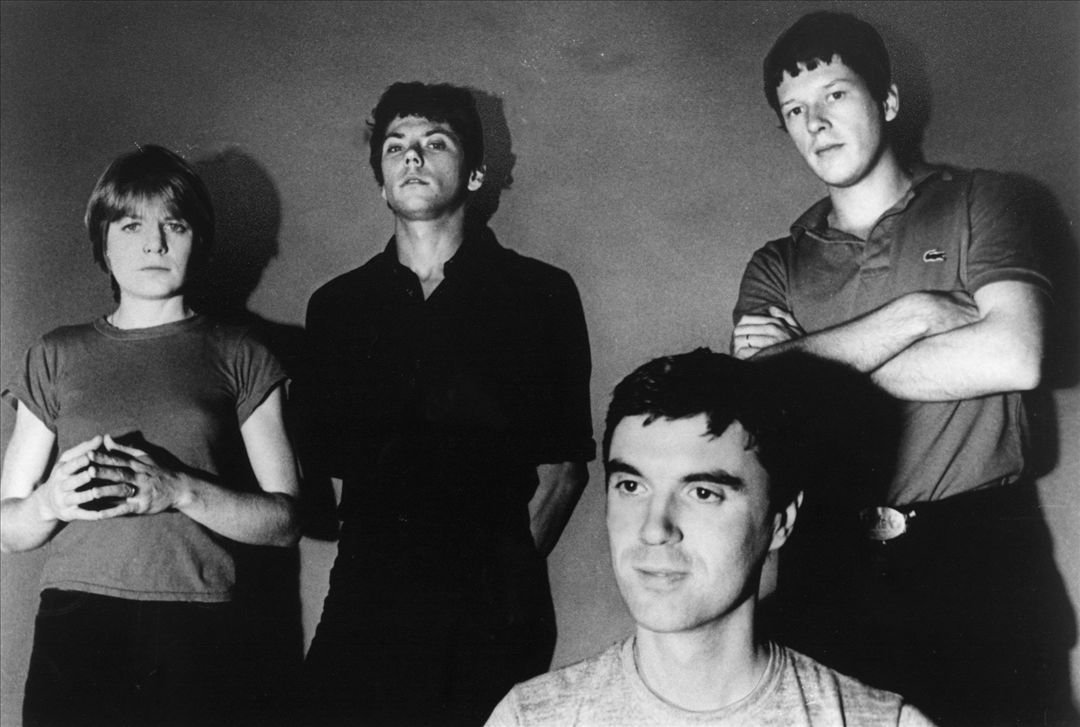
The first song Talking Heads ever wrote together was a murder ballad they imagined as a joke about villainy — and it outlived every cooler, cleverer thing they did afterwards. Psycho Killer was written in a Rhode Island art school in 1974, three years before anyone outside a few New York clubs had heard of David Byrne, Tina Weymouth, and Chris Frantz. It became the only song on their debut album to reach the Billboard Hot 100, opened their epochal concert film Stop Making Sense, and waited forty-eight years for an official music video. Songs are not supposed to have lives this long, or this strange.
An Art-School Ballad
Byrne and Frantz met at the Rhode Island School of Design, where they formed a band called the Artistics — sometimes billed, in a very art-school joke, as the Autistics. In early 1974 the Artistics recorded a three-song demo in Providence, and one of the songs was an early Psycho Killer: not the twitching funk record the world knows, but a ballad. For half a century that demo tape sat forgotten; it was rediscovered in the archives of the RISD Museum in 2025 and released on the compilation Tentative Decisions: Demos & Live, a reminder that the song predates punk, CBGB, and the band itself.
Byrne has explained the original concept in the liner notes to a band compilation: “When I started writing this (I got help later), I imagined Alice Cooper doing a Randy Newman-type ballad. Both the Joker and Hannibal Lecter were much more fascinating than the good guys. Everybody sort of roots for the bad guys in movies.” The early lyric sheets, reprinted with the 2006 remaster of Talking Heads: 77, show a semi-narrative of the killer actually committing his murders. What survived into the finished song is stranger and better: not a story but a state of mind — tense, agitated, slipping between English and French as it comes apart. Prototype versions were in Talking Heads’ stage set as early as December 1975, within months of the band’s debut, and the song essentially never left the set again; a 1977 live recording made for radio broadcast, complete with an extra verse the studio version drops, turned up on the live album The Name of This Band Is Talking Heads in 1982.

Tina Writes the French
The song’s most famous feature — the bridge sung in French, and the baffled refrain “Qu’est-ce que c’est?” (“What is this?”) — came from the band’s bassist. According to Frantz, he pointed out to Byrne that Tina Weymouth’s mother was French and that French was spoken in the Weymouth home. “Tina agreed to do it and just sat down and did it in a little over an hour,” Frantz recalled. “I wrote a couple of more verses, and within a few hours, ‘Psycho Killer’ was more or less done.” The shared labour is preserved in the writing credit, which belongs to Byrne, Frantz, and Weymouth — the trio who formed the band’s core before guitarist Jerry Harrison, late of the Modern Lovers, completed the line-up in time for the debut album.
What those three built the song around was Weymouth’s bass. AllMusic has called her part “one of the most memorable, driving basslines in rock & roll,” and it functions like the killer’s pulse — level, insistent, impossible to argue with — while Byrne’s guitar scratches and his vocal cycles through its fa-fa-fa refrain, part scat singing, part nervous breakdown. Consequence of Sound ranked the song eleventh in its list of the fifty best punk songs, filing it under “art-punk”; the Times called it an art-pop masterpiece. All of that architecture rests on a ballad three students wrote for fun.
When Talking Heads played their first concert — opening for the Ramones at CBGB on 5 June 1975 — Psycho Killer was already in the set, French bridge and all, delivered in the anxious yelp that became Byrne’s trademark. Footage and recordings from that first CBGB era show it being performed acoustically, still close to the Artistics ballad, before the band learned to make it twitch. It would be another two years before they recorded it.

Son of Sam and the Cello B-Side
The band cut Talking Heads: 77 in New York with producers Tony Bongiovi and Lance Quinn, and Sire released the album in September 1977. Psycho Killer followed as a single on 25 November 1977, and its timing was, in a word used by more than one chronicler, eerie: the Son of Sam killings had terrorised New York from July 1976 to July 1977, and a song narrated by a fictional murderer landed in shops weeks after the real one’s arrest. The band always insisted the association was coincidence — the song had existed since 1974 — but the “macabre synchronicity” fixed it in the public mind.
The single reached No. 92 on the Billboard Hot 100, modest numbers that made it, nonetheless, the only track from the album to chart at all; in the Netherlands it climbed to No. 11 and in Belgium to No. 19, and early in 1978 the band took it to British television on The Old Grey Whistle Test. Its flip side paired the acoustic reading with another early song, I Wish You Wouldn’t Say That. Its B-side carried a second, ghostlier life: an acoustic version of the song featuring the avant-garde cellist Arthur Russell, a friend from the downtown scene. Harrison later wrote that he was glad the band persuaded Bongiovi and Quinn that the cello version “shouldn’t be the only one.” The song is now enshrined in the Rock and Roll Hall of Fame’s list of 500 Songs That Shaped Rock and Roll.
The Boombox, the Bassline, and a Video at Last
In 1984, Psycho Killer achieved the strangest immortality available to a song: it opened Stop Making Sense, Jonathan Demme’s concert film, with Byrne alone on a bare stage announcing “Hi. I’ve got a tape I want to play,” a boombox at his feet, playing the song on acoustic guitar over the chatter of what sounds like that boombox — actually a Roland TR-808 drum machine. It remains one of the most famous entrances in cinema. The bassline, meanwhile, went out into the world on its own — Selena Gomez built her 2017 hit Bad Liar on top of Weymouth’s part, with the band’s blessing. The borrowings run in every direction: will.i.am has said the song’s alternation between English and French partly inspired the Black Eyed Peas’ I Gotta Feeling, Ice-T has cited it as a starting influence on Body Count’s Cop Killer, and the cover versions range from Duran Duran to Miley Cyrus to the Ukulele Orchestra of Great Britain at the BBC Proms. In 2023, Loudwire reported that its lyrics were the most searched of any punk song over the previous four and a half years — a 1974 art-school experiment still generating questions nobody can quite answer.
And then, in 2025, the song finally got the one thing it had never had.On 5 June 2025 — exactly fifty years after that first CBGB concert — Talking Heads released the official video attached to this article: their first ever for the song, directed by Mike Mills and starring Saoirse Ronan as a woman quietly coming undone inside the machinery of an ordinary week. Mills pitched his idea to all four former members over Zoom and won out over several other filmmakers. “This video makes the song better,” the band said. “We love what this video is not — it’s not literal, creepy, bloody, physically violent or obvious.” The record-buying public responded the way it had in 1977, only faster: the song climbed to No. 12 on Billboard’s Hot Rock & Alternative Songs chart. Fifty years on, the art-school ballad about a killer had become a film about everybody. Qu’est-ce que c’est, indeed.
Leave a Reply