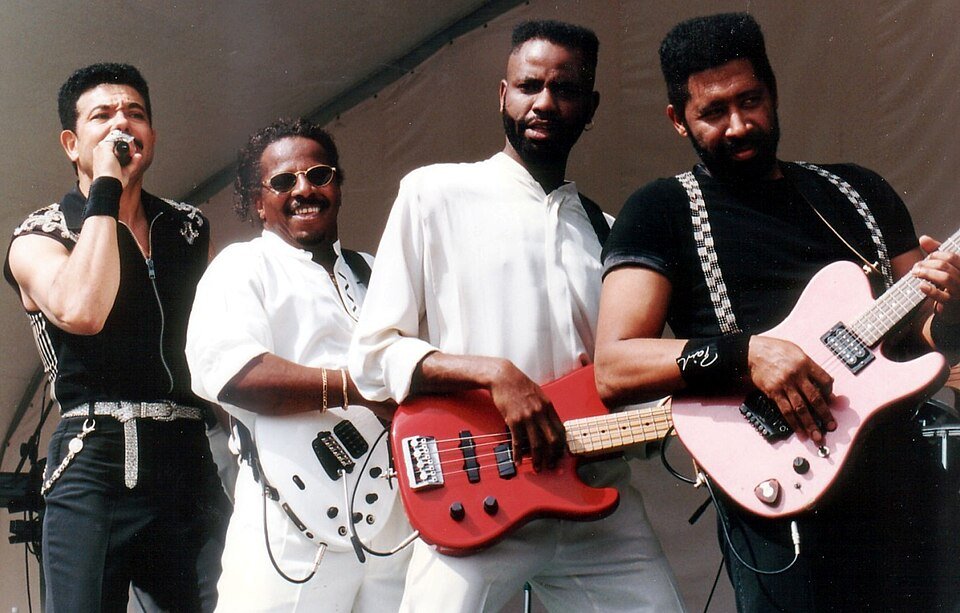
In the spring of 1984, the music world lost two of its giants within days of each other — and a struggling funk band from Tuskegee, Alabama found itself with an impossible task: saying goodbye in song. The result was “Nightshift”, a tribute so tender and so true that it became the biggest hit of the Commodores’ career without Lionel Richie, won them a Grammy, and still brings tears to eyes forty years later. This is the story of how heartbreak became a masterpiece.
Two Funerals and a Blank Page
April 1, 1984, was the day the music died a little. Marvin Gaye — the Prince of Motown, the voice of “What’s Going On” — was shot dead by his own father in Los Angeles, just one day short of his 45th birthday. The news stunned the world, and it devastated the Commodores, who’d shared a label, a touring circuit and a brotherhood with Gaye for years.
Then, barely three weeks later, came a second blow: Jackie Wilson, the great showman they called “Mr. Excitement”, died on January 21, 1984, after spending nearly nine years in a coma following his collapse on a New Jersey stage in September 1975. Two legends gone. Drummer Walter Orange, the Commodores’ co-lead voice, felt the losses like deaths in the family. Somebody had to sing about it. He decided it would be him.
The losses were personal in a way outsiders couldn’t fully grasp. Marvin Gaye wasn’t just a labelmate; he was Motown family — the Commodores had come up in the same system, toured the same circuits, breathed the same air. His death on April 1, 1984 — shot by his own father, one day shy of his 45th birthday — was a wound to the whole Motown clan. And Jackie Wilson, “Mr. Excitement”, had been a ghost for nearly a decade before he died on January 21, 1984: collapsed on a New Jersey stage back on September 29, 1975, he’d lingered in a coma for almost nine years while the music world held its breath. When he finally let go, it felt like losing him twice. Orange carried both men with him into the writing room.
Franne Golde’s Title
Every great song needs a title that says everything, and this one got its from an unexpected source: songwriter Franne Golde. Working with Orange and veteran producer Dennis Lambert, Golde came up with the phrase that unlocked the whole song — “Nightshift”. It was perfect: the image of the departed stars working the eternal night shift in heaven, still singing, still shining, just on a different stage now.
The three writers built the song as a direct address to the fallen. The first verse is for Marvin, weaving in a loving nod to “What’s Going On” — his masterpiece, his message. The second verse belongs to Jackie, name-checking the songs that made him immortal: “Lonely Teardrops”, “Baby Workout”, and “(Your Love Keeps Lifting Me) Higher and Higher”. Nothing was spelled out; everything was felt. It was a eulogy disguised as a groove.
The writing trio was an inspired combination: Orange, the drummer with the singer’s heart; Dennis Lambert, the veteran producer with the pop craftsman’s touch; and Franne Golde, the songwriter whose single word — “Nightshift” — gave the whole project its frame. Together they built the song as a pair of portraits. The first verse belongs to Marvin, and it quotes him directly, folding “What’s Going On” into the lyric like a prayer. The second verse is Jackie’s, nodding to “Lonely Teardrops”, “Baby Workout” and “(Your Love Keeps Lifting Me) Higher and Higher” — his biggest, brightest moments, returned to him as tribute. Nothing is spelled out; everything is understood. If you know, you weep.
The New Singer’s Verse
Here’s where the story gets really interesting. The Commodores were in transition — Lionel Richie was long gone, and their new lead singer was J.D. Nicholas, formerly of the British funk band Heatwave, who’d joined in 1984. Producer Dennis Lambert wanted Orange — the song’s co-writer and the band’s veteran voice — to sing lead all the way through. It was his song, his grief.
But Orange had a better idea. He insisted that Nicholas take a verse — that the new man be introduced to the world on the most important record the band had ever made. It was an act of extraordinary generosity: Orange sharing his most personal song to welcome the newcomer into the family. When Nicholas’s smooth tenor floats in on that second verse, you’re hearing a band being reborn in real time — the past honoring the future, the old guard lifting up the new.
Consider what was at stake. J.D. Nicholas had joined in 1984 from the British funk band Heatwave, stepping into the impossible shadow of Lionel Richie — the most thankless frontman job in popular music. Lambert, thinking commercially, wanted Orange’s veteran voice carrying the whole record; it was safer, surer. But Orange understood something deeper: a tribute to the dead is also a promise to the living, and the best way to prove the Commodores had a future was to put the future on the record. Handing Nicholas a verse of his most personal song wasn’t just generosity. It was strategy, faith, and brotherhood in a single gesture.
The Band That Didn’t Believe
And then, astonishingly, the Commodores tried to kill their own hit. When Lambert and the label wanted to release “Nightshift” as a single in January 1985, the band pushed back — hard. They didn’t think it was commercial enough. They worried a slow, mournful tribute couldn’t compete on radio. They’d just come off the disappointment of 1983’s “Commodores 13”, a flop that had shaken their confidence to the core.
History, of course, had other plans. Released on January 18, 1985, on Motown — the label that had been their home since the beginning — “Nightshift” didn’t just succeed; it exploded. Sometimes the artists are the last to know what they’ve got. The band that opposed the single ended up owing their second act to it entirely.
Their fear was understandable. The 1983 album “Commodores 13” had flopped, shaking the confidence of a band already navigating life after Richie. A slow, mournful tribute to two dead singers felt like commercial suicide — where were the hooks, the dance floor, the radio format? When the single was released on January 18, 1985, on Motown, the band held its breath. Then radio did what radio rarely does: it recognized a great record. The song the Commodores didn’t believe in became the song that saved them — a reminder that artists are often the worst judges of their own magic, and that the public can smell sincerity a mile away.
No. 3 on Both Sides of the Atlantic
The numbers tell the story of a song the world was waiting for. “Nightshift” climbed to No. 3 on the British charts in the week of March 3, 1985, and matched it in America, hitting No. 3 on the Billboard Hot 100 in the week of April 20. On the Hot Black Singles chart, it went all the way to No. 1 — the Commodores’ first chart-topper of the post-Richie era, and a vindication for everyone who’d believed in the new lineup.
There was a lovely symmetry in it, too. “Nightshift” was the second straight No. 1 R&B tribute to Marvin Gaye — Diana Ross’s “Missing You” had done it just before. Motown’s family was mourning together, in public, on the radio. And the critics noticed: John Leland, writing in Spin, praised the record’s grace and feeling. This wasn’t a novelty or a cash-in. It was the real thing.
The chart run was a thing of beauty: No. 3 in Britain in the week of March 3, 1985, then No. 3 on the Billboard Hot 100 in the week of April 20 — the same peak on both sides of the Atlantic, as if the world had agreed. On the Hot Black Singles chart it went all the way to No. 1, the sweetest vindication for the post-Richie lineup. And there was poetry in the timing: “Nightshift” was the second consecutive R&B No. 1 tribute to Marvin Gaye, following Diana Ross’s “Missing You” — Motown’s family mourning together, in public, at the top of the charts. Even the critics surrendered: Spin’s John Leland praised the record’s grace, hearing what the band had almost missed.
A Grammy and a Goodbye to Motown
The ultimate validation came from the music industry itself. “Nightshift” won the Grammy Award for Best R&B Performance by a Duo or Group with Vocals — the Commodores’ crowning achievement, earned without their most famous member, earned on the strength of a song about loss. Orange, Nicholas and the band took the stage and held the trophy for every musician who’d ever had to sing through tears.
It was also, poignantly, the end of an era. “Nightshift” appeared on the album of the same name — the band’s final album for Motown, the label that had raised them. They’d arrived as Richie’s backing band and were leaving as Grammy winners in their own right. The night shift, it turned out, was just beginning.
The Grammy — Best R&B Performance by a Duo or Group with Vocals, awarded in 1985 — was the industry’s formal apology for ever doubting them. Orange, Nicholas and the band took the stage as champions, not survivors: winners without their most famous member, winners on the strength of a song about grief. And there was a quiet poignancy underneath the celebration. “Nightshift” anchored an album that would be the Commodores’ last for Motown — the label that had raised them from Tuskegee hopefuls to superstars. They’d arrived as an opening act and were leaving as Grammy winners. Endings don’t get more graceful than that.
From Springsteen to Michael Jackson: The Legacy
Great songs don’t retire; they get adopted. In 2010, the Commodores re-recorded “Nightshift” and dedicated the new version to another fallen giant, Michael Jackson — proof that the song had become something larger than its original occasion, a universal vessel for grief and love.
Then came the most unexpected tribute of all. In October 2022, Bruce Springsteen — the Boss himself — released his own version of “Nightshift” as part of his soul-covers album “Only the Strong Survive”, complete with a video directed by Thom Zimny and a performance on “The Tonight Show Starring Jimmy Fallon” that November. When Bruce Springsteen sings your song to honor the dead, you’ve written something eternal. From a Tuskegee garage to the Boss’s songbook — not bad for a single the band didn’t even want to release.
The afterlife has been extraordinary. In 2010, the Commodores re-recorded “Nightshift” and dedicated it to Michael Jackson — another genius gone too soon — proving the song had outgrown its original occasion to become a universal vessel for mourning. Then, in October 2022, came the ultimate co-sign: Bruce Springsteen cut his own version for “Only the Strong Survive”, his album of soul covers, with a video directed by Thom Zimny and a spine-tingling performance on “The Tonight Show Starring Jimmy Fallon” on November 16. When the Boss sings your tribute to honor the dead, you’ve written something permanent. The nightshift never ends; it just changes singers.
“Nightshift” endures because it understands something about loss: that the best way to honor the gone is to keep the groove going. Walter Orange, Dennis Lambert and Franne Golde didn’t write a dirge; they wrote a celebration with tears in its eyes, a song that lets you dance and mourn at the same time. Marvin Gaye and Jackie Wilson never got to hear it. But somewhere, on the eternal nightshift, you’d like to think they’re singing along.
Leave a Reply