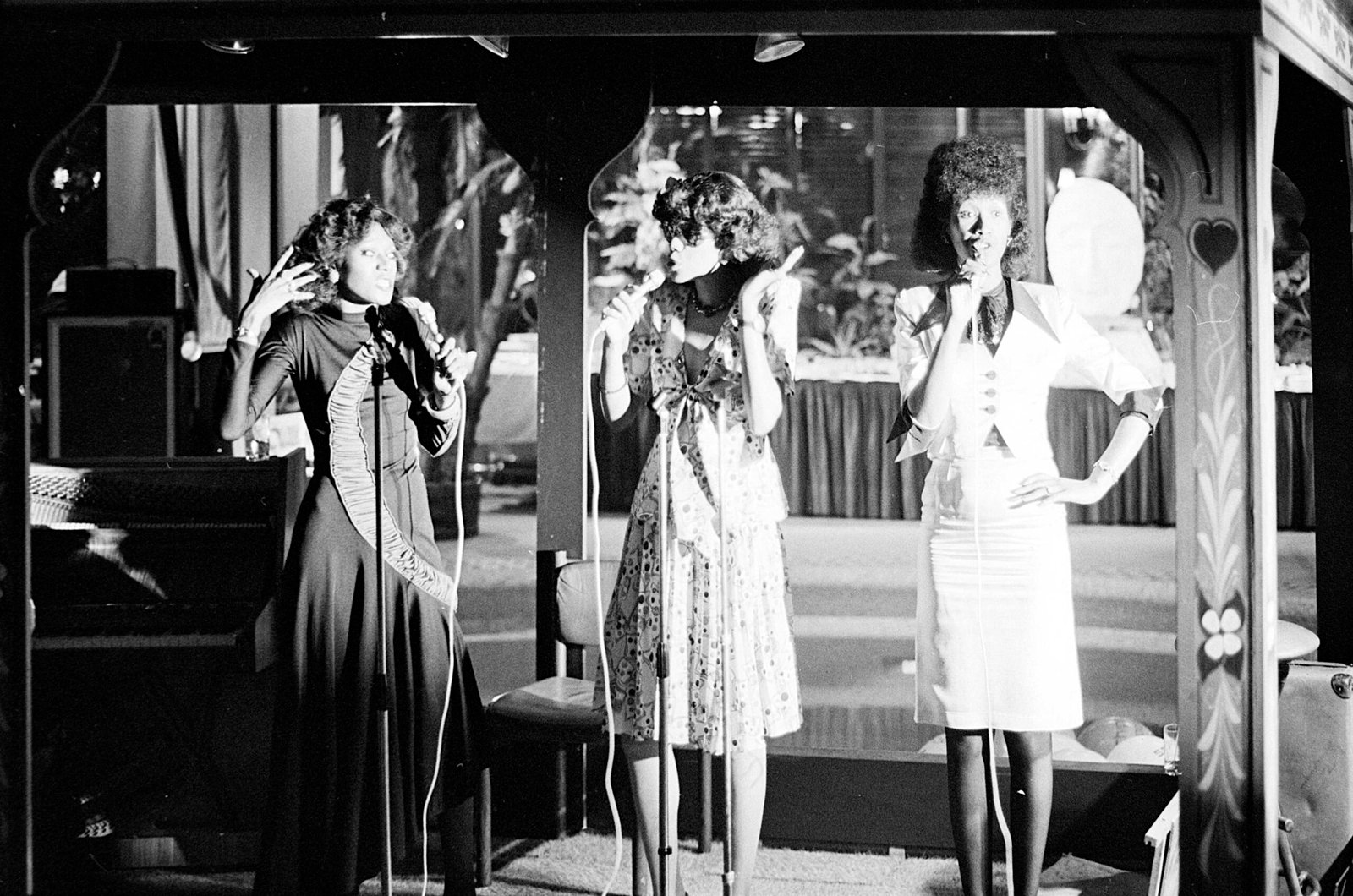
Some hits are written. This one was redirected by fate — twice. “Fire,” the 1978 smash that carried the Pointer Sisters to No. 2 on the Billboard Hot 100, began as a love letter from Bruce Springsteen to his idol Elvis Presley. The demo was mailed to Graceland. The King died before it arrived. What happened next is one of the great relay races in pop history: a rockabilly singer took the baton first, and then three sisters from Oakland grabbed it and ran it all the way to the top of the charts. This is the story of the song that refused to die — and the woman who finally gave it its flame.
The Song the Boss Wrote for the King
On May 28, 1977, Bruce Springsteen and his E Street Band compatriot Stevie Van Zandt went to see Elvis Presley perform at the Spectrum in Philadelphia. Springsteen had worshipped Presley since childhood — seeing the King on “The Ed Sullivan Show” in 1956 was, by his own account, the moment that made him want to be a rock star. But the Philadelphia show was, in Springsteen’s later words, “not a good night.” The King was visibly unwell, a shadow of the force who had invented the job.
Saddened, Springsteen went home and did what songwriters do: he wrote his feelings into a song. “Fire” was a slow, smoldering number deliberately shaped for Presley’s voice — a playful, physical love song, all heat and swagger. Springsteen cut his own studio version on June 17, 1977, during the sessions for “Darkness on the Edge of Town,” and then he did something extraordinary: he sent a demo to Graceland, hoping the man who had made him pick up a guitar would record it. The package never got its hearing. Elvis Presley died on August 16, 1977, before the tape reached him.
The Shelf Life of a Hit
“Fire” didn’t make the cut for “Darkness on the Edge of Town” — one of 52 tracks Springsteen recorded and shelved, judged too playful for the darkest album he had yet made. Springsteen reportedly worried that if it appeared on the record, his label would push it as the single. So the song sat, waiting for a singer. He completed his own studio recording on June 17, 1977 — a version that wouldn’t see official release for years — and moved on, leaving “Fire” to find its own way in the world.
Its first recorded life came through Robert Gordon, a neo-rockabilly singer Springsteen had met through E Street Band bassist Garry Tallent. Springsteen had caught Gordon performing live with guitar legend Link Wray and decided Gordon’s voice gave him the impression of Elvis singing. He handed “Fire” over, sat in on piano himself, and Gordon cut it in December 1977 at Plaza Sound Studios in Manhattan with producer Richard Gottehrer. It appeared on Gordon’s “Fresh Fish Special,” released in late winter 1978, and drew airplay on album-rock stations — but it never reached the Hot 100. Gordon’s version was stylish, all rockabilly swagger and Link Wray twang, and Springsteen himself loved it. But a song written for the King of Rock and Roll needed more than style. It needed soul. The song was still looking for its true voice.
A Trio in Need of a Spark
The Pointer Sisters, meanwhile, were at a crossroads. Bonnie Pointer — the sister who had started it all — had left for a Motown solo deal. Anita, Ruth, and June had regrouped as a trio and signed with producer Richard Perry’s brand-new Planet Records label. Perry was no gamble: his production credits included Carly Simon’s “You’re So Vain,” Nilsson’s “Without You,” Ringo Starr’s “Photograph,” and Leo Sayer’s “You Make Me Feel Like Dancing” — all of them No. 1 pop hits. He had the golden ear, and he was looking for material for the trio’s first album, “Energy.”
Perry heard “Fire” and knew. He played the Pointer Sisters a tape of Springsteen singing it himself — just the Boss and a guitar, raw and unadorned. The sisters listened in the studio, the new trio holding its breath. And Anita Pointer’s first instinct was to pass it along. The key sat too low for her, she told Perry; he must want Ruth, with her deep contralto, on this one. Perry’s answer was instant and absolute: “No — I want you to sing it.”
“No — I Want YOU to Sing It”
That single casting decision is the whole record. Where Springsteen had written a man burning with desire, Anita Pointer sang a woman deciding — pulled close, saying no, and hearing her own kiss argue back. Her restraint became the performance: cool on the surface, smoldering underneath, the exact emotional temperature of the lyric. Perry built a soul-pop arrangement around her, and the track became a smoldering duet of sorts between Anita’s voice and the nasty guitar of Davey Johnstone, Elton John’s longtime axe-man.
“Fire” was released on October 2, 1978, as the trio’s first single — the first Pointer Sisters record without Bonnie. Everything was riding on it: the new label, the new lineup, the new sound. The sisters had gone from retro-revue eclecticism to sleek, radio-ready rock-soul in a single leap. If “Fire” flopped, the Pointer Sisters might have been finished.
The Voice in the Middle
Anita Pointer was always the group’s secret weapon — the middle sister with the songwriter’s mind and the lead singer’s nerve. She had sung lead on “Yes We Can Can,” the Allen Toussaint funk blast that gave the quartet its first hit in 1973, reaching No. 11 on the Hot 100. She had co-written “Fairytale” with Bonnie, the country ballad that won the group its first Grammy and made them the first Black act at the Grand Ole Opry. She was, in every sense, the musical center of the Pointer Sisters.
“Fire” made that official. Perry’s instinct — that the song belonged not to Ruth’s contralto but to Anita’s smolder — was the kind of producer’s gamble that defines careers. Anita didn’t belt “Fire”; she inhabited it, finding the drama in restraint, the heat in coolness. It was a masterclass in what a great singer can do with a great song: not oversing it, but own it. From that moment on, there was no question who fronted the Pointer Sisters. The trio had a voice, and the voice had a name.
No. 2 With a Bullet
It did not flop. “Fire” roared up the Billboard Hot 100 and peaked at No. 2 in February 1979 — the highest chart position the group had ever achieved, and higher than Springsteen’s own biggest hit “Born to Run” would ever climb. It was certified gold, the Pointer Sisters’ first gold single; as Ruth Pointer later marveled, they had had gold albums before, but a gold single was different — that one song played over and over, all over the world. The “Energy” album, released in November 1978, went gold too, and spun off a second hit in “Happiness.”
And it wasn’t just America. “Fire” went to No. 1 in Belgium, the Netherlands, South Africa, and New Zealand, reached No. 3 in Canada, and made the UK Top 40. For a group that had started the year as a fractured quartet on a brand-new label, it was nothing short of a resurrection — proof that the Pointer Sisters’ real talent wasn’t any single genre but the ability to make any song, from any writer, unmistakably their own.
And it wasn’t just America. “Fire” went to No. 1 in Belgium, the Netherlands, South Africa, and New Zealand, and reached No. 3 in Canada. A song written for Elvis Presley in a Philadelphia hotel room of the heart had become a global smash in the voice of a pastor’s daughter from Oakland. The irony was exquisite: the most successful version of “Fire” belonged to none of the men who had touched it first.
The Cover That Outlived Its Writer
Springsteen, to his credit, never begrudged the sisters their triumph. He kept “Fire” in his own live sets — he had first performed it at the 1978 tour opener in Buffalo — and in 1986 he placed a live version from December 1978 on his “Live 1975–1985” box set, releasing it as a single in early 1987. It was a fine version. It peaked in the upper half of the Top 100. The Pointer Sisters’ record remains the definitive one, the version the world remembers.
There is a coda to the Elvis story that makes the whole thing ache a little. Springsteen once said he gave the song to Robert Gordon because Gordon’s voice reminded him of Elvis — “when I hear him, I kinda get the impression that Elvis is singing it.” He was trying, in his way, to get the song to the King even after the King was gone. But fate had other plans, and they were better: the song didn’t need a king. It needed three sisters, a producer with a golden ear, and a singer brave enough to sing it low and mean it.
“Fire” saved the Pointer Sisters’ career and launched the most commercially successful decade of their lives — the road that would lead, a few years later, to “Break Out” and pop immortality. But it started with a demo tape mailed to Graceland in the summer of 1977, and a singer who never got to hear it.
There is a final irony worth savoring. Bruce Springsteen wrote “Fire” because Elvis Presley made him want to be a rock star — the 1956 “Ed Sullivan” appearance that set a New Jersey kid’s life on course. He tried to hand the song back to its inspiration, and death intervened. So the song went looking for someone else to inspire, and it found Anita Pointer: a pastor’s daughter who had been forbidden to sing the blues, who had sung backup for other people’s dreams, who had just watched her sister walk out of the family business. She took a dead man’s demo and a rock star’s castoff and made it immortal — and in doing so, gave the Pointer Sisters the second act that made everything after possible.
Some songs find their singers. This one had to wait for its singer to find it — and when Anita Pointer finally did, she set the whole world on fire. Nearly fifty years later, “Fire” still burns: on oldies radio, in films, in every karaoke bar where somebody reaches for that low, smoldering verse. Elvis never heard it. The world never stopped.
Leave a Reply