The biggest pop song The Police ever made was older than The Police. When Every Little Thing She Does Is Magic reached number one in Britain in November 1981, the song itself was already five years old: Sting had written it in 1976, before the band existed, before the hits, before he had anything to his name in London but a suitcase and Stewart Copeland’s telephone number. His bandmates, by then, had heard it, liked it well enough, and quietly decided it was too soft for a Police record. The hit that finally emerged in 1981 was not really a new recording at all. It was the old demo, dressed for the radio — and getting it there nearly drove the three men apart.
A Song Older Than the Band
In Lyrics by Sting, the songwriter placed the song’s birth precisely: “It was written in 1976, the year I moved to London. I had no money, no prospects, nowhere to live. All I had was Stewart Copeland’s phone number and a handful of songs I hoped might one day mean something.” He had arrived in the capital after quitting his job as a schoolteacher in the north-east, and the song belongs to that moment of penniless optimism. It was a love song written at a piano, and it sounded like one — warm, open-hearted, unashamedly romantic, with none of the reggae tension or new wave bite that would soon make its writer famous.
That autumn, Sting demoed it in the loft of bassist Mike Howlett’s house in Acton, London, working entirely alone with an acoustic guitar, a bass guitar, an African drum, a TEAC four-track recorder and some cheap microphones. The performance survived, and listeners can still hear how complete the idea already was: when the demo was finally released in 1997 on Strontium 90: Police Academy — Strontium 90 being Howlett’s short-lived project, the bridge between Gong and The Police — the piano figure, the structure and the melody were all in place. Nothing essential about the song would change in five years. What had to change was everything around it.
The Demo That Sounded Like a Number One
Through the first three Police albums the song stayed in a drawer. Outlandos d’Amour, Reggatta de Blanc and Zenyatta Mondatta built the band a harder, leaner identity, and a piano-led love song from 1976 simply did not fit the frame. Sting, though, refused to let it go. In January 1981 he travelled to Le Studio in Morin Heights, Quebec — the residential studio made famous by Rush — and rebuilt the song as a polished demo with engineer Nick Blagona. A Roland CR-78 drum machine kept time while French-Canadian keyboardist Jean Roussel, a former sideman to Cat Stevens, layered the arrangement with pianos, Minimoog synthesiser and clavinet. At that point Sting was seriously considering keeping the song for a possible solo project.

When A&M Records heard the Montreal demo, the label heard a hit and asked for it on the next Police album. Sting agreed, and later explained the song’s long exile to The Independent: “This was first recorded as a demo, with the piano figure, in a studio in Montreal. I had written the song long before the Police were successful, but it seemed a bit soft for the band at first. But the demo was really great. It sounded like a No 1 song to me.” The problem was that the other two members of the band did not hear it that way — and they were the ones who had to play it.
The Fight at AIR Montserrat
In the summer of 1981 The Police were at AIR Studios on Montserrat, George Martin’s Caribbean residential studio, recording their fourth album, Ghost in the Machine, with producer Hugh Padgham — the engineer-turned-producer whose gated drum sound was about to define the decade, and who would stay with the band for their final albums. It was a dark, heavy, saxophone-laden record about technology and dystopia, its title borrowed from Arthur Koestler’s philosophy of mind, and into the middle of it Sting wanted to drop his five-year-old love song. Worse, he wanted to bring its pianist with it. Against the wishes of guitarist Andy Summers and drummer Stewart Copeland, Sting flew Jean Roussel to Montserrat to recreate his keyboard parts. Summers, appalled at the outsider’s exuberance, complained that Roussel “must have played 12 piano parts on that song alone.”
The band then tried to do what bands do: they tried to beat the demo by re-recording the song their own way. They played it faster, slower, harder, punked up and stripped down — and every version made it less of a hit, not more. Days went by. Copeland later admitted that they spent more time wrestling with this one track than with all the others put together, and that the hated demo “could have gone on the radio as it was.” The most technically gifted trio in rock was being defeated by a home recording made with cheap microphones in an Acton loft.
One Take, in a Temper
The breakthrough came from the drummer’s bad mood. One morning Copeland arrived at the studio, in his own words, in “a morning grump,” seething at the whole situation, and issued a challenge: “Okay, put up Sting’s original demo and I’ll show you how crummy it is. So they put up the demo, and Sting is standing over me pointing out where the verse, the chorus, and all the different pieces are.” Sting conducted him through the changes like a man defusing something. Copeland played the song once — one take, powered substantially by irritation — and that furious single performance became the drum track on the finished record.
After that, the surrender was total. Summers added his guitar over the top of the demo arrangement rather than against it. Sting re-played his bass part so it locked to Copeland’s real drums instead of the CR-78. Roussel’s keyboards stayed. The Police had not re-recorded Every Little Thing She Does Is Magic at all; they had, one by one, climbed aboard the recording Sting had brought with him. It is one of the strangest constructions in their catalogue: a 1981 hit single whose skeleton is a demo, whose pianist is a guest, and whose drummer is on record because he lost his temper at nine in the morning.
Number One, Five Years Late
Ghost in the Machine was released on 2 October 1981, and Sting had argued for the old song’s inclusion on frankly therapeutic grounds: he said it was there “to leaven the rather sober tone of the rest of the record.” Issued as a single that autumn, it did far more than leaven anything. In November 1981 it gave The Police their fourth British number one, and in America it climbed to number three on the Billboard Hot 100 — the band’s biggest stateside hit to that point. The video, directed by Derek Burbidge and shot at AIR Montserrat, shows the three of them clambering happily over the studio’s Trident mixing desk, pressing its buttons as they perform — an image Copeland later joked was treated “like The Who destroying equipment, of our time.”

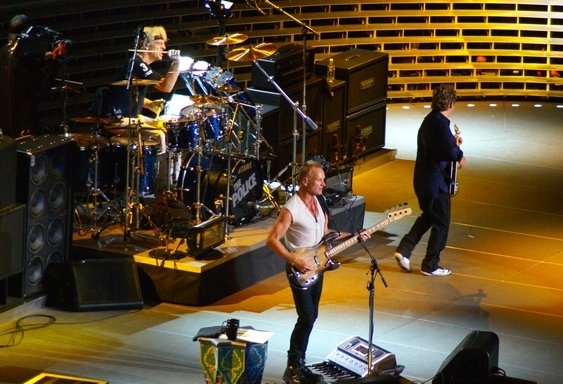
The song has never really left. It became one of the defining singles of the band’s short career, a fixture of their reunion tour three decades later, and a permanent fixture of Sting’s solo shows, sung now by a man in his seventies who wrote it as a penniless twenty-five-year-old with a handful of hopes. Roussel, the outsider flown in over the band’s objections, remains a footnote in the credits — the only guest musician to leave fingerprints all over a Police studio album, and the man whose dozen piano parts turned out to be the one element nobody could improve on. Its lesson is the one the band learned the hard way on Montserrat: some recordings are not improved by being done again, only by being believed in. The demo was the record. It just took The Police five years, one flown-in pianist and one very angry drum take to admit it.
Leave a Reply