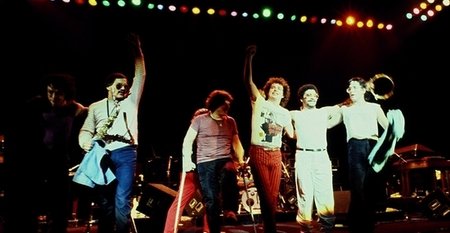
The biggest album of Toto’s career does not begin with a voice, a guitar, or a keyboard. It begins with a drum kit, entirely alone, playing a lopsided, ghost-noted shuffle that drummers have been trying to copy ever since. Two bars of drums — then the horns, the keyboards, and the voices pile in, and Rosanna is under way: five and a half minutes of studio perfection that opened Toto IV, spent five weeks pinned at number two in America behind two of the biggest singles of the decade, and then, to complete the joke, was named the finest record of the year at the Grammy Awards.
Nothing about its birth suggested a masterpiece. Its writer assembled its heroine out of three different women and borrowed her name from a fourth — an actress who happened to be dating the band’s keyboard player. Its famous groove was an act of cheerful theft, stitched together from three other drummers’ signature beats. And the band that recorded it was not coasting: after the disappointing Hydra and the outright flop of Turn Back, Toto walked into the studio in 1981 knowing their record company was losing patience. They were, in the most literal sense, playing for their careers.
Three Girls and a Borrowed Name
The song came from David Paich, Toto’s keyboardist and chief songwriter, and he has never made any mystery of its ingredients. “Rosanna is about three girls I knew, all rolled into one,” he has said — a high school sweetheart among them, folded into a single fictional woman who walked out on the singer and took his heart with her. The chorus, with its desperate plea to meet you all the way, existed before the woman had a name. Paich needed a name that would sing, that would land on the melody the way the lyric demanded.
The name was sitting in the studio. At the time, keyboardist Steve Porcaro was dating a young actress named Rosanna Arquette, who was around the band and its sessions. Paich’s confession is disarmingly blunt: “After I met Rosanna Arquette I just stole her name and stuck it on there.”
The band, mischief-makers by nature, played along with the world’s assumption that the song was a portrait of Arquette herself. She leaned into the joke with good humour, remarking in an interview that the song must be about her showing up at four in the morning bringing the musicians juice and beer during their sessions. The misunderstanding has now outlived most of the participants’ denials — but Paich has never budged. The woman in the song is a composite. Only her name was ever real.
The Groove Built From Three Drummers
Before anyone sings a note, Rosanna makes its real statement. Jeff Porcaro’s drum part is a half-time shuffle: the snare’s backbeat lands heavily on the third beat of the bar while the hi-hat swings in triplets above it and a filigree of ghost notes — strokes so quiet they are felt rather than heard — whispers through the spaces in between. It feels loose, lazy, almost drunk. It is, in fact, fiendishly difficult, and Porcaro never hid where he had stolen it from.
His first source was Bernard Purdie, the R&B drummer whose “Purdie shuffle” lit up Steely Dan’s Home at Last on the album Aja — a record the young Toto men knew inside out, having grown up in the same Los Angeles session world. His second was John Bonham, whose swaggering half-time groove on Led Zeppelin’s Fool in the Rain had shown what a shuffle could do inside a rock song. Underneath both, Porcaro tucked the rolling rhythm of the Bo Diddley beat. Fused together and played with a jazzman’s touch, the three borrowings became something none of their inventors had ever played.
The result acquired the rarest honour a drum part can earn: a name of its own. The “Rosanna shuffle” entered the drummer’s vocabulary as a standard to be mastered, and Porcaro — who died in 1992, barely thirty-eight — took the time to break it down note by note in an instructional video, patiently explaining his thefts to the generations who would spend years trying to reproduce them. The track is still regularly ranked among the greatest drum performances in rock, and its sound is so immaculately captured that hi-fi magazines cite Rosanna as one of the best-mastered songs ever made and use it to test loudspeakers.
One Day for the Rhythm Track, One Take for the Solo
For all its complexity, the record came together with the speed of men who played together every day. Toto recorded Rosanna in 1981 at Sunset Sound and Record One in Hollywood, producing themselves, with the veteran Al Schmitt tracking the sessions and Greg Ladanyi mixing. The basic rhythm track — the whole band locked into that shuffle — was completed in a single day. Steve Lukather’s guitar solo, the one that tears through the song’s middle, was recorded in one take.
The finished performance is a small miracle of moving parts. There are two lead singers: Lukather begins the verses in the key of G major, then the song shifts down into F and Bobby Kimball takes over, the pair of them having worked out the transposition between keys together. A horn section arranged by Jerry Hey — Tom Scott on tenor saxophone, Jim Horn on baritone, Jimmy Pankow on trombone — punches through the choruses, while percussionist Lenny Castro rattles underneath. And in the middle, Paich and Steve Porcaro built an overlapping duel of keyboard solos, layering line upon line with the newest machinery in the building — a Micro-Composer, a Minimoog, Yamaha CS-80s, Prophets, a Hammond organ, a GS1 — with Porcaro dreaming up the segment and playing most of its parts.
Even the ending was an accident that the band was smart enough to keep. The song was supposed to stop; Porcaro simply kept the groove going, Paich fell in behind him with a honky-tonk piano, and everyone else followed. As Lukather remembers it, “the song was supposed to end but Jeff carried on and Dave started playing the honky-tonk piano and we all just followed on.” That spontaneous jam became the album version’s long, joyous fade. Radio got a tighter edit, cut down from five and a half minutes to just under four.
Five Weeks at Number Two
Released in the United States on March 31, 1982, as the opening track and lead single of Toto IV, Rosanna climbed the Billboard Hot 100 and then stopped — one step from the summit, for five consecutive weeks. The songs holding it off were no embarrassments: the Human League’s Don’t You Want Me and Survivor’s Eye of the Tiger, the Rocky III anthem that owned the summer of 1982. In Britain the single reached number twelve, the album reached number four in America, and the single has since been certified double platinum in the United States.
The industry’s verdict arrived the following February, at the 1983 Grammy Awards. Rosanna won Record of the Year — the prize for the recording itself, for exactly the performance and production its makers had sweated over — and David Paich’s composition was nominated for Song of the Year besides. The band’s haul that night ran to six Grammys, including Album of the Year for Toto IV and Producer of the Year for a group of session men who had produced themselves. Steve Porcaro and Lukather have a name for the song that started it all: “the ultimate Toto track.”
The Name That Wouldn’t Go Away
Rosanna kept finding new lives. Its West Side Story-inspired video, directed by Steve Barron, cast dancer Cynthia Rhodes as the girl in the red dress — a performance that helped win her a role in Staying Alive — and featured, uncredited among the dancers, a young Patrick Swayze. Decades later, in 2018, Weezer released a cover of Rosanna as a teasing near-miss for the fans besieging them to record another Toto song entirely, and Lukather declared himself flattered.
It is a fitting afterlife for a record assembled, openly and gleefully, out of borrowed parts: three half-remembered girlfriends, a fourth woman’s name lifted from the studio couch, and a drum groove stitched from the life’s work of three other drummers. Toto stole everything about Rosanna except the skill — and the skill was the one thing nobody could lend them. The album it opened saved their career. The groove it launched outlived the drummer who invented it. And the name, which never belonged to the song at all, belongs to it forever now.
Leave a Reply