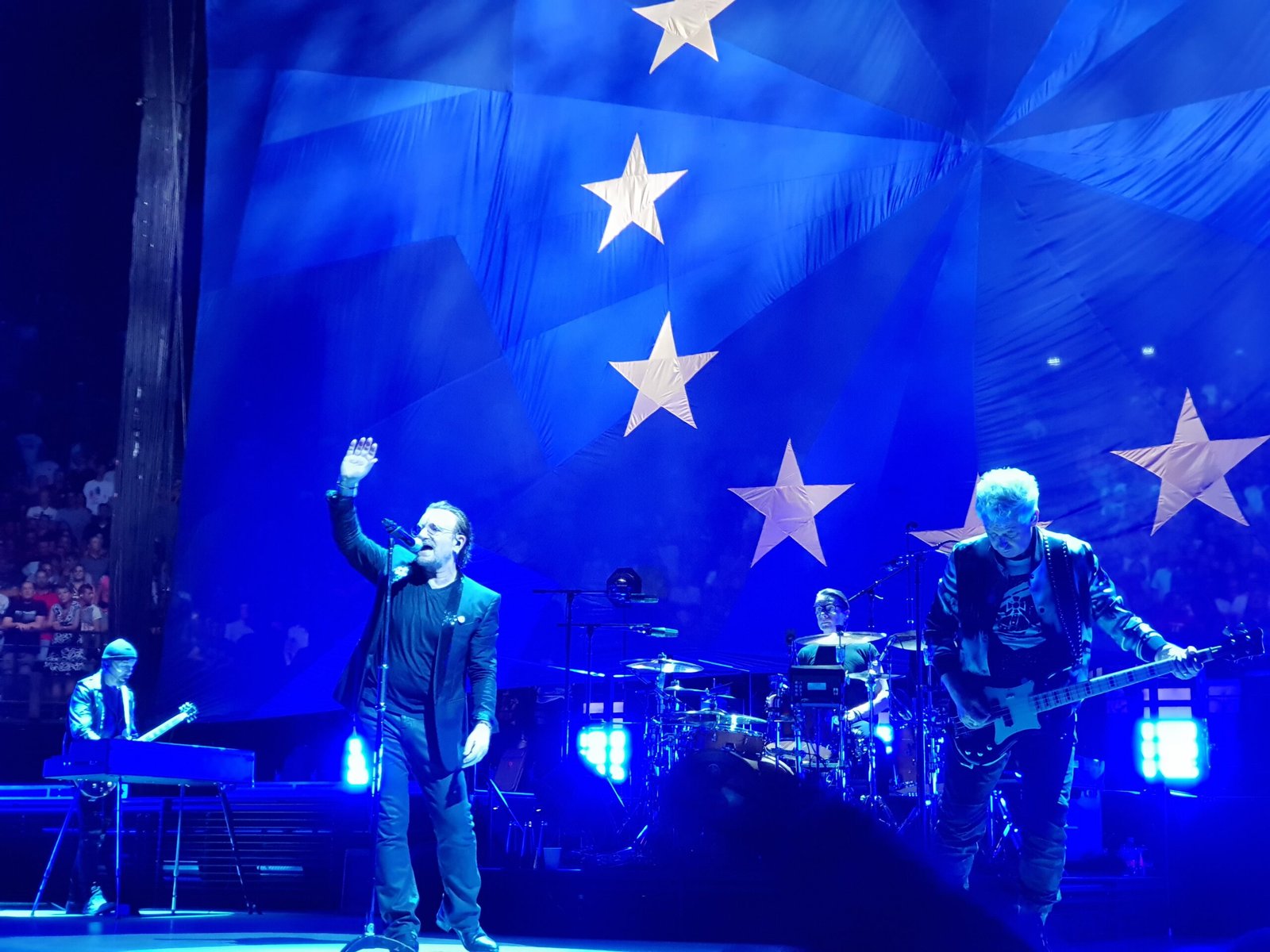
In the autumn of 1990, the biggest band in the world went to Berlin to reinvent itself, and very nearly ended instead. U2 arrived in the reunifying city expecting inspiration and found a cold studio, a pile of half-finished demos, and an argument about what they should even sound like. The song that rescued them arrived by accident, improvised in a single inspired passage of playing — a ballad about people falling apart that somehow held four men together.
It is called One, and it became the emotional centre of Achtung Baby, one of the most acclaimed albums of the decade. Bono has said the band wrote it because they needed to hear it. At the time, that was not a metaphor.
Berlin, and a Band Coming Apart
U2 had flown to Hansa Studios in October 1990, on the very eve of German reunification, chasing the energy of a new Europe. Hansa was hallowed ground — the studio where David Bowie, with Brian Eno, had made his Berlin records — and Eno and Daniel Lanois were again producing. But the mood was bleak. Bono and the Edge wanted to tear up the band’s earnest eighties sound and absorb the industrial noise and electronic dance music coming out of Europe. Adam Clayton and Larry Mullen Jr., the rhythm section, wanted to remain a rock band. Demos refused to become songs. Each side blamed the other: the singers thought the band was failing the material; the rhythm section thought the material was failing the band.
Mullen later admitted he thought it might be the end of U2. It is hard to overstate how real the danger was. This was a band whose entire identity rested on unity — four school friends from Dublin who had never changed a member — and in Hansa’s vast, freezing hall they had built, as Bono put it, their own wall down the middle of the studio, in the city that had just torn one down.
The Chords That Fell Out of the Sky
The breakthrough came while the band were grinding away at other material. The Edge, working through chord changes intended for a bridge section of another song, strung two progressions together on an acoustic guitar — a minor-key descent resolving into something warmer — and the room changed temperature. One by one the others joined in. Bono stepped to the microphone and began improvising a melody and fragments of lyric over the top. Within a short space of time, the skeleton of One existed, and everyone present understood what had happened: the band had written, in real time, the song they had been unable to force for weeks.
The producers recognised the moment for what it was. Sessions that had been circling for weeks suddenly had a centre of gravity, and work moved with new purpose; the band decamped to Ireland to finish the album in a rented house called Elsinore, overlooking the sea at Dalkey, with early U2 producer Steve Lillywhite among those brought in to help land the mixes. Whatever else Achtung Baby would become — the irony, the leather, the noise — it now had a heartbeat, and the four men who had arrived in Berlin as a band at war with itself left as a band again. As Bono wrote years later in his memoir, “‘One’ was such a song. We wrote it because we needed to hear it.”
The lyric Bono shaped from that improvisation drew on everything cracking around them. His own band was fracturing; the Edge’s marriage was breaking down; Germany outside the window was doing the opposite, two halves becoming one country. Before the trip, Bono had declined an invitation from the Dalai Lama to attend a “Festival of Oneness,” signing off his letter with a postscript that became the song’s thesis: “One, but not the same.”
Not a Love Song
That line is the key to the whole record, and the reason it is so often misunderstood. One is sung at weddings constantly, and Bono has spent thirty years gently horrifying the couples: “Are you mad? It’s about splitting up!” The lyric is an argument, not a vow — you say love is a temple, you ask me to enter but then you make me crawl; we are one, but we are not the same, and we have to carry each other anyway. It is not a celebration of unity. It is a negotiation between people who cannot live together and cannot walk away, which is to say it was a documentary of U2’s own condition in Berlin, dressed as a love song.
The band polished it for months afterwards, working and re-working the mix through the rest of the Achtung Baby sessions in Dublin, at Elsinore in Dalkey and Windmill Lane Studios. On the finished album it sits third, the still point in a record of noise, irony, and distortion — the moment the masks come off.
Three Videos and a Cause
By the time One was released as the album’s third single on February 24, 1992, Achtung Baby had already topped charts around the world and U2 were launching the Zoo TV Tour, the most ambitious multimedia production rock had attempted. One became the tour’s emotional counterweight — the moment each night when the sensory bombardment fell away and four men simply played. U2 directed their proceeds from the single to AIDS research. It reached number seven in Britain and number ten in America, topping the US rock charts. Its release produced one of the era’s strangest video sagas: three separate clips. Anton Corbijn’s Berlin film, featuring the band in drag and the city’s beloved Trabant cars, was shelved when the band worried it might muddy the song’s connection to the AIDS cause. Mark Pellington’s version — a lone buffalo running in slow motion across a plain — became the iconic one, projected behind the band on tour. A third, directed by Phil Joanou, simply showed Bono in a bar, singing and smoking, as if the whole Berlin drama had been distilled into one tired man at closing time.
The Song That Refuses to Retire
In a 2003 readers’ poll in Q magazine, One was voted the greatest song of all time — ahead of everything by the Beatles, the Stones, and Dylan. Johnny Cash recorded it, gravely, for his American III album; Mary J. Blige duetted it with Bono in 2006 and took it to number two in Britain. It has been played at memorials, benefits, and weddings alike — the misreading and the truth coexisting, because the song makes room for both. Bono’s anti-poverty organisation, the ONE Campaign, took its name from the song’s central idea: separate people, one shared obligation.
On stage, it became the still centre of U2’s increasingly spectacular shows — the song around which the Zoo TV circus, and every production after it, arranged its moments of sincerity. Dedicatees changed with the years: the band aimed it at everyone from AIDS campaigners to the victims of disasters and wars, and audiences learned to hear their own fractures in it. Few rock songs have been asked to carry so much public grief, and fewer still have borne the weight without collapsing into sentimentality. The reason may be that One never promises reconciliation. It promises only the attempt — which, in Berlin in 1990, was exactly enough.
U2 survived Berlin, finished Achtung Baby, and never again came quite that close to the edge. The four schoolboys are still the same four men. Every time Bono introduces One on stage, the subtext is the band’s own origin story of survival: a group that discovered, in a cold studio in a divided city learning to be whole, that the only way out was to give each other a leg up the wall — and wrote it down before they could forget.
Leave a Reply