I Was Made for Lovin’ You: The Night KISS Went Disco and Lived to Tell About It
In the spring of 1979, the biggest rock band in America was terrified. KISS — the demons and spacemen in greasepaint, the band that had turned rock concerts into comic-book warfare — was watching its empire crack. Album sales were softening. The solo albums each member had released the previous fall, in an unprecedented burst of hubris, had shipped platinum and come back by the truckload. Punk and new wave were calling bands like KISS dinosaurs. And on the radio, in the clubs, in every mall in America, there was only one sound that mattered: disco.
So Paul Stanley did what desperate men do. He went dancing.
Night after night, the Starchild — the pretty one, the romantic, the co-founder who had built KISS alongside Gene Simmons from the ashes of a failed glam band called Wicked Lester — was going to Studio 54, the most famous nightclub on earth, and standing on the dance floor until sunrise. He wasn’t there to be seen, exactly. He was there to listen. The DJs were playing records at 126 beats per minute, four-on-the-floor, strings and synthesizers and voices soaring over machine-precise drums. And Stanley, a rock guitarist who had spent a decade trying to be louder than everyone else, had a thought that would change his band forever: I can do that.
What came next — a song written in about an hour, a bet about how easy disco was, a drummer who wasn’t in the band playing on the record, a music video filmed on a canceled stage, and a backlash so fierce it nearly killed KISS — is one of the strangest stories in rock history. “I Was Made for Lovin’ You” shouldn’t have worked. It was a disco song by a band that stood for everything disco wasn’t. And yet it became one of the biggest hits KISS ever had, a song they still play at every show, nearly fifty years later, to crowds that sing every word.
This is the story of how the toughest band in rock learned to dance — and what it cost them.
Wicked Lester
Before there was KISS, there was Wicked Lester — and the story of that failure explains everything about what came later. In the early seventies, Gene Simmons (born Chaim Witz in Haifa, Israel, in 1949, raised in Queens, New York) and Paul Stanley (born Stanley Eisen in Manhattan in 1952) were playing together in a band that couldn’t decide what it wanted to be. Wicked Lester had elements of glam, pop, folk-rock, and Beatlesque harmony — a little of everything, not enough of anything. They recorded an album for Epic Records that was never released. The band fell apart.
What Simmons and Stanley took from the wreckage was a philosophy: never be vague again. When they started KISS in 1973, every decision was deliberate. The makeup wasn’t an accident — it was branding, a way to be instantly recognizable in a crowded market. The characters weren’t personas — they were trademarks. The Demon, the Starchild, the Spaceman, the Catman: four archetypes, four masks, four products. Simmons, who had studied the music business with the intensity of a law student, understood that a rock band in the seventies was competing not just with other bands but with television, movies, and comic books. KISS would be all of those things at once.
They found their drummer in Peter Criss, a Brooklyn-born jazz and R&B veteran who had placed a famous ad in Rolling Stone declaring himself willing to do anything to make it. They found their guitarist in Ace Frehley, a Bronx kid with a blistering technique and a chaotic personal life. The chemistry was immediate and volatile. By 1974, they had a record deal with the fledgling Casablanca Records — a label run by Neil Bogart that would bet everything on KISS and, later, on disco itself. The irony of that would not become clear for five years.
The early albums — Kiss (1974), Hotter Than Hell (1974), Dressed to Kill (1975) — sold modestly. What made KISS famous was the road. They toured relentlessly, building a live show of unprecedented theatricality: Simmons breathing fire and spitting blood, Frehley’s guitar shooting rockets, Criss’s drum riser ascending into the rafters, Stanley smashing his guitar at the climax. Alive!, the 1975 double live album, captured the mayhem and turned it into legend. It went gold, then platinum, then multi-platinum. KISS became the biggest live draw in America.
The Empire Cracks
To understand 1979, you have to understand what KISS had been. Formed in New York City in 1973 by Gene Simmons and Paul Stanley, with drummer Peter Criss and guitarist Ace Frehley completing the classic lineup, KISS had spent the mid-seventies building the most successful live operation in rock history. The makeup, the costumes, the fire-breathing, the blood-spitting, the levitating drum riser — it was all theater, and it was all deliberate. Simmons, the band’s businessman and self-mythologizer, understood something his peers didn’t: in the seventies, rock wasn’t just music. It was spectacle. And KISS was the greatest spectacle of all.
The live album Alive! (1975) had made them stars. Destroyer (1976) had given them “Detroit Rock City” and “Beth.” By 1977, they were arguably the biggest band in America — bigger than Led Zeppelin in ticket sales, bigger than anyone in merchandise. The KISS Army, their fan club, numbered in the millions. There were KISS dolls, KISS lunch boxes, KISS comic books printed with the band members’ actual blood mixed into the ink.
But empires rot from the inside. By 1978, the classic lineup was fracturing. Peter Criss, the Catman, was struggling with the aftermath of a serious 1978 car accident and with substance abuse that was affecting his drumming. Ace Frehley, the Spaceman, was drifting, increasingly unreliable, increasingly at odds with Simmons and Stanley’s discipline. The band’s solution to the tension was characteristically grandiose: in September 1978, all four members released solo albums on the same day. It was the first time in history any band had attempted such a thing. Casablanca Records shipped them platinum. The public shrugged. Hundreds of thousands of copies came back unsold.
The message was clear: people wanted KISS, not four solo artists. But which KISS? The audience was changing. The kids who had screamed for “Rock and Roll All Nite” in 1975 were growing up. And the new kids — the ones buying records in 1979 — wanted to dance.
The Solo Albums Disaster
The four solo albums of September 1978 deserve a closer look, because they explain the desperation of 1979. On paper, the idea was brilliant: each member of KISS would release a solo album simultaneously, demonstrating the band’s depth and giving each personality room to breathe. In practice, it was a catastrophe that revealed how fragile the empire had become.
The numbers tell the story. Casablanca shipped each album platinum — a million copies — based on advance orders. But shipments aren’t sales. When the records actually reached stores, the public’s response was indifference bordering on hostility. Ace Frehley’s album did the best, powered by his cover of Russ Ballard’s “New York Groove,” which became a genuine hit. Paul Stanley’s was respectable. Gene Simmons’s — a bizarre grab-bag featuring a cover of “When You Wish Upon a Star” from Pinocchio and guest appearances by half of Hollywood — confused everyone. Peter Criss’s, a collection of R&B ballads, sank without a trace.
Hundreds of thousands of copies were returned. The financial hit was enormous, but the psychological hit was worse. The solo albums proved something Simmons and Stanley didn’t want to admit: the magic was in the combination, not the individuals. KISS was a gestalt — four masks that only worked together. Apart, they were just four musicians with varying degrees of talent and wildly varying degrees of judgment.
The failure also exposed the internal divisions. Frehley’s relative success bred resentment. Criss’s failure confirmed what everyone suspected about his declining abilities. And the whole fiasco left Casablanca Records — already stretched thin — in a precarious position. The label needed KISS to deliver a hit album, and it needed it fast.
This was the atmosphere in which Vini Poncia was hired. Casablanca didn’t want another Love Gun — the 1977 album that had been the band’s last real triumph. They wanted something that could compete with the Bee Gees. They wanted disco. And Paul Stanley, dancing at Studio 54 until sunrise, was the only member of the band who seemed to understand what that meant.
Studio 54
Studio 54 was more than a nightclub. Opened in 1977 in a former CBS television studio on West 54th Street in Manhattan, it became the most famous room in America — a place where Andy Warhol held court, where Bianca Jagger rode in on a white horse, where the velvet rope created a caste system out of nightlife. The music was disco: Donna Summer, Chic, the Bee Gees, Gloria Gaynor. The beat was relentless. The room was euphoric.
Paul Stanley went there the way other people go to church. In his 2014 memoir Face the Music, he described what he found: “Studio 54 was a den of iniquity. It was sordid to a level and degree that I wasn’t completely comfortable with. It was hardcore debauchery — sexual relations between everybody and anybody and drugs everywhere — but I loved going there to dance.”
And he listened. “I had heard all these 126-beats-per-minute songs and listened to the lyrics and thought, ‘Gee, I can do that,’” Stanley recalled. He went home, set a drum machine to 126 BPM, and started writing. The first line came to him out of the debauchery itself: Tonight I’m gonna give it all to you.
There is a legend about what happened next — that Stanley bet someone he could write a hit disco song in a matter of hours, just to prove how formulaic the genre was. The story is unproven, and Stanley himself has described it less as a bet than as a conscious experiment. But the underlying attitude was real: this was a rock musician approaching disco the way a safecracker approaches a lock. He was going to prove it could be done.
What Stanley didn’t expect was that he would write something he actually loved.
The Hour at SIR
Stanley had met Desmond Child a couple of years earlier, and the meeting had been pure New York. It was 1977, and Stanley came across a flyer in Greenwich Village for a show by Desmond Child and Rouge — a glammed-up band fronted by Child, a mop-topped singer-songwriter backed by three brunette backup singers named Myriam Valle, Maria Vidal, and Diana Grasselli. Stanley was blown away. The two became friends, and then collaborators. They had already written a song called “The Fight” for Desmond Child and Rouge’s 1979 debut album.
Now Stanley called Child with a proposition: help me write a disco song. They met at SIR Studios in New York City — the rehearsal complex where half the rock bands in America prepared for tours — and went to work. According to Child, they wrote the verses together in about an hour. Stanley played chords, Child played guitar, and they shaped the song the way craftsmen shape wood: quickly, confidently, without overthinking.
The chorus came later, after Child had left the studio. Stanley worked on it with Vini Poncia, the producer KISS had hired for their new album. Poncia was an inspired and slightly odd choice — a soft-rock veteran whose credits included albums by Ringo Starr and Melissa Manchester, not exactly the man you’d hire to produce the hottest band in hard rock. But Casablanca wanted a more commercial sound, and Poncia knew how to make records that radio would play. Together, Stanley and Poncia wrote the chorus — the “Motown-influenced” refrain, as Child later described it — and the song was complete.
“I Was Made for Lovin’ You.” Three writers: Stanley, Child, Poncia. One drum machine set to 126 BPM. And a melody hook that Stanley later admitted he had lifted, consciously or not, from the Four Tops’ “Standing in the Shadows of Love,” reworked into something new.
Anton Fig: The Ghost Drummer
The story of Anton Fig deserves its own chapter, because it illustrates how thoroughly the Dynasty sessions departed from the KISS myth. Fig was twenty-six years old, a session musician with impeccable technique and no image whatsoever — the opposite of everything KISS stood for. He had played on Ace Frehley’s solo album, which is how Poncia knew him. When Poncia decided Criss couldn’t cut it, Fig was the obvious replacement: precise, reliable, and — crucially — able to play disco.
What Fig brought to “I Was Made for Lovin’ You” was a feel that Peter Criss could never have provided. Criss was a jazz-influenced drummer with a loose, swinging style — perfect for “Black Diamond” or “Hard Luck Woman,” but all wrong for four-on-the-floor dance music. Fig played like a machine: steady, exact, relentless. The drum track on “I Was Made for Lovin’ You” doesn’t swing. It drives. It’s the sound of a man who understands that in disco, the drummer’s job is to disappear into the groove.
Criss’s absence was an open secret that became a running wound. He was on the album cover. He appeared in the videos, miming to Fig’s playing. But everyone in the industry knew. And Criss knew that everyone knew. His 1978 car accident had been serious — he had injured his hands, and the recovery had been complicated by his substance abuse — but the deeper issue was that the band had moved on without him, musically and personally. Within a year of Dynasty‘s release, Criss was out of KISS. He wouldn’t return for nearly two decades.
Fig, meanwhile, became one of the most successful ghost musicians in rock history. He played on most of Dynasty and on the follow-up, Unmasked (1980). Later, he became the drummer for the Late Night with David Letterman house band, holding one of the most visible drumming jobs in television for decades. But his work on “I Was Made for Lovin’ You” remains his most-heard performance — played by millions of people who have no idea his name.
The Dynasty Sessions
The album was called Dynasty, and the sessions took place in January and February 1979 at Electric Lady Studios and the Record Plant in New York. From the beginning, the recording was troubled. Peter Criss, the band’s drummer, was in no condition to play. His injuries from the 1978 car accident, compounded by his substance abuse, had left his drumming shaky and unreliable. Producer Vini Poncia made a decision that would haunt the band for years: he replaced Criss with a session drummer.
The replacement was Anton Fig, a young South African-born drummer who had played on Ace Frehley’s 1978 solo album. Fig was precise, metronomic, perfect for disco — everything Criss, with his loose, jazzy swing, was not. Fig played drums on all but one track of Dynasty, including “I Was Made for Lovin’ You.” Criss appeared in the music video and on the album cover, miming to another man’s playing. It was the beginning of the end for the Catman; within a year, he would be out of the band.
The rest of the track was assembled with similar studio precision. Paul Stanley sang lead and played rhythm guitar. Gene Simmons played bass — despite years of rumors to the contrary, Poncia later confirmed that Simmons’s bass is on the record. Ace Frehley played lead guitar. Poncia himself added synthesizers, keyboards, and backing vocals. The result was a hybrid: KISS’s guitars and voices grafted onto a disco chassis, with a four-on-the-floor beat and a chorus built for the dance floor.
It didn’t sound like KISS. That was the point — and the problem.
The Twelve-Inch
One detail that reveals how seriously KISS took the disco experiment: the twelve-inch single. In the disco era, the twelve-inch single was an art form — extended mixes, stretching songs to seven or eight minutes, built for DJs to mix in clubs. “I Was Made for Lovin’ You” got the full treatment. The twelve-inch version runs nearly eight minutes, twice the length of the album cut, with extended instrumental passages designed for the dance floor.
This wasn’t a rock band dabbling in disco. This was a rock band committing to disco, using its formats, speaking its language. The twelve-inch of “I Was Made for Lovin’ You” is a remarkable artifact: KISS, the band of fire and blood, making a record designed to be played at Studio 54 at 2 a.m. And it worked. The song was a genuine club hit, played by the same DJs who played Chic and Donna Summer.
The seven-inch single, with “Hard Times” on the B-side, was the version most people heard on the radio. But the twelve-inch tells you what Stanley was really after. He wasn’t making a novelty record. He was making a disco record — as carefully and deliberately as KISS had ever made anything.
The Backlash
“I Was Made for Lovin’ You” was released in May 1979 as the first single from Dynasty, which followed on May 23. The band didn’t hide it. They put it first on the album — track one, side one, the opening statement. This wasn’t a guilty experiment tucked at the end of the record. It was a declaration.
The public responded with its wallet. The single went gold in the United States on August 16, 1979 — KISS’s second gold single — and went platinum in several other countries. It reached number 11 on the Billboard Hot 100 and stayed on the chart for sixteen weeks. Dynasty peaked at number 9 on the Billboard 200. By any commercial measure, the disco experiment was a triumph.
But the KISS Army was not happy. The backlash was immediate and ferocious. To the faithful — the kids in makeup who had pledged allegiance to rock and roll — “I Was Made for Lovin’ You” was a betrayal. Rolling Stone‘s David Fricke, reviewing the album, essentially predicted a revolt, warning that the KISS Army was going to mutiny over the disco opening. He wasn’t wrong. Concert crowds were divided. The old songs still brought the house down, but the new one got a cooler reception from the diehards.
And then came Disco Demolition Night. On July 12, 1979, at Chicago’s Comiskey Park, a radio DJ named Steve Dahl staged a publicity stunt in which thousands of disco records were blown up on the field between games of a doubleheader. The event turned into a riot. Disco, as a cultural force, effectively died that night — or at least, the backlash against it became impossible to ignore. Lance Tawzer, the curator of a museum exhibit about Disco Demolition Night, later told the Chicago Tribune that KISS’s disco song may have helped inspire the event’s fury: “That’s KISS’ disco song, ‘I Was Made for Lovin’ You’… That’s the moment when they jumped the shark.”
It was unfair — “I Was Made for Lovin’ You” didn’t cause the riot, and disco’s decline had many fathers — but the song became a symbol. For rock fans who hated disco, KISS had committed the ultimate sin: they had crossed over.
Inside the band, the song was divisive too. Gene Simmons, the Demon, the co-founder, has never liked it. In a 2018 interview, he admitted he always disliked the song — partly because of his vocal part, partly, one suspects, because it represented everything he thought KISS shouldn’t be. Stanley, meanwhile, has always defended it. He wrote it. He believed in it. He still does.
The Video on the Canceled Stage
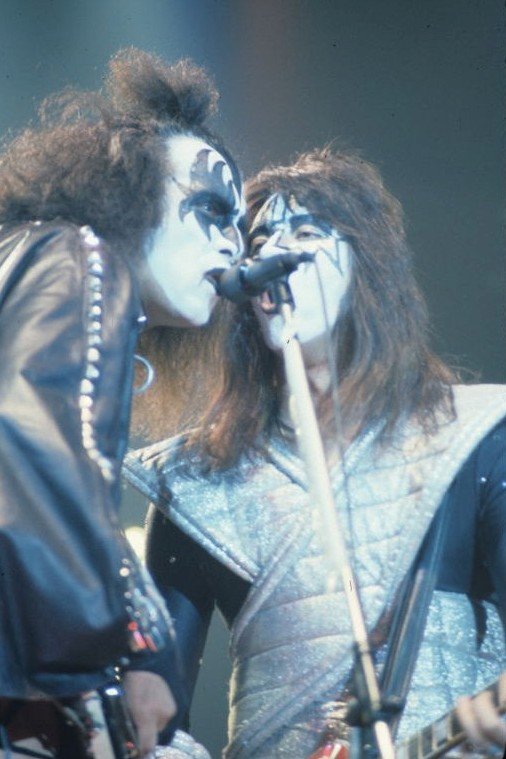
The music video for “I Was Made for Lovin’ You” was filmed on June 20, 1979, at the Savannah Civic Center in Savannah, Georgia, directed by John Goodhue. The circumstances were pure KISS chaos: a concert had been canceled, but the stage was already built — the full Dynasty stage set, lights and all. Rather than tear it down, the band decided to use it. They filmed a promotional video of themselves performing the song on the empty stage, in full costume and makeup, playing to no one.
There’s something poignant about that image: four men in demon paint, performing a disco song to an empty arena, not knowing that the culture was about to turn against them. The video is straightforward — just the band, playing — but it captures a moment of transition. This was KISS at the height of their fame and the beginning of their fall, and they didn’t know it yet.
The Long Afterlife
Here is the thing about “I Was Made for Lovin’ You” that nobody predicted in 1979: it survived. The backlash faded. Disco came back, first as a guilty pleasure, then as a respected influence. And the song — that ridiculous, irresistible, perfectly constructed song — turned out to be indestructible.
KISS never stopped playing it. Through the eighties, when they took off the makeup and tried to be a “serious” rock band. Through the nineties, when they put the makeup back on and became a nostalgia act. Through the 2000s and beyond, on farewell tours that never quite farewell. “I Was Made for Lovin’ You” is a permanent part of the setlist, and when those opening drums kick in — Anton Fig’s drums, still, on the record — the crowd goes wild. The kids who hated it in 1979 bring their grandchildren now, and everybody sings.
The song has been covered, sampled, and licensed into ubiquity. It plays in movies, in commercials, at weddings, at sporting events — the full lifecycle of a standard. In 2009, KISS performed it in Melbourne, Australia, with the Melbourne Symphony Orchestra — the orchestra members wearing KISS makeup with their tuxedos. It was absurd and magnificent, the way all the best KISS moments are. A disco song, played by a symphony, by a rock band in demon paint, to an audience that spanned three generations. If you had described that scene to Paul Stanley in 1979, he might have laughed. But he also might have recognized it: this was always where the song was going.
And Paul Stanley was right. He could do that. The song he wrote in an hour at SIR Studios, to prove how easy disco was, turned out to be one of the most enduring singles of his career — bigger, in the long run, than almost anything else KISS recorded in the seventies. It outlasted the backlash. It outlasted disco itself. It outlasted the classic lineup, the makeup, the empire.
There is a lesson in that, though Stanley might not put it this way. The song worked not because it was a cynical genre exercise, but because it wasn’t. For all the talk of bets and formulas and 126 BPM, “I Was Made for Lovin’ You” is a genuinely great pop song — the verses build, the chorus explodes, the hook is undeniable. Stanley set out to prove he could write a disco song. He ended up proving he could write a standard.
Gene Simmons still hates it. The KISS Army still argues about it. But on a summer night in 1979, Paul Stanley went dancing at Studio 54, came home, and wrote the future. The beat was 126 beats per minute. The song has been playing ever since. And somewhere, in a club that no longer exists, in a decade that never quite ended, the Starchild is still on the dance floor — not as a rock star slumming it, but as a songwriter who understood something his critics didn’t: that a great song doesn’t care what you call it. It just makes you move.
Leave a Reply