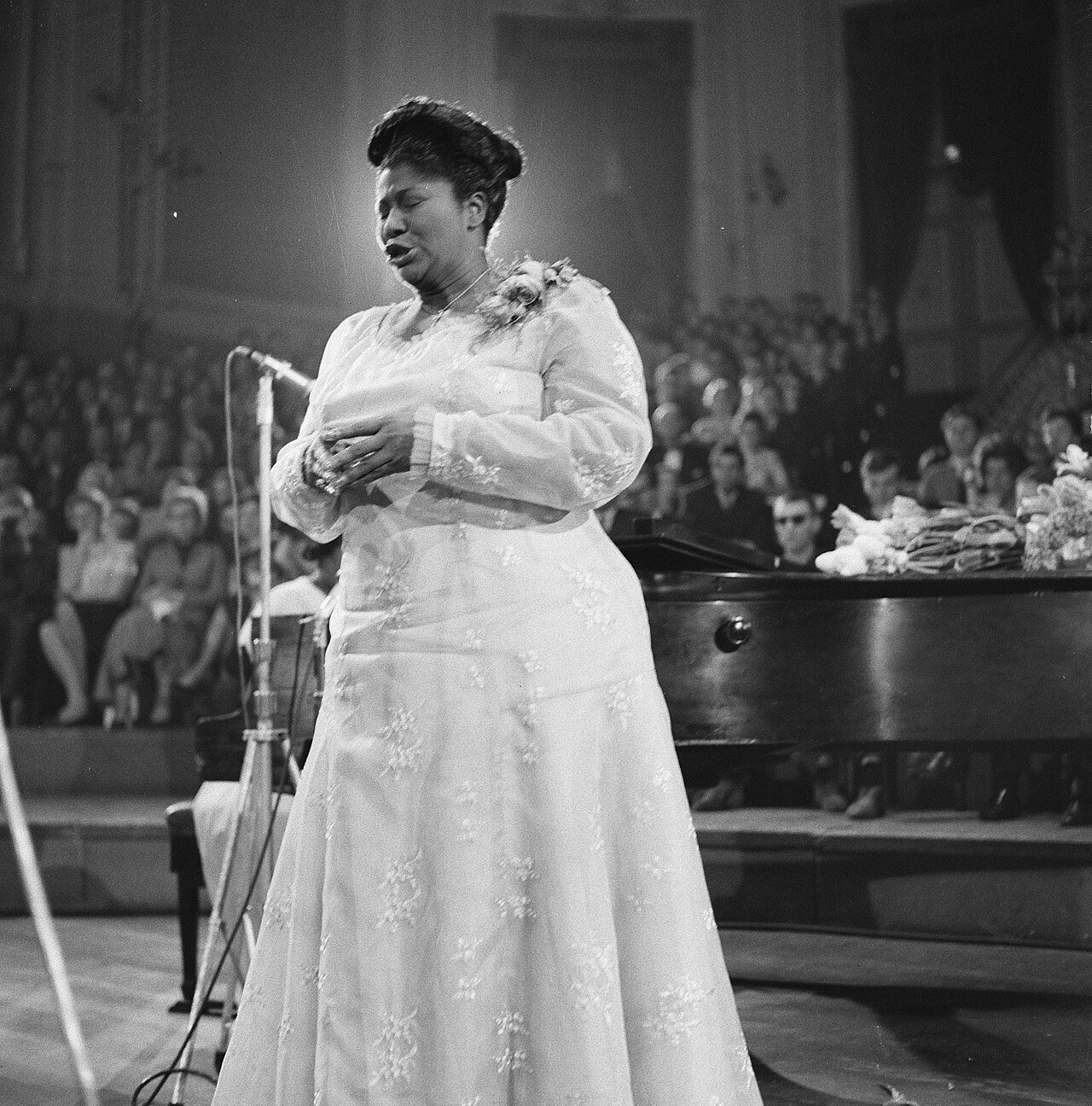

Mahalia Jackson was born on 26 October 1911 in New Orleans, Louisiana, in a neighbourhood where music was not entertainment first but worship, work, and survival. She grew up singing in church, in a city where gospel, blues, and jazz lived on the same streets and sometimes in the same room, and she carried that mixture with her for the rest of her life. By the time she was famous, she was known everywhere as the Queen of Gospel, a title that was not a marketing slogan but a description of a fact: no other gospel singer of her generation commanded so large an audience, so consistently, for so long, or with so much authority. And on 28 August 1963, at the March on Washington for Jobs and Freedom, she sang just before Martin Luther King Jr. delivered his “I Have a Dream” speech, in one of the most famous juxtapositions of music and oratory in American history. To understand that moment, it is necessary to understand the singer, the song she chose, and the movement she had already been serving for years.
Jackson’s early life was shaped by poverty, by the church, and by the particular musical culture of Black New Orleans. She was raised in a household where the Baptist church provided both community and music, and she learned to sing by listening to the women around her, to the preachers, and to the records that came into the house. She did not have formal conservatory training, and she did not need it. Gospel singing, as she practised it, was a discipline of its own: breath, phrasing, dynamics, and, above all, the ability to make a congregation feel that a song was happening to them, not merely being performed for them. When Jackson sang, she did not stand apart from the music; she seemed to enter it, and to take the audience with her. That quality, which audiences would later describe as power, was really a form of communion. She sang as if she believed every word, and because she did, listeners believed her.
From New Orleans to Chicago
In her late teens Jackson moved to Chicago, a city that was becoming a centre of Black gospel music, and there she joined the Greater Salem Baptist Church choir and began to sing with the Johnson Gospel Singers. Chicago gave her something New Orleans could not: a large, organised gospel world with its own composers, choirs, publishers, and recording opportunities, and a growing Black middle class that supported gospel concerts as well as church services. Jackson worked steadily, sang in churches and at concerts, and slowly built a reputation that travelled by word of mouth, by radio, and by the records she began to make.
Her breakthrough as a recording artist came in the late 1940s, above all with “Move On Up a Little Higher”, recorded in 1947. The record sold in numbers that were extraordinary for a gospel record at the time — contemporary accounts speak of millions of copies — and it made Jackson a national figure in gospel music. It also established the pattern of her career: she would sing gospel music, and only gospel music, with a seriousness that sometimes puzzled the record industry. She was offered, at various times, opportunities to sing blues, jazz, or popular music for larger fees, and she refused them. That refusal was not snobbery; it was conviction. Jackson believed that gospel was not a stepping stone to something else but a complete art in itself, and she believed that her voice had been given to her for a purpose that secular singing would betray. The decision cost her money in the short term and earned her, in the long term, a moral authority that no other singer of her generation possessed.
By the 1950s Jackson was famous well beyond the gospel world. She sang on radio and television, including her own programme, toured in the United States and in Europe, and became the first gospel singer to perform at Carnegie Hall. She recorded for Columbia Records, made albums that sold to listeners who had never set foot in a Black Baptist church, and became a familiar figure to white audiences as well as Black ones, without changing her repertoire or her manner. She sang gospel songs in concert halls as she had sung them in churches, with the same directness, the same volume when the song required it, and the same quietness when it required that instead. Audiences responded not because gospel had been made fashionable but because Jackson made it impossible to hear it as anything other than serious, beautiful, and true.
A Singer in the Movement
Jackson’s involvement in the civil rights movement was not a late addition to her career; it grew naturally out of her gospel world, her friendships, and her convictions. She knew Martin Luther King Jr. personally, sang at movement rallies and fundraisers, and used her fame and her income to support the cause. She sang at the Montgomery bus boycott events, travelled in the South, and lent her presence to occasions where a famous singer’s presence could draw a crowd, raise money, and lift spirits. For Jackson, the movement was not a political cause separate from her faith; it was an expression of it. The songs she sang — songs about getting over, about moving on up, about precious Lord taking a hand — were, in her understanding, already songs about freedom. When she sang them at a rally, she was not providing entertainment between speeches; she was preaching in the form she knew best.
That is why her place on the programme at the March on Washington on 28 August 1963 mattered so much. The march was a vast, carefully organised demonstration, with a programme of speakers and singers that included Joan Baez, Bob Dylan, Peter, Paul and Mary, and others, as well as the leaders of the major civil rights organisations. Jackson sang two songs: “I’ve Been ‘Buked and I’ve Been Scorned” and “How I Got Over”. The second of these, a gospel hymn composed by Clara Ward and published in 1951, was a song of survival and praise, a song that looked back at hardship and forward to deliverance in the same breath. Sung by Jackson, in front of a crowd estimated at a quarter of a million people, it was not a warm-up act. It was a statement of what the movement was about, in musical form, before King spoke a word.
The Moment Before “I Have a Dream”
What happened next has become one of the most retold stories in American history, and it is worth telling carefully, because the popular version sometimes simplifies it. King was delivering a prepared speech, formal and carefully argued, when, according to many accounts, Jackson called out to him from nearby, urging him to tell the audience about the dream. The exact words vary in different retellings — “Tell them about the dream, Martin” is the version most often quoted — but the substance of the story is consistent: Jackson, who knew King’s preaching style from church, recognised that the moment called for something more than a prepared text, and she prompted him to move into the improvised, sermon-like passage that became the most famous part of the speech. King did so, and the “I Have a Dream” sequence, with its repetitions, its biblical cadences, and its vision of a future America, entered history.
Whether Jackson’s shout was the sole cause of that shift is a matter historians still discuss, and it would be wrong to reduce a great speech to a single prompt. King was a preacher of extraordinary gifts, and the dream imagery had appeared in his earlier sermons. What is not in doubt is that Jackson was there, that she sang immediately before him, and that her singing had already set a tone — a tone of faith, endurance, and hope — that made the dream passage possible. Music and speech were not separate items on a programme that day; they were part of a single event, in which a gospel singer prepared the ground for a preacher, and the preacher, in turn, gave words to what the singing had already expressed. Jackson herself understood it that way. She did not claim to have written the speech, and she did not need to. Her contribution was her own, and it was enough.
After the march, Jackson continued to sing for the movement, including, five years later, at King’s funeral in 1968, where she sang “Take My Hand, Precious Lord”, King’s favourite hymn. It was a devastating occasion, and Jackson’s singing of that hymn — slow, unadorned, and full of grief — became one of the most remembered moments of the funeral. She had sung for King in life, at the height of his public triumph; now she sang for him in death, and the same voice that had lifted a crowd of a quarter of a million people now carried the sorrow of a movement that had lost its leader. The two performances, five years apart, frame Jackson’s role in the movement with a terrible symmetry: the voice that announced hope, and the voice that mourned its cost.
The Voice Itself
It is easy, in telling a story as dramatic as Jackson’s, to forget to describe the voice, but the voice is the reason the story matters. Jackson sang with a contralto of great power and warmth, with a vibrato that could widen or narrow as the song required, and with a sense of rhythm that made even a slow hymn feel as if it were moving forward. She did not sing with the polished smoothness of a classical singer, and she did not sing with the clipped precision of a pop singer. She sang with the full body, with breath that seemed inexhaustible, and with a habit of holding a note just a fraction longer than expected, so that the listener felt the weight of it. She could also sing very quietly, and those quiet moments, in a large hall, were often the most powerful of all, because they forced an audience to listen rather than merely to hear.
Her repertoire was, by choice, narrow in genre and wide in feeling. She sang traditional spirituals, gospel songs by contemporary composers, and a small number of popular songs that she could treat as gospel in spirit, but she did not sing the blues, and she did not sing jazz for its own sake. That discipline gave her performances a coherence that other singers, with wider repertoires, sometimes lacked. A Jackson concert was not a variety show; it was a single argument, made in song after song, that faith could sustain a person through suffering and that suffering, faced honestly, could become a source of strength. Audiences who did not share her faith could still feel the argument, because it was made with such conviction and such musical skill that it did not need agreement to be moving.
Jackson died on 27 January 1972 in Chicago, at the age of sixty. She had been ill, and her last years had been marked by declining health, but she had continued to sing when she could, and her reputation had only grown. Her funeral was a major public occasion, and her legacy was already secure: she had taken gospel music from the church to the concert hall, from the Black South to the world, without diluting it, and she had shown that a singer could be both an artist and a witness. Later gospel singers, from Aretha Franklin to the many choir leaders who followed her, worked in a world that Jackson had helped to create, a world in which gospel was recognised as one of America’s great musical traditions, not as a curiosity or a stepping stone.
To listen to Jackson today is to hear a voice that seems, paradoxically, both of its time and outside it. The recordings are old, the arrangements are simple, and the songs are, for the most part, familiar. But the singing itself has not dated, because it was never fashionable in the first place. It was, and remains, a direct communication from one person to another, made with a voice that believed what it sang. At the March on Washington, that voice prepared the way for one of the great speeches of the twentieth century. It did so not by competing with the speech but by doing what music can do and words alone cannot: it made a crowd feel, together, the hope that the speech would then name. That is Jackson’s place in history, and it is a place no other singer could have filled.
Sources / further reading
- Library of Congress, Van Vechten Collection: Mahalia Jackson, photographed 16 April 1962, public domain.
- Accounts of the March on Washington, 28 August 1963, including Jackson’s performances of “I’ve Been ‘Buked and I’ve Been Scorned” and “How I Got Over” before King’s speech.
- Reference entries on Mahalia Jackson (1911–1972), “Move On Up a Little Higher” (1947), Carnegie Hall, Columbia Records, and her civil rights work.
- Clara Ward, “How I Got Over” (published 1951), and its performance history.
Image credit: Mahalia Jackson, photographed by Carl Van Vechten, 16 April 1962, Library of Congress, public domain, via Wikimedia Commons.
Leave a Reply