Most hit albums arrive, climb, and fade. A few stay for a season. Almost none stay for a generation. Pink Floyd’s The Dark Side of the Moon belongs in that rarest category, not simply because it sold in enormous numbers, but because it kept being found, kept being played, and kept returning to the charts long after the year of its release had become history. This is not another retelling of the band’s whole story, and it is not a companion piece to The Wall. It is a look at one album as a piece of listening that was built to be heard from beginning to end, and at why that design gave it a chart life unlike almost anything else in popular music.
The basic facts still startle, even when they are stated plainly. The Dark Side of the Moon was the eighth studio album by the English progressive rock band Pink Floyd. It was released in the United States on 1 March 1973 by Capitol Records, and in the United Kingdom on 16 March 1973 by Harvest Records. It runs for 42 minutes and 49 seconds. It topped the United States album chart, spending one week at number one, while in Britain it reached number two rather than the top spot. By 2013 it had sold more than 45 million copies worldwide, making it the band’s best-selling release, the best-selling album of the 1970s, and the fourth-best-selling album in history according to the account given on its reference page. Those sales figures alone would be enough to secure its place. The chart story, however, is stranger and more interesting than a single peak position.
The album’s first long run on the American Billboard chart is usually given as 741 weeks, from 1973 to 1988. That is more than fourteen years of chart appearances, spread across roughly fifteen and a half calendar years. Later re-entries, after Billboard changed its rules to allow older catalogue albums to compete again on the main album chart, pushed the total higher still. One widely cited total, given on the album’s reference page, is 996 weeks on the United States Billboard Top LPs and Tape chart. Other sources, writing at different dates, give slightly different totals, because a total of this kind is a moving target: every re-entry changes it. The point that does not change is the shape of the story. This was not an album that peaked and vanished. It was an album that settled into the chart and stayed there, week after week, year after year, while musical fashions changed around it.
Built on the road, finished in the studio
One reason the album feels so complete is that it was not assembled in a hurry after a sudden idea in the studio. It was developed during live performances before recording began. At a band meeting at drummer Nick Mason’s home in north London, bassist Roger Waters proposed an album that could form part of the tour, dealing with the things that make people mad: the pressures of the band’s demanding lifestyle, and the mental health problems of former band member Syd Barrett, who had left the group in 1968. The band approved a concept unified by a single theme, and Waters worked on demo tracks in a small studio in a garden shed at his home in Islington.
The new material was given the provisional title Dark Side of the Moon, an allusion to lunacy rather than to astronomy. When the band discovered that another band, Medicine Head, had already used that title, it was temporarily changed to Eclipse. The material was premiered at The Dome in Brighton on 20 January 1972, and performed for the press at the Rainbow Theatre in London on 17 February 1972, more than a year before the album’s release. After Medicine Head’s album failed commercially, Pink Floyd returned to their original title. That long period of live performance mattered. By the time the band entered the studio, the music had already been tested in front of audiences, reshaped on tour, and sequenced in the order in which it would eventually appear on the record. The album did not need to find its shape in the studio, because it already had one.
Recording took place in two sessions in 1972 and 1973 at EMI Studios in London, now known as Abbey Road Studios, in approximately sixty days between 31 May 1972 and 9 February 1973. The band were assigned staff engineer Alan Parsons, who had worked as assistant tape operator on their fifth album, Atom Heart Mother from 1970, and had gained experience as a recording engineer on the Beatles albums Abbey Road and Let It Be. The sessions made use of advanced studio techniques for the time, including Studer A80 sixteen-track recorders, a clear advantage over the eight-track or four-track recordings the band had previously made. Mix supervisor Chris Thomas later helped with the final mix. The album was produced by Pink Floyd themselves.
That combination of a road-tested structure and a disciplined studio process is audible throughout. The record builds on ideas explored in Pink Floyd’s earlier recordings and performances, while limiting the extended instrumentals that had characterised much of the band’s earlier work. The result is tighter, clearer, and more direct than the band’s previous albums, without losing the sense of space and atmosphere that made their music distinctive. It is an album that rewards close listening, but it does not require a listener to already know the band’s history to follow it.
One continuous argument about ordinary life
The second reason for the album’s endurance is its subject. The Dark Side of the Moon was conceived as a concept album, and its lyrical themes are conflict, greed, the passage of time, death, and mental illness. Those are not exotic subjects. They are the pressures of ordinary adult life, named plainly and examined in turn. Waters was the album’s lyricist, and the record marked the first Pink Floyd album on which he took the lyrical reins for a whole album. In later interviews he described the album as genuinely thematic, and genuinely about something, in a way that earlier Pink Floyd lyrics had not always been.
Each side of the original vinyl album is a continuous piece of music. The five tracks on each side reflect stages of human life, beginning and ending with a heartbeat, and exploring the nature of human experience and, in Waters’s word, empathy. That structure gives the album a feeling of completeness that a collection of unrelated songs cannot match. A listener who starts at the beginning is carried forward by design, not by accident. The heartbeat that opens the record returns at its close, suggesting a cycle rather than a straight line. Life, in this album’s telling, does not resolve neatly. It repeats, it pressures, and it continues.
That plainness of theme helps explain why new listeners have kept arriving. A teenager in the 1970s, a student in the 1980s, a record buyer in the 1990s, and a streaming listener in the 2020s do not share the same musical background, but they do share the experience of time passing faster than expected, of money shaping choices, of conflict that seems senseless, and of the fear of losing one’s way. The album does not preach about those subjects, and it does not offer easy comfort. It gives them a musical shape, and it lets the listener sit inside that shape for forty-three minutes. That is a different kind of appeal from a catchy single, and it lasts longer.
Sound as design, not decoration
If the theme explains why people kept returning to the album, the sound explains why they kept recommending it to other people. The Dark Side of the Moon employed multitrack recording, tape loops, and analogue synthesisers, including experimentation with the EMS VCS 3 and a Synthi A. Those tools were not used as novelties. They were used to build an atmosphere in which everyday sounds become part of the music itself.
The album opens with a heartbeat. The opening track, “Speak to Me”, serves as an overture, containing cross-fades of elements from other pieces on the album, and it was given a rare solo composing credit to Nick Mason. From there, the record moves into “Breathe”, then into the synthesiser-driven instrumental “On the Run”, which evokes the stress and anxiety of modern travel, and in particular keyboardist Richard Wright’s fear of flying. “Time” examines the way the passage of time can control a life, and it is famous for its opening sequence of clocks. Alan Parsons had recorded clocks in an antique shop for a sound-effects record, and those recordings became part of the track’s dramatic opening. The first side ends with “The Great Gig in the Sky”, Wright’s soulful metaphor for death, featuring session singer Clare Torry, whom Parsons recruited. Torry’s wordless vocal, improvised over Wright’s chord sequence, remains one of the most discussed performances on any rock album, precisely because it says so much without using words at all.
The second side opens with “Money”, the album’s most commercially successful track, and one of its two singles, alongside “Us and Them”. “Money” opens with the sound of cash registers and rhythmically jingling coins. For that track, Waters created effects loops in an unusual seven-four time signature from recordings of money-related objects, including coins thrown into a mixing bowl in his wife’s pottery studio. The sound effects were later created in the studio by splicing together recordings of clinking coins, tearing paper, a ringing cash register, and a clicking adding machine, used to create a seven-beat effects loop. The song mocks greed and consumerism, and its odd time signature gives it a lurching, slightly off-balance feel that suits its subject. It was released as a single on 7 May 1973, and it reached number thirteen in the United States, becoming the band’s breakthrough single in America. “Us and Them”, released as a single on 4 February 1974, addresses the senseless nature of war and the isolation of people who feel cut off from others, with saxophone playing by Dick Parry.
Elsewhere on the record, interviews with the band’s road crew and other people working at the studio are woven into the music. Waters came up with the idea of asking people a series of questions, ranging from everyday matters to serious subjects such as madness and death, and threading some of their answers into the tracks. The effect is to make the album feel less like a performance delivered from a stage, and more like a conversation overheard in real life. Those voices, like the heartbeat and the clocks, remind the listener that the album’s grand themes are grounded in ordinary people and ordinary work.
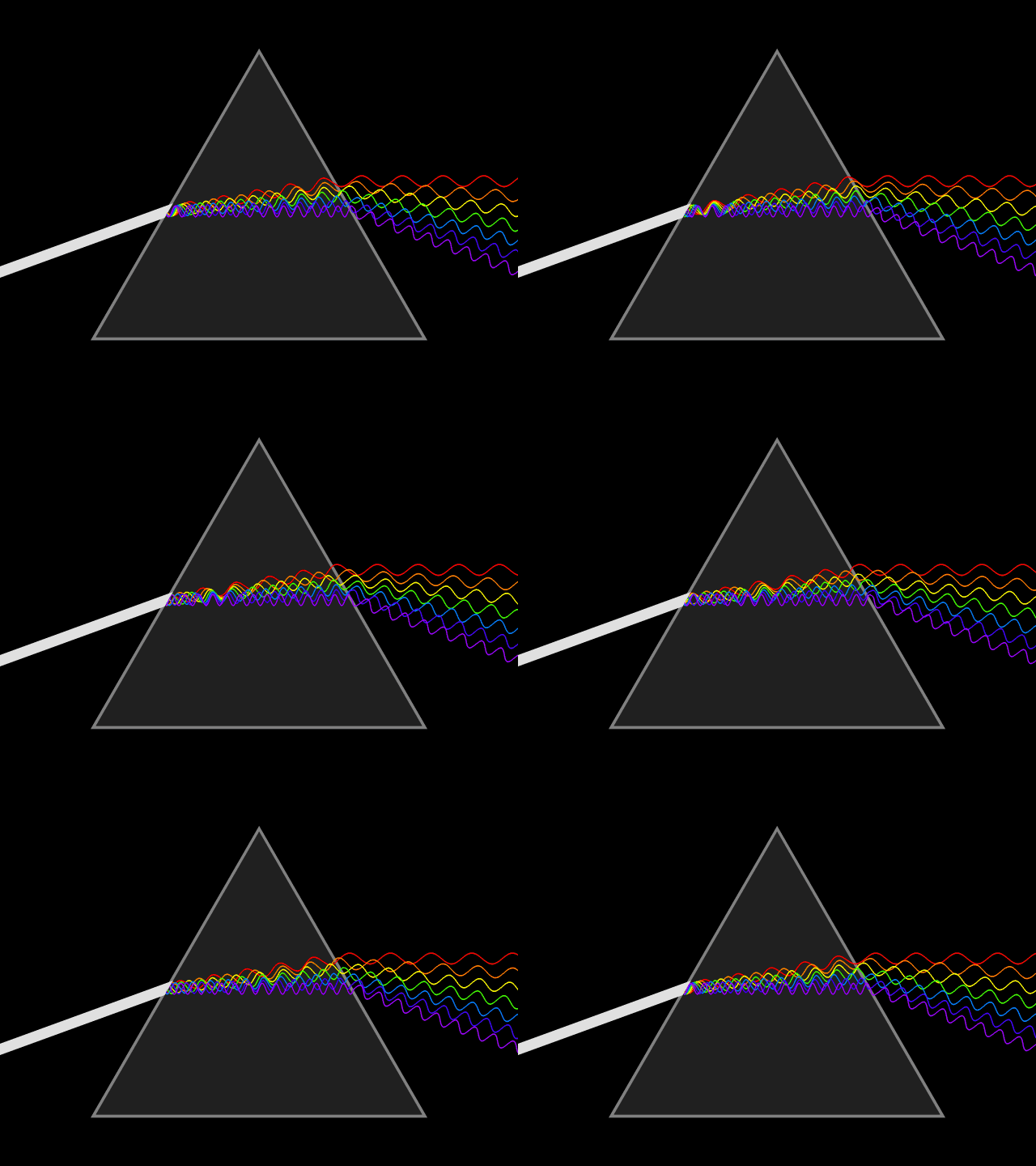
The sleeve, designed by Storm Thorgerson in response to Wright’s request for a simple and bold design that would represent the band’s lighting and the album’s themes, depicts a prismatic spectrum on a black background. It has become one of the most recognised images in popular music, and it is worth noting here only in words, because the artwork itself is copyrighted and is not reproduced with this draft. The image chosen for this article instead shows the same physical idea in a different form: white light dispersed by a prism into its spectrum. That is a useful reminder of what the album does musically. It takes a single beam of experience, ordinary life, and separates it into its parts, so that each part can be seen clearly, before the whole comes together again.
Why the chart run lasted so long
A chart run of this length cannot be explained by one hit single, however strong. “Money” helped the album reach a wider audience in America, but the album’s long life came from a combination of factors that reinforced each other over time.
First, the album was made to be played as a whole. In an era when albums were becoming the main format for serious rock listening, The Dark Side of the Moon rewarded the listener who played it from start to finish. Its continuous sides, its recurring sounds, and its return to the opening heartbeat all encourage a complete listen rather than a single-track sample. That made it a natural recommendation: if you liked one part, you were likely to want the whole record.
Second, it became a reference recording. Because the production is clean, spacious, and detailed, with careful use of stereo space and sound effects, it was widely used to demonstrate hi-fi equipment and to test speakers and headphones. A record that is used to show off sound systems will keep selling to people who have just bought new equipment, and it will keep being talked about by people who care about sound quality. That is not the whole story, but it is part of why the album kept appearing in shops and in conversations long after its release year.
Third, it passed from one generation to the next. Parents played it for children, older siblings played it for younger ones, teachers and friends recommended it, and later, radio programmers kept it in rotation. Classic rock radio made it a staple, and its presence on the radio kept introducing it to listeners who had not bought it yet. Each new format also gave it a new life: vinyl, cassette, compact disc, remastered editions, and later digital and streaming versions each brought a fresh wave of buyers and listeners. A fiftieth-anniversary edition in 2023, for example, reminded a new audience that the album was still being discussed as a living work, not only as a museum piece.
Fourth, its subject matter did not date in the way that topical songs often do. The album does not depend on a particular news event, a particular fashion, or a particular technology. Time, money, conflict, death, and mental health remain relevant, and the album’s treatment of them is general enough to feel personal to different listeners at different ages. A listener who first hears it as a teenager may hear it differently at thirty, and differently again at fifty, because the pressures it describes change their meaning as life changes. That is a rare quality, and it is one of the strongest explanations for a chart run measured in years rather than weeks.
It is also important to be honest about what the chart numbers do and do not mean. The often-quoted figure of 741 weeks describes the album’s first long period on the Billboard 200, ending in 1988. That run was not entirely unbroken in the strictest sense: the album briefly slipped off the chart on occasion, and its longest uninterrupted stretch is usually given as 593 weeks, from December 1976 to April 1988. That is still more than eleven straight years. After Billboard changed its methodology in 2009 to allow older catalogue albums to compete directly on the Billboard 200 again, the album returned to that chart, adding further weeks to its total. Different totals therefore appear in different sources, depending on the date of writing and on whether they count only the original run or all appearances. The honest summary is that the original run alone was a record, and the total, however it is counted at a given date, remains extraordinary.
A walk through the album, side by side
For a new listener, it helps to hear the album as two connected movements rather than as ten separate songs. The first side begins with birth and breath, moves through travel and anxiety, confronts time, and ends with death. The second side begins with money, moves through war and human division, explores the illusion of choice, confronts mental illness, and ends with a vision of unity and shared humanity. That arc is not a story with characters in the usual sense. It is a meditation, and its power comes from the way the music carries the listener from one pressure to the next without a break.
“Speak to Me” and “Breathe” together highlight the mundane and sometimes futile elements of life, alongside the importance of living one’s own life rather than drifting. “On the Run” shifts the scene to an airport and to the rush of modern travel. “Time” warns against letting years slip by while focused only on routine, and it closes with a reprise of “Breathe”, as if returning to the starting point with new knowledge. “The Great Gig in the Sky” then faces death directly, not with words, but with a vocal performance that moves between fear, grief, and acceptance.
On the second side, “Money” opens with its famous cash-register loop and takes aim at greed with a mixture of humour and bite. “Us and Them” is slower, more spacious, and more sorrowful, contrasting ordinary people with the forces that divide them. “Any Colour You Like” is an instrumental that tackles the illusion of choice in society. “Brain Damage” looks at mental illness, and at the effect of elevating fame and success above the needs of the self, with a direct reference, in its imagery, to Barrett’s breakdown. The album ends with “Eclipse”, which brings the themes together and encourages the listener to recognise the common traits shared by humanity, before the heartbeat returns and the record fades into silence, or, for a vinyl listener, into the run-out groove.
Heard in this way, the album is not a puzzle to be solved, and it does not require knowledge of the band’s biography to enjoy. The biography adds depth, especially the shadow of Barrett, but the music works on its own terms. A listener who knows nothing about Pink Floyd can still follow the journey from a heartbeat to a heartbeat, and can still feel the shift from anxiety to reflection to a kind of sober hope at the end.
What the album changed for Pink Floyd, and for rock
Before The Dark Side of the Moon, Pink Floyd were a respected and inventive band with a devoted following, but they were not yet a mainstream commercial force on the scale they would become. The album brought international fame and wealth to all four band members: Waters, guitarist and vocalist David Gilmour, keyboardist and vocalist Richard Wright, and drummer Nick Mason. It also propelled record sales throughout the music industry during the 1970s, as a blockbuster release of the album era. Its success showed that a carefully made concept album, without a conventional pop formula, could reach an enormous audience, and that an audience would stay with a demanding record if the record respected its intelligence.
The album has since received widespread critical acclaim and is often featured in publication listings of the greatest albums of all time. It was inducted into the Grammy Hall of Fame in 1999, and in 2012 it was selected for preservation in the United States National Recording Registry by the Library of Congress for being culturally, historically, or aesthetically significant. In the United Kingdom it is certified fourteen times platinum. Those honours are not the reason people listen to it, but they confirm what listeners had already decided: this is a record that belongs in the permanent collection of popular music, not only in the charts of its own year.
It is worth distinguishing this album from the band’s later work, because the two are sometimes confused. The Wall, released in 1979, is a different kind of concept album: more narrative, more theatrical, and more directly autobiographical in its story of isolation. The Dark Side of the Moon is quieter and more universal. It does not tell the story of one character. It describes pressures that many people recognise, and it does so in a musical language that is spacious rather than confrontational. That difference is part of why the earlier album has had such a long, steady life, while the later album is remembered more for its dramatic peaks.
How to listen to it now
If you are hearing the album for the first time, the best advice is simple, and it follows from everything above. Listen to it in order, without shuffling, and without interruption if you can. Use headphones or good speakers, because much of the album’s detail lives in quiet sounds, in stereo movement, and in the spaces between instruments. Pay attention to the sounds that are not notes: the heartbeat, the clocks, the cash registers, the voices, and the way those sounds return in different contexts. Notice how the album’s two sides mirror each other, and how the ending returns to the beginning.
If you are returning to it after many years, try listening for what has changed in your own hearing. The track that once seemed mainly about travel may now seem mainly about anxiety. The track that once seemed mainly about money may now seem mainly about the choices money forces. The track about time, which can sound abstract to a young listener, often sounds painfully concrete to an older one. That shifting response is not a flaw in the album. It is the reason it has lasted. A record that means exactly the same thing at every age is a record that can be outgrown. A record that grows with its listener is a record that stays.
It is also worth listening to the album alongside its singles, but not instead of the album. “Money” works as a single, and its success in America helped the album reach people who might otherwise never have heard it. “Us and Them” works as a single too, in a slower and more reflective way. But both songs gain meaning from their place in the whole. “Money” is sharper when it follows a meditation on death, and “Us and Them” is sadder when it follows a satire on greed. The album’s design is the point, and the singles are doors into that design, not replacements for it.
Why it still matters
More than fifty years after its release, The Dark Side of the Moon is still in print, still in conversation, and still being discovered. That is not true of most albums from 1973, however good they were in their own year. The difference lies in the combination described here: a road-tested structure, a clear and universal theme, a studio production that treats sound as part of the meaning, and a listening experience that rewards a complete play rather than a quick sample. Those qualities made the album a commercial success in 1973, and they are the same qualities that kept it on the charts for more than a decade, and that keep bringing it back.
There is also a simpler, human reason. The album takes seriously the idea that ordinary pressures can become overwhelming, and that people need music that acknowledges that without sensationalising it. It does not offer a slogan, and it does not pretend that the pressures disappear. It offers a space in which to hear them clearly, to recognise them as shared, and to find, in the final track’s turn toward unity, a reason to keep going. That is a modest claim for a rock album, but it is a durable one. Fashions change, chart rules change, and formats change. The pressures do not, and neither, it seems, does the audience for an album that names them honestly.
For Past Tunes readers, the lesson of this album’s chart run is therefore not only a piece of trivia about weeks on a chart, impressive as that trivia is. It is a reminder of what a great album can do when it is built as a whole. Singles come and go. A well-made album, heard from heartbeat to heartbeat, can stay with a listener for a lifetime, and, as this record proves, it can stay on the charts for a generation as well.
Sources / further reading
- Wikipedia, “The Dark Side of the Moon”: https://en.wikipedia.org/wiki/The_Dark_Side_of_the_Moon
- Wikimedia Commons / Wikipedia file page, “Light dispersion conceptual waves.gif” (public domain, by Lucas Vieira): https://en.wikipedia.org/wiki/File:Light_dispersion_conceptual_waves.gif
- Guitar Player, “Before It Was an Album, ‘The Dark Side of the Moon’ Was a Tour”: https://www.guitarplayer.com/players/pink-floyd-the-dark-side-of-the-moon-david-gilmour
- Parade, “Iconic ’70s Album Still Holds This Record After Nearly Four Decades”: https://parade.com/news/pink-floyd-dark-side-of-the-moon-billboard-chart-record
- Best Classic Bands, “June 28, 1997: Pink Floyd ‘Dark Side’ 20 Years on Sales Chart”: https://bestclassicbands.com/pink-floyd-dark-side-sales-6-28-15555/
- The Shot, “Pink Floyd’s The Dark Side of the Moon spent 741 weeks on the Billboard 200”: https://www.theshot.com/music/pink-floyds-dark-side-moon-spent-741-weeks-billboard-200-then-vanished
- Louder, “Money by Pink Floyd – The Story Behind The Song”: https://www.loudersound.com/music/tracks-singles/pink-floyd-money
- Classic Rock Artists, “Pink Floyd – ‘Money’ (1973)”: https://classicrockartists.com/pink-floyd-money-1973/
- BMG, “The Dark Side Of The Moon Celebrates 50 Years As A Groundbreaker”: http://www.bmg.com/news/The-Dark-Side-of-the-Moon-celebrates-50-years-as-a-groundbreaker

Image credit: “Light dispersion conceptual waves” by Lucas Vieira (LucasVB), released into the public domain, via Wikimedia Commons: https://en.wikipedia.org/wiki/File:Light_dispersion_conceptual_waves.gif
Leave a Reply