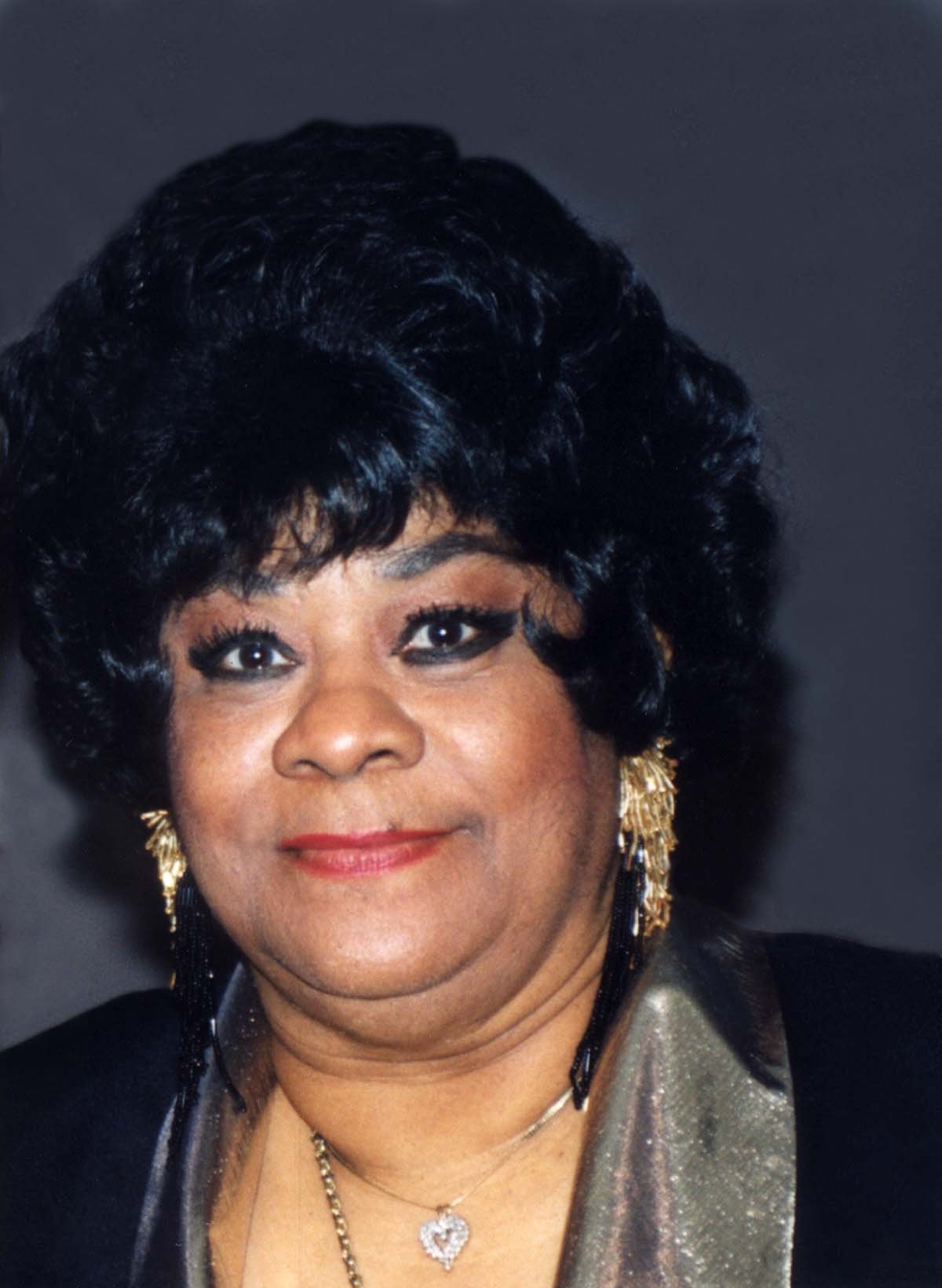

Ruth Brown was born Ruth Alston Weston on 12 January 1928 in Portsmouth, Virginia, the eldest of seven children in a family where her father directed a church choir and music was part of the household’s daily life. She began singing in church as a small child, and she learned, as many singers of her generation did, that a voice could be both a gift and a way out — out of a small town, out of limited expectations, and into a larger world. What she could not have known, as a girl singing in Portsmouth, was that her voice would help to build one of the great record companies in American history, that the company would become famous partly because of her, and that she would later have to fight that same company, in public and in court, for the money she was owed. That arc — from church choir to chart-topper to advocate for musicians’ rights — is the story of Ruth Brown, and it is one of the most important stories in the history of rhythm and blues.
Brown’s early singing was shaped by the church and by the popular music she heard on the radio. She admired singers who could be both elegant and earthy, who could sing a ballad with feeling and then turn, without embarrassment, to a song with a beat. In her teens she began singing in clubs and with local bands in the Tidewater region of Virginia, learning the practical skills of a working singer: how to hold a room, how to pace a set, how to sing over a band, and how to make a song sound fresh on the hundredth hearing. She also learned, early, that the music business was not a fair place for a young Black woman singer. Managers, promoters, and record men made promises easily and kept them selectively, and a singer who did not look after her own interests could find herself famous and broke at the same time. Brown would learn that lesson more than once, and the second time she learned it, she did something about it.
The Hospital-Bed Contract
The most famous episode in Brown’s early career is also one of the strangest. In the late 1940s, after singing in clubs and with the orchestra of Lucky Millinder, she came to the attention of Ahmet Ertegun and Herb Abramson, the founders of a small new record company called Atlantic Records. Ertegun and Abramson had driven from New York to Washington to hear her sing, and they were impressed enough to offer her a contract. There was a complication: Brown had been in a serious car accident and was in hospital, recovering, when the contract was presented to her. She signed it from her hospital bed. The story has been told many times, sometimes as a charming anecdote about a young company’s determination, sometimes as a warning about how little bargaining power a young singer had. Both readings are true. Atlantic was a small, ambitious company that needed a star, and Brown was a young singer who needed a break. The contract gave her the break, and it gave Atlantic its star. What it did not give her, as she would discover over the following years, was a fair share of the money her records made.
Brown’s first Atlantic record, “So Long”, released in 1949, reached the rhythm-and-blues top five, and her second major hit, “Teardrops from My Eyes”, released in 1950 and written by Rudy Toombs, reached number one on the rhythm-and-blues chart, where it stayed for eleven weeks. The record was a turning point in more than one sense. Musically, it was Brown’s first upbeat major hit, a jump-blues number that let her show a rhythmic, playful side that her earlier ballads had only hinted at. Commercially, it made her a star. Personally, it gave her a nickname that would stay with her: “Miss Rhythm”, a name bestowed by the singer Frankie Laine, and a name that captured something real about her singing. Brown sang rhythm as if it were a natural part of speech. She did not sing over a beat; she sang inside it, and the beat seemed to answer her.
The hits kept coming through the early 1950s: “I’ll Wait for You” and “I Know” in 1951, “5-10-15 Hours” and “(Mama) He Treats Your Daughter Mean” in 1953, “Oh What a Dream” and “Mambo Baby” in 1954, and others. Between 1949 and 1955, her records spent a total of 149 weeks on the rhythm-and-blues chart, and she scored twenty-one top-ten rhythm-and-blues hits in all, including five number ones. She became, by any measure, the most successful female rhythm-and-blues singer of the early 1950s, and Atlantic became, in large part because of her, a major company. The phrase “the house that Ruth built” — a play on the nickname for the old Yankee Stadium, “the house that Ruth built” for Babe Ruth — became a common description of Atlantic, and it was not flattery. Without Brown’s records, Atlantic might not have survived its early years. With them, it grew into a company that could sign and develop other artists, build a catalogue, and eventually become one of the dominant forces in American popular music.
The Voice: Pop Feeling in Rhythm and Blues
It is worth pausing to describe what Brown actually sounded like, because her historical importance sometimes overshadows her artistry. Brown brought a pop sensibility to rhythm and blues at a time when the two were usually kept apart. She sang with clear diction, with a warm, slightly husky tone, and with a habit of bending a note or adding a small, almost spoken aside that made a song feel intimate even when the band was playing loudly. She could sing a ballad without sentimentality and a jump number without losing her elegance, and that combination made her records attractive to audiences beyond the rhythm-and-blues market. White listeners bought her records, pop radio played them, and she became one of the first Black rhythm-and-blues singers to cross over in a sustained way, not as a novelty but as a regular presence on the charts.
That crossover mattered, and it mattered in ways that went beyond Brown’s own career. In the late 1940s and early 1950s, the American record business was still largely segregated, not by law but by habit, by radio formats, and by the assumptions of record companies about who would buy what. A Black singer who could sell to both Black and white audiences challenged those assumptions, and Brown did so at a moment when the challenge was still unusual. She did not do it by abandoning rhythm and blues; she did it by bringing a pop clarity to rhythm and blues, so that listeners who had never bought a rhythm-and-blues record could hear her and understand, immediately, what the music was about. Later singers, from the girl groups of the early 1960s to the soul singers of the later decade, worked in a market that Brown had helped to open.
Brown’s stage presence matched her records. She was a confident, witty performer, with a sense of humour that came through even in sad songs, and a way of talking to an audience between numbers that made a concert feel like a conversation. She toured extensively, played the Apollo Theatre in New York and other major venues, and built a loyal audience that followed her from record to record. She was, by the mid-1950s, a star in the full sense of the word: famous, in demand, and, to the outside world, successful. Inside the business, however, the picture was less comfortable, and it would become much less comfortable still.
The Lean Years and the Reckoning
By the early 1960s, Brown’s relationship with Atlantic had ended, and her chart career had cooled. Musical fashions had changed, new singers had arrived, and Brown, like many stars of the early 1950s, found herself working less and earning less. She took acting work, sang in clubs, and, at times, struggled financially. The contrast with her earlier success was stark, and it was made starker by a fact that she and other Atlantic artists of her generation gradually came to understand: the money from their records — from sales, from reissues, from later uses — had not reached them in anything like the amounts the records had earned. Brown, who had helped to build Atlantic, found herself, in her own later account, with little to show for it in savings, and with a sense that the company she had helped to build had not looked after her.
In the 1980s, Brown decided to fight back, and she did so in a way that changed the music business. She sued Atlantic Records for unpaid royalties, and, after a long struggle, she reached a settlement. More importantly, she used the settlement and her public profile to found, in 1988, the Rhythm and Blues Foundation, a non-profit organisation designed to provide financial assistance and advocacy for rhythm-and-blues artists, many of whom were in the same position she had been in: famous in their day, neglected by the industry that had profited from them. The foundation, funded in part by money from Brown’s settlement, became a model for how artists could organise on their own behalf, and it helped to change the conversation about royalties, reissues, and the treatment of older artists. Record companies, faced with public pressure and with the example of the foundation, began to pay more attention to the artists whose catalogues they owned.
Brown’s advocacy was not an abstraction. She spoke plainly about her own experience, about the hospital-bed contract, about the years when she had earned little from records that were still selling, and about the musicians she knew who had died poor after making records that were still famous. She did so with humour and without self-pity, but also without pulling her punches. She understood that the music business, for all its glamour, was a business, and that artists who did not organise would be treated as a cost to be minimised rather than as partners to be paid. Her work with the foundation, and her willingness to sue a company she had once helped to build, made her a hero to a generation of musicians who had felt powerless in the face of record companies, and it earned her respect far beyond the world of rhythm and blues.
The Later Career: Broadway, Grammy, and Honour
Brown’s later career was, in its own way, as remarkable as her early one. She returned to recording, made albums that showed her voice had lost none of its warmth or intelligence, and won a Grammy Award in 1989 for Best Jazz Vocal Performance, Female, for her album “Blues on Broadway”. She also became a successful stage actress, winning a Tony Award in 1989 for her performance in the Broadway musical “Black and Blue”, a revue that celebrated the music of her generation. She appeared in films and television, including a memorable role in the film “Hairspray”, and she became a familiar figure to audiences who had never bought a rhythm-and-blues record in the 1950s. She was inducted into the Rock and Roll Hall of Fame in 1993, an honour that recognised not only her records but her place in the history of American popular music.
Through all of this, Brown remained, in interviews and in performance, the same singer she had always been: direct, funny, and unwilling to pretend that the music business was fairer than it was. She talked about her early years with affection and with candour, about the excitement of making records that people loved and about the disappointment of discovering how little of the money had reached her. She also talked, with pride, about the foundation and about the artists it had helped, and she made it clear that she regarded that work as part of her legacy, not as a footnote to it. When she died on 17 November 2006, at the age of seventy-eight, she was remembered not only as the Queen of Rhythm and Blues and as Miss Rhythm but as a fighter for musicians’ rights, a woman who had built a company, lost a fortune, and then helped to change the rules for everyone who came after her.
To listen to Brown today is to hear a singer who understood, earlier than most, that rhythm and blues and pop were not separate worlds but parts of a single American music, and who sang accordingly. Her records from the early 1950s still sound fresh, not because they were ahead of their time in any technical sense but because they were made with a singer’s intelligence: clear words, a steady beat, a voice that knew when to push and when to hold back. And her later life adds a second reason to remember her. Ruth Brown did not only make great records; she made it harder for the music business to forget the people who made them. The house that Ruth built eventually had to pay Ruth, and, because she fought for it, it had to pay others too. That is a legacy that outlasts any single hit, and it is why Brown’s story belongs not only in the history of rhythm and blues but in the history of American labour, fairness, and art.
Sources / further reading
- Reference entries on Ruth Brown (1928–2006), Atlantic Records, “Teardrops from My Eyes” (1950, 11 weeks at rhythm-and-blues number one), and “the house that Ruth built”.
- KSUT / NPR Music: “Forebears: Ruth Brown, The Fabulous Miss Rhythm”.
- Rhythm and Blues Foundation: founding in 1988, following Brown’s Atlantic settlement.
- Grammy Awards (1989, Best Jazz Vocal Performance, Female, “Blues on Broadway”) and Tony Awards (1989, “Black and Blue”); Rock and Roll Hall of Fame induction, 1993.
Image credit: Image: Amin Asbaghipour via Pexels, free licence (thematic piano image, not a photograph of Ruth Brown).
Leave a Reply