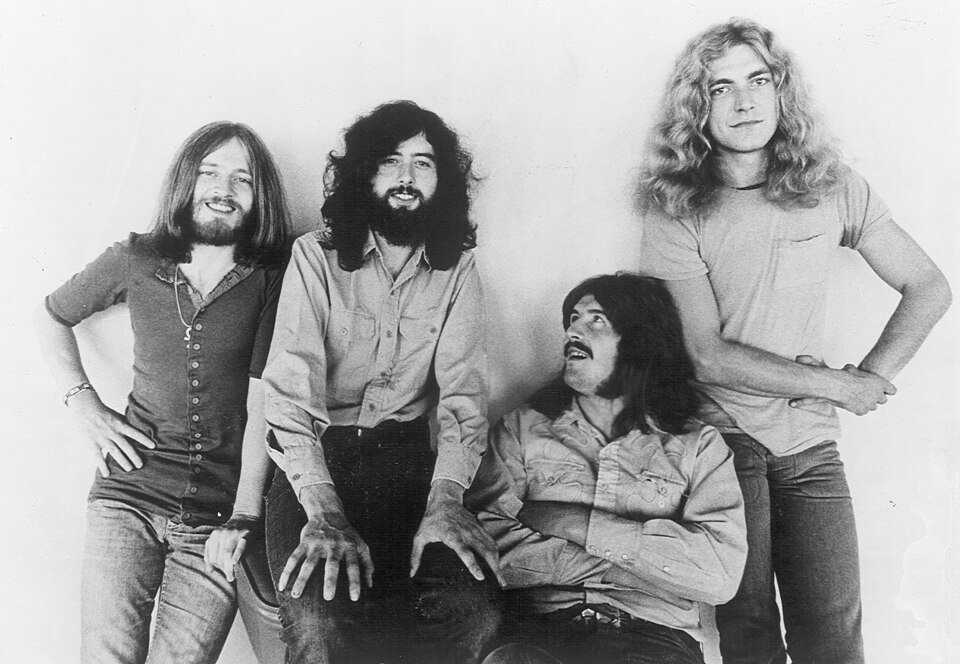
“Stairway to Heaven”: The Song That Was Never a Single and Conquered the World Anyway
On the night of March 5, 1971, in the Ulster Hall in Belfast, Led Zeppelin played a song nobody in the audience had ever heard. It began with a lone acoustic guitar, fingerpicked, delicate — so quiet that the crowd, expecting the hammer of the gods, barely knew what to make of it. Eight minutes later it ended in a full-tilt hard-rock assault, Jimmy Page ripping through one of the most famous guitar solos ever recorded while Robert Plant screamed about a bustle in a hedgerow. The Belfast audience applauded politely. They had no idea they had just witnessed the debut of the song that would become the most-played rock song in radio history — a song that was never released as a single, that its own singer would come to resent, that would be accused of hiding satanic messages and of stealing its opening notes, and that would end up at the center of one of the longest copyright trials in music history.
“Stairway to Heaven” is rock’s great paradox: the biggest song by the biggest band of the seventies, built from the quietest beginnings imaginable. It was written in a Welsh cottage with no electricity, finished by a fireside in a drafty Hampshire mansion, and recorded in pieces across two studios. It made Led Zeppelin immortal and then haunted them for the rest of their lives. This is how it was built — and what it cost.
The Cottage with No Electricity
It was April 1970, and Led Zeppelin were exhausted. They had just completed their fifth North American tour in less than two years, a punishing schedule that had made them the biggest live draw in rock and left them running on fumes. Robert Plant invited Jimmy Page to stay at Bron-Yr-Aur, a remote eighteenth-century cottage in Montgomeryshire, mid-Wales, that Plant’s family used. The cottage had no electricity and no running water. The setting, Page would later say, was sublime.
Page had an idea he had been carrying for a while: an epic composition that would, in his words, “unravel in layers as the song progressed.” He wanted to write the ultimate showpiece, a song that would begin fragile and end in a full-blown assault — a journey from acoustic folk to electric thunder that would encapsulate everything Led Zeppelin could do. He always kept a cassette recorder around, and at Bron-Yr-Aur he began working through guitar pieces, recording fragments, assembling the architecture in his head. “I wrote the music over a long period,” Page said, “the first part coming at Bron-Yr-Aur one night.”
The timing was no accident. The band’s third album, Led Zeppelin III, released in October 1970, had been the product of that same Welsh retreat — a record that shocked fans expecting more hammer-of-the-gods bombast by leaning into acoustic folk, Celtic mysticism, and quiet. Critics had been lukewarm; the band had been defiant. But the acoustic turn had opened a door. Page had discovered that quiet could be as powerful as loud, that a fingerpicked guitar in a cottage with no electricity could hit harder than a Marshall stack. “Stairway to Heaven” was his plan to prove it on the grandest possible scale: not a folk song and not a rock song, but a song that contained both, and the journey between them.
The writing continued at Headley Grange, a huge, drafty Victorian former workhouse in East Hampshire that the band would use as a residential studio. Page had been taken with the idea of a band living and recording in the same place, away from the clock-watching formality of a London studio. The Rolling Stones’ mobile recording unit was parked outside. The drums sounded enormous in the stone hallways — that room sound would become part of the legend. And it was there, one evening, that the song’s second miracle happened.
The Pencil Moves by Itself
Page was strumming the chord sequence he had been developing, running the band through the sections, working out the order of what he called the “gear shifts” — the moments the song would change size and shape. Plant was sitting on the floor, back against the wall, with a pencil and paper. He was, by his own account, in a very bad mood. And then, as Page played, something happened that Plant has described the same way for fifty years: his hand started writing on its own.
“I was sitting next to Jimmy in front of the fire at Headley Grange,” Plant later recalled. “He’d written this chord sequence and was playing it to me. I was holding a pencil and paper and suddenly my hand is writing the words ‘There’s a lady who’s sure all that glitters is gold…’ I sat there, looked at the words and almost leaped out from my seat. Looking back, I suppose I sat down at the right moment.”
Page remembered it too, vividly. “Robert’s writing his lyrics, and it’s almost like he’s channelled the damn thing,” he said. “I remember vividly Robert was sitting on the floor, back against the wall, writing, while this was going on. We had another couple of run-throughs and then he walks over and he starts singing along. From my recollection he had a good 90% of it then.” Page has always maintained that a huge percentage of the lyrics were written there and then, in that single sitting by the fire — the lady and her stairway, the signs on the wall, the piper calling to join him, the May Queen, the bustle in the hedgerow, all of it pouring out in one sustained rush of rustic mysticism and Arthurian imagery.
Plant’s own explanation of what he had written was characteristically earthy. The opening, he said, “was some cynical aside about a woman getting everything she wanted all the time without giving back any thought or consideration. The first line begins with that cynical sweep of the hand… and it softened up after that.” The singer had been reading widely — Lewis Spence’s books on Celtic magic, Tolkien, the whole countercultural library of runes and folklore — and the lyrics came out steeped in that world. Others have read the song as being about the drug culture, about spiritual seeking, about the music business itself. Plant has spent five decades answering questions about the words, and his most honest answer may be the one he gave years later: “Depending on what day it is, I still interpret the song a different way — and I wrote the lyrics.”
The Four Alchemists
What makes “Stairway to Heaven” more than a Page-and-Plant showcase is that all four members of Led Zeppelin are essential to it, each arriving at exactly the right moment. John Paul Jones, the band’s quiet multi-instrumentalist, gave the song its ancient atmosphere: the recorders that float through the opening, the electric piano that thickens the middle, the bass that anchors the end. “I picked up a bass recorder and played a run-down riff which gave us an intro, then I moved into a piano for the next section, dubbing on the guitars,” he recalled — a modest description of the part that makes the song’s first two minutes sound like something unearthed from another century.
John Bonham, for his part, does something extraordinary: he waits. The most powerful drummer in rock sits out the entire first movement, entering only when the song needs weight, and then building with terrifying patience — no flash, no fills for their own sake, just momentum, until the final section where he becomes a force of nature. The drum sound itself is part of the legend: Bonham’s kit set up in the stone hallway of Headley Grange, the natural reverb of the old workhouse captured by the Rolling Stones’ mobile unit, giving every hit the sound of thunder in a cathedral. It is the same room sound that would define “When the Levee Breaks,” and it has never been duplicated.
And Page, producing as well as playing, assembled it all with an arranger’s patience — acoustic twelve-string and six-string layered in the middle section, the electric entrance timed to the exact bar where the song needs to detonate. He wanted, he once explained, the instruments themselves to have a “vocal” quality, to sing even where Plant was silent. Listen to the guitar solo that way and it makes sense: it is not a display of technique but a second voice, answering the lyric’s questions with sound instead of words.
Building the Layers
Recording began in December 1970 at Island Records’ new Basing Street Studios in London. The band’s approach was as architectural as Page’s original concept: the song would be built in three great movements, each larger than the last. It opens with Page’s fingerpicked acoustic guitar, alone and unaccompanied, playing the now-immortal descending figure. Then John Paul Jones enters with recorders — “I picked up a bass recorder and played a run-down riff which gave us an intro, then I moved into a piano for the next section, dubbing on the guitars,” Jones recalled — and the song’s folk-mystical first movement takes shape around Plant’s hushed vocal.
The second movement brings in the full band: John Bonham’s drums, Jones’ bass and electric piano, twelve-string electric guitars, the tempo and the temperature rising together. And then the third movement — the gear shift Page had been planning since Bron-Yr-Aur — detonates. The acoustic world falls away entirely and the song becomes a hard-rock juggernaut, Page’s guitar solo screaming over Bonham’s thunder while Plant, no longer hushed, testifies at full voice. Page returned to Island Studios separately to record that solo, the most famous eight bars of his career, and then the song ends as abruptly as it began: a final crashing chord, a beat of silence, and Plant’s quiet coda — “And she’s buying a stairway to heaven.”
The whole thing runs eight minutes and two seconds. It was completed with the addition of Plant’s lyrics during the Headley Grange sessions in early 1971, with Page’s solo cut back at Island. The recording process itself mirrored the song’s architecture: patient, layered, built piece by piece rather than captured live. Page, producing, was obsessive about the transitions — the exact bar where the drums enter, the exact moment the electric guitars take over — because he understood that the song’s power lived in those gear shifts, in the listener’s feeling of being carried somewhere larger. Nothing about “Stairway to Heaven” was accidental, except the lyric, which had arrived like weather. When the band’s fourth album — the untitled one, Led Zeppelin IV — was released on November 8, 1971, “Stairway to Heaven” was its centerpiece and its closing statement on side one. The album cover bore no band name and no title, only four mysterious symbols, one for each member — a gesture of defiance toward a music press the band despised. It was an album that refused to explain itself, and at its heart was a song that refused to explain itself either. The inner sleeve carried the lyrics to “Stairway” — the only song on the record whose words were printed. Page and Plant knew what they had.
The Song on Stage
From that first Belfast performance on March 5, 1971 — when the band played it live before the album was even finished — “Stairway to Heaven” became the centerpiece of every Led Zeppelin concert. It was the closing ritual, the song the audience waited for all night, the moment the show became a communion. To play it live, Page used his famous double-neck Gibson EDS-1275, switching between the twelve-string and six-string necks mid-song — an instrument that became as iconic as the song itself, inseparable from every photograph and film of the band at their peak.
The definitive filmed version comes from Madison Square Garden in July 1973, captured in The Song Remains the Same: Plant in his open embroidered shirt, Page on the double-neck, twenty thousand people in a kind of trance as the song makes its eight-minute journey. It is the performance that fixed the song in the cultural imagination — the one playing in a million dorm rooms and guitar shops ever since.
The song outlived the band. When Led Zeppelin reunited at Live Aid in 1985 — with Phil Collins and Tony Thompson filling in on drums for the late John Bonham — “Stairway” was there. When Page and Plant toured together in the nineties, it was there, sometimes rearranged, sometimes defiant. And on December 10, 2007, at the O2 Arena in London, for the Ahmet Ertegun tribute concert — the band’s first full show in twenty-seven years, with Jason Bonham on drums in his father’s place — they played it again, and for eight minutes the years fell away. Plant, who had spent decades dodging the song, sang it straight, and twenty thousand people sang it back to him. Whatever his ambivalence, in that room, on that night, the song belonged to everyone.
The Song That Ate Radio
Here is the strangest fact about “Stairway to Heaven”: it was never released as a commercial single. In an era when the single was the entire machinery of popular music, Led Zeppelin simply refused to cut their eight-minute epic down to three. Atlantic Records wanted a single; the band said no. And so the song did something no one had planned: it conquered radio anyway.
American FM rock radio, then in its freeform golden age, embraced the song’s length as a virtue. Disc jockeys could play it and take a long break. It became the most requested song in the history of rock radio, and then the most played. The numbers are staggering to contemplate: by the turn of the millennium, it had accumulated millions of radio plays, generated a reported hundreds of millions of dollars in publishing revenue, and become, by most reckonings, the most-played song in the history of American radio. Guitar publications repeatedly voted Page’s solo the greatest guitar solo of all time. The song did all of this without ever appearing on a singles chart — proof, if any were needed, that the old machinery of hits had nothing to do with what the song actually was.
It also became a burden. Plant, who had channeled the lyrics in a flash by a Hampshire fireside, grew to resent the albatross around his neck. “If you absolutely hated ‘Stairway to Heaven,’ nobody can blame you for that because it was so… pompous,” he told Q magazine in 1988. He donated money to an Oregon public radio station after its DJs pledged never to play the song again. When fans screamed for it at his solo shows, he sometimes refused, or played it in perverse rearrangements. The man who wrote “There’s a lady who’s sure all that glitters is gold” in a single inspired sitting spent the next forty years trying to outrun her.
The song attracted stranger shadows, too. In the early eighties, as the satanic-panic era reached its fever pitch, evangelists claimed that playing the record backwards revealed hidden messages — an artifact of Page’s well-known interest in the occultist Aleister Crowley, whose writings the guitarist collected and whose former home, Boleskine House, he had purchased. Plant dismissed it all with weary good humor: “‘Stairway to Heaven’ was written with every best intention,” he said. The backward-masking claims were nonsense, but they were a measure of the song’s cultural weight: it had become so large that people needed secret meanings to explain its power.
The Trial
The strangest chapter, though, was still to come — and it began with a song almost no one remembered. In 1968, the American psychedelic band Spirit released their self-titled debut album. Its opening instrumental, “Taurus,” was a two-and-a-half-minute guitar piece written by the band’s guitarist, Randy Wolfe, who performed as Randy California. It featured a descending chromatic guitar figure. Led Zeppelin and Spirit had toured together; the bands knew each other, played the same bills, and Page owned Spirit’s albums. Randy California drowned in 1997 while rescuing his son from a riptide in Hawaii. For years, musicians and fans had murmured about the resemblance between the opening of “Taurus” and the opening of “Stairway to Heaven.”
In May 2014, Michael Skidmore, the trustee of Randy California’s estate, filed a copyright infringement lawsuit against Led Zeppelin, Page, Plant, and Warner Music. The claim: that the opening of “Stairway to Heaven” was substantially similar to the opening passage of “Taurus,” and that the estate was owed a share of the song’s enormous royalties. It became the most talked-about music trial in decades.
On June 23, 2016, after a week-long trial in Los Angeles at which both Page and Plant took the stand — Page testifying that he had written the music on his own and first played it for his bandmates at Headley Grange, Plant corroborating the account — a federal jury found that Led Zeppelin had not infringed “Taurus.” Page and Plant issued a joint statement: “We are grateful for the jury’s conscientious service and pleased that it has ruled in our favour, putting to rest questions about the origins of ‘Stairway to Heaven’ and confirming what we have known for 45 years.”
But the case was not over. In September 2018, a three-judge panel of the Ninth Circuit Court of Appeals overturned the verdict, ruling that the jury had been improperly instructed — among other things, the jury had not been allowed to hear the actual recordings of either song. That was because “Taurus,” written in 1967, was registered under the old 1909 Copyright Act, which protected only sheet music, not sound recordings; the judge had ruled that the jury could compare the compositions as written, not as played. The case went to an en banc rehearing before eleven judges, and the music industry held its breath: in 2019, more than 120 artists — including members of Korn, Tool, and Judas Priest — filed a brief supporting Led Zeppelin, warning that a ruling for the estate could unleash a flood of lawsuits over common musical building blocks.
On March 9, 2020, the full Ninth Circuit upheld the original 2016 verdict: no infringement. The court also used the case to kill off the “inverse ratio rule,” a long-standing doctrine that had lowered the bar for proving substantial similarity when access to the original work was strongly shown — a ruling with consequences far beyond this one song, since, as the judges noted, proof of possible “access” via the internet is available in almost every case and proves almost nothing. In October 2020, the United States Supreme Court declined to hear the estate’s appeal. Six years of litigation were over. “Stairway to Heaven” belonged, definitively and finally, to Led Zeppelin.
Plant, who had watched the trial with a kind of weary detachment, later described the experience of sitting in the courtroom listening to lawyers dissect the song he had written by a fire in a single evening half a century earlier. There was something almost comically disproportionate about it: the most mystical, spontaneous creation of his life, reduced to sheet music and legal doctrine, defended measure by measure. But the verdict mattered, and not just to the band. It drew a line — as the judges wrote — between original expression, which copyright protects, and common musical elements like descending chromatic scales and arpeggios, which it does not.
The Weight of the Song
What is it about “Stairway to Heaven” that made all of this — the radio immortality, the resentment, the satanic panic, the six-year lawsuit — not just possible but inevitable? Partly it is the architecture: no other rock song takes the listener on such a complete journey, from a whisper to a detonation, in eight minutes. Partly it is the mystery of its making: the cottage with no electricity, the pencil moving by itself, the lyrics that arrived almost channeled. Songs that are made that way acquire auras. People sense, correctly, that something unusual happened in that room at Headley Grange, and they spend the rest of their lives trying to name it.
And partly it is the timing. “Stairway to Heaven” arrived in November 1971, at the exact moment the sixties dream was giving way to the seventies’ harder realities, and it offered something the new decade desperately needed: a song that took transcendence seriously. The lady buying her stairway, the piper calling, the May Queen — it was all slightly ridiculous, and Plant knew it, and it didn’t matter, because the feeling underneath was real. Everybody, in 1971, wanted to believe there was a stairway somewhere. The song just gave the feeling eight minutes and a guitar solo.
There is also the matter of what the song refuses to do. It never resolves its own questions. “Is there anybody out there?” Plant asks in the middle section, and the song never answers. The final line — “And she’s buying a stairway to heaven” — is sung quietly, almost as an afterthought, after the loudest music the band ever made. It is an ending that withholds as much as it gives, and that withholding is the engine of the song’s immortality. A song that explained itself would have been forgotten. A song that keeps its secret gets played forever, each listener climbing the stairs to find their own meaning at the top.
Led Zeppelin played it at nearly every show from that Belfast night in March 1971 until the band’s end. It became the closing ritual, the song the audience waited for, the moment the concert became a communion. Page’s double-neck Gibson — the instrument he used to play it live, switching between twelve-string and six-string necks mid-song — became as famous as the song itself. And when the band ended, the song didn’t. It kept playing on the radio, in guitar shops, at weddings, at funerals, in films, in the background of millions of lives, accumulating meaning the way a river accumulates stones.
Robert Plant never made his peace with it, quite. But perhaps that is fitting. “Stairway to Heaven” was never really his, not after that night by the fire. It belonged to everyone who heard it and needed it, from the first Belfast audience to the jurors in Los Angeles to the kid in a guitar shop today, working out the fingerpicking pattern note by note.
There is a final irony worth sitting with. The song that Page conceived as a showcase of everything Led Zeppelin could do — the layers, the gear shifts, the journey from whisper to thunder — ended up showcasing something none of them planned: the way a piece of music can escape its makers entirely. It escaped Atlantic’s singles department. It escaped Plant’s intentions; he has been interpreting his own lyric differently every day for fifty years. It escaped the courtroom, where lawyers tried to reduce it to sheet music and it refused to be reduced. It even escaped the band’s own ending — Bonham died in 1980, the band dissolved, and the song kept climbing anyway, eight minutes at a time, up radio towers and into films and wedding playlists and funeral services, accumulating meaning the way a river accumulates stones.
Page built the staircase. Plant climbed it in a single evening and never came all the way back down. The rest of us have been climbing it ever since — from the quietest guitar figure in rock to the loudest, from a cottage with no electricity to the biggest stages on earth, looking for whatever is waiting at the top. The song never tells us what we will find there. That is why we keep listening, and why, more than half a century after a pencil moved by itself in front of a Hampshire fire, we are still not done with the climb, not yet.
Leave a Reply