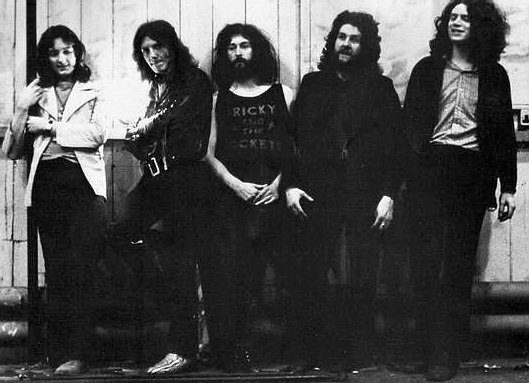
Supertramp’s music was about the distance between people — between dreamers and realists, between schoolboys and the system, between the logical song and the heart that refused to sing it. Offstage, the band lived that distance. Its two founders were opposites who never became friends. Its drummer was a Californian among Englishmen. Its saxophonist recorded a masterpiece in a toilet. And its quietest member, the gruff baritone at the Wurlitzer, turned out to be the one who held it all together the longest. This is the human story behind the harmony.
Two Boys, Two Englands
Rick Davies and Roger Hodgson could hardly have come from more different Englands. Davies was born in Swindon in 1944, a working-class kid who fell in love with the drums listening to Gene Krupa’s “Drummin’ Man” and switched to keyboards out of necessity. In 1966 he joined a band called the Lonely Ones as organist — and later confessed he had lied about his abilities to get the gig, admitting he could not actually play the organ at the time. The band became the Joint, decamped to Munich, and there caught the ear of the Dutch millionaire who would bankroll Supertramp.
Hodgson was born Charles Roger Pomfret Hodgson in Portsmouth in 1950 and raised in the world of English boarding schools, including Stowe. His parents divorced when he was young; his guitar became his best friend. He began writing songs at twelve, and the Beatles convinced him that pop music could be art. Where Davies was earthy, bluesy, and sardonic, Hodgson was airy, spiritual, and yearning. They answered the same classified ad in Melody Maker in August 1969. They needed each other musically from the first rehearsal. Socially, by Hodgson’s own admission, they never bonded at all.
The Decade of Harmony
For ten years — the classic lineup years, 1973 to 1983 — the mismatch worked like magic. Davies’s barking Wurlitzer and Hodgson’s floating tenor, Davies’s “Bloody Well Right” and Hodgson’s “Dreamer,” Davies’s “Goodbye Stranger” and Hodgson’s “The Logical Song”: the contrast was the band’s genius. They wrote separately, sang separately, and credited everything jointly, Lennon-McCartney style. Onstage, for two hours a night, the two voices that never got along were in perfect harmony.
The men between the voices made it possible. John Helliwell, the saxophonist and woodwind player, was the band’s resident wit and warmth — the extrovert who could talk to anyone, the showman who gave Supertramp its visual life. Bob Siebenberg, the American drummer from California, was the outsider who became the backbone, his steady, musical drumming the foundation the perfectionists built on. Dougie Thomson, the Scottish bassist, held the low end with quiet reliability. They were not the songwriters, but they were the band — the five people in the room, no click tracks, no splicing, that made “Breakfast in America” sound human.
Rick’s Other Life
If Hodgson was the dreamer, Davies was the realist who never stopped being a musician’s musician. Offstage, he was warmer than his sardonic stage persona suggested — loyal, funny, and devoted to the R&B and blues roots that had made him pick up keyboards in the first place. His wife Sue, who managed Supertramp from 1984 on, was his partner in every sense, and their home on Long Island became his sanctuary.
Davies never stopped playing. When Supertramp was not on the road, he gigged locally with a small R&B outfit called Ricky and the Rockets, turning up at intimate venues like the Stephen Talkhouse in Amagansett — the rock star as weekend bar-band keyboardist, clearly in his element. It was the same impulse that had made him lie his way into the Joint all those years ago: he just wanted to play. The Wurlitzer bark, the gruff baritone, the jazz-inflected piano — that was not a persona. That was Rick Davies.
Roger’s Sabbatical
Hodgson left Supertramp in 1983, and his reasons were the opposite of the usual rock-star exit. He did not leave for money or ego. He left to raise his two children. After the band’s stellar success, he decided that being a present father and being a rock star were incompatible, so he chose his family — moving them to a healthy home in California, away from the music industry, in a clean environment. They did a lot of homeschooling in a house that was totally solar-powered and off the grid. As he later put it, he was green before it became fashionable.
The sabbatical was also spiritual. Hodgson had been on a private quest for years — the boarding-school Christianity that never made sense to him, the longing for God and love that poured into songs like “Lord Is It Mine” and “Child of Vision.” He lived in a spiritual community for a while, studied Native American teachings, did retreats. He turned vegetarian back in the seventies, when everyone in England thought he was crazy, and found in California a place where he could be who he wanted to be.
He did not stop making music. His 1984 solo debut, “In the Eye of the Storm,” was recorded over seven months at his own 58-track home facility, Unicorn Studio, in Nevada City, California — and it was a solo endeavor in the truest sense: Hodgson wrote, arranged, sang, produced, and played all the instruments himself, with only a handful of guests. He has toured the world ever since, solo and with band or orchestra, and he still closes his shows with “Give a Little Bit” — the song he wrote as a teenager, inspired by the Beatles’ “All You Need Is Love,” the idealism of the sixties still alive in him.
The Feud That Never Healed
The saddest part of the human story is the one the music could not fix. When Hodgson left in 1983, the two founders made a verbal agreement, witnessed by the band: Davies would keep the Supertramp name, and his band would not play Hodgson’s songs. For about five years, Davies honored it. Then, as audiences thinned, the Davies-led Supertramp began performing Hodgson’s hits with other singers, and Hodgson called it a betrayal — the thing that, in his words, “hurt very deeply” and scuttled every chance of a reunion.
They spoke over the years. They discussed working together. But as Hodgson put it, “it seems to go from bad to worse” — a royalty dispute over their 1977 publishing agreement even reached the US federal appeals court in 2025. They never shared a stage again. The two voices that had been in perfect harmony for a decade could not manage a single conversation. It is the oldest story in rock and roll, and it never gets less sad.
The Drummer’s Son
One of the loveliest footnotes in the Supertramp story is what happened to the drummer’s kid. Bob Siebenberg’s son, Jesse Siebenberg, grew up around the band — the child of the classic lineup era, raised on the road and in the studio. And then, in the most natural succession imaginable, he became a member of Supertramp himself, joining the Davies-led lineup on keyboards, percussion, and vocals. Father and son, sharing a stage in the band the father had helped make famous.
It is the kind of story that does not happen often in rock, and it says something about what Supertramp was at its best: not just a band but a family business, a place you could grow up in. The Siebenbergs, father and son, drumming and singing their way through the same songs, decades apart. Rick Davies, who had believed in Bob Siebenberg since the seventies, ended up believing in his son too.
The Warmest Voice in the Room
If you ask the band’s fans who the heart of Supertramp was, many will not say Davies or Hodgson. They will say John Helliwell. The saxophonist was the band’s ambassador to the audience — the witty, theatrical, endlessly entertaining presence who turned concerts into events and interviews into comedy shows. While the two songwriters brooded, Helliwell charmed. While they feuded, he stayed friends with everybody.
That warmth was not an act. Through every lineup change, every lawsuit, every canceled tour, Helliwell remained the constant — the man who had recorded in a toilet in 1978 and was still there decades later, sax in hand, making people laugh. Dougie Thomson, the quiet Scot on bass, played the same role in his own way: steady, uncomplaining, the reliable low end in every sense. The band’s history is usually told as the story of two geniuses who could not get along. It is just as much the story of three musicians who could — and did, for fifty years.
The Illness and the Farewell
Davies kept Supertramp alive through the eighties, nineties, and 2000s — the final studio album, “Slow Motion,” arrived in 2002 — and mounted a fortieth-anniversary tour in 2010 without Hodgson. The band’s last performance came in Madrid in 2012. Then, in 2015, a planned tour was canceled when Davies was diagnosed with multiple myeloma, a rare blood cancer. He fought it with the same resilience he had brought to everything, even returning to live performance in 2022.
On September 6, 2025, Rick Davies died at his home in East Hampton, New York. He was eighty-one. The tributes noted his warmth, his resilience, and what the band’s statement called his “unmistakable touch on the Wurlitzer” — the barking electric piano that had been Supertramp’s heartbeat from the first note to the last. Sue, his wife of decades and the band’s longtime manager, was by his side, as she had been for everything.
What Remains
What remains is the music — and the strange, moving fact that it outlived every feud. Hodgson still tours the world singing the songs he wrote as a young man, closing with “Give a Little Bit,” giving audiences, as he puts it, “a bit of hope and joy.” The Davies-led Supertramp’s records still sell. “The Logical Song” is still quoted in classrooms, a delicious irony for a song attacking the education system.
And the five people in the room are still there on the tapes: Davies’s Wurlitzer, Hodgson’s twelve-string, Helliwell’s sax (recorded in a toilet, immortal forever), Siebenberg’s drums, Thomson’s bass. They were opposites who made each other great — the dreamer and the realist, the Englishmen and the Californian, the perfectionists who spent nine months making forty-six minutes of joy.
Supertramp’s story is really two stories: the music, which was perfect, and the people, who were human. Rick Davies, the Swindon kid who lied his way into a band and ended up holding one together for forty years. Roger Hodgson, the boarding-school boy who traded arenas for a solar-powered house and his children’s childhoods. The saxophonist, the drummer, the bassist — the men between the voices. Put on “Breakfast in America” today and none of the bitterness matters. For forty-six minutes, they are all in the same room again, playing together, no click tracks, no splicing. That was the trick all along. That was the band.
Leave a Reply