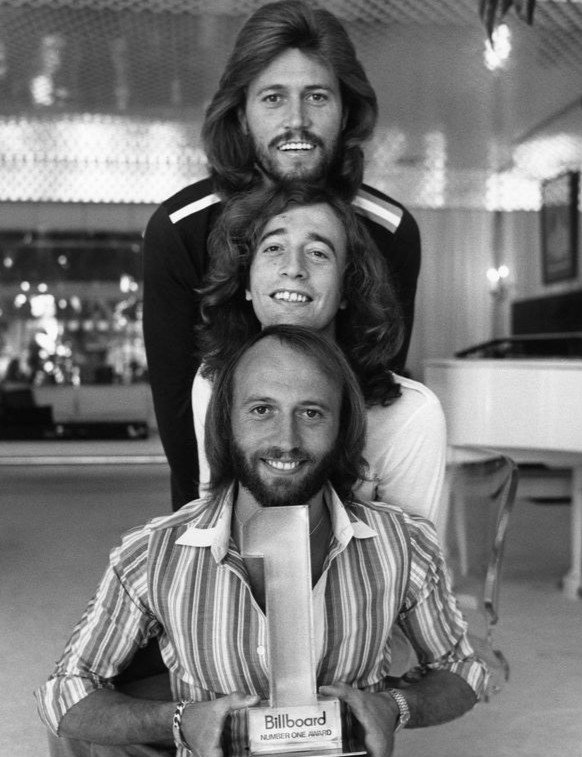
The Ballad Written for Someone Else: How “How Deep Is Your Love” Became the Bee Gees’ Tender Masterpiece
“I know your eyes in the morning sun, I feel you touch me in the pouring rain.”
Of all the records the Bee Gees made at the peak of their powers — the strutting falsetto of “Stayin’ Alive,” the four-on-the-floor thunder of “Night Fever” — the one that has outlasted them all is the quietest. “How Deep Is Your Love” is barely a disco record at all. It’s a ballad: a slow, breathing, almost whispered confession, carried on Barry Gibb’s aching falsetto and the blood-harmony of three brothers, with an electric piano figure that falls like rain on a windowpane. It topped the Billboard Hot 100 on Christmas Eve, 1977, stayed there for three weeks, and then did something no single had ever done: it lingered in the Top 10 for seventeen weeks, a record of endurance that stood for years. It won a Grammy. It survived a plagiarism lawsuit that went all the way to a federal appeals court. And it was, by every account, never meant for the Bee Gees to sing at all.
The song was written in France, in the small hours of the morning, for a woman’s voice — Yvonne Elliman, the Mary Magdalene of “Jesus Christ Superstar,” one of the stars of the Bee Gees’ own RSO Records roster. It took a phone call from their manager to change its fate. This is the story of how a ballad meant for someone else became the most beloved thing three brothers ever recorded: the French château, the night session, the demo cut between midnight and dawn, and the movie that almost didn’t want them.
The Château and the Phone Call
To find the beginning of “How Deep Is Your Love,” you have to go to a nineteenth-century château in the French countryside. In early 1977, the Bee Gees — Barry, Robin, and Maurice Gibb — were settled in at the Château d’Hérouville studios outside Paris, the storied residential studio where Elton John had recorded “Honky Château” and David Bowie had cut “Pin Ups.” They had just finished mixing their live album, “Here at Last… Bee Gees… Live,” and had begun work on the follow-up to their 1976 studio breakthrough, “Children of the World.” The plan was simple: make another Bee Gees album, the way they’d always made them.
Then the phone rang. On the other end was Robert Stigwood, their manager and the head of RSO Records — and a film producer. Stigwood was in the middle of producing a low-budget movie based on a 1976 New York magazine article by the British writer Nik Cohn, “Tribal Rites of the New Saturday Night,” a reported piece about the disco subculture of Brooklyn. The film would become “Saturday Night Fever,” directed by John Badham and starring a young John Travolta as Tony Manero, a working-class kid who lives for the dance floor. But at the moment Stigwood called, the Bee Gees knew almost none of that. What Stigwood needed was music — four new songs, on short notice, for a picture that was already in motion.
Barry Gibb would later say, in the authorized biography written by David Leaf, that the brothers had never seen a script. “(Robert) said, ‘It’s about a bunch of guys that live in New York,’” Barry recalled. Maurice put it even more plainly: “So that’s all we knew, except it was John Travolta playing the part.” They hadn’t seen the film, barely knew what it was about, and, as Billboard would later note, they hadn’t even been told there was a love scene in it. They simply assumed a movie about young people in New York would need one — and they wrote accordingly.
The first song they wrote after Stigwood’s call was “How Deep Is Your Love.” Not “Stayin’ Alive.” Not “Night Fever.” The ballad came first. Working alongside their longtime keyboard player Blue Weaver and co-producer Albhy Galuten, the brothers began sketching the new material in the château’s studios, and the tenderest song in the pile was the one that arrived earliest. It was written, by all accounts, with astonishing speed — the melody flowing out of Barry as he sat at the keyboard with Weaver, the three brothers’ harmonies locking in the way only siblings’ voices can, that phenomenon musicians call blood harmony. Nobody in the room that week knew they were writing the centerpiece of the biggest soundtrack of the decade. They were just trying to give Stigwood his four songs.
He got five. Stigwood flew to France a couple of weeks later, heard the rough demos — including the new batch the brothers had cut in about two and a half weeks — and, in Maurice’s words, told them they’d hit the nail right on the spot. When Stigwood left the château, he carried the rough mixes back with him. The Bee Gees stayed in France, working, while “Saturday Night Fever” was being shot in the United States. The songs would travel across the Atlantic on tape, ahead of the brothers themselves.
The Song That Belonged to Yvonne
Here is the detail that still stops people cold: “How Deep Is Your Love” was not written for the Bee Gees to sing. It was written for Yvonne Elliman.
Elliman was, in 1977, one of the most gifted voices in Stigwood’s orbit. A Hawaiian-born singer, she had originated the role of Mary Magdalene in the “Jesus Christ Superstar” concept album and carried it to Broadway and to film, giving the world the aching “I Don’t Know How to Love Him.” She had spent the mid-1970s touring as a backup singer with Eric Clapton. She was an RSO artist — and her husband, Bill Oakes, was the president of Stigwood’s RSO Records. When the Bee Gees wrote the ballad in France, they heard her voice on it. It was, in their minds, her song: a woman’s confession of devotion, tender where the rest of the soundtrack would be swaggering.
Stigwood heard the demo and disagreed — completely, and instantly. In “The Ultimate Biography of the Bee Gees,” he is quoted telling the brothers: “You’ve got to do this song yourself, you should not give it to anybody.” His reasoning, as Billboard later reported, was that the song was better suited to the male trio’s voices — that the blood-harmony of the three brothers would do something no solo voice could. The Bee Gees argued, or at least hesitated. Then they did what Stigwood said. It was the right call, and one of the most consequential A&R decisions of the decade — the kind of producer’s instinct that looks obvious only in hindsight.
Elliman did not go home empty-handed. The Bee Gees had written another song for the film, “If I Can’t Have You,” and that one she did get to sing. Her version — soaring, wounded, unmistakably hers — became one of the soundtrack’s defining tracks, and when it was released as a single it went all the way to number one on the Billboard Hot 100 in 1978. So the “Saturday Night Fever” soundtrack ended up carrying two Bee Gees-penned ballads about the outer limits of love: one sung by the brothers who wrote them, one by the woman who was supposed to sing the first. History, in this case, was generous to everyone.
But imagine the alternate timeline for a moment. Imagine “How Deep Is Your Love” as an Yvonne Elliman record — a fine, soulful single, probably a hit, certainly beautiful. It would have been a good song. What it would not have been is the record we know: three brothers breathing the same air into the same microphone, Barry’s falsetto floating above Robin and Maurice like a kite on a string, the whole thing held together by the invisible physics of family. Stigwood understood something the brothers didn’t yet fully grasp about themselves — that their greatest instrument wasn’t any one voice, but the blend.
The Night Session at the Château
The way the song was actually built is one of the best-documented recording stories of the seventies, thanks largely to Blue Weaver, the keyboardist who sat at the piano through most of it. According to Weaver’s own account, the demo was made at the Château d’Hérouville in the dead of night. “We started work about 12 o’clock maybe one o’clock in the morning,” he recalled, “and that demo was done at about three or four o’clock in the morning.” Albhy Galuten played piano on that demo — Weaver, by his own cheerful admission, had either drunk too much or gone to bed. He woke the next morning, listened back to what they’d captured in those small hours, and began layering: strings, textures, the architecture of the arrangement. “Then we actually recorded it for real in Criteria,” he said. “The chords and everything stayed the same, the only thing that changes from that demo is that when we got to Criteria, I worked out the electric piano part which became the basis of the song.”
That journey — demo in a French château at 3 a.m., finished record at Criteria Studios in Miami — is the song’s secret geography. The bones of “How Deep Is Your Love” were cut in the middle of a French night by exhausted men working on instinct; the flesh was added back home in Florida, where Weaver’s electric piano figure became the song’s heartbeat and lush string arrangements, orchestrated by Wade Marcus, were draped over the top like evening light. Barry Gibb worked out the melody with Weaver, though Weaver was never officially credited as a songwriter — the writing credit reads, as it does on most Bee Gees songs, Barry, Robin, and Maurice Gibb.
Barry later described the process with unusual precision. “A lot of the textures you hear in the song were added on later,” he said. “We didn’t change any lyrics, mind you, but the way we recorded it was a little different than the way we wrote in the terms of construction. A little different for the better, I think; the title ‘How Deep Is Your Love’ we thought was perfect because of all the connotations involved in that sentence, and that was simply it.”
Listen to the record with that in mind and you can hear the two rooms in it. The vocal is all intimacy — Barry’s falsetto lead, recorded close enough that you can hear him breathe, with Robin and Maurice wrapping around him in harmonies so tight they sound like a single voice splitting into three. The track underneath is all craft: that rippling electric piano, the strings swelling at exactly the right moments, a rhythm section that pushes without ever shoving. It’s a ballad built like a cathedral and sung like a whisper, and that tension — between the grandeur of the arrangement and the nakedness of the vocal — is why it still stops rooms fifty years later.
Three Voices, One Blood
There is a reason Stigwood was right and the demo’s intended fate was wrong, and it has a name musicians use with something close to reverence: blood harmony. Siblings who sing together share more than training — they share the physical architecture of their voices, the same overtones, the same resonant chambers, and when their notes lock, the blend produces a shimmer no assembled group of session singers can fake. The Bee Gees were the great modern proof of it. By 1977, Barry Gibb had emerged as the group’s lead singer, and he had spent the previous years exploring what his voice could do at the very top of its range — a falsetto that wasn’t a trick or a novelty but a second instrument, pure and aching, capable of carrying a whole song on its back.
“How Deep Is Your Love” is the fullest expression of that discovery. Barry sings the lead almost entirely in falsetto, close-miked and unguarded, and the effect is startling: a man’s voice reaching into a register we associate with vulnerability, with pleading, with the sound someone makes when they mean every word. Beneath and around him, Robin and Maurice weave the harmony — Robin’s unmistakable vibrato threading through, Maurice anchoring the low end — until the three voices merge into something that feels less like singing than like breathing in unison. No solo singer, not even one as gifted as Yvonne Elliman, could have produced that texture. It exists only between brothers.
The songwriting itself is as sophisticated as the singing. The composition is built on a foundation of major-to-minor chord changes — the harmony constantly shifting between light and shadow, resolution and longing — which is why the song feels like it’s always reaching for something just beyond its grasp. The lyric, by the Gibbs’ own admission, wasn’t drawn from any particular love story; it was built around the connotations of its title, a question rather than a statement. “How deep is your love?” isn’t a declaration. It’s an inquiry, asked in the dark, and the music’s refusal to settle comfortably into either major or minor is the sound of that question hanging in the air. Lyrically, the song is about emotional intimacy in its barest form — no story, no characters, no scene-setting, just two people and the distance between them, measured in feeling.
That’s what makes the record radical in the context of its moment. In the autumn of 1977, the charts were filling with the machine-tooled propulsion of disco — four-on-the-floor drums, orchestral stabs, euphoria as engineering. The Bee Gees would master that machinery themselves within months. But “How Deep Is Your Love” goes the other way: it slows down, strips back, and bets everything on the human voice. The strings swell, the electric piano ripples, but the center of the record is three men from Manchester and Brisbane singing like their lives depend on being believed. In a year of anthems, they released a whisper — and the whisper outsold the shouts.
The Ballad That Outran Disco
“How Deep Is Your Love” was released as a single in September 1977 — the first single issued from the “Saturday Night Fever” soundtrack, arriving before the film itself had even opened. That sequencing matters. The Bee Gees were, at that moment, a pop group with momentum but not yet a phenomenon; “Children of the World” had given them hits, but nothing had prepared the industry for what the soundtrack would do. The ballad went out first, alone, to test the water.
The water was deep. The single entered the Billboard Hot 100 on the chart dated September 24, 1977, at a modest number 83, and then began one of the most methodical climbs of the decade — up through the lower reaches in October, into the Top 10 by mid-November, and hovering near the summit through December as the film opened and the country fell under the spell of Tony Manero’s white suit. On the chart dated December 24, 1977 — Christmas Eve — “How Deep Is Your Love” reached number one, ending the ten-week reign of Debby Boone’s “You Light Up My Life.” It stayed there for three weeks, through the turn of the year, the sound of America exhaling after the holidays.
And then it did something stranger than reaching the top: it refused to leave. The single spent seventeen weeks in the Top 10 — a record at the time, a marathon of affection no one had seen before — and thirty-three weeks on the Hot 100 in total. It spent six weeks atop the adult contemporary chart, where its gentleness played perfectly, and reached number three in both the United Kingdom and Australia. It was, remarkably, the first of six consecutive American number-one singles for the Bee Gees, the opening shot of a run of chart dominance the industry had rarely witnessed.
What followed is the stuff of music-business legend. “Stayin’ Alive” went to number one in February 1978 and stayed four weeks. Then the Gibbs’ younger brother Andy hit the top with “Love Is Thicker Than Water” — co-written by Barry. Then the Bee Gees returned with “Night Fever,” then Yvonne Elliman’s “If I Can’t Have You.” Barry Gibb had a hand in writing four successive American number-one singles, a feat no songwriter in history had ever achieved. The “Saturday Night Fever” album itself spent twenty-four consecutive weeks at number one on the Billboard album chart and lingered on the chart for 120 weeks, on its way to becoming one of the best-selling soundtracks of all time.
But notice what the ballad did that the disco anthems didn’t. “Stayin’ Alive” and “Night Fever” were of the moment — brilliant, propulsive, unmistakably 1977. “How Deep Is Your Love” was outside of time. It wasn’t really a disco record at all; it was a love song that happened to be released during disco’s imperial phase, and it behaved like one, outlasting every trend around it. The seventeen weeks in the Top 10 tell the real story: this wasn’t a song people danced to and forgot. It was a song people lived inside.
Grammy Night
The industry’s verdict arrived on February 23, 1978, at the Shrine Auditorium in Los Angeles, at the 20th Annual Grammy Awards. “How Deep Is Your Love” won Best Pop Vocal Performance by a Group — the Bee Gees’ first career Grammy, as the Recording Academy itself would later note. Consider the company it beat: the nominees included Crosby, Stills & Nash, the Eagles’ “Hotel California,” Fleetwood Mac’s “Rumours,” and Steely Dan’s “Aja” — a murderers’ row of the era’s defining rock records. The ballad written in a French château at three in the morning, meant for someone else to sing, stood above them all.
The brothers were also nominated that night for Producer of the Year, alongside Albhy Galuten and Karl Richardson — recognition that the Bee Gees weren’t just singers but architects, men who built their records from the ground up. They wouldn’t have long to wait for more gold: the “Saturday Night Fever” soundtrack would win Album of the Year the following year. But the first Grammy, the one for the ballad, was the hinge. It said what the charts had already whispered: the Bee Gees were not a disco act. They were songwriters of the first rank, and “How Deep Is Your Love” was the proof.
The Lawsuit
Success, in the music business, brings lawyers. In 1983, a Chicago songwriter named Ronald Selle sued the Bee Gees, claiming they had stolen melodic material from a song of his called “Let It End” — a song he said he’d written in a single day in the fall of 1975 and copyrighted that November — and used it in “How Deep Is Your Love.” Selle had never released the song; by his own account, he’d made a home recording and sent the demo to only a few recording companies.
What happened next is one of the strangest episodes in copyright history. The case went to a jury, and the jury — swayed by technical musical analysis from Selle’s expert witness — actually found in Selle’s favor. The Bee Gees, the biggest hitmakers on the planet, had been found liable for plagiarism. For a moment, the little guy had beaten Goliath.
It didn’t last. The Bee Gees’ attorney immediately moved for judgment notwithstanding the verdict, arguing that Selle had failed to prove the one thing the law requires beyond similarity: access. Selle admitted he’d sent his demo to only a handful of companies, none of which did business with the Bee Gees. He further admitted that there were similarities between his song and several Bee Gees compositions that predated his own by years, as well as similarities to the Beatles’ “From Me to You.” The federal judge, George N. Leighton, agreed, threw out the jury’s verdict, and ruled for the Bee Gees. Selle appealed. In 1984, the Seventh Circuit Court of Appeals upheld the ruling in a decision — Selle v. Gibb, 741 F.2d 896 — that became a landmark: striking similarity between two songs, the court held, is not enough to prove plagiarism without evidence that the accused ever had access to the original.
The case left its mark on music law forever, and it left something else: a quiet vindication for the brothers. The melody that had flowed out of Barry Gibb at that château keyboard — the one Stigwood had insisted they keep for themselves — was theirs. It had always been theirs. The court said so.
In the Film: The Train and the Reckoning
For all its chart glory, the song’s most indelible home is the film it was written for — and the way “Saturday Night Fever” uses it tells you everything about what the Bee Gees had intuited without ever seeing the script. The movie is, as one critic later put it, something of a downer beneath the glitter: Tony Manero’s life is a mess of dead-end jobs, family fights, and friends spiraling toward tragedy. “How Deep Is Your Love” doesn’t score the dance floor. It scores the wreckage.
The ballad first enters the film in its darkest passage. Tony’s friend Bobby C has died, his body pulled from the water beneath the Verrazano Bridge. Tony — beaten, alienated, hollowed out — boards the subway to Manhattan to find Stephanie, the dance partner who represents the better life he can’t quite reach. Over that train ride, lost and grieving in the fluorescent dark, the Bee Gees sing. The song returns a few minutes later, when Tony finds Stephanie at her apartment and asks, with nothing left to offer but honesty, whether they can be friends. She says yes. It’s the closest the film comes to grace — and the ballad is its soundtrack.
That’s the miracle of the commission. The brothers wrote a love song for a love scene they were never told existed, for a movie they’d never seen, imagining a tenderness the film desperately needed and hadn’t known how to ask for. Stigwood’s rough outline — guys in New York, Travolta, Saturday night — was almost comically thin. The Bee Gees filled in the rest with instinct. The ballad lands in the film exactly where a ballad belongs: not at the height of the dancing, but in the quiet after, when the music has to tell the truth.
The Standard
“How Deep Is Your Love” never really left. In 1996, the British group Take That covered it for their “Greatest Hits” album and took it to number one on the UK Singles Chart for three weeks — a new generation discovering what their parents had known on Christmas Eve, 1977. Rolling Stone placed the original at number 375 on its list of the 500 Greatest Songs of All Time. And Barry Gibb himself, in a 2001 interview with Billboard, named “How Deep Is Your Love” as his favorite Bee Gees song — the one he’d keep above all the others, above the anthems and the number ones and the disco inferno.
Think about what that means. This is a man who wrote some of the most successful songs ever recorded, a catalog that defined an era. And the one he loved most was the ballad written between midnight and dawn in a French château, the one meant for Yvonne Elliman, the one his manager had to talk him into keeping. Artists are often the worst judges of their own work — except when they’re the best.
The song endures because it does the hardest thing a popular song can do: it makes intimacy feel vast. Three brothers, one falsetto, an electric piano figure worked out in a Miami studio months after the melody arrived in France — and a question, asked over and over, that never gets old: how deep is your love? The Bee Gees spent their career proving that the deepest things are often the quietest. They proved it first, and best, at three in the morning in the Château d’Hérouville, writing someone else’s song that turned out to be their own.
Leave a Reply