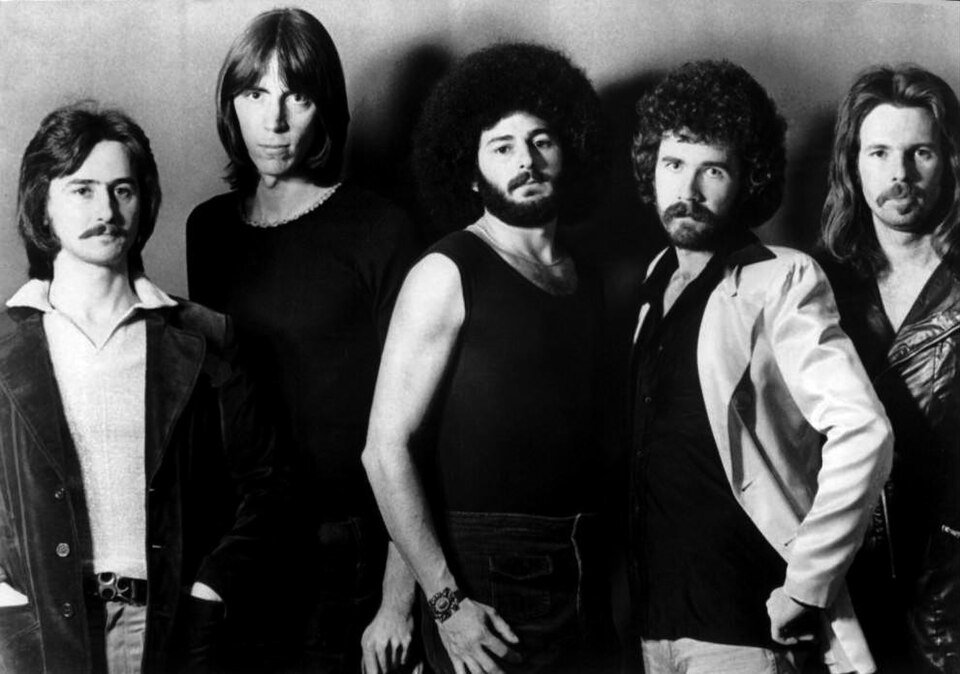
The Basement Tapes That Fooled a Record Label: How Tom Scholz Built “More Than a Feeling”
In 1975, Tom Scholz was 28 years old, working days as a senior product-design engineer at the Polaroid Corporation, and spending his nights in the basement of his rented house in Watertown, Massachusetts, building a rock record almost entirely by himself. He had sent demo tapes to two dozen record labels. Almost all of them had said no. One rejection letter — from Epic Records, no less — was so insulting that Scholz would later frame it and hang it on his wall.
A year later, the song he’d spent five years perfecting in that basement would be the biggest rock debut of the decade. “More Than a Feeling” — all chiming acoustic guitars, stacked harmonies, and one of the most recognizable choruses ever recorded — peaked at number five on the Billboard Hot 100 and launched an album that has sold more than seventeen million copies in America alone. Fifteen years after that, the most important rock musician of his generation would admit, on the record, that his generation-defining anthem was built on its riff.
And here’s the part the record label never knew at the time: most of that debut album wasn’t recorded in a professional studio at all. While Epic Records believed its new signing was cutting the record in Los Angeles under professional supervision, Scholz was back in Watertown, alone in his basement, re-recording his demos on the same equipment he’d used to make them — pulling off one of the great deceptions in rock history.
This is the story of the song that took five years, two dozen rejections, one elaborate lie, and a $100 department-store guitar to become immortal.
The Engineer
Tom Scholz was not supposed to be a rock star. He was supposed to be — and, by every conventional measure, was — an engineer.
A classically trained pianist who’d grown up serious about music, Scholz had gone to the Massachusetts Institute of Technology and earned a master’s degree in mechanical engineering. In 1969, at the age of 21, he went to work for Polaroid, the Boston-based research giant, as a senior product-design engineer. It was a prestigious, well-paid, grown-up job — the kind of job parents brag about. And Scholz was good at it. He had the engineer’s mind: systematic, obsessive, unwilling to accept that something couldn’t be built better.
But at night, he went downstairs. In the basement of his rented house in Watertown, Scholz had begun assembling a recording facility — later dubbed Foxglove Studios — piece by piece, learning audio engineering the same way he’d learned everything else: by taking it apart and figuring out how it worked. While his Polaroid colleagues went home to dinner, Scholz spent his evenings layering guitars, experimenting with microphone placement, and inventing equipment to get the sounds he heard in his head. “I never thought it would be more than a hobby,” he later recalled. It was the most productive hobby in rock history.
“More Than a Feeling” was the centerpiece of those basement years — and it did not come quickly. Scholz worked on the song for roughly five years, refining it between 1968 and 1975, building it layer by layer like one of his engineering projects. The acoustic intro, the explosive power chords, the soaring chorus, the meticulously constructed guitar solo — each element was designed, tested, and revised with an engineer’s patience. Most songwriters write songs. Scholz built them.
Six Songs and Two Dozen Rejections
Scholz wasn’t entirely alone in the basement. He had two crucial collaborators: drummer Jim Masdea, a local player with a solid, unflashy groove, and a singer named Brad Delp — a soft-spoken Massachusetts native with a voice of astonishing range and sweetness, capable of floating a falsetto over walls of guitar without ever sounding strained. Delp was the human center Scholz’s mechanical perfection needed, and Scholz knew it.
By 1973, the trio had a six-song demo tape ready to mail. The songs on it would become familiar to the world: “More Than a Feeling,” “Peace of Mind,” “Rock & Roll Band,” “Something About You,” “Hitch a Ride,” and “Don’t Be Afraid” — the embryonic versions of most of Boston’s debut album, recorded in a basement on borrowed time. Scholz and his wife sent copies to every record company they could find.
The response was a blizzard of no. RCA passed. Capitol passed. Atlantic passed. Elektra passed. Epic Records — the label that would eventually sign the band — rejected the tape flatly, with what Scholz remembered as a “very insulting letter” signed by company executive Lennie Petze, opining that the band “offered nothing new.” Scholz kept the letter. He had it framed. It hangs on his wall to this day — a monument to the unreliability of expert opinion.
“I sent tapes to two dozen labels,” Scholz later laughed, “but they were rejected by almost everybody.” Undaunted, he did what engineers do: he upgraded his equipment. He purchased a pricey Scully 8-track tape machine — paid for with money earmarked for a down payment on a first home — and called Delp back into the basement for one more round of demos. Delp, who by then had a wife, rent to pay, and every reason to get on with his life, didn’t hesitate. “I had a wife and I had rent to pay and that kind of stuff,” he remembered, “but I was jumping up and down that Tom would call me to do some more tapes.”
It was, by Scholz’s own later admission, his final attempt. He was 29 years old. He’d spent the better part of a decade on these songs. If this demo didn’t work, he was prepared to give up and be an engineer full-time. He finished his sixth demo in 1975 — the same songs, recorded better, on better equipment — and sent it out into the world one last time.
This time, Epic bit. The demo tape fell into the right hands at the CBS-owned label, and in mid-1975 — after having rejected Scholz once already — Epic offered the band, then performing under the name Mother’s Milk, a recording contract. The basement tapes had done what two dozen rejections said they couldn’t. But the label had one non-negotiable condition: the album would be re-recorded professionally, in Los Angeles, with an in-house producer.
Scholz had other plans.
The Decoy
John Boylan was the producer Epic hired — a respected industry veteran tasked with turning Scholz’s basement project into a proper major-label album. He flew to Boston, listened to the demos, and reached a conclusion that must have startled his employers: the basement tapes were already good enough to release. The problem was convincing CBS of that without letting CBS watch Scholz work — because Scholz knew, with absolute certainty, that he couldn’t make this record any other way. “I’d gotten used to working alone,” he later explained. A commercial studio, with its clocks and its union engineers and its executives dropping by, would destroy the painstaking process he’d spent years perfecting.
So Boylan devised a plan — a decoy, in Scholz’s own word.
While a band was dispatched to Los Angeles — guitarist Barry Goudreau, bassist Fran Sheehan, newly hired drummer Sib Hashian, and singer Brad Delp — to maintain the appearance of proper West Coast sessions, Scholz stayed behind in Watertown. Alone in his basement, unsupervised and uninterrupted — “something CBS would not have allowed,” as Scholz wryly noted — he re-recorded the album’s backing tracks himself, playing nearly every instrument, on the same equipment he’d used for the demos. “I had to record all the songs exactly the same as they were on the demo,” he recalled. “And not only did I record it exactly the same, I recorded it on the same equipment. It was still done in a basement studio by the same person. So it was really crazy.”
The details of those sessions have become rock legend. The now-famous acoustic intro to “More Than a Feeling” — that bright, chiming 12-string figure — was played on Delp’s cheap Yamaha acoustic, a $100 guitar purchased at a suburban Boston department store, captured with a simple EV RE16 dynamic microphone. (Boylan, meanwhile, had arranged for Delp to receive a custom-made Taylor acoustic costing thousands of dollars, billed to the album budget. Scholz recorded the hit with the hundred-dollar Yamaha.) Masdea’s drum tracks were cut with nothing but a handful of Shure SM-57s — the workhorse microphones found in every club in America.
When the backing tracks were done, Boylan returned to Watertown to hear them. Then came the most audacious part of the whole operation: a remote recording truck was hired from Providence, Rhode Island, driven to Scholz’s house, and a cable “snake” was run through the basement window to transfer Scholz’s tracks to a professional 3M-79 two-inch 24-track deck. The entire album — one of the best-selling debuts in history — was thus laundered from a basement in Watertown into the professional format CBS expected, without CBS ever knowing where it really came from.
Only one element was recorded outside the basement: Brad Delp’s vocals. Weeks later, Scholz escorted the finished tapes to Los Angeles, where Delp cut his vocal overdubs at Capitol Studios’ Studio C. Every vocal was double-tracked except the lead, and Delp — singing part after part in quick succession — gave the performance of his life. A couple of songs had to be finished back in the basement when Delp struggled with his voice in the L.A. smog; Scholz carted the tapes home, recorded the fixes, and flew them back to be dubbed in from a separate analog machine. It was, from first note to last, a triumph of stubbornness over procedure.
The Voice
It’s easy, telling the story of the basement and the decoy, to make “More Than a Feeling” sound like a triumph of technology. It wasn’t. It was a triumph of a voice.
Brad Delp’s singing is the reason the song works — the human warmth at the center of Scholz’s gleaming machine. Listen to what he does: the verses, conversational and wistful; the pre-chorus, building with quiet urgency; and then the chorus, where Delp’s voice soars into a stratosphere of layered harmony, singing “it’s more than a feeling” like a man testifying. The double-tracking — every harmony part sung twice and stacked — gives the vocals a cathedral-like richness, but it’s Delp’s tone that makes it transcendent: sweet without being saccharine, powerful without ever shouting, emotional without ever overselling.
Delp was the perfect singer for Scholz’s songs because he understood what they were about. Beneath the walls of guitar, “More Than a Feeling” is a song about memory — about hearing an old song on the radio and being transported. “I looked out this morning and the sun was gone / Turned on some music to start my day / I lost myself in a familiar song / I closed my eyes and I slipped away.” It’s a song about how music collapses time, and Delp sings it like a man who’s lived inside that collapse. The nostalgia in his voice isn’t performed; it’s inhabited.
The partnership was alchemical: Scholz the perfectionist architect, Delp the effortless emotional conduit. Scholz could build the most intricate guitar cathedrals ever recorded, but without Delp’s voice floating above them, they’d be monuments without worshippers. Every great Boston song is a duet between the machine and the man — and “More Than a Feeling” is where the balance was perfect.
Anatomy of a Masterpiece
Strip “More Than a Feeling” to its structure and you find an engineer’s blueprint executed with a poet’s touch.
It opens with that acoustic 12-string figure — bright, circular, instantly memorable — played on the hundred-dollar Yamaha. Then, with a crack like a starting gun, the electric guitars detonate: huge, layered power chords, each one multi-tracked into a wall of harmonic richness that was unlike anything on rock radio in 1976. Scholz had invented much of his own equipment to get these tones, and the result was a guitar sound with unprecedented clarity and sustain — every note ringing like a bell, every chord a small explosion.
The verse pulls back, Delp’s voice floating over a leaner arrangement, building tension through the pre-chorus until the chorus erupts — “It’s more than a feeling!” — one of the most cathartic releases in rock history. Then the second verse, the second chorus, and the guitar solo: a meticulously constructed lead break that Rolling Stone would later rank among the 100 greatest guitar solos of all time. It’s not a blues wail or a speed demonstration; it’s a composition, every phrase placed with architectural precision, building to a climax that hands the song back to Delp for the final choruses.
The Hammond organ hums underneath it all, the bass — played by Scholz himself, like most of the instruments — locks in with the drums, and the whole thing gleams with a production clarity that made every other rock record of 1976 sound muddy by comparison. This was the Scholz signature: music that hit like rock but shone like pop, aggression and beauty in perfect equilibrium. Nobody had ever made guitars sound like this. A generation of producers would spend the next decade trying to figure out how he did it.
August 1976
Boston was released on August 25, 1976. “More Than a Feeling” had been issued as the lead single earlier that month. Radio — the same industry that had rejected the demos two dozen times — surrendered instantly. The song’s acoustic-to-electric detonation was unlike anything on the airwaves, and listeners responded the way they always do to something genuinely new: they called, they requested, they bought.
The single peaked at number five on the Billboard Hot 100 in the fall of 1976 — held off the top by the disco juggernauts of the moment, but outselling and outlasting most of them. It was the rare debut single that sounded like it had always existed: radio programmers added it instantly, and listeners who’d never heard of Boston suddenly knew every word of the chorus. The song’s journey from a basement demo to the Top 5 had taken the better part of a decade; its journey from release to ubiquity took about six weeks. The album kept selling. And selling. Boston would eventually be certified seventeen-times platinum in the United States — more than seventeen million copies — making it one of the best-selling debut albums in history. In 2021, Rolling Stone placed “More Than a Feeling” on its list of the 500 Greatest Songs of All Time, formalizing what rock radio had known for decades: the basement tapes had produced a monument.
Scholz, characteristically, didn’t celebrate by becoming a rock star. He remained what he’d always been: an engineer who happened to make records. He founded Scholz Research & Development, invented the Rockman — the revolutionary headphone guitar amplifier that became a studio staple — and approached Boston’s follow-up albums with the same painstaking perfectionism, to the occasional despair of his label and bandmates. The framed rejection letter stayed on the wall. He’d earned the right to look at it every day.
The Grunge Debt
Fifteen years later, in a damp rehearsal room in Seattle, Kurt Cobain played his bandmates a new riff: four power chords, loud-quiet-loud, simple as a brick through a window. It would become “Smells Like Teen Spirit,” the song that detonated the alternative-rock explosion and defined a generation.
And Cobain knew exactly where it came from. Or at least, he knew it came from somewhere familiar. “It was such a cliched riff,” he told Rolling Stone in a 1994 interview. “It was so close to a Boston riff or ‘Louie Louie.’ When I came up with the guitar part, Krist [Novoselic] looked at me and said, ‘That is so ridiculous.’” Cobain had been trying, by his own admission, to write “the ultimate pop song” — to rip off the Pixies’ soft-loud dynamics and wrap them around a hook as undeniable as anything on seventies radio. The hook he found had been living in his subconscious since childhood: the power-chord DNA of “More Than a Feeling.”
He wasn’t the only one who heard it. Billy Corgan of the Smashing Pumpkins later recalled hearing an early mix of Nevermind on producer Butch Vig’s boombox on July 4, 1991, and thinking immediately: that’s “More Than a Feeling.” Months later, at a Nirvana show in Tokyo, Corgan watched Cobain tease the opening riff of the Boston song before launching into “Teen Spirit” — a sly, smiling acknowledgment, hiding in plain sight. And at the 1992 Reading Festival, Nirvana made the joke official: the band played roughly twenty-five seconds of “More Than a Feeling” — Delp’s melody and all — before crashing into “Smells Like Teen Spirit,” to the delight of tens of thousands of fans.
For his part, Scholz was graciousness itself. Asked about the similarity in 1994, he said, “I take it as a major compliment, even if it was completely accidental.” Years later, reflecting on whether Nirvana’s quotation had been homage or mockery, he told MusicRadar: “Regardless, Nirvana was, from what I’ve heard, a great band. I was really impressed by the couple of things I heard. Regardless of what the context was, it’s an honor to be heard in the same airspace as Nirvana.”
Consider the symmetry. In 1976, the most polished, meticulously constructed rock record ever made — built by an MIT engineer in a basement — conquered the world. In 1991, the rawest, most visceral rock record of its era — built by a punk kid in Seattle — conquered the world using the same four chords. The engineer’s perfection and the punk’s fury turned out to be opposite ends of the same wire. Cobain had the honesty to admit it. Scholz had the grace to be flattered. And “More Than a Feeling” gained the rarest of distinctions: a song so fundamental that even the revolution against it had to be built on its foundation.
The Afterlife
“More Than a Feeling” never left rock radio. It couldn’t — it’s structural now, part of the format’s load-bearing walls. The song’s acoustic-to-electric blueprint became the template for a thousand power ballads and arena-rock anthems; its production clarity set a standard that producers chased for decades; its chorus remains one of the great communal sing-along moments in rock, the rare chorus that sounds bigger the more voices join in.
The song also became a kind of Rorschach test for rock’s eternal argument about authenticity. To the punks, it was the epitome of corporate rock — overproduced, impersonal, everything they were rebelling against. To everyone else, it was simply perfect: the sound of craft elevated to art. The truth, as the basement story proves, is more interesting than either caricature. “More Than a Feeling” wasn’t corporate product; it was the opposite — a handmade object, built in secret by an obsessive in a basement, smuggled past the corporation that paid for it. The punks who dismissed it as industry product were wrong about its origins. Cobain, to his credit, heard past the polish to the song underneath.
Scholz never stopped being Scholz. Boston’s later albums arrived at glacial intervals, each one fussed over for years, each one greeted by a fanbase that had learned patience. Delp remained the voice of the band until his death in 2007 — a loss that devastated Scholz and the band’s fans alike. But the debut endures, untouched by time, still gleaming from its basement birth.
The Sound That Changed Production
It’s hard, from the vantage point of the present, to grasp how alien Boston sounded in 1976 — and how completely it rewired rock production.
Rock records in the mid-seventies were, by and large, documents of performances: bands in rooms, captured with the best microphones money could buy, mixed to sound like the room. Scholz came from a different planet. He treated the recording studio the way an engineer treats a laboratory: as a place to construct something that couldn’t exist in nature. His guitars weren’t recorded; they were assembled — layer upon layer of precisely played parts, each one building on the last, until the composite sounded less like a guitar and more like a force of nature. He built much of his own equipment to get there, soldering together devices that commercial manufacturers didn’t make, chasing tones that existed only in his head.
The result was a clarity that felt almost violent. Every note on “More Than a Feeling” rings with a bell-like precision; every chord change lands with the force of architecture. Critics called it “corporate rock,” and the insult stuck — but it missed the point so completely it’s almost funny. There was nothing corporate about the record. Corporations don’t solder their own equipment in basements. Corporations don’t spend five years on a chorus. What Scholz built was closer to artisanal obsession: the handmade object, perfected in secret, that happened to conquer the mass market.
A generation of producers spent the 1980s trying to reverse-engineer what Scholz had done. The multi-tracked guitar armies, the pristine drum sounds, the vocals stacked to the sky — the entire sonic vocabulary of eighties arena rock starts in that Watertown basement. Scholz didn’t just make a hit record. He built the template for how rock records would sound for the next fifteen years, then watched the industry he’d fooled spend a fortune trying to copy the basement it never knew about.
Delp and Scholz: The Partnership
Every great studio obsessive needs a human being to keep the music breathing, and Tom Scholz found his in Brad Delp — a partnership as essential, in its way, as Rodgers and Edwards, as Ocasek and Orr.
Delp was the opposite of Scholz in almost every way: where Scholz was systematic, Delp was instinctive; where Scholz fussed, Delp flowed. But Delp shared the essential quality: total commitment. When Scholz called him back into the basement for “one more round” of demos — the sixth attempt, the last chance — Delp came running, rent and responsibilities notwithstanding. He believed in the songs the way Scholz did, and he gave them the one thing Scholz couldn’t manufacture: soul.
Listen to the Boston album as a duet between its creators and you hear the whole story. Scholz provides the architecture — the gleaming guitar cathedrals, the Hammond foundations, the rhythmic precision. Delp provides the weather — the clouds moving across the architecture, the human warmth that makes the perfection feel like feeling. Without Scholz, Delp would have been a great singer looking for great songs. Without Delp, Scholz would have been a brilliant technician with nobody to sing his blueprints. Together, they made something neither could have made alone.
It’s one of rock’s cruel ironies that the partnership ended the way it did. Delp died in 2007, and Scholz — the engineer who’d built everything to last — was left with the one thing he couldn’t fix. But the records remain, and “More Than a Feeling” remains their monument: the machine and the man, the basement and the voice, the five years and the three minutes, perfect.
The Framed Letter
There’s a coda to this story, and it hangs on a wall in Tom Scholz’s house.
It’s the rejection letter from Epic Records — the one signed by Lennie Petze, the one that said the band “offered nothing new.” Scholz framed it. He looks at it, by his own account, as a reminder: of how wrong the experts can be, of how little the industry understands the music it’s supposed to champion, of the distance between a basement in Watertown and the top of the charts.
“More Than a Feeling” took five years to write, two dozen rejections to survive, one elaborate deception to record, and a hundred-dollar guitar to launch. It was built by a man who treated songs like engineering problems and solved them like an artist. It fooled a record label, conquered radio, sold seventeen million albums, and — fifteen years later — provided the raw material for the song that killed the era it defined.
The experts said it offered nothing new. The framed letter says otherwise. So does every radio on earth — and every kid in a basement, soldering together a dream the experts can’t hear yet.
Leave a Reply