The Desert Song Written in the English Rain: How America’s “A Horse with No Name” Fooled Neil Young and Conquered America
Picture this: it is raining in England — that gray, sideways, unending English rain — and three teenagers, all of them Americans who have barely set foot in their own country in years, are huddled inside a country house trying to write a song about the desert. Not just any desert: a blazing, shimmering, bone-dry desert they half-remember from childhood road trips through Arizona and New Mexico, now summoned up like a mirage to fight off the damp.
The song they wrote was called “Desert Song.” Nobody thought much of it. The writer himself thought it was a novelty. The band thought it was corny. A record producer heard it, renamed it, and put it on the radio — and within months it was the number-one song in America, banned by some stations as a drug anthem, mistaken by millions for Neil Young, and so big it knocked Neil Young’s own “Heart of Gold” off the top of the chart.
This is the story of “A Horse with No Name” — a song that should never have worked, written by a band that shouldn’t have existed, in a country that wasn’t even theirs, about a desert most of them had barely seen.
Three Air Force Brats in London
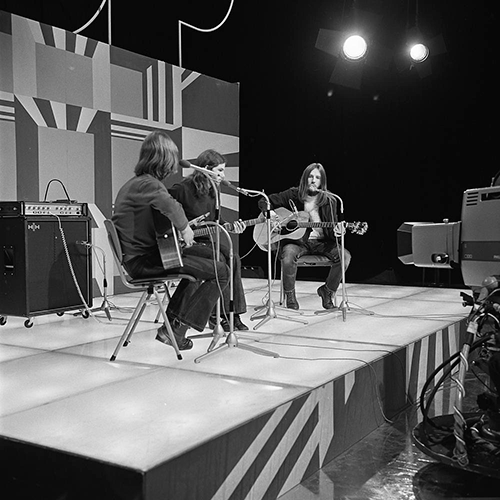
The first thing to know about America is that they were not, in any meaningful sense, from America. Dewey Bunnell, Gerry Beckley, and Dan Peek were all sons of American military personnel, and they met in the late 1960s at London Central High School in Bushey, just outside London, where their fathers were stationed. They were teenagers adrift between two cultures — American kids growing up in England, English-schooled, surrounded by British rock — and the band they formed in their late teens was an acoustic folk-rock trio gigging around London’s club circuit.
London in the late sixties was the center of the rock universe, and the three Americans were close enough to touch it but separated from it by an invisible pane of glass. They weren’t part of any scene; they were military kids playing acoustic guitars, harmonizing like Crosby, Stills & Nash because that was the music that made sense to boys who’d grown up between countries. What they had, and what no London band had, was a kind of double vision: they could write about America the way only outsiders can, with the longing of people who’d heard about a place more than they’d lived in it.
They caught the ear of concert promoter Jeff Dexter, who booked bands at the Roundhouse in London — the legendary venue where the Doors, Jefferson Airplane, and just about everyone else had played — and introduced them to a songwriter and record producer named Ian Samwell at Warner Bros. Samwell was no lightweight: he was the man who had written Cliff Richard’s debut hit, “Move It,” the record that effectively invented British rock and roll. He signed the trio to Warner Bros. and asked them to come up with some songs — especially songs that would work on the radio. The band’s eponymous debut album was recorded in London, with Samwell producing, at the famed Trident Studios — the same rooms where the Beatles and David Bowie had made history — and released in the UK at the end of 1971. But here’s the twist: the album as originally released didn’t contain “A Horse with No Name” at all. The label had been planning to release Gerry Beckley’s tender ballad “I Need You” as the lead single, but Warner Bros. asked the band if they had anything else — something more commercial, something that would fare better on radio. The band went back into the studio to demo four more songs. One of them was a sprightly, mystifying folk-rock number Bunnell had been carrying around.
It was called “Desert Song.” And Bunnell didn’t think much of it. “It was just thrown into a pile of other songs,” he later told American Songwriter. “When I first brought it to Gerry and Dan, and we were playing it, I really thought it was almost a novelty song.”
The Rain, the Paintings, and Three Chords
The song’s origins were, by Bunnell’s own account, almost comically indirect. It was written while the band was staying at the home of musician Arthur Brown (a different Arthur Brown from the “Fire” singer), near Puddletown in Dorset, England. The first two demos were recorded there by Dexter and Dennis Elliott. Bunnell later explained that the song was an attempt to capture the sensation of a hot, dry desert — the kind depicted in a Salvador Dalí painting and in a picture by M. C. Escher that featured a horse, both of which were hanging in the studio. He was also reaching back to childhood memories: when his family lived at Vandenberg Air Force Base in California, he and his brother had spent time poking around the high desert, and they’d driven through Arizona and New Mexico. He loved the cactus and the heat.
The music itself came from Bunnell messing around with open tunings on his acoustic guitar. “I tuned the A string way down to an E,” he explained, “and I found this little chord, and I just moved my two fingers back and forth, and the entire song came from basically three chords.” That two-chord shuffle — Em to D6add9/F#, for the guitarists keeping score — is the whole engine of the song: hypnotic, circular, as dry and rolling as a tumbleweed.
“I wanted to capture the imagery of the desert, because I was sitting in this room in England, and it was rainy,” Bunnell said. “The rain was starting to get to us, and I wanted to capture the desert and the heat and the dryness.” It was homesickness in reverse — a kid who’d grown up in England, longing for a desert he’d barely known, writing about it in the rain.
The band was skeptical. Before committing it to tape at Morgan Sound Studios in Willesden, London — a room Beckley already knew well, having played bass on demo sessions there a few years earlier — the members thought it sounded too corny. But Samwell — the veteran hitmaker — heard something. As they honed the song down, he said immediately, “Well, dude, you must call this ‘Horse With No Name.’” The personnel on the recording were Bunnell on lead vocals and acoustic guitar, Beckley on twelve-string acoustic guitar and backing vocals, Peek on bass and backing vocals, with session drummer Kim Haworth and percussionist Ray Cooper filling out the sound.
It’s worth pausing on what Samwell heard that the band didn’t. The debut album, cut at London’s famed Trident Studios, was a gentle folk-rock record — lovely, but with no obvious single. Warner had wanted “I Need You,” Beckley’s ballad, to lead. Samwell understood something the three teenagers didn’t: that the weirdest thing in the pile was the most commercial thing in the room. The hypnotic two-chord vamp, the wide-open lyric, the voice floating above it all — it didn’t sound like anything else on the radio, which in early 1972 meant it could sound like the future. Bunnell’s “novelty song” was, to a producer who’d written a rock-and-roll landmark in the fifties, the hit. The band argued. The producer won. The producer was right.
Bunnell later said the song carried an environmental message in its closing verses — a young man’s lament for a pristine landscape, written before environmentalism had a pop vocabulary. The desert in the song isn’t just scenery; it’s something pure that the singer is watching slip away, the way the song’s traveler watches the world recede. And the anonymous horse itself was a metaphor. “I see now that this anonymous horse was a vehicle to get me away from all the confusion and chaos of life to a peaceful, quiet place,” he said. Read that way, the song’s famous vagueness isn’t a bug; it’s the point. The horse has no name because it isn’t a horse. It’s whatever carries you out of the rain — youth, memory, music, the desert itself.
Bunnell later said the song had an environmental message at its end, and that the anonymous horse was a metaphor — “a vehicle to get me away from all the confusion and chaos of life to a peaceful, quiet place.” The lyrics that resulted — “the heat was hot,” “there were plants, and birds, and rocks, and things” — would be mocked for decades as some of the oddest phrasings in pop history. Decades later, Penn Jillette confronted the band after a show in Atlantic City about the “plants and birds and rocks and things” line; according to Jillette, their explanation was that they’d been intoxicated with cannabis while writing it. Beckley disputed that in a 2012 interview: “I don’t think Dew was stoned.” The band has generally downplayed suggestions of chemical influence, and Bunnell himself has insisted the song was written in a clear-headed attempt to bottle a landscape.
Banned in Kansas City
“A Horse with No Name” was released as the featured song on a three-track single in the United Kingdom, Ireland, France, Italy, and the Netherlands in late 1971. In the US, it arrived as a single on January 12, 1972 — and was added to the American reissue of the debut album, which had originally come out without it.
Then came the trouble. In the United States, “horse” is a common slang term for heroin. Some American radio programmers heard a song about riding a horse with no name through the desert — a horse you can’t see, that takes you away from pain (“’cause there ain’t no one for to give you no pain”) — and concluded it was a drug song. Several stations banned it, most notably WHB in Kansas City, a major Top 40 outlet whose refusal to play the record should have killed it in the Midwest.
It didn’t. If anything, the whiff of scandal helped. This was 1972: a song rumored to be about drugs carried a charge that no promotion budget could buy, and teenagers who might have ignored a gentle folk-rock single leaned in closer to hear what the fuss was about. The ban became a kind of backhanded endorsement — proof, to a generation raised on rock-and-roll moral panics, that the song must be saying something worth hearing.
Bunnell was genuinely baffled. “It’s true the song got banned from radio at one time because people said it was about heroin, which sometimes was called ‘horse,’” he told American Songwriter. “That was news to me. Living in England, I don’t ever recall that term. I think it was more of an American term. It might have been smack or dope or H.” The irony was rich: a song written by a kid who’d spent his teens in England, trying to evoke the clean dryness of the Arizona desert, was being kept off the air because Americans heard narcotics in it.
The ban didn’t matter. Or rather, it may have helped. The song rode to number one on the Billboard Hot 100 in March 1972, spending three weeks at the summit. It charted earlier in the Netherlands (number 11), Ireland (number 4), and the UK (number 3 — the band’s only Top 40 hit in Britain). The single was certified gold by the RIAA, and the album quickly reached platinum status.
“Virtually Everyone Assumed It Was Neil”
The song’s resemblance to some of Neil Young’s work aroused controversy from the start. In its review, Cash Box — one of the industry’s bible magazines — described America outright as “CSN&Y soundalikes,” a label that stuck to the band for years. It was meant as a dismissal, but it was also, accidentally, a compliment: to be mistaken for Crosby, Stills, Nash & Young in 1972 was to be mistaken for the gold standard. The trouble was that America wasn’t imitating a sound — they were three kids who’d grown up on it, the way you’d grow up on a language, and it came out of them naturally. Bunnell never pretended otherwise, and his honesty about the influence is part of why the song survived the controversy. He didn’t steal Neil Young’s voice. He just couldn’t help sounding like the music he loved.
Bunnell has never denied the influence. “I know that virtually everyone, on first hearing it, assumed it was Neil,” he said. “I never fully shied away from the fact that I was inspired by him. I think it’s in the structure of the song as much as in the tone of his voice. It did hurt a little, because we got some pretty bad backlash. I’ve always attributed it more to people protecting their own heroes more than attacking me.”
The confusion ran deeper than casual listeners. Neil Young’s own father was reportedly among those who heard “A Horse with No Name” and assumed it was his son. Imagine that: the most distinctive voice in folk-rock, mistaken for itself by its own blood, on a record made by three teenagers in London who’d grown up on American Air Force bases in England. Young himself, by most accounts, was not pleased with the similarities — and who could blame him? He’d spent a decade building that sound out of the Canadian prairies and the Laurel Canyon folk scene, and here came a song that wore it like a rented suit all the way to number one.
And then came the coincidence that made the whole thing legendary: “A Horse with No Name” knocked Neil Young’s own “Heart of Gold” off the number-one spot on the US pop chart. The soundalike had dethroned the original — not just any song, but the biggest hit of Young’s career, the gentle banjo-led ballad from Harvest that had finally given him a chart-topper of his own. America hadn’t just been mistaken for Neil Young. They’d beaten him at his own game, on his own chart, in his own moment.
It was a delicious irony and a genuine wound at once. America had arrived as a band accused of being someone else — three American kids from England, singing about a desert most of them had barely visited, in a voice that sounded like a Canadian. The backlash from Young loyalists was real, and Bunnell felt it. “It did hurt a little,” he admitted, “because we got some pretty bad backlash.” But the chart didn’t care about purity. The public heard something in that hypnotic two-chord groove — something elemental, something that sounded like wide open space — and made it the biggest song in the country.
The Album That Had to Be Rebuilt
There is a detail about “A Horse with No Name” that tells you everything about how the music business worked in 1972 — and how little anyone understood what they had. The song was not on America’s debut album. Not in the original plan, not in the track listing, not anywhere. The LP had been recorded at Trident, sequenced, and released in Britain at the end of 1971 without it. The band’s debut, as conceived, was a gentle folk-rock record led by Gerry Beckley’s ballad “I Need You.”
Then Warner Bros. asked for something more commercial, the band demoed four extra songs at Morgan Studios, Samwell heard “Desert Song” and renamed it — and suddenly the label had a hit single with no album to put it on. The solution was gloriously blunt: rebuild the album. For the American release, Warner grafted “A Horse with No Name” onto the record as the opening track, making it the lead single and the de facto title statement of a debut that had been finished months earlier. The US version of America is, in a real sense, a different record from the British one — same band, same sessions, but re-sequenced around an afterthought that became the whole point.
It worked beyond anyone’s imagining. The single went gold. The album went platinum. And the song the writer had thrown into a pile — the novelty number his bandmates had called corny — became the foundation of a career that would produce a string of seventies soft-rock staples. None of them, though, ever matched the strange, accidental perfection of the first one. Bunnell spent the rest of his career as the man who wrote “A Horse with No Name,” and he seems, by all accounts, at peace with that. He should be. Most songwriters never write one song that good. He wrote his as a teenager, in the rain, trying to remember the desert.
Three Weeks at the Top
The numbers, when you lay them out, are startling for a song nobody wanted. “A Horse with No Name” reached number one on the Billboard Hot 100 in March 1972 and stayed there for three weeks — a genuine chart-topping run, not a one-week wonder. Three weeks at the summit meant the song wasn’t just a curiosity; it was the sound of America in the spring of 1972, the record everyone was hearing everywhere, the one that defined the season. It had already proven itself overseas: number 11 in the Netherlands, number 4 in Ireland, and number 3 in the United Kingdom — which remains, remarkably, America’s only Top 40 hit in Britain, the country where the band actually formed. The single was certified gold by the Recording Industry Association of America, and the debut album — hastily reissued in the States with the hit grafted onto it — quickly reached platinum.
Think about what that reissue represents. The American version of America is a different album from the British one, and the difference is one song: the afterthought. Warner Bros. took a finished, released LP and rebuilt it around a track the band had recorded only because the label asked for something more commercial. It’s one of the bluntest examples in rock history of the industry being right for the wrong reasons — or the right reasons; Samwell’s ear was genuine. Either way, without that retrofit, the debut is a cult folk-rock record. With it, it’s a platinum album by a household name.
And the strangest footnote of all: the drug panic that got the song banned on stations like WHB in Kansas City was aimed at a lyric written by a teenager who, by his own account, had never even heard “horse” used as slang for heroin. “Living in England, I don’t ever recall that term,” Bunnell said. The censors heard narcotics; the writer heard the desert. Both of them were listening to the same two chords. In the end, the listeners outvoted the censors — three weeks at number one, a gold single, a platinum album, and a permanent place in the American songbook for a song about an English rainstorm.
“Plants and Birds and Rocks and Things”
No account of “A Horse with No Name” is complete without confronting its lyrics — some of the most cheerfully peculiar ever to top the American charts. “The heat was hot.” “There were plants, and birds, and rocks, and things.” “‘Cause there ain’t no one for to give you no pain.” Generations of listeners have laughed at these lines, and generations of critics have held them up as proof that the song is empty — a beautiful sound with nothing inside.
Bunnell has never been defensive about it, exactly, but he’s been honest: the words came fast, attached to a guitar pattern, in a room in England, from a teenager reaching for a landscape he half-remembered. They weren’t crafted; they were channeled. And the oddness is, in a way, the point — the lyric has the logic of a dream, or a mirage, which is what the song is about. You don’t describe a mirage precisely. You describe the heat, and the things you think you see in it.
The most famous interrogation of the lyric came years later, when Penn Jillette — the magician, and a man not known for letting strangeness pass unexamined — confronted the band after a show in Atlantic City about the “plants and birds and rocks and things” line. According to Jillette, their explanation was that they’d been intoxicated with cannabis while writing it. Beckley disputed that in a 2012 interview: “I don’t think Dew was stoned.” The band has generally downplayed any chemical influence, and Bunnell’s own accounts describe a clear-headed, almost meditative process: a kid with a detuned guitar, trying to bottle the desert.
Who’s right hardly matters. What matters is that the lyric, for all its oddity, does something no polished lyric could do: it puts you in the desert without telling you how to feel about it. “The heat was hot” is a tautology and also the truest thing anyone’s ever said about the desert. Sometimes the simplest words are the ones that survive.
The Horse Keeps Riding
More than fifty years later, “A Horse with No Name” remains America’s first and most successful single — the song that defined them before anyone knew who they were, and the one they’ve never escaped. It remains one of the most recognizable opening riffs in rock history — two chords, a dry strum, and a voice floating over it like heat haze. It has been mocked, parodied, analyzed, and covered; its lyrics have been held up as the gold standard of gloriously odd pop poetry. But it has never gone away, because at its core it does exactly what Bunnell set out to do on that rainy day in Dorset: it takes you somewhere else.
There is something fitting in the fact that a band called America, made up of kids who’d barely lived there, wrote the most evocative desert song in rock history while trying to stay dry in England. The whole record is an act of imagination — a mirage made of two chords and a detuned guitar string. Bunnell wasn’t documenting the desert. He was inventing it, the way you invent a home when you’re far from one. And millions of listeners, hearing that invention on their car radios in 1972, recognized it instantly — not because they’d been to that desert, but because they’d all, at some point, needed a horse with no name to carry them out of the rain.
Bunnell once said he saw the anonymous horse as a vehicle — a way to get away from the confusion and chaos of life to a peaceful, quiet place. He was a teenager in a foreign country, missing a desert he’d half-imagined, writing with two fingers on a detuned guitar. He thought it was a novelty. His bandmates thought it was corny. The label thought it was a hit. The censors thought it was about heroin. Half the country thought it was Neil Young.
Everybody was wrong about “A Horse with No Name” except the people who just listened to it. They heard two chords, a dry wind of a strum, and a voice describing heat and distance — and they understood, without needing it explained, that the song was an invitation. Get on. Ride out. Leave the rain behind. The horse has no name because it doesn’t need one. It knows where you’re going: away from the confusion, toward the quiet place. Bunnell wrote it trying to get there himself. Fifty years later, we’re all still riding — through the desert he invented, on the horse he never named, toward the quiet place we all need.
Bunnell once said he saw the anonymous horse as a vehicle — a way to get away from the confusion and chaos of life to a peaceful, quiet place. He was a teenager in a foreign country, missing a desert he’d half-imagined, writing with two fingers on a detuned guitar. He thought it was a novelty. His bandmates thought it was corny. The label thought it was a hit.
The label was right. The horse had no name, but it carried America all the way to the top — past the drug bans, past the Neil Young comparisons, past “Heart of Gold” itself, into the permanent American songbook. Not bad for a desert song written in the English rain.
Leave a Reply