The Pop Song That Fell Out of a Jam: How Genesis Accidentally Wrote “Invisible Touch”
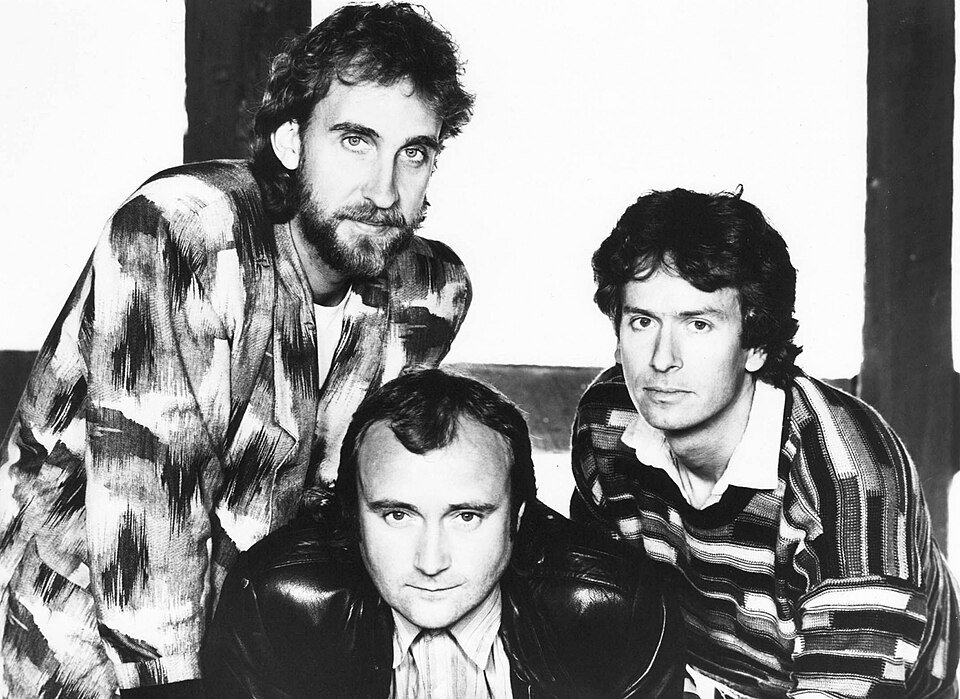
On the morning of July 19, 1986, the three members of Genesis woke up as something they had never been before: the owners of the number one single in America. After nearly two decades of twenty-minute suites, mythology, costumes, and some of the most elaborate progressive rock ever committed to tape, the band from Godalming, Surrey had finally reached the summit of the Billboard Hot 100 — with a three-and-a-half-minute pop song about a woman you can’t resist, built on a drum machine, that Phil Collins had improvised on the spot while Mike Rutherford fiddled with an echo pedal.
The beautiful irony of it all? Nobody planned it. Nobody sat down to write a hit. There was no grand commercial strategy, no outside songwriter flown in to polish the chorus, no record-company memo demanding a single. “Invisible Touch” fell out of a jam session the way a coin falls out of a pocket — casually, accidentally, and then, once it hit the floor, everybody in the room bent down to look at it. This is the story of how the least likely band in the world stumbled onto the biggest song of their lives.
The Prog Band That Learned to Let Go
To appreciate what happened in the summer of 1986, you have to understand how strange it was. Genesis were not supposed to make songs like this. Formed in 1967 by schoolboys at Charterhouse, they had become the high priests of British progressive rock: Peter Gabriel in fox heads and flower costumes, singing twenty-three-minute epics about the battle of Epping Forest; double albums about Puerto Rican street kids lost in subterranean New York; time signatures that changed like weather. When Gabriel left in 1975, drummer Phil Collins — who had joined the band in 1970 — stepped reluctantly to the front of the stage, and against all expectations, the band got bigger.
By the early 1980s, Genesis were in the middle of a slow, fascinating transformation. Albums like “Duke” (1980), “Abacab” (1981), and the self-titled “Genesis” (1983) had shown the trio of Collins, keyboardist Tony Banks, and guitarist-bassist Mike Rutherford inching toward shorter songs and bigger hooks, without ever quite abandoning their musicianly DNA. “That’s All” and “Mama” were genuine hits. But “Invisible Touch” was something else entirely: not a prog band flirting with pop, but a full-blooded, no-apologies dance-rock single that sounded like it belonged on the same radio dial as Prince, Madonna, and Whitney Houston.
The crucial thing is that it wasn’t a betrayal of the band’s methods — it was the purest expression of them. Genesis had always written by jamming. The difference in 1985 was that the jams had started to sound like the inside of a nightclub.
A Blank Bit of Paper
The story begins, as so many Genesis stories do, at The Farm — the band’s private recording studio in Chiddingfold, Surrey, a converted farmhouse where the trio could work in total privacy, without clock-watching engineers or label executives hovering by the mixing desk. The sessions that produced “Invisible Touch” ran from October 1985 through February 1986, with the band’s longtime collaborator Hugh Padgham co-producing alongside the group.
But before any of that could happen, the band had to disappear for a while. 1984 was a fallow year for Genesis as a unit, and each member spent it becoming a bigger star on his own. Collins released “No Jacket Required” in early 1985, an album that turned him into arguably the biggest male pop star on the planet, with “Sussudio” and “One More Night” dominating American radio. Rutherford launched Mike + The Mechanics, whose debut album — featuring the hits “Silent Running” and “All I Need Is a Miracle” — made him a hitmaker in his own right. Banks, the most private of the three, worked on film scores. When the three men finally reconvened at The Farm in the autumn of 1985, they were, collectively, at the absolute peak of their commercial powers — and they had absolutely nothing prepared.
That was deliberate. As with the self-titled 1983 album, the band entered the studio with no songs, no demos, no preconceived ideas. “On day one, we had no songs, no ideas, and a blank bit of paper,” Rutherford later told The Guardian. The method was improvisation, pure and simple. A typical session would see the trio work from 11 in the morning until 2 the following morning, and it would start with Collins programming a drum pattern on a drum machine so that Banks and Rutherford could jam ideas over the top. Collins later described the process as being “close to jazz” — three musicians chopping away, fine-tuning and honing down ideas, never quite knowing what was going to happen. “You never quite know what’s going to happen,” he said. “It’s just the three of us chopping away, fine-tuning and honing down all these ideas.”
It sounds romantic, and in a way it was. But it was also a machine for generating happy accidents — and the happiest accident of all arrived while the band was working on something else entirely.
“She Seems to Have an Invisible Touch — Yeah!”
Genesis were deep in the writing sessions, laboring over “Domino” — the album’s long, two-part centerpiece — when the moment came. Rutherford started playing an improvised guitar riff, drenched in echo, just messing around between takes. And Collins, without thinking, without planning, without even particularly meaning it, suddenly sang: “She seems to have an invisible touch — yeah!”
It came into his head fully formed. That was Collins’s own description, given to The Guardian in a 2014 “How We Made” interview conducted by Laura Barnett: “‘Invisible Touch’ is my favourite Genesis song, and it came more or less out of nowhere. We would arrive in the studio every day and just start playing. One day Mike Rutherford played a riff on the guitar, with an echo, and I suddenly sang: ‘She seems to have an invisible touch — yeah!’ It came into my head fully formed.”
The band recognized instantly that they had something. The improvised phrase became the chorus hook, and Collins built the lyric around it — a song about being irresistibly drawn to someone mysterious and overpowering, even when it’s not good for you. Collins has said he heard the influence of Prince and Sheila E. in the music, specifically the groove of Sheila E.’s “The Glamorous Life,” and you can hear it in the track’s slinky, syncopated pulse: this was Genesis, the prog band, making a record that wanted to move hips. He played the drum parts on an Oberheim DMX drum machine and Simmons electronic pads, layering the electronic precision with his own thunderous acoustic drumming, all of it carrying the gated-reverb signature he had helped pioneer earlier in the decade.
Around that skeleton, the other two built the song’s architecture. Rutherford laid down a supple, melodic bassline beneath his own echoing guitar. Banks — always the band’s harmonic engine — contributed bright, cascading keyboard textures and a sparkling synthesizer solo, engineering the track’s celebrated key change in the outro that sends the whole song soaring upward in its final minute. What had started as a throwaway moment during the “Domino” sessions had become, almost against the band’s will, the most undeniable thing they’d ever recorded.
There was one more ingredient, and it’s the most human one. The lyric Collins wrote — about a woman with an invisible touch, someone who gets under your skin and won’t let go — was, he later acknowledged, drawn from real life. In his 2016 autobiography, Collins revealed that large chunks of the lyrics were about his first wife, Andrea Bertorelli, to whom he was married from 1975 to 1980, as well as a few other people he had known who had “got under his skin.” The breeziest, most effervescent Genesis single ever made was, underneath the sheen, a song about the kind of attraction that leaves a mark. That tension — candy coating over something complicated — is part of why it has lasted.
And yet, for all of that, Collins wasn’t sure it would be a hit. He has admitted that despite liking the song himself, and despite the band’s previous success, he wasn’t certain “Invisible Touch” would connect. The band’s instincts, honed over hundreds of hours of jamming, told them it was special. But “special” and “number one in America” are very different things, and Genesis — a band that had spent the 1970s being proudly, defiantly uncommercial — had no real way of knowing which one they were holding.
“We Weren’t Afraid to Make Lousy Noises”
The 2014 Guardian interview remains the most revealing account of how “Invisible Touch” came to be, because it captures something essential about Genesis: these were three men who had been making music together for so long that they had developed their own private language, their own permission structure. “We weren’t afraid to make lousy noises,” Collins explained. “We knew each other well: if I started singing crap, no one would say, ‘What the hell are you doing?’ Still, there was a good percentage of crap.”
That safety — the freedom to be terrible in front of each other — was the engine of the whole album. Rutherford described the daily ritual with disarming simplicity: “The best songs tend to get written quickly. That’s how it was with ‘Invisible Touch.’ We’d rock up, have a cup of tea, see what happened.” There was no pressure, no A&R man demanding a single, no awareness that the clock was ticking on their relevance. Just three friends in a farmhouse in Surrey, following the sound of a drum machine and seeing where it led.
It’s worth pausing on how radical that was as a way to make a pop record. Most hit singles of the mid-1980s were constructed: written by professional songwriters, demoed to within an inch of their lives, produced by committee. “Invisible Touch” was closer to a jazz trio’s improvisation that happened to land on a perfect melody. Collins himself made the comparison explicit, and he wasn’t being cute. The song’s structure — the way the verse tumbles into the chorus, the way Banks’s keyboards answer Rutherford’s guitar, the way the whole thing lifts into that final key change — has the looseness of something discovered rather than designed. You can hear three musicians listening to each other in real time, which is exactly what they were doing.
Rutherford has called it “a wonderful song: upbeat, fun to play, always a strong moment in any gig.” He named it one of his live favorites, which tells you something: for all the complexity Genesis were capable of, what they loved most about this one was its simplicity. It was fun. After years of intricate arrangements and conceptual ambition, there was a pure, uncomplicated joy in playing a song that just made people move.
The Grain Store by the Thames
Before the single could conquer America, it needed a video — and Genesis, to their credit, refused to take the whole thing too seriously. They reunited with director Jim Yukich, who had previously worked with them on the “That’s All” video in 1983, and filmed in a huge old grain store by the Thames. The concept, such as it was, consisted mostly of the three band members goofing around: Collins, Rutherford, and Banks clowning with 8mm film cameras, Collins using his own drumsticks as a microphone, the whole band fooling around with Yukich and the crew.
“We never took our music videos too seriously,” Rutherford told The Guardian. “I think the public saw us as a bit serious, so we liked to surprise them. Phil would come up with some kind of comic character. The shoot for ‘Invisible Touch’ was in a huge old grain store by the Thames. In one frame, you can see us rolling around in what looks like a big silver cotton reel.”
It was a shrewd move, whether intentional or not. The video humanized a band that many still associated with capes and codpieces, and MTV put it into power rotation — it finished the year at number 9 on the channel’s list of the Top 100 videos of 1986. For millions of American viewers, their first real impression of Genesis wasn’t a prog-rock epic but three grinning Englishmen having the time of their lives in a warehouse. The song was already irresistible; the video made the band irresistible too.
The Summer Genesis Owned America
“Invisible Touch” was released as a single on May 19, 1986, a couple of weeks before the album of the same name arrived. It entered the Billboard Hot 100 at number 45 on the May 31 chart — a strong debut — and then began one of the most satisfying climbs of the decade. Week by week it rose: through the 30s, the 20s, the teens, the top ten. Seven weeks after its debut, on the chart dated July 19, 1986, it reached number 1. It stayed there for one week, and it also spent three consecutive weeks atop the Billboard Hot 100 Airplay chart, with heavy rotation on both pop and rock radio — it hit number 1 on the Mainstream Rock Tracks chart too.
Consider what that meant. Genesis had been releasing records since 1969. They had sold millions of albums, headlined arenas, and survived the departure of their iconic frontman. They had never once had a number one single in the United States. “Follow You Follow Me” had reached number 23 in 1978. “Misunderstanding” had made number 14. “That’s All” had stalled at number 6. And now, finally, at the very moment when the band was arguably at its most commercially calculated — or at least its most pop — the top of the chart opened up and let them in.
But the chart story of “Invisible Touch” has a twist so perfect it sounds scripted, and it involves the ghost of Genesis past. The week “Invisible Touch” sat at number 1, the number 2 song in America was “Sledgehammer” — by Peter Gabriel, the band’s former lead singer, who had left Genesis eleven years earlier. It was, as Billboard noted at the time, the first occasion in chart history that a band and one of its former members had occupied the top two positions on the Hot 100 simultaneously. And the following week, on July 26, Gabriel’s “Sledgehammer” climbed past “Invisible Touch” to claim the number one spot for itself — also Gabriel’s first and only American chart-topper.
Collins, learning about this years later, was characteristically dry about it. “I read recently that Peter Gabriel knocked us off the No. 1 spot with ‘Sledgehammer,’” he told The Guardian in 2014. “We weren’t aware of that at the time. If we had been, we’d probably have sent him a telegram saying: ‘Congratulations — bastard.’”
Rutherford, looking back in his memoir “The Living Years,” was more reflective: “That Pete was reaching his peak at the same time as us wasn’t a surprise. We had been both working hard at our careers and each of our albums had sold more than the last, so at some stage it was very likely that we’d end up at the same point in our separate trajectories. I don’t think either of us had thought those points would be as high as they were.”
It was the summer of Genesis, in every sense. On the Hot 100 chart for May 31, 1986 — the week “Invisible Touch” debuted — no fewer than six Genesis-related records were jockeying for position: the mothership band’s new single at number 45, Gabriel’s “Sledgehammer,” GTR’s “When the Heart Rules the Mind” (the new band of former Genesis guitarist Steve Hackett), Howard Jones’s “No One Is to Blame,” which Collins had co-produced, and two Mike + The Mechanics singles, “Taken In” and “All I Need Is a Miracle.” At the peak week of July 19, the chart read like a family reunion: “Invisible Touch” at number 1, “Sledgehammer” at number 2, Hackett’s GTR at number 14, the Jones record at 19, and both Mechanics singles still climbing. Past and present members of one band, scattered across the entire American top 70 at the same time. It had never happened before, and it will probably never happen again.
The single’s success wasn’t confined to America. It reached number 15 in the UK — a respectable showing, though the British had always been cooler on Genesis the pop band than the Americans were — and the top ten in Canada, Australia, Ireland, and New Zealand. But it was America where the song truly detonated, and where it remains, to this day, the band’s only number one single.
Five for Five
The single was only the beginning. When the album “Invisible Touch” arrived — released June 6, 1986 in the United States and June 9 in the UK — it became the biggest record Genesis ever made. It debuted at number 1 on the UK Albums Chart and peaked at number 3 on the US Billboard 200. In America it was eventually certified six-times platinum by the RIAA, signifying more than six million copies sold — the band’s highest-selling album by a wide margin, and one of the defining commercial blockbusters of the 1980s.
What followed was a singles run that rewrote the record books. “Invisible Touch” was the first of five consecutive top-five singles from the album on the Billboard Hot 100: the title track at number 1, “Throwing It All Away” at number 4, “Land of Confusion” at number 4, “In Too Deep” at number 3, and “Tonight, Tonight, Tonight” at number 3. Genesis became the first band — and the first non-American act — to place five singles from a single album in the Hot 100’s top five, equaling a record previously set only by Michael Jackson as a solo artist (a feat later matched by Janet Jackson and Madonna). For a band that had once been famous for songs too long to fit on a 45, it was a staggering reversal of fortune.
The album itself was a showcase for the trio’s democratic method. As Rhino’s retrospective notes, the lyrics were split more or less evenly: Collins wrote “Invisible Touch,” “Tonight, Tonight, Tonight,” and “In Too Deep”; Rutherford wrote “Land of Confusion” and “Throwing It All Away”; Banks wrote “Domino” and “Anything She Does.” All the music was credited to the three of them jointly — the product of those long Farm improvisations, captured on Banks’s E-mu Emulator sampler and sculpted into songs. Only eight tracks (with “Domino” in two parts), and five of them became massive hit singles. It remains one of the most efficient hit-to-track ratios in pop history.
And the sound! For all the talk of commercial calculation, “Invisible Touch” the album is a marvel of mid-80s studio craft. Padgham’s production — gleaming, spacious, precise — gave the band’s jam-born songs a polish that never smothered their energy. Banks’s keyboards, built on the Prophet and the Synclavier, created icy digital textures that felt futuristic. Collins’s drums, mixing acoustic thunder with Simmons electronic pads and drum machines, defined the era’s rhythmic vocabulary. It was, in every sense, the sound of a band that had mastered the present tense.
The Long Echo
Genesis took “Invisible Touch” on the road in the autumn of 1986, launching the Invisible Touch Tour — a worldwide trek that ran from September 1986 through July 1987, playing more than a hundred shows across North America, Europe, Japan, Australia, and New Zealand. It was the biggest tour the band had ever undertaken, and “Invisible Touch” was its centerpiece: a show-stopping, stadium-shaking moment, with Collins sprinting between the microphone and the drum kit, trading licks with touring drummer Chester Thompson in their famous “drum duel.” The tour’s scale confirmed what the charts had already said: Genesis were no longer a cult prog band with a pop sideline. They were one of the biggest live acts on earth.
The song never left the setlist. It was performed on every subsequent Genesis tour — the We Can’t Dance tour, the Calling All Stations tour with Ray Wilson on vocals, the Turn It On Again reunion, and the final Last Domino? tour, where it served as the set closer. Collins also carried it into his solo shows for decades. A live version released as a single in 1992 even became a UK top-ten hit in its own right, reaching number 7 — Genesis’s final British top-ten single.
There is a lovely coda to the song’s live history. When Genesis performed “Invisible Touch” at Wembley Stadium for Live Earth in 2007, Collins — who had taken to altering one of the song’s lyrics in concert since the early 1990s — let slip an expletive in front of millions of afternoon television viewers, prompting an on-air apology from the BBC’s presenter. It was a small, human, slightly embarrassing moment, and in a way it was perfect: the most polished pop song Genesis ever made, delivered with a flash of the unscripted mischief that had created it.
Betrayal or Breakthrough?
Not everyone celebrated. Among die-hard progressive rock fans, “Invisible Touch” was received by some as a commercial betrayal — a far cry from the band’s roots, as the band’s own official history candidly puts it. The men who had written “Supper’s Ready” were now making dance-pop with drum machines. To a certain kind of listener, it felt like surrender.
The band’s answer, then and now, is the method itself. “Invisible Touch” — like every track on the album — was born from the same collaborative jam sessions that had produced Genesis music for years. The process hadn’t changed; only the results had. The trio hadn’t hired outside writers or chased trends in a boardroom. They had done what they always did — arrived at the studio, started playing, and followed the music. That the music led them somewhere poppier than ever before wasn’t a compromise. It was honesty. As Collins put it, their writing process was close to jazz. You don’t accuse a jazz trio of selling out when the improvisation swings.
History has largely sided with the band. In 2017, ShortList’s Dave Fawbert listed the song as containing “one of the greatest key changes in music history” — that outro lift that Banks engineered, sending the final chorus soaring. The song has been anthologized in the “Rock Song Index: The 7500 Most Important Songs for the Rock and Roll Era,” a recognition that it belongs not just to pop history but to rock history, full stop. And the prog fans, by and large, came around: it is hard to argue with a song the band so clearly loved playing, or with a number one record that was made, start to finish, by three friends improvising in a farmhouse.
The Accident That Became the Summit
Here’s the thing about “Invisible Touch” that still matters, forty years on. It is very easy, in retrospect, to tell the story of Genesis as a band that sold out — that traded the fox heads and the twenty-minute epics for drum machines and MTV. The die-hard prog fans certainly told it that way at the time; the song is still viewed by some as a commercial betrayal, a far cry from the band’s roots.
But listen to the story of how it was actually made, and a different picture emerges. Nobody in that room at The Farm in the winter of 1985 was chasing a hit. They were three friends with a blank piece of paper, a drum machine, and a cup of tea, doing what they had always done: playing, listening, and following the music wherever it went. The fact that where it went happened to be the top of the American charts doesn’t make the process cynical. If anything, it makes the process look prophetic. Genesis had spent fifteen years learning to improvise together with total trust. “Invisible Touch” was simply what that trust sounded like when the world was finally ready to hear it.
Phil Collins called it his favorite Genesis song. Not “Supper’s Ready.” Not “The Lamb Lies Down on Broadway.” Not “In the Cage” or “Los Endos” or any of the epics the faithful hold sacred. His favorite was the three-and-a-half-minute pop song that fell out of a jam while the band was working on something else — the one that came into his head fully formed, the one he wasn’t even sure would be a hit, the one that gave Genesis their only American number one and then got knocked off the top by their old singer.
There’s a lesson in that, and it’s not about commerce. It’s about the strange alchemy of making things with people you trust: you show up, you start playing, you aren’t afraid to make lousy noises, and sometimes — once in a career, if you’re lucky — the universe drops a perfect song into the room like a coin from a pocket. All you have to do is notice it on the floor, pick it up, and recognize what you’re holding. Genesis did. And for one week in July 1986, the whole of America was holding it with them.
Leave a Reply