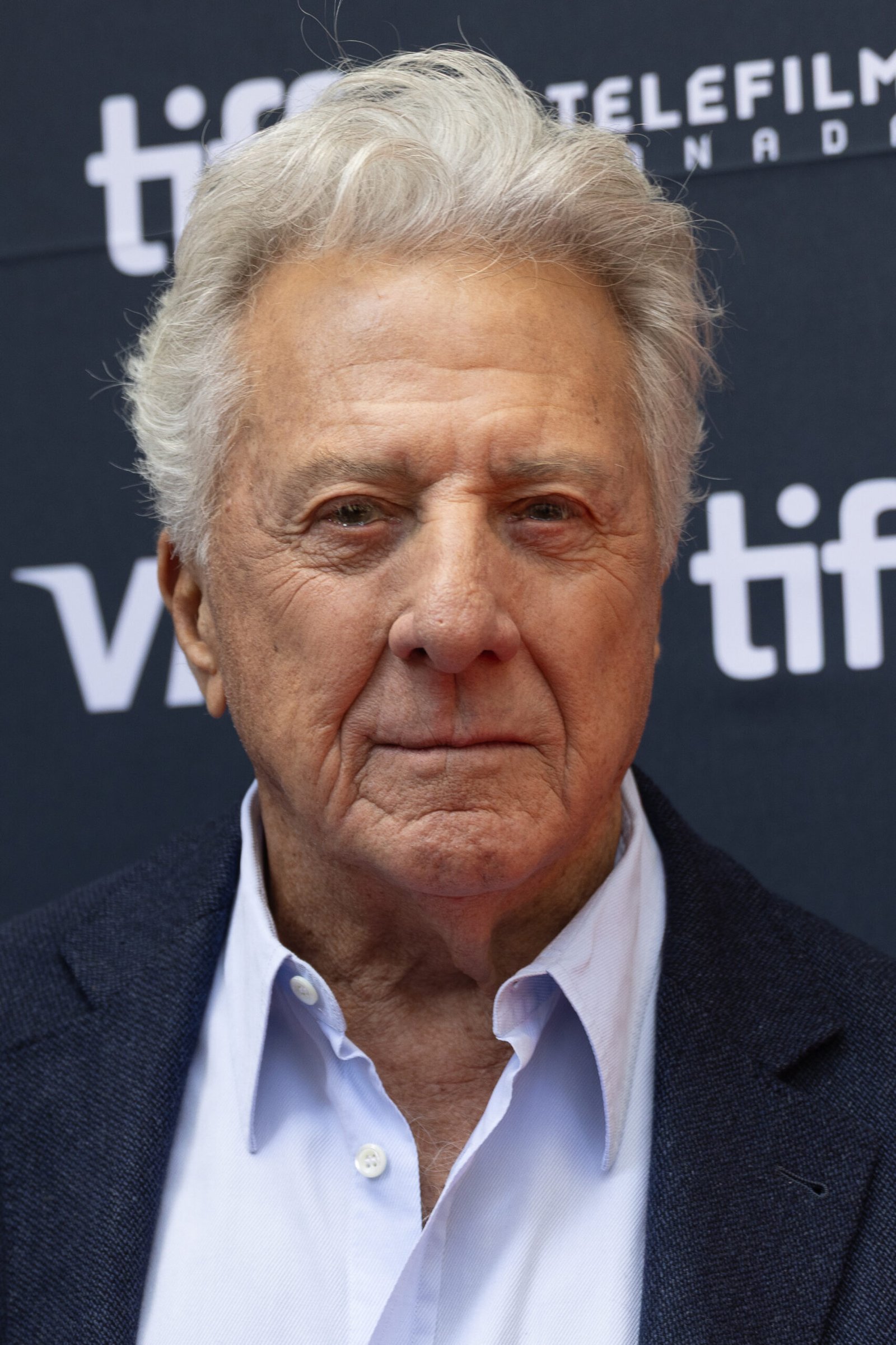
Dustin Hoffman was never supposed to be famous. He said so himself, many times, with the bewildered gratitude of a man who still can’t quite believe his luck. He was too short. His teeth had braces. His face, in his own brutal assessment, had “one of the worst cases of acne in California.” In the Hollywood of Cary Grant and Rock Hudson — tall, square-jawed, gleaming — Dustin Hoffman looked like somebody’s accountant.
Then he became the biggest movie star in the world anyway, and changed what a movie star could look like forever. This is the story of the outsider who talked his way into the Actors Studio, shared a roach-infested apartment with two other nobodies named Gene Hackman and Robert Duvall, and built a career out of refusing to be ordinary.
The Slowest Kid in the Room
Dustin Lee Hoffman was born on August 8, 1937, in Los Angeles, the second of two sons of Ukrainian-Jewish parents. His father, Harry, had worked as a set designer and prop man for Columbia Pictures before the Depression cost him the job; he became a furniture salesman. His mother, Lillian, loved show business and once wangled a walk-on for Dustin’s older brother Ron in Frank Capra’s Mr. Smith Goes to Washington.
Young Dustin developed slowly. He rode his first scooter at two and a half. He didn’t speak until he was three. Money arguments filled the house — “we lived in a great state of friction,” he later said — and the family bounced between working-class neighborhoods, which left the shy boy feeling like a permanent outsider. While Ron brought home straight A’s, Dustin’s grades were poor. “I lacked concentration and discipline,” he admitted. He saw himself as undersized, overlooked, and observant — the kid watching from the corner.
What he had was music. At Los Angeles High School he studied classical piano seriously, and after graduating in 1955 he enrolled at Santa Monica College intending to study medicine, then music at the Los Angeles Conservatory. Acting was an accident — or rather, a dare. A friend suggested he try an acting class at the Pasadena Playhouse. Hoffman asked, more or less, why he would want to do that. He went anyway. He never really left.
Three Nobodies in New York
New York in the late 1950s was not kind to Dustin Hoffman. He trained at the Actors Studio under Lee Strasberg, the high priest of Method acting, and supported himself with the classic litany of odd jobs: waiting tables, teaching, working for a time as an attendant in a psychiatric facility — an experience he would draw on for decades. He was, by every conventional measure, unemployable as a leading man.
He was also, crucially, not alone. Hoffman shared cramped apartments and lean years with two fellow strugglers: Gene Hackman and Robert Duvall. Three unknown, unconventionally handsome actors, splitting rent and rejection slips, telling each other they were going to make it. Within a decade, all three would be among the most celebrated actors of their generation — the vanguard of a New Hollywood that didn’t care about jawlines.
Hoffman paid his dues the hard way: small television parts, off-Broadway roles, years of near-misses. He won a Drama Desk Award for the 1966 off-Broadway play Eh?. He made his film debut in a forgettable Spanish-Italian co-production. He was thirty years old, and Hollywood still didn’t know his name.
The Audition He Bombed (and Won)
Then came The Graduate. Director Mike Nichols was looking for someone to play Benjamin Braddock, the aimless 21-year-old seduced by Mrs. Robinson — and he looked past the obvious choices. Robert Redford wanted the part. Charles Grodin tested for it. Nichols chose the thirty-year-old unknown with the bad audition.
The audition story is pure Hoffman. Nervous, rumpled, he went to shake the prop man’s hand and all his subway tokens spilled out of his pocket onto the floor. The prop man picked them up, handed them back, and said: “Here, kid — you’re gonna need these.” Hoffman got the part anyway. Nichols saw what the tokens couldn’t hide: a young man vibrating with the exact anxious, alienated energy of a generation.
The Graduate (1967) was a cultural detonation. Hoffman’s Benjamin — drifting in his parents’ pool, stammering through seduction, screaming Elaine’s name in a church — became the defining image of 1960s youth disillusionment. The film made Hoffman a star overnight and earned him his first Oscar nomination. He had beaten out Redford by being the opposite of Redford, and Hollywood never looked at leading men the same way again. Al Pacino, Jack Nicholson, Gene Hackman — the whole generation of brilliant, irregular faces — walked through the door Hoffman kicked open.
The Reinvention Machine
What followed was one of the most restless careers in film history. Hoffman never played the same man twice. In Midnight Cowboy (1969) he was Ratso Rizzo, the limping street hustler — and when a taxi nearly ran him down during a location shoot, his furious, improvised “I’m walkin’ here! I’m walkin’ here!” became the most famous ad-lib in movies. In Little Big Man (1970) he aged from seventeen to 121. In Lenny (1974) he was the doomed comic Lenny Bruce. In Marathon Man (1976) he was tortured in a dentist’s chair. In All the President’s Men (1976) he was Carl Bernstein.
Then came the role that broke him open: Ted Kramer in Kramer vs. Kramer (1979), the workaholic father who learns to parent after his wife leaves. Hoffman, going through his own divorce at the time, poured his life into it and won his first Academy Award. Three years later he disappeared into Tootsie (1982), playing an out-of-work actor who becomes a woman to get a job — a farce that made $177 million and earned him another nomination. Decades later, a clip of Hoffman tearfully describing what playing Dorothy Michaels taught him about beauty — about all the interesting women he’d dismissed in his life — would go viral, moving millions. The short kid from L.A. had become Hollywood’s conscience.
Love, Family, and the Townhouse Next Door
Hoffman married ballet dancer Anne Byrne on May 4, 1969. He adopted her daughter Karina from a previous marriage, and their daughter Jenna was born on October 15, 1970. For a time they lived in Greenwich Village — in a building next door to a townhouse occupied by members of the radical Weathermen group. In March 1970, a bomb being built in that townhouse’s basement accidentally detonated, killing three people and shaking the whole block. Hoffman can be seen in the documentary The Weather Underground, standing in the street in the aftermath — a surreal footnote in a life full of them.
The marriage ended in divorce in 1980. That same year, on October 21, Hoffman married Lisa Gottsegen, a young law school graduate. They have four children together — Jacob, Rebecca, Maxwell, and Alexandra — and by all accounts it is one of Hollywood’s genuinely happy marriages, now past its fortieth year. Hoffman has said that all of his children had bar or bat mitzvahs, and that he is a more observant Jew now than he was as a young man.
It hasn’t all been smooth. Hoffman was successfully treated for cancer in 2013. In 2017, he faced allegations of misconduct from several women, which he denied — a painful chapter in the late career of a beloved figure, and one that complicates but hasn’t erased his legacy.
The Method and the Madness
Hoffman trained at the Actors Studio under Lee Strasberg, and he took the Method’s gospel — live the part, don’t play it — further than almost anyone. The stories are legendary. Preparing for Marathon Man, he famously stayed up for three days to play a man who hadn’t slept; his co-star Laurence Olivier, the patron saint of classical technique, is said to have replied, “My dear boy, why don’t you just try acting?” Whether or not the exchange happened exactly that way, it became the perfect parable of two eras colliding: the old school and the new, politeness versus possession.
The immersion was real, whatever the anecdotes. For Midnight Cowboy he haunted Times Square until the limp and the cough felt like his own. For Kramer vs. Kramer, in the middle of his own collapsing marriage, he reportedly provoked his co-stars off-camera to keep the tension raw. Directors alternately adored and despaired of him — he would do forty takes and ask for one more, not from vanity but from a genuine terror of faking it. “I don’t want to act,” he once said. “I want to be.”
It made him exhausting to work with and impossible to look away from. And it set the template for a generation of actors who believed, as he did, that the job wasn’t to be interesting — it was to be true.
Captain Hook and the Elder Statesman
By the 1990s, Hoffman was an institution — which meant he could do whatever he wanted, and did. He played Captain Hook in Steven Spielberg’s Hook (1991), twirling a mustache with visible glee. He chased a virus in Outbreak (1995), schemed in Wag the Dog (1997), and stole scenes as a harried father-in-law in Meet the Fockers (2004). He directed himself in Quartet (2012), a gentle comedy about retired opera singers that revealed a tenderness behind the intensity.
The late-career highlights kept the through-line intact: men who feel too much and say it badly. In Noah Baumbach’s The Meyerowitz Stories (2017) he was a monstrous, needy, utterly human patriarch. In As They Made Us (2022), directed by Mayim Bialik — who would later sit him down for that long, searching interview about his childhood and his craft — he played a man facing the end of his life with the same unflinching honesty he’d brought to every role since 1967.
Through it all, he remained what he had always been: the outsider who got in, the character actor who became a star without ever learning how to be one.
The Work Continues
Now in his late eighties, Hoffman keeps showing up — in films, on stage, in long, discursive interviews where he talks about acting the way other men talk about baseball. In a 2022 conversation with Mayim Bialik, he traced it all back: the childhood hypervigilance, the years watching people because he felt invisible, the discovery that his strangeness was his instrument.
That is the real secret of Dustin Hoffman. He didn’t overcome being the short, spotty, overlooked kid. He weaponized it. Every great Hoffman performance — Benjamin Braddock, Ratso Rizzo, Raymond Babbitt, Dorothy Michaels — is the outsider looking in, feeling everything, missing nothing. He made a career out of the thing Hollywood told him was a flaw.
In 1967, a prop man handed a nervous unknown his subway tokens and told him he’d need them. He was right. Dustin Hoffman needed every token, every rejection, every odd job and empty apartment — because the long way around is the only way he ever learned to get anywhere. And somewhere along that long way, he became not just a star, but the reason the rest of us believed we could be one too.
There’s a coda worth remembering. Hoffman has two Academy Awards, seven nominations, and a career spanning six decades — but ask him what matters and he’ll talk about the work, the preparation, the terror before the first take. The short kid from Los Angeles who didn’t speak until he was three ended up with the most eloquent face in movies. He just needed the world to stop and listen long enough to notice.
Leave a Reply