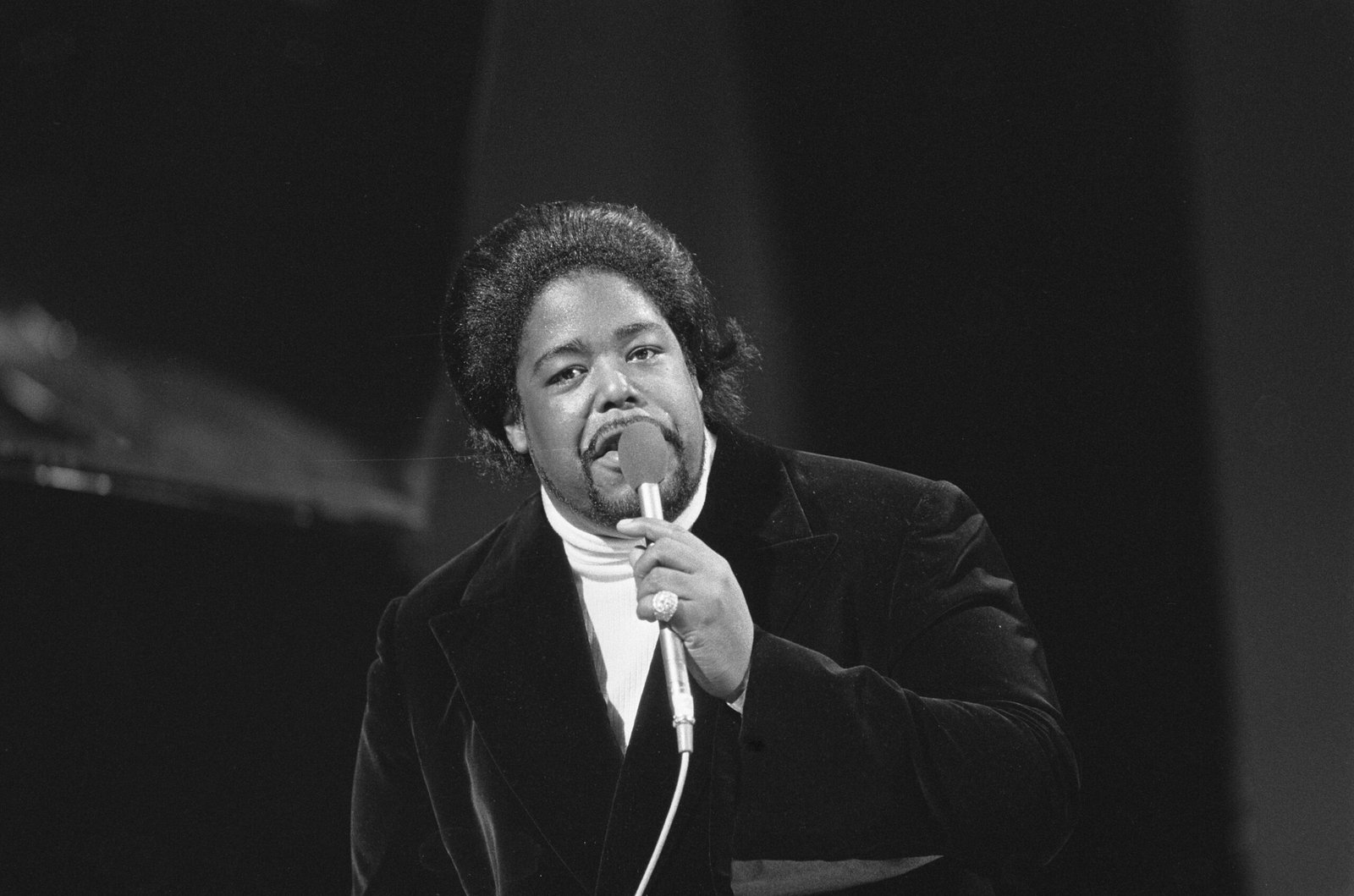
He was the voice you turned down the lights to. A velvet bass-baritone that could make a woman fall in love over the telephone and a man feel like a poet with one whispered intro. But behind the silky suits and the trademark spoken-word preludes, Barry White was one of the sharpest musical minds of the 1970s — a self-made producer, arranger, and hit factory who practically built an orchestra with his own two hands.
From South Central Struggles to Self-Taught Musician
Barry White was born Barry Eugene Carter on September 12, 1944, in Galveston, Texas. When he was just a baby, his mother Sadie moved him and his younger brother to South Central Los Angeles, where he grew up in rough, high-crime neighborhoods. Music, however, was his escape hatch. He taught himself to play the piano as a kid, spending hours at the keyboard while the streets outside churned with trouble.
As a teenager, he sang with a local Los Angeles R&B group called the Upfronts and began haunting recording studios, hungry to learn the trade. He wasn’t just dreaming of being a singer — he was studying everything: how records were made, how arrangements were built, how producers worked their magic. That education would become the foundation of everything that followed.
The Producer Behind the Curtain: Love Unlimited
White’s big break came behind the scenes. In the late 1960s, he discovered a female vocal trio that he named Love Unlimited, wrote their material, produced their records, and arranged their sound. In 1972, their single “Walkin’ in the Rain (With the One I Love)” became a million-selling hit and reached the Top 20 of the pop charts. He married the group’s lead singer, Glodean James, on July 4, 1974 — the same calendar date on which, decades later, he would pass away.
To back Love Unlimited, White assembled a lush 40-piece ensemble he called the Love Unlimited Orchestra. It was a daring idea: an orchestra steeped in funk and soul, with sweeping strings riding over deep percussion. In early 1974, the Orchestra’s instrumental recording of his composition “Love’s Theme,” from the album “Rhapsody in White,” went all the way to number one on the Billboard Hot 100 — one of only a handful of instrumental recordings ever to top the chart. Almost overnight, Barry White the producer had become a name everyone in the business knew.
The Maestro Steps to the Microphone
For years, White had hidden his own voice in the background of his productions, convinced that nobody wanted to hear it. What finally coaxed him forward was necessity — and confidence. In 1973, he released his solo debut single “I’m Gonna Love You Just a Little More Baby,” which climbed to number one on the R&B chart and number three on the pop chart. The follow-up, “Never, Never Gonna Give You Up,” hit number two R&B and number seven pop. The man with the voice he’d been shy about suddenly had a solo career nobody could ignore.
His albums “I’ve Got So Much to Give” and “Stone Gon’” — both released in 1973 — earned him a Grammy nomination for Best New Artist (he lost to Bette Midler). Barry White was no longer just a behind-the-scenes maestro. He was a star.
1974: The Year the World Fell in Love
In 1974, White released the album “Can’t Get Enough,” and popular music bent toward him like flowers toward the sun. The album hit number one on the Billboard 200. It gave the world his two signature songs: “Can’t Get Enough of Your Love, Babe,” which became his first number one on the Billboard Hot 100 and topped the R&B chart as well, and “You’re the First, the Last, My Everything,” which topped the R&B chart, reached number two on the Hot 100, and went to number one in the United Kingdom.
Nobody sounded like him. His songs opened with spoken-word monologues — intimate, slow, impossibly smooth — before blooming into full orchestral soul. Critics called it sensual, fans called it magic, and the nickname “the Walrus of Love” stuck forever. He recorded 20 studio albums over his career and sold more than 100 million records worldwide, with 20 gold and 10 platinum singles to his name. More hits kept coming through the seventies: “What Am I Gonna Do with You,” “Let the Music Play,” “It’s Ecstasy When You Lay Down Next to Me,” and “Your Sweetness Is My Weakness” all climbed the charts and kept his orchestra-fueled brand of romance at the top of the airwaves. He was so beloved in the UK that “You’re the First, the Last, My Everything” sat at number one on the British chart, and he returned to the British Top 20 two decades later with “Practice What You Preach.”
The Comeback King of the Nineties
The disco backlash of the late 1970s slowed White’s chart momentum, and he spent much of the 1980s recording for his own label, Unlimited Gold, without matching his earlier commercial peak. But the nineties brought a glorious second act. In 1994, he released “The Icon Is Love,” which soared to number one on the Billboard R&B album chart. Its single “Practice What You Preach” gave him his first number one R&B single in nearly 20 years, and the album earned a Grammy nomination for Best R&B Album — losing to TLC’s “CrazySexyCool,” a sure sign that the R&B world he had helped build was still thriving.
Then came a poignant full circle. His final album, 1999’s “Staying Power,” won him the two Grammy Awards of his career — Best Male R&B Vocal Performance and Best Traditional R&B Vocal Performance — and he published his autobiography, “Love Unlimited.” Younger audiences discovered him anew through a voice role on “The Simpsons” and three memorable guest appearances as himself on “Ally McBeal,” where his music underscored the show’s romantic dream sequences. He seemed genuinely delighted to be in on the joke.
Honors, Illness, and the Final Measure
The honors came too: he was inducted into the Dance Music Hall of Fame in 2004, and on what would have been his 69th birthday — September 12, 2013 — he received a star on the Hollywood Walk of Fame.
But years of high blood pressure and diabetes had caught up with him. In the fall of 2002, he was hospitalized with kidney failure; a severe stroke in May 2003 forced him to retire from public life. On July 4, 2003 — 29 years to the day after he married Glodean — Barry White died of kidney failure at Cedars-Sinai Medical Center in Los Angeles. He was 58.
Few artists ever turned romance into an art form the way Barry White did. He was a producer before he was a star, an arranger before he was a sex symbol, and a hopeless romantic before it was fashionable. When that unmistakable voice drops into its whisper — “I can’t get enough of your love, babe” — it’s hard not to smile, and even harder not to remember where you were the first time you heard it. The Walrus of Love gave the world permission to swoon, and the world is still swooning.
Leave a Reply