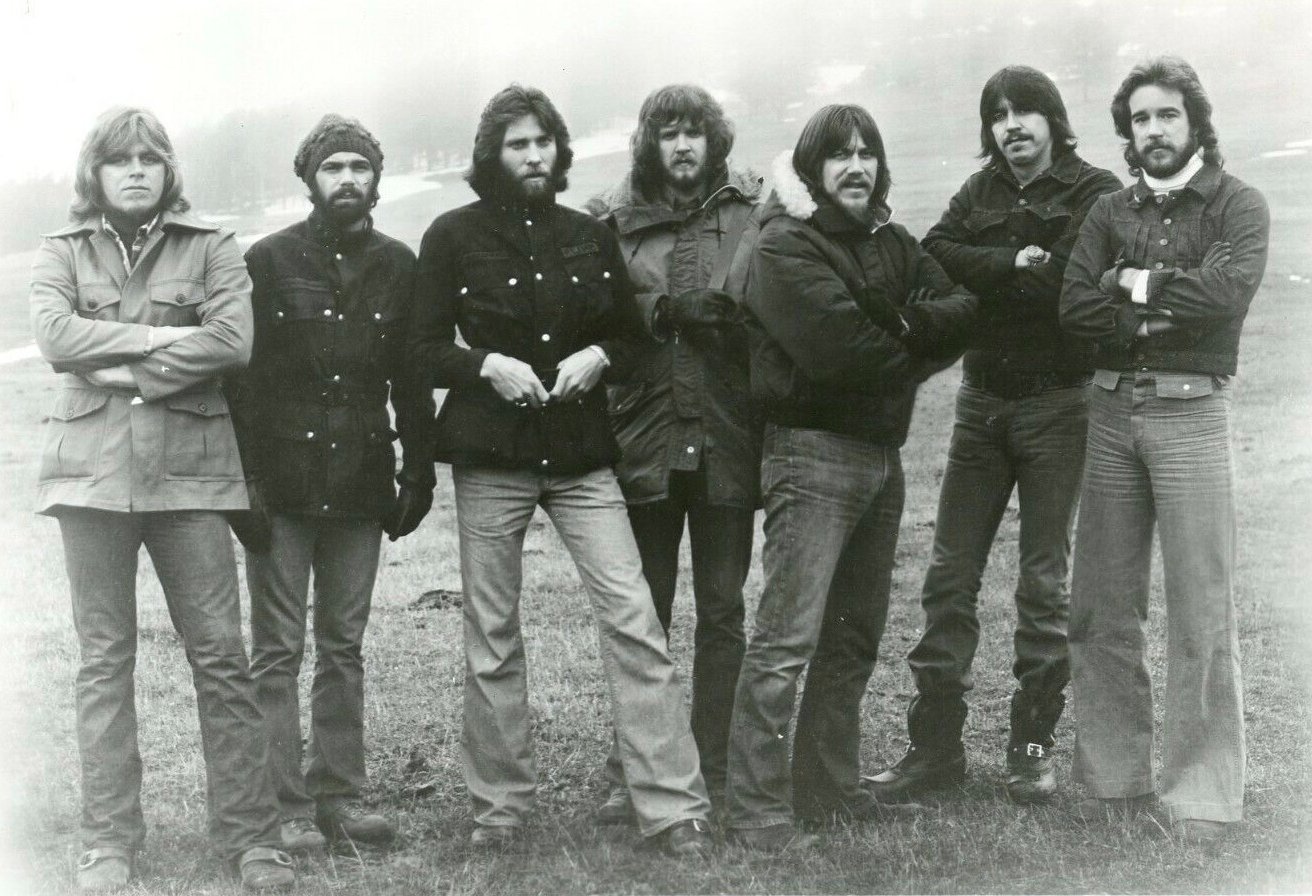
They started as a scrappy jazz-rock experiment with an unwieldy name and a sound nobody could categorize. They became one of the best-selling American bands of all time, survived the shocking death of their leader, reinvented themselves as ballad kings, and outlasted almost everyone who ever doubted them. Chicago’s story is really two stories: the fiery, horn-driven rock band of the early seventies, and the sleek hit machine of the eighties. The bridge between them is a tragedy.
The Big Thing From the Windy City
In 1967, six young Chicago musicians — guitarist Terry Kath, saxophonist Walter Parazaider, trumpeter Lee Loughnane, trombonist James Pankow, keyboardist Robert Lamm, and drummer Danny Seraphine — started jamming together, soon adding bassist Peter Cetera. They called themselves The Big Thing, and their concept was genuinely radical: a rock band with a full-time, three-piece horn section, blending the muscle of electric blues, the sophistication of jazz, and the punch of brass.
Nobody knew what to do with them. Rock audiences had never seen horns used this way — not as sweetening, but as a lead instrument, riffing and wailing like a second guitar. The band’s 1969 debut was a sprawling double album that announced their ambition in its very first track, a Kath composition that introduced each band member like a roll call. It was bold, political, experimental — and it worked. The debut went platinum, and the horn band from the Windy City was suddenly the most exciting new sound in rock.
The Name the Transit Authority Wouldn’t Let Them Keep
Success brought an unexpected legal headache. After that first album, the band had been performing as the Chicago Transit Authority — a grand, civic-minded name for a grand, ambitious band. The only problem was that the Chicago Transit Authority was also the name of the city’s actual public transportation agency, and the real CTA did not appreciate sharing its name with a bunch of long-haired rock musicians. Facing a threatened lawsuit, the band did the sensible thing: they shortened the name to simply Chicago.
It was a blessing in disguise. “Chicago” was cleaner, tougher, and more memorable — and it turned out to be one of the most durable brand names in music history. The band would go on to title nearly all of their albums with the name plus a Roman numeral, a numbering system that became a trademark in itself.
Jimi Hendrix’s Favorite Guitarist
Terry Kath was Chicago’s soul: a stocky, sticker-covered-Telecaster-wielding powerhouse who sang like Ray Charles and played guitar like a force of nature. And he had a fan that most guitarists would kill for. In 1968, when the band — still called the Chicago Transit Authority — was playing the Whisky a Go Go in Los Angeles, a quiet figure approached saxophonist Walter Parazaider after the set. It was Jimi Hendrix.
According to Parazaider, Hendrix introduced himself softly, said he’d been watching the band, and delivered a verdict that has echoed through rock history: the horns sounded like one set of lungs, and “your guitar player is better than me.” Whether Hendrix meant it literally or was simply being generous to a young band he admired, the story stuck — repeated by every member of Chicago for the rest of their lives — because anyone who heard Kath play found it entirely plausible. His seven-minute solo at Tanglewood in 1970 remains a jaw-dropping display of controlled fury.
“25 or 6 to 4”: Rock’s Most Misunderstood Title
Chicago’s 1970 breakthrough single had a title that launched a thousand theories. Was “25 or 6 to 4” a drug reference? A gambling code? A secret message? For years, fans spun elaborate interpretations of the cryptic numbers. The truth, as songwriter Robert Lamm has cheerfully explained, is almost comically mundane.
Lamm wrote the song in the middle of the night in a house in the Hollywood Hills, struggling with writer’s block and trying to describe the very process of writing the song he was writing. He glanced at his watch: it was 25 or 26 minutes to four in the morning — 3:35 or 3:34 a.m. He jotted the phrase down as a placeholder, intending to write a proper lyric later. The placeholder stuck, the band’s horn section turned his descending riff into a brass-rock anthem, and one of rock’s most mysterious titles turned out to be nothing more than a timestamp. Lamm composed it on a twelve-string guitar missing its two low E strings and wrote the words in a single day.
The Night the Music Died: Losing Terry Kath
On January 23, 1978, Chicago’s first era ended in an instant. Terry Kath, then thirty-one, was at the Woodland Hills home of the band’s roadie and keyboard technician, Don Johnson, handling one of his handguns. According to the accounts of those present, Kath put the gun to his temple and, believing it was unloaded, told Johnson not to worry. There was a bullet in the chamber. Kath died instantly, leaving behind his wife Camelia and their two-year-old daughter Michelle.
The band was devastated — and at a crossroads. At the time of Kath’s death, Chicago had released eleven consecutive platinum albums, an almost unthinkable run. Some members wanted to quit. Instead, they chose to carry on, signaling their resolve with a defiant comeback single pointedly titled “Alive Again.” But something essential was gone. Kath had been the band’s rock conscience, the force that kept the horns honest and the guitars loud. Without him, Chicago would never sound quite the same — and the transformation that followed would divide their fanbase forever.
The Ballad Machine: Peter Cetera, David Foster, and the Great Reinvention
Even before Kath’s death, a shift was underway. Bassist Peter Cetera, with his soaring tenor, had begun writing lush romantic ballads, and 1976’s “If You Leave Me Now” — recorded live in the studio with producer James Guercio himself playing acoustic guitar — became Chicago’s first number-one single and won the Grammy for Best Pop Vocal Performance by a Duo or Group. The horns were still there, but they were increasingly window dressing on love songs.
After Kath’s death, the transformation accelerated. Cetera took greater control, and when hotshot producer David Foster came aboard in the eighties, Chicago became a hit factory of a completely different kind: gleaming, keyboard-driven power ballads like “Hard Habit to Break” and “You’re the Inspiration” that dominated adult-contemporary radio. The old fans grumbled that the band had gone soft; the new fans didn’t care. The Foster era produced some of the biggest singles of Chicago’s career — and then Cetera himself walked away in 1985 to go solo, leaving the band to carry on with a new singer.
The Producer Who Built an Empire in the Rockies
Behind Chicago’s early success stood a svengali-like figure: James William Guercio. A former session musician and songwriter, Guercio discovered the band, became their manager and producer, and shaped their dense, ambitious sound across their first eleven albums. At the height of their fame, he bought a 4,000-acre ranch in the Colorado mountains and converted its barn into Caribou Ranch, a state-of-the-art recording studio where Chicago cut some of their biggest records.
It was at Caribou that the band recorded “If You Leave Me Now,” the ballad that changed everything. The track was cut live, with the whole band playing together in the room — Guercio himself strumming the acoustic guitar part, Terry Kath switching to bass, and Cetera pouring his heart into the vocal. The song’s intimacy came from that live spontaneity, and its success — a Grammy and a number-one single — convinced the band that ballads, not brass-rock epics, were their future. Guercio eventually parted ways with the group, but his fingerprints are all over their golden era.
“Saturday in the Park”: A Home Movie Set to Music
One of Chicago’s sunniest hits began as a home movie. Robert Lamm had been wandering through Central Park in New York with a Super 8 film camera, shooting ordinary footage of people enjoying a summer day. Back home, he found himself describing what he’d filmed — and the description became a song. “Saturday in the Park,” released in 1972, was Lamm’s cine-poem about the simple joy of watching strangers share a beautiful afternoon, and it became one of the band’s most beloved singles.
It’s a perfect example of Lamm’s gift: he wrote about time and place the way other songwriters wrote about love. Between “Does Anybody Really Know What Time It Is?,” “25 or 6 to 4,” and “Saturday in the Park,” he turned clocks and calendars into poetry — and gave the horn band some of its most human moments.
The Bassist Who Sang Like an Angel (and Left Like a Businessman)
Peter Cetera’s 1985 departure was the band’s second great rupture. The bassist with the angelic tenor had become Chicago’s commercial engine, and he knew it. Tired of the band’s grueling schedule and eager to control his own destiny, he walked away at the peak of the Foster era — and promptly proved he didn’t need the horns at all. His solo debut produced “Glory of Love,” the theme from “The Karate Kid Part II,” which hit number one in 1986 and earned an Oscar nomination.
Chicago, meanwhile, refused to fold. They recruited singer and bassist Jason Scheff — whose vocal resemblance to Cetera was almost eerie — and kept the hits coming into the nineties. The Cetera split remains one of rock’s great “what ifs”: what if the voice of the ballads had stayed with the band of the horns? But Chicago’s answer was always the same — keep touring, keep recording, keep the name alive.
The Revolving Door: Fired Drummers and Missing Founders
Chicago’s later decades read like a soap opera. Founding drummer Danny Seraphine — the powerhouse behind those early grooves — was fired in 1990, a split that remained bitter for years. Guitarists came and went: Donnie Dacus, Chris Pinnick, Dawayne Bailey, Bill Champlin, Keith Howland. Through it all, the horn section — Lamm, Pankow, Parazaider, Loughnane — held the center, touring relentlessly and keeping the Chicago name alive through changing fashions.
The ultimate vindication came in 2016, when Chicago was inducted into the Rock and Roll Hall of Fame — decades later than most fans thought fair. Original members reunited for the ceremony, and for one night, the old magic flickered back to life. The induction felt like an apology from an institution that had long treated horn-driven rock as somehow less authentic than guitar-driven rock.
Chicago endures because the songs endure — the brassy blast of the early years and the silky ballads of the later ones alike. They lost their greatest guitarist to a senseless accident, lost their golden-voiced bassist to solo stardom, and lost their edge to the eighties. What they never lost was the work ethic of seven kids from the Windy City who believed a rock band could have a horn section — and proved it, eleven platinum albums in a row.
Leave a Reply