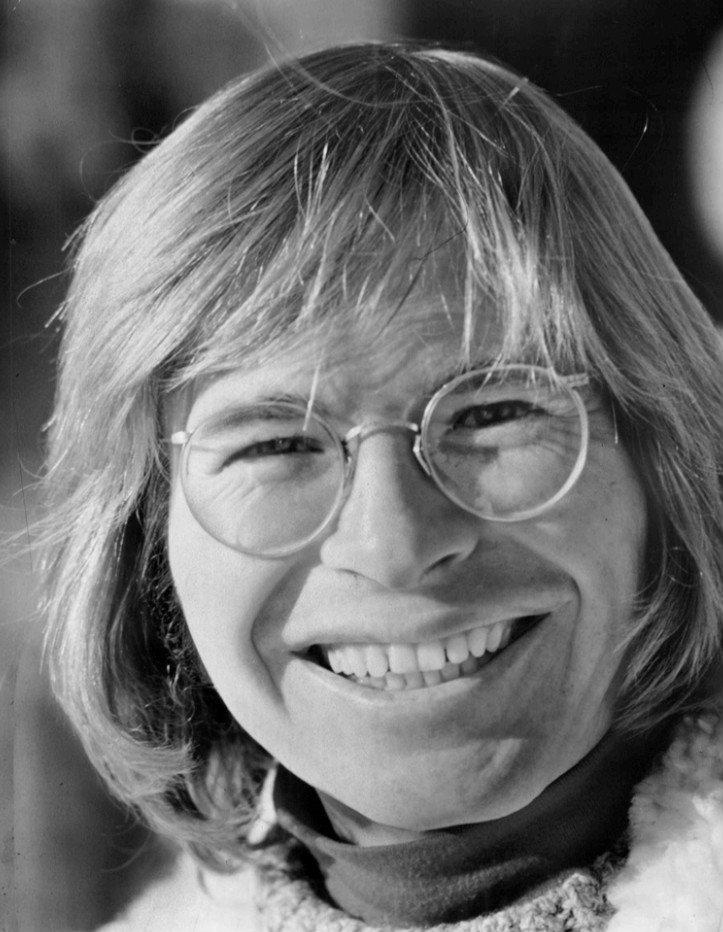
He was the clean-cut troubadour of the 1970s, the blond grinning kid with the wire-rimmed glasses singing about mountains and country roads. John Denver sold the world a vision of pure, sunlit innocence — and for a while, America bought it completely. He was the best-selling performer in the country in the mid-seventies, with four number one singles and three number one albums in a two-year span. But behind the sunshine was a far more complicated man: a military brat who reinvented himself, a songwriter accused of corrupting the youth, a pilot who couldn’t stay out of the sky, and a star whose brightest anthem was written about a place he’d never been.
The Name That Wouldn’t Fit on a Marquee
He was born Henry John Deutschendorf Jr. on December 31, 1943, in Roswell, New Mexico — yes, that Roswell. His father was a U.S. Air Force officer and flight instructor, which meant young Henry grew up on military bases, moving from town to town, never quite belonging anywhere. Music became his anchor. When he started performing, he made a practical decision: “Deutschendorf” would never fit on a theater marquee. He took his stage name from the capital of Colorado, the state whose mountains would define his image and his life. It was a brilliant piece of branding — and a quiet erasure. The Air Force kid from Roswell became “John Denver,” a name that sounded like it had been carved into a mountainside. He spent the rest of his life trying to live up to the authenticity he’d invented.
A Song About a Road He’d Never Seen
“Take Me Home, Country Roads” is West Virginia’s unofficial anthem — one of its official state songs, played at every Mountaineers football game, known by heart across the globe. Here’s the catch: when John Denver recorded it, he had never been to West Virginia. Neither had the song’s co-writers.
The song began with Bill Danoff and Taffy Nivert, a folk duo who were Denver’s opening act. Driving along Clopper Road in Gaithersburg, Maryland, on the way to a family reunion, they started sketching a song about the winding back roads of their youth. They’d never been to West Virginia either — they just liked the way the words sounded. They’d actually been planning to pitch the unfinished song to Johnny Cash. Then, late one night in December 1970 after a show at Washington’s Cellar Door, they played it for Denver at their apartment. He stayed up until dawn helping them finish it, and by the next night they were performing it together onstage. Denver knew instantly. He brought the Danoffs to New York, recorded it with them singing backup — you can hear their voices on the record — and released it in April 1971. It climbed to number two on the Hot 100, became his first hit and the first of thirteen Top 40 singles that decade, entered the Grammy Hall of Fame, and was eventually preserved in the Library of Congress’s National Recording Registry. All for a road none of them had ever driven down. Sometimes the truest songs are the ones you imagine.
Ten Minutes on a Chairlift
If “Country Roads” was a happy accident, “Annie’s Song” was a lightning strike. In January 1973, Denver and his wife Annie Martell were coming through a rough patch in their marriage. He went skiing at Aspen Mountain to clear his head. After conquering a particularly difficult run, exhilarated and flooded with the beauty of the snow and light, he boarded the Ajax chairlift — and the song simply arrived. By the time he reached the top, about ten and a half minutes later, “Annie’s Song” was finished in his head. He skied down, went home, and wrote it down.
Annie later recalled: “It was written after John and I had gone through a pretty intense time together and things were pretty good for us. He skied down and came home and wrote it down. Initially it was a love song and it was given to me through him and yet for him it became a bit like a prayer.” Released in 1974, it became his second number one.
But here’s the part almost nobody knows: when Denver played the new song for his longtime producer Milt Okun, Okun went quiet and told him it had the same melody as the second movement of Tchaikovsky’s Fifth Symphony. Denver walked to the piano, sat down for an hour, and reworked the tune until the only thing remaining from Tchaikovsky was the first five notes. One of the most beloved love songs ever written was nearly a classical accident — saved by an hour of frantic rewriting.
“High” Crimes
In 1972, “Rocky Mountain High” — inspired by a night watching the Perseid meteor shower over Colorado — became a Top 10 hit. It also became a scandal. The Federal Communications Commission, which in those days could lean on broadcasters over drug references, decided that the line about “friends around the campfire and everybody’s high” was about marijuana. Some stations banned the song outright. Denver was bewildered: the “high” was the euphoria of standing on a mountain ridge, the spiritual lift of the Rockies. He’d said so publicly, repeatedly. It didn’t matter. The wholesome poster boy of American folk had been branded a drug pusher by his own government.
He got his revenge thirteen years later. In September 1985, when Tipper Gore’s Parents Music Resource Center hauled the music industry before the Senate demanding warning labels on records, the star witness lineup was surreal: Frank Zappa, Twisted Sister’s Dee Snider — and John Denver. The clean-cut folk singer sat beside heavy metal’s wildest men and calmly dismantled the censors’ case, testifying that “Rocky Mountain High” had been “obviously” misread “by people who had never seen or been to the Rocky Mountains.” He compared the PMRC’s crusade to book burning. It was the most punk-rock moment of his career, delivered in a cardigan.
The Muppet Years
For all his earnestness, Denver had a mischievous streak that found its perfect outlet in felt. His friendship with Jim Henson — forged through guest spots on “The Muppet Show” — produced two beloved television specials, “A Christmas Together” and “Rocky Mountain Holiday,” and some of the most genuinely joyful musical television of the era. Watching Denver sing with a frog takes on a different glow when you know how dark his offstage life could get. He also tried straight acting, starring opposite George Burns in the 1977 hit comedy “Oh, God!” and hosting the Grammy Awards five times. And long before he was famous, he’d already written one of the decade’s defining songs: “Leaving on a Jet Plane,” which Peter, Paul and Mary took to number one in 1969. The kid who couldn’t get a record deal was writing hits for other people — a very Neil Diamond problem to have.
The Activist in the Cardigan
The sunshine image was real — but it was never the whole man. Denver was one of the first major pop stars to throw his fame behind environmental causes, and he did it when it wasn’t fashionable. He founded the Windstar Foundation in 1976, campaigned against nuclear arms proliferation, backed Jimmy Carter’s 1976 presidential campaign, and traveled the world on humanitarian missions. His friendship with Jacques Cousteau produced the hit “Calypso,” a love letter to the explorer’s ship that became one of his signature songs. He testified before Congress not just on censorship but on environmental causes, using his clean-cut credibility as a weapon for the planet.
It cost him. His earnest activism alienated parts of his conservative country audience; his perfectionism and temper strained his marriages and friendships. The man who sang about peace could be, by many accounts, extraordinarily difficult to live with. Denver himself seemed to know the contradiction — the second half of his career was a long attempt to reconcile the symbol with the person, the sunshine boy with the shadows. He never quite managed it, which is precisely what makes him interesting.
Shadows Behind the Sunshine
The sunshine image cracked in the 1980s and ’90s. His marriage to Annie — the woman immortalized in his most famous love song — ended in divorce in 1982. He adopted two children, Zachary and Anna Kate, and later described the breakup of his family as the great wound of his life. There were DUI arrests, very public and very un-Denver-like. He threw himself into environmental activism, founding the Windstar Foundation and campaigning against nuclear arms, sometimes alienating the conservative half of his audience. The man who sang about peace couldn’t find much of it.
And he never stopped flying. His father had been a flight instructor; the sky was in his blood. He held a private pilot’s license with ratings for single- and multi-engine planes, seaplanes, and gliders, plus an instrument rating and even a Learjet type rating. Flying was his escape — and, finally, his end.
The Pilot’s Last Flight
On October 12, 1997, Denver took off from Monterey Peninsula Airport in a newly purchased experimental aircraft, a Rutan Long-EZ with the registration N555JD. It was a strange, beautiful little plane — and it had a lethal quirk. The designer had intended the fuel-selector handle to sit between the pilot’s legs. But the man who built this particular plane disliked having fuel lines in the cockpit, so he’d relocated the handle to the bulkhead behind the pilot’s left shoulder, where it couldn’t be reached from the seat. The fuel gauges were back there too, unmarked, invisible to the person flying.
Denver knew about the problem. That afternoon, he and a mechanic had tried to fix it with a pair of Vise-Grip pliers clamped to the handle to extend its reach. It didn’t work. The mechanic told Denver he had less than half a tank on the right and less than a quarter on the left, handed him a small inspection mirror so he could peer over his shoulder at the gauges, and Denver declined an offer to refuel. He took off anyway.
When the right tank ran dry over Monterey Bay, Denver had to unstrap, twist his whole body ninety degrees to the left, and wrestle the handle behind him. In doing so, his right foot pressed the right rudder pedal — and in a light, twitchy aircraft at low altitude, that was enough. The plane rolled, and there was no room to recover. He was fifty-three. The NTSB’s investigation found no drugs or alcohol in his system — the toxicology was completely negative — just a chain of small, preventable decisions and one badly placed handle. The little inspection mirror was recovered from the wreckage.
John Denver spent his career singing about going home — to country roads, to the mountains, to Annie. In the end, the boy from Roswell who renamed himself after a place he loved never quite found his way back to solid ground. But the songs remain, sunlit and certain, playing at football games and weddings and campfires, carrying millions of people home to places they’ve never been. Which, when you think about it, is exactly what he was doing all along.
Leave a Reply