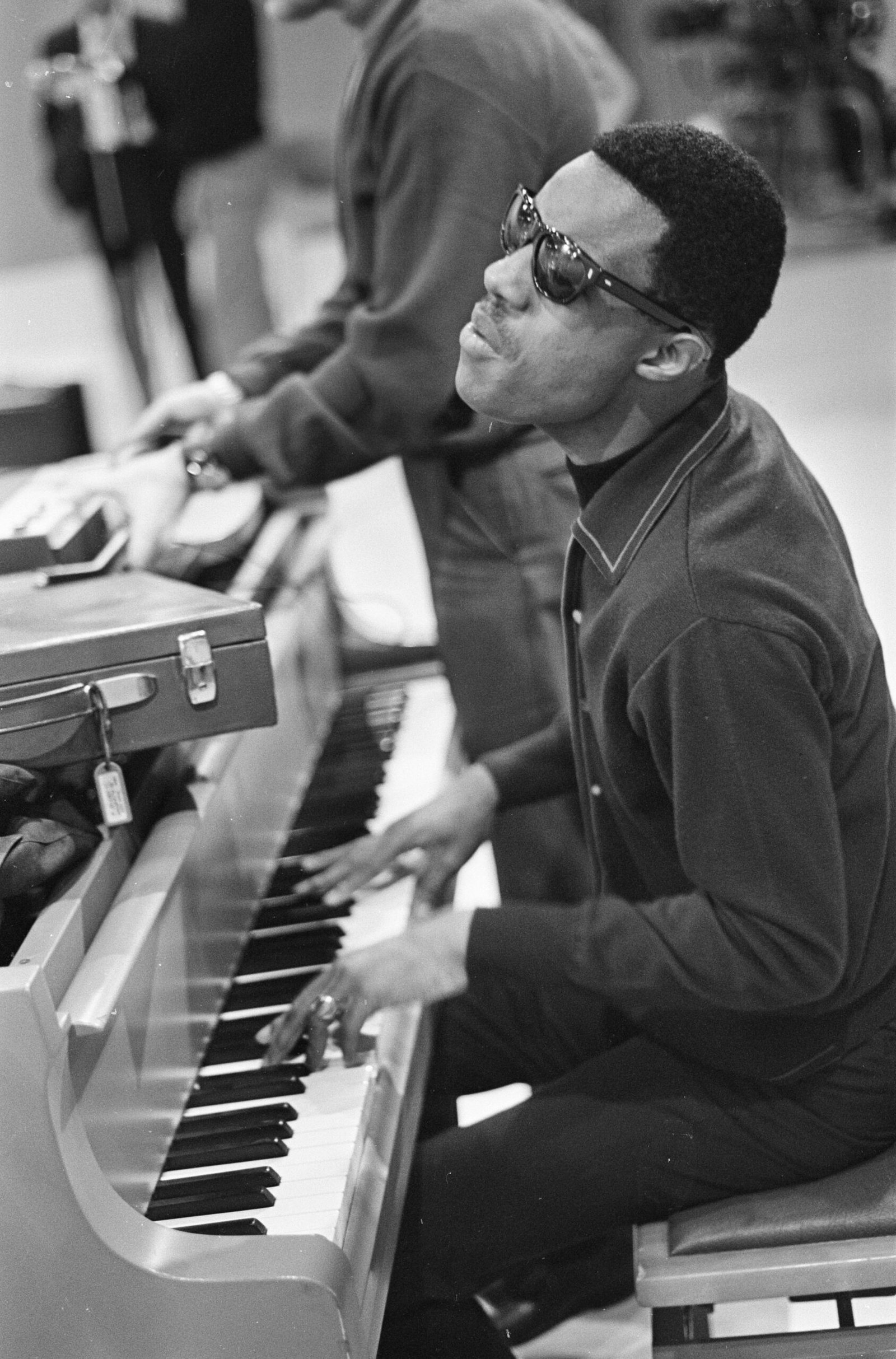
He has been called a genius so often that the word has gone a little numb — but in Stevie Wonder’s case, it was never hype. It was a job description. Blind from infancy, signed to Motown at eleven, a chart-topper at thirteen, and the architect of one of the greatest creative runs in popular music, Wonder didn’t just overcome his circumstances. He built an entire universe out of sound, and then he used that universe to change the law of the land. This is the story of how a premature baby from Saginaw, Michigan, became the man whose music quite literally helped create a national holiday.
The Incubator That Saved Him and Blinded Him
Stevland Hardaway Judkins was born on May 13, 1950, in Saginaw, Michigan — six weeks premature, tiny, his lungs not ready for the world. In 1950, doctors had one answer for a preemie who couldn’t breathe: pump the incubator full of pure oxygen. It saved his life. It also took his sight.
The oxygen-rich atmosphere triggered a condition called retinopathy of prematurity — then known as retrolental fibroplasia. The blood vessels in his underdeveloped eyes grew abnormally, scarred, and caused his retinas to detach. He was not, strictly speaking, born blind; he lost his sight in the first weeks of life, before he had any memory of seeing. Decades later, he would tell an interviewer that his doctor simply didn’t know what medicine knows now about the right amount of oxygen — and that a baby girl born one minute before him didn’t survive the same treatment at all.
Wonder has never treated his blindness as a tragedy. He once said he considered it almost a blessing, because it forced him to judge people by who they are inside rather than what they look like. But it also shaped his relationship with music in a way sighted musicians can only imagine. Deprived of the visual world, he navigated entirely by sound — and sound, in return, gave him everything.
The Twelve-Year-Old Who Topped the Charts
The legend starts, as all great Motown legends do, with Berry Gordy. In 1961, an eleven-year-old Stevie — already a prodigy on piano, harmonica, and drums — sang his own composition for Gordy and was signed to Motown’s Tamla label on the spot. They called him “Little Stevie Wonder,” and the nickname fit: he was a child, and he was a wonder.
What happened next still stands in the record books. In 1963, his live single “Fingertips” — a rollicking, half-improvised party of a record, with Stevie shouting and blowing harmonica over a ecstatic crowd — shot to number one on the Billboard Hot 100. He was thirteen years old, making him the youngest solo artist ever to top the American chart. It was his first number one since — well, ever — and it announced that this was no novelty act.
But the child-star years were nearly the end of him. As his voice changed in his teens, his early hits dried up, and there was a real moment when Motown considered dropping him. The shrill, exuberant kid sound didn’t fit the young man he was becoming. Wonder responded the way he always would: by taking control. He began writing, producing, and playing nearly everything himself, and when his 21st birthday arrived in 1971, he used the expiration of his childhood contract as leverage to negotiate a new deal — with full artistic control and his own publishing rights. It was an almost unheard-of power grab for a Motown artist. It changed the label forever, and it set the stage for the greatest five-year run in soul music history.
The Song That Wasn’t Supposed to Be His
“Superstition” is one of the most recognizable funk records ever made — that snarling clavinet riff, the thundering drums, the horns. What almost no one knows is that Stevie Wonder wrote it for somebody else.
In 1972, Wonder was working on his “Talking Book” album and had struck up a friendship with British guitar hero Jeff Beck, who played on the sessions. As part of their arrangement, Wonder promised to write Beck a song in return. Beck came up with the opening drum beat, Wonder improvised over it, and “Superstition” was born — intended as Beck’s record. But Berry Gordy heard the demo and made an executive decision: this one was too good to give away. Motown rush-released Wonder’s version as a single in October 1972, months before Beck could record his own.
Beck was reportedly furious — and who could blame him? — but the two eventually reconciled and even performed the song together on stage. Wonder’s version hit number one in early 1973, won him Grammy Awards, and became his signature song. It’s a delicious irony: one of the defining records of Stevie Wonder’s career exists because his boss stole it back from the man it was written for.
There’s a charming coda, too. In 1973, Wonder performed “Superstition” on “Sesame Street,” treating the children’s show like any other gig — stretching the song to nearly seven minutes, directing his band through intricate shifts while Muppets danced around them. It’s one of the coolest things ever broadcast on children’s television, and it happened because Stevie Wonder simply didn’t know how to phone it in.
The Crash That Changed Everything
On August 3, 1973, Stevie Wonder released “Innervisions,” the album many consider his masterpiece — a sweeping, socially conscious, musically dazzling record featuring “Higher Ground,” “Living for the City,” and “Don’t You Worry ’bout a Thing.” Three days later, he nearly died.
On August 6, Wonder was traveling through North Carolina in a rented Mercury Cruiser, driven by his cousin, on his way to a benefit concert in Durham. He was asleep in the passenger seat, listening to his own new album on headphones, when the car slammed into the back of a flatbed truck outside Salisbury. The truck bed shattered the windshield and struck him in the head. He suffered a brain contusion and fell into a coma that lasted four days.
His bandmates, traveling behind, pulled his unconscious body from the wreck and rushed him to a hospital in Salisbury; he was later transferred to Winston-Salem’s North Carolina Baptist Hospital for neurological care. For days, the world held its breath. Then came the detail that sounds like something out of a movie: gospel singer Ira Tucker, Wonder’s friend and tour director, walked into the hospital room, leaned into Stevie’s ear, and sang “Higher Ground” — the song from the album released just days before. Wonder’s fingers began moving in time to the music. It was the first sign he was coming back.
He woke with a new sense of mortality and, he said, a feeling of having visited “a much better spiritual place.” He had temporarily lost his sense of smell — a cruel blow for anyone, let alone a musician — and he kept the scar on his forehead for the rest of his life rather than having it removed. Less than a year later, he released “Fulfillingness’ First Finale.” The title wasn’t metaphorical. He had confronted his finale and been pulled back by his own song.
The Song That Made a Holiday
Here’s something most people get wrong about Stevie Wonder’s “Happy Birthday”: it isn’t a birthday song. Not really. It’s a protest song wearing a party hat — and it helped create a federal holiday.
The campaign to honor Dr. Martin Luther King Jr. with a national holiday began in 1968, just days after King’s assassination, when Representative John Conyers introduced a bill in Congress. It went nowhere for over a decade; a 1979 vote failed by just five votes. Then Stevie Wonder got involved. He had met King as a teenager in the 1960s, and the cause was personal.
Wonder wrote “Happy Birthday” after what he described as a vivid dream — in the dream, he told Coretta Scott King, he was marching with petition signs to make King’s birthday a national holiday. He called King’s widow to tell her about it, then went to work: a four-month concert tour that doubled as a holiday awareness campaign, rallies on the National Mall in Washington, D.C., a lobbying office he personally funded, and the song itself — with its pointed lyric insisting there ought to be a law against anyone who takes offense at celebrating King’s birthday — released on his 1980 album “Hotter Than July.”
The campaign worked. On November 2, 1983, President Ronald Reagan signed the bill creating Martin Luther King Jr. Day, first observed in January 1986. A pop song didn’t single-handedly change the law — but Wonder’s relentless, years-long campaign, with “Happy Birthday” as its anthem, moved the needle when a decade of congressional effort had stalled. How many musicians can say their discography includes a federal holiday?
The Classic Run
Between 1972 and 1976, Stevie Wonder released five albums — “Music of My Mind,” “Talking Book,” “Innervisions,” “Fulfillingness’ First Finale,” and “Songs in the Key of Life” — that together form one of the most astonishing creative streaks anyone has ever produced. He wrote, produced, arranged, and played nearly everything himself, pioneering the use of synthesizers in soul and R&B and writing about everything from inner-city despair to spiritual transcendence to pure, goofy love.
Consider “Higher Ground,” recorded in a whirlwind session in May 1973: Wonder played every single instrument on the final recording himself, laying down the track in a matter of hours because, as he later said, he felt an almost premonition that something was going to happen — that he had to get it done. Three months later came the crash. The song’s lyrics about reincarnation and second chances took on an eerie new dimension.
And then there was “Songs in the Key of Life,” the 1976 double album (plus a bonus EP) that many call his crowning achievement. It debuted at number one, won Album of the Year, and contained “Sir Duke,” “I Wish,” “Isn’t She Lovely” — written for the birth of his daughter — and “As.” Wonder was 26 years old. He had already been a star for thirteen years. He was just getting started.
The Alias and the Second Home
Even Wonder’s footnotes are fascinating. In 1968, at the height of his teen-idol years, he secretly recorded an album of instrumental soul-jazz — mostly harmonica solos — and released it under the pseudonym “Eivets Rednow.” That’s “Stevie Wonder” spelled backward. The album went nowhere, and its only single, a cover of “Alfie,” barely scraped the chart. But the alias revealed something essential: even then, Wonder was an artist who needed secret doors, private rooms where he could just play.
Decades later, he found another kind of home. In 2024, Wonder took Ghanaian citizenship, describing it as the culmination of a fifty-year dream of uniting people of African descent across the diaspora. For a man whose music had always carried the weight of history — from the civil rights anthems to the MLK campaign — it felt less like a late-career gesture and more like a homecoming.
Stevie Wonder once said he never thought of being blind as a disadvantage, and never thought of being Black as a disadvantage either. “I am what I am,” he said. “I love me!” It’s easy to hear that as a platitude until you look at what he actually did: the child star who seized control of his career at twenty-one, the crash survivor pulled back from a coma by his own song, the pop star who lobbied a holiday into existence. He heard the world differently from the rest of us — and then he spent sixty years teaching us to listen.
Leave a Reply