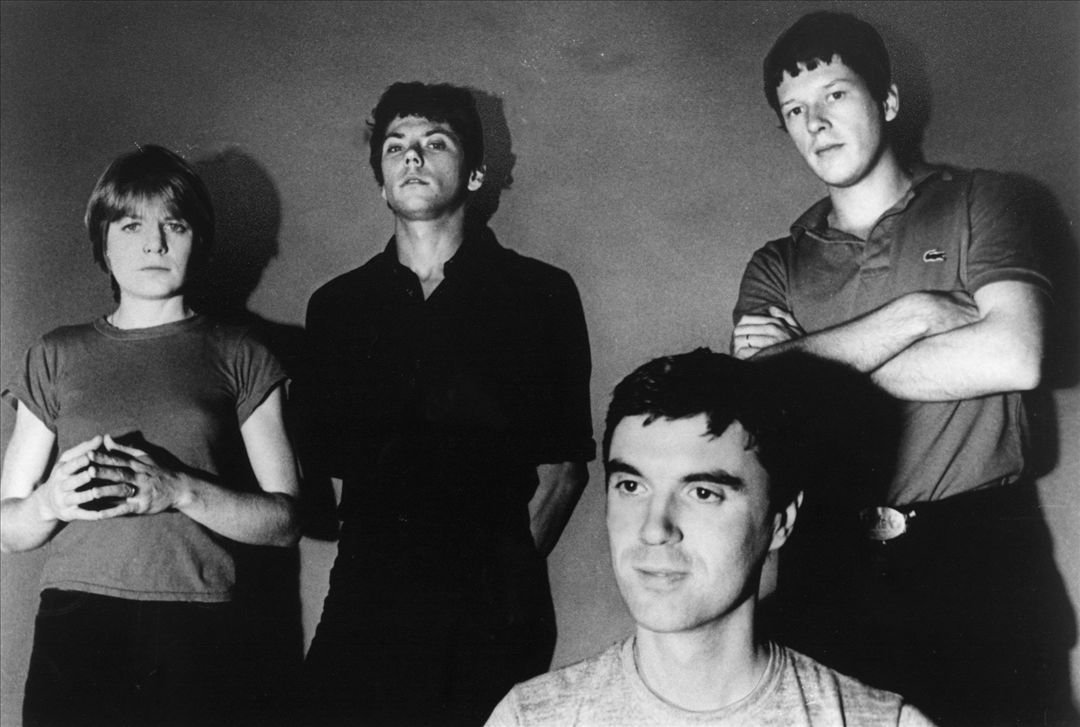
No band ever looked less like rock stars and changed rock more. Talking Heads were four art students who treated the stage as a canvas, the recording studio as a laboratory, and the music video as a short film — and who fell apart so completely that the singer announced the breakup in a newspaper without telling his bandmates. Between the humble beginning and the bitter end lies one of the great creative runs in popular music: eight albums, a landmark concert film the band paid for itself, and a frontman whose oversized suit became as famous as any guitar solo.
“All Content, No Action”
The name came from television, which is fitting for a band that always seemed to be broadcasting from some adjacent dimension. David Byrne, Chris Frantz, and Tina Weymouth met as freshmen at the Rhode Island School of Design, where Byrne and Frantz played in an art-rock combo called the Artistics. When that group folded, the trio moved to New York City in 1975 with no name and no plan beyond finding one. A friend staying with them was flipping through an issue of TV Guide and spotted a term used by TV studios to describe a head-and-shoulders shot of a person talking: a “talking head,” defined as “all content, no action.” As Weymouth later recalled, “It fit.” Byrne, who had been painting candidate names on cardboard circles and mounting them on Frantz’s bass drum, was hooked.
The name was a mission statement disguised as a joke. Talking Heads would spend sixteen years proving that content without action — nervous intellect, deadpan observation, rhythmic obsession — could fill arenas.
The CBGB Debut
On June 5, 1975, Talking Heads played their first gig under that name, opening for the Ramones at CBGB in New York’s East Village. They were a trio then — Byrne on guitar, Frantz on drums, and Weymouth on bass, an instrument she had only recently learned at Frantz’s urging. The first song they ever wrote together, “Psycho Killer,” was in the set that night, complete with Byrne’s French-language bridge, delivered in the anxious yelp that would become his trademark.
The audience that night included Seymour Stein, the co-founder of Sire Records, who had come to see the Ramones — a band he had just signed. Instead, he found himself riveted by the opening act. “I was standing out there with Lenny Kaye,” Stein later recalled, “and all of a sudden I hear music playing. I felt myself just moving more and more… and I was riveted.” Sire signed Talking Heads, and the art students suddenly had a record deal. They would add former Modern Lovers keyboardist Jerry Harrison the following year, completing the classic quartet: Byrne, Frantz, Weymouth, and Harrison, four of the most distinctive musical personalities ever assembled in one band.
The Eno Laboratory
The band’s imperial phase began when they enlisted Brian Eno — the former Roxy Music synthesist turned avant-garde producer — for three consecutive albums: “More Songs About Buildings and Food,” “Fear of Music,” and the masterpiece “Remain in Light.” The collaboration reached its apex on the last of the three, recorded in 1980. Inspired by the Afrobeat of Nigerian bandleader Fela Kuti, the band built the album from extended rhythmic jams, layering interlocking grooves until Byrne and Eno could carve songs out of the sprawl. It was a radical way to make a rock record — the rhythm section composing first, the singer arriving weeks later to find the words.
“Once in a Lifetime,” the album’s signature track, grew out of those sessions, and its video became one of the defining images of the early MTV era. Byrne co-directed it with Toni Basil — yes, the “Mickey” singer, who was also a respected choreographer — and the two of them did genuine research, poring over footage of preachers, religious trances, and ritual movement at California universities. Byrne’s herky-jerky, trance-like dancing in the clip, multiplied across bluescreen backgrounds, was choreographed from that study of ecstatic worship. MTV had launched barely six months earlier and was desperate for content; the strange little film went into heavy rotation and made the band’s art-school weirdness nationally famous.
Taking “Remain in Light” on the road required an equally radical step: the four-piece band expanded into a sprawling funk orchestra, drafting King Crimson’s Adrian Belew on guitar, Parliament-Funkadelic’s Bernie Worrell on keyboards, and a small army of percussionists and backing vocalists. The contrast was delicious — four tense New York minimalists fronting a joyous, polyrhythmic big band — and the resulting shows remain legendary among those who saw them. It was the sound of a band willing to dissolve its own identity in pursuit of a groove.
The Song Born From a P-Funk Chant
“Burning Down the House,” the band’s biggest American hit, has an origin story Tina Weymouth loved to tell. Drummer Chris Frantz had just seen Parliament-Funkadelic in full glory at Madison Square Garden and came home electrified. During a band jam session, he kept shouting the P-Funk audience chant — “Burn down the house!” — over and over. Byrne, intrigued by the phrase’s raw energy, grabbed it and built a song around it. What began as one drummer’s concert afterglow became a Top 10 single in 1983, the moment Talking Heads crossed over from critical darlings to genuine pop stars. It is a perfect emblem of the band’s method: eavesdrop on the world, steal something wonderful, and make it stranger.
The Side Project That Out-Sampled Them All
During a band hiatus in 1981, Frantz and Weymouth — married since 1977 — started a side project called Tom Tom Club, essentially a vehicle for Weymouth’s songwriting and a looser, funkier alter ego to Talking Heads’ tension. Their debut single, “Genius of Love,” was a joyful tribute to the Black funk, soul, and reggae artists they adored, namechecking everyone from James Brown to Bob Marley over a bubbling, minimalist groove.
Nobody expected what happened next. “Genius of Love” became one of the most sampled records in music history. Its DNA runs through Mariah Carey’s “Fantasy” — one of the defining hits of the 1990s — and through dozens of hip-hop and dance records since, all the way to Latto’s “Big Energy” in the 2020s. The royalties from other artists’ borrowings have likely earned Weymouth and Frantz more than most of Talking Heads’ own catalog. It is one of pop’s great ironies: the “side project” became a foundational text of modern music, sampled into immortality while the main band was busy being serious.
The Film They Paid For Themselves
By 1983, Talking Heads were at their commercial peak, touring behind “Speaking in Tongues.” Director Jonathan Demme — fresh off “Melvin and Howard” and years before “The Silence of the Lambs” — proposed filming the show. No studio would finance it on the band’s terms, so the band did something almost unheard of: they raised the $1.2 million budget themselves.
What Demme captured over four nights at Hollywood’s Pantages Theatre in December 1983 is widely considered the greatest concert film ever made. “Stop Making Sense” opens with Byrne alone on a bare stage, carrying an acoustic guitar and a boombox, performing “Psycho Killer” to an empty room. Song by song, the band assembles around him — Weymouth, then Frantz, then Harrison, then the expanded touring lineup with Bernie Worrell, Alex Weir, Lynn Mabry, Ednah Holt, and Steve Scales — while stagehands visibly build the set in real time. It is a film about the joy of construction, musical and otherwise.
And then there is the suit. Midway through the show, Byrne disappears for a costume change while Tom Tom Club — Frantz and Weymouth’s side band, folded into the concert — perform “Genius of Love.” Byrne returns wearing an enormous, absurdly oversized gray business suit, his head appearing tiny above its vast shoulders, to perform “Girlfriend Is Better.” The big suit, which Byrne designed as an exaggerated theatrical costume, became one of the most recognizable images in rock history — a visual joke about success, conformity, and the smallness of the individual inside the corporate uniform. In 2021, the Library of Congress selected “Stop Making Sense” for preservation in the National Film Registry, an honor rarely granted to concert films.
The Breakup by Newspaper
For all the onstage joy, the band was quietly coming apart. Byrne grew increasingly controlling in the studio and increasingly distant outside it, pouring his energies into solo projects, film scores, and collaborations. The other three kept the faith, assuming the long silence after 1988’s “Naked” was just another hiatus.
They learned otherwise from the newspaper. In December 1991, Byrne told the Los Angeles Times’ Sunday pop column, in passing, “You could say (we’ve) broken up, or call it whatever you like.” Frantz later said the band was “shocked to find out about Byrne’s departure via the Los Angeles Times,” adding the immortal line: “As far as we’re concerned, the band never really broke up. David just decided to leave.” Weymouth called Byrne “a very controlling person.” The split turned openly bitter, with Frantz accusing Byrne of taking sole songwriting credit for music the whole band had created.
Byrne, to his credit, has owned his part. In a 2023 interview, he called himself “a little tyrant” in those years and admitted the breakup “wasn’t handled well” and was “kind of ugly.” The four did reunite briefly — and frostily — for their 2002 Rock and Roll Hall of Fame induction, their only performance together in decades, and again for Q&A appearances around the film’s acclaimed 2023 re-release. But Talking Heads, as a working band, ended the way so many great partnerships end: not with a farewell concert, but with a sentence in a newspaper.
The others did not sit idle. In 1996, Frantz, Weymouth, and Harrison recorded an album as the Heads — “No Talking, Just Head” — drafting a rotating cast of guest vocalists to fill Byrne’s unfillable shoes. And the band’s legacy has only grown: Harrison and Belew have toured performing “Remain in Light” in full, and on June 5, 2025 — fifty years to the day after that first CBGB gig — Talking Heads released a new music video, a quiet reminder that the content, at least, never stopped.
Talking Heads proved that rock music could be brainy without being boring, rhythmic without being dumb, and strange without being alienating. They took a phrase from a TV Guide, a chant from a funk concert, and a suit several sizes too large, and built a body of work that still sounds like the future. The goodbye was ugly. The music never was.

Public domain (1977 Sire Records publicity photo), via Wikimedia Commons
Leave a Reply