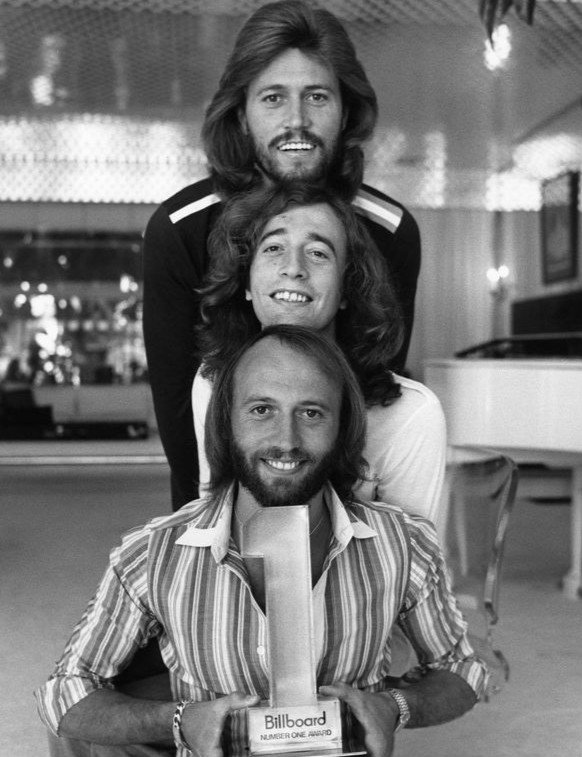
They were supposed to be a footnote. Three brothers from the Isle of Man who sang themselves hoarse at an Australian speedway, got mistaken for the Beatles, broke up, made up, invented disco, were destroyed by disco, and then quietly wrote half the hits of the eighties for other people. The Bee Gees survived every catastrophe the music industry could throw at them — except, for a while, success itself. This is the story of Barry, Robin, and Maurice Gibb: the most resilient harmony in pop history.
What’s in a Name?
Almost everything you think you know about the name “Bee Gees” is wrong. It does not stand for “Brothers Gibb” — or at least, it didn’t start that way. The story begins in August 1958, when the Gibb family emigrated from Manchester, England, to Redcliffe, Queensland, Australia. Barry was eleven; twins Robin and Maurice were eight.
To raise pocket money, the boys sang between races at the Redcliffe Speedway, usually standing on the back of a truck that drove around the track during intervals. The crowd threw coins onto the track for them. Speedway promoter and driver Bill Goode, who had hired them, introduced them to Brisbane radio DJ Bill Gates — no relation to the Microsoft founder. Gates suggested they call themselves the “BGs,” after the initials of Bill Goode, Bill Gates, and Barry Gibb. The name was later stylized into “Bee Gees,” and only after Goode and Gates faded from the picture did the world assume it had always meant “Brothers Gibb.”
Before that, they had been the Rattlesnakes, then Wee Johnny Hayes and the Bluecats. “BGs” was the first name that stuck — a tribute not to brotherhood, but to two Australian showbiz hustlers who gave three kids their first break.
The Beatles Hoax
In early 1967, armed with an Australian hit (“Spicks and Specks”) and demos their father had mailed to Brian Epstein, the brothers sailed back to England and auditioned for Epstein’s associate Robert Stigwood. He signed them on the spot and declared them “the most significant new musical talent of 1967,” spending a fortune — reportedly over £50,000 in 1967 money — to launch them.
Then came one of the great marketing cons in pop history. Their international debut single, “New York Mining Disaster 1941” — written by Barry and Robin in a darkened stairway at Polydor’s offices during a power cut, about a mining tragedy that never actually happened — was mailed to radio stations with a blank white label listing only the song title. DJs, primed by Stigwood’s hype, leapt to the obvious conclusion: this had to be a secret new Beatles single. They played it in heavy rotation. The rumor mill even suggested “Bee Gees” was code for “Beatles Group.”
It worked. The song reached the top twenty in both Britain and America. Paul McCartney himself, after Stigwood played him the track, reportedly said, “Sign them, they’re great.” The brothers had arrived in England as unknowns; within months, they were being compared to the biggest band on earth — partly because their manager had tricked the world into making the comparison.
The Song Otis Redding Never Sang
Their follow-up single carried its own ghost story. At Stigwood’s request, Barry and Robin wrote “To Love Somebody” as a soul ballad in the style of Sam & Dave, tailor-made for one specific voice: Otis Redding’s. Redding had met Barry at the Plaza Hotel in New York, told him he loved the brothers’ material, and asked Barry to write him a song. Barry went downstairs that same night and wrote it.
Redding died in a plane crash in December 1967 before he could ever record it. The Bee Gees cut it themselves, and it became their second American hit, reaching number seventeen. Decades later, in a 2001 interview, Barry offered a startling revision: the song, he said, had really been written for Stigwood himself. “It was for Robert. I say that unabashedly. He asked me to write a song for him, personally. It was written in New York and played to Otis but, personally, it was for Robert. He meant a great deal to me.” A love song with two muses — one who died too soon, one who made them stars.
Breaking Up and Making Up
Fame nearly killed them before disco got the chance. By 1969, the pressure of constant recording, touring, and sibling rivalry cracked the trio open. The flashpoint was almost comically small: which song should be the next single. Robin wanted his “Lamplighter”; Barry and Maurice preferred “First of May.” Robin lost the vote — and quit the band.
He launched a solo career, scoring a British number-two hit with “Saved by the Bell,” while his brothers carried on as a duo. Maurice, meanwhile, married pop star Lulu in 1969, a union that lasted until 1975. For eighteen months, the Bee Gees didn’t exist. Then, in August 1970, the brothers reconciled and reformed — older, warier, and about to enter the strangest decade of their lives.
Bingo Halls to Miami
By 1974, the Bee Gees were washed up. Their records stiffed, their sound was dated, and they were reduced to playing dinner clubs in northern England — crooning over bingo games at places like the Batley Variety Club to crowds more interested in beer than ballads. Salvation came from an unlikely source: Eric Clapton, who had rebuilt his own career recording in Florida, suggested they try Criteria Studios in Miami.
They took the advice, teamed with Atlantic producer Arif Mardin, and started over from the rhythm section up. The comeback single, “Jive Talkin’,” gave them their first American number one in four years — and its groove had the oddest origin imaginable. Driving to the studio each day across a Miami causeway, Barry began vocalizing a scratchy rhythm to match the thump of the car’s tires on the bridge expansion joints. That bumpy commute became the song’s opening pulse.
Then came the accident that changed pop singing forever. Recording “Nights on Broadway” for the “Main Course” album, Mardin felt the track needed more urgency and asked if any of the brothers could, as Barry later quoted him, “scream in tune.” Barry stepped to the microphone and unleashed a piercing, powerful falsetto he had never known he possessed. “My whole life I never knew I could do this,” he marveled years later. The scream became the “blaming it all” refrain, the single reached number seven, and Barry Gibb’s falsetto — the most imitated voice in disco — was born in a Miami studio as a joke that worked.
The Night Fever Sessions
In 1977, the brothers were holed up at the Château d’Hérouville in rural France, working on a new studio album, when Stigwood called with an emergency. He was producing a low-budget film about Brooklyn disco culture and needed songs — fast. The Bee Gees handed over what they had: “Stayin’ Alive,” “Night Fever,” and “How Deep Is Your Love,” none of them written with the film in mind. Barry would later insist “Stayin’ Alive” was never really about dancing at all, but about survival and striving for a better life — which is why it fit a movie about a desperate kid from Bay Ridge so perfectly. The film was even retitled around their music: it had been called simply “Saturday Night” until “Night Fever” convinced the producers to add the fever.
The recording of “Stayin’ Alive” produced one of the great studio legends. Midway through the sessions, drummer Dennis Bryon had to rush home to England after a death in the family. Rather than hire a replacement, producer Albhy Galuten and engineer Karl Richardson took two bars of drums from the already-recorded “Night Fever,” copied them onto a loop of quarter-inch tape, and draped the tape around the control room — literally running it over microphone stands — to create a repeating backbeat. It was one of the first drum loops on a hit record, years before sampling existed. As a joke, they credited the drums to a fictitious “Bernard Lupe,” a play on session great Bernard Purdie — and for years, people tried to hire the nonexistent Mr. Lupe.
The loop was so good they used it twice more: on “More Than a Woman,” and — sold to an outsider — on Barbra Streisand’s 1980 smash “Woman in Love.” “Stayin’ Alive” itself sold an estimated 34 million copies, making it one of the best-selling singles of all time. Four weeks at number one. A strut down a Brooklyn street that became the defining image of the seventies.
Disco Demolition and the Wilderness
Then the world turned. The disco backlash crested in 1979 — most infamously at Chicago’s Disco Demolition Night, when thousands of records were blown up on a baseball field — and the Bee Gees, as the faces of the genre, became its most prominent casualties. American radio effectively blacklisted them; “Bee Gee-free weekends” became a programming stunt. The biggest band in the world couldn’t get arrested.
So they did what great songwriters do: they wrote for everyone else. Barry Gibb wrote the title song from “Grease” (a number-one for Frankie Valli in 1978). The brothers wrote “Islands in the Stream” for Kenny Rogers and Dolly Parton, “Woman in Love” for Barbra Streisand, and “Heartbreaker” for Dionne Warwick — a string of smashes that kept the Gibb machine humming while their own records gathered dust. When they finally returned to the top themselves with “You Win Again,” a British number one in 1987, it felt less like a comeback than a reminder: they had never actually left.
The Last Brother Standing
The final chapters are the hardest. Younger brother Andy Gibb — a solo heartthrob with three straight number-one singles of his own — died of heart failure in March 1988 at just thirty. Maurice died suddenly in January 2003 from complications of a twisted intestine; Barry and Robin retired the Bee Gees name in grief, reviving it in 2009. Robin succumbed to cancer in May 2012. Of the three boys who sang on the back of a truck in Queensland, only Barry remained.
He has carried the harmony alone ever since — a celebrated 1997 “One Night Only” reunion concert in Las Vegas stands as the classic lineup’s last great statement, and Frank Marshall’s 2020 HBO documentary “How Can You Mend a Broken Heart” finally gave their story the epic treatment it deserved.
The Bee Gees were mistaken for the Beatles, anointed kings of disco, exiled from radio, and reborn as the ghostwriters of the eighties. Through breakups and backlash and unbearable loss, the one thing that never broke was the blend — three voices from the same blood, finding each other in the dark. From a speedway in Redcliffe to a billion streams and counting: stayin’ alive was never just a song title. It was the family business.
Leave a Reply