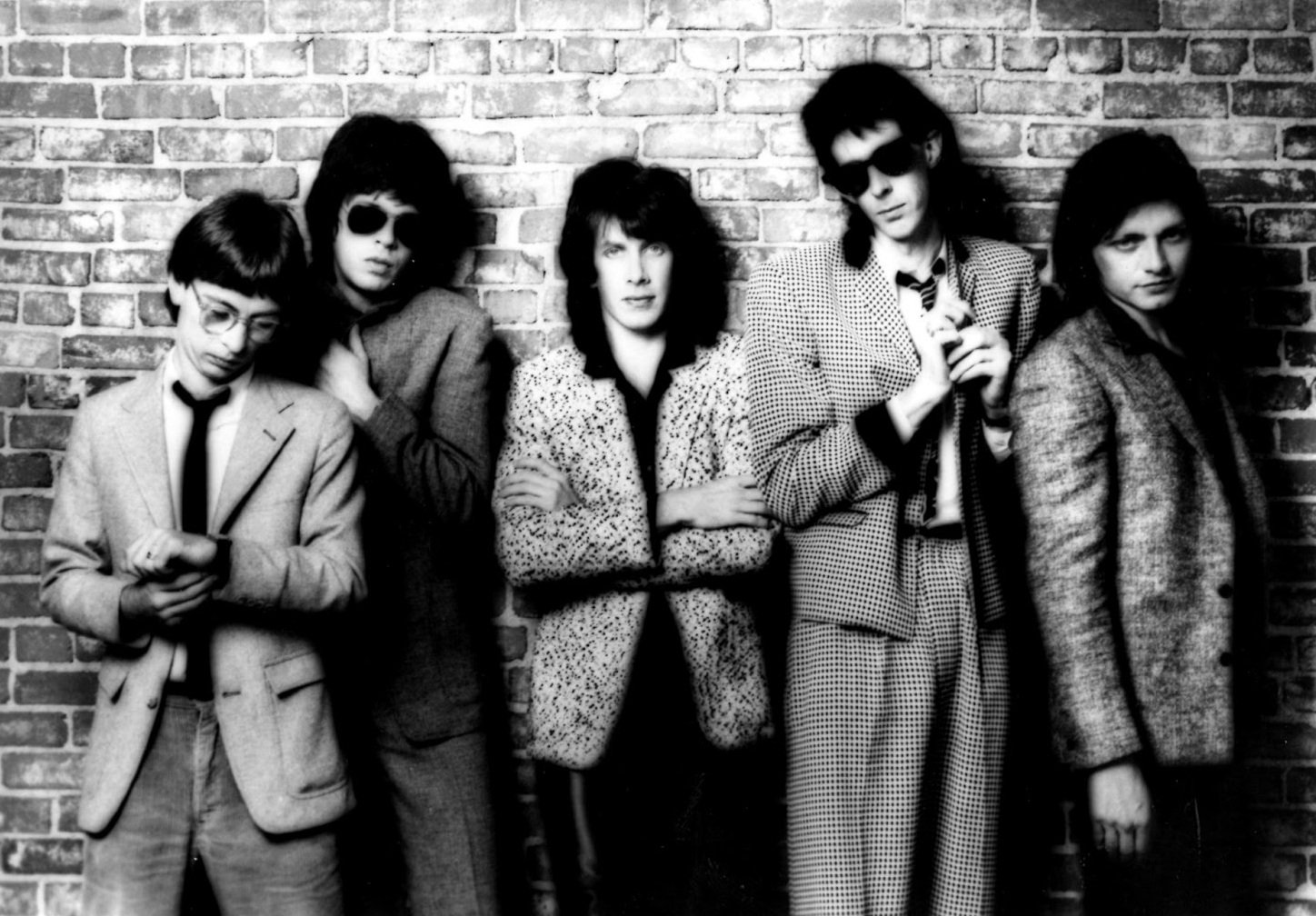
They looked like robots and sounded like the future. Five oddly-matched Bostonians in matching skinny ties, fronted by a six-foot scarecrow with jet-black hair and a voice like a bored telegram — and for a decade, nobody on earth made smarter, stranger, more perfect pop singles. The Cars sold millions, defined MTV’s first golden age, and then watched their story curdle into one of rock’s saddest finales: a dead bassist, a shattered marriage, and a frontman found lifeless in his Manhattan townhouse, a cup of coffee growing cold nearby. But before the ending, there was the most improbable hit machine of the new wave era. This is how it happened.
The Big 5 Show
It started, of all places, on a local Cleveland TV variety show. In 1965, a twenty-one-year-old named Richard Otcasek caught a performance by a local band called the Grasshoppers on “The Big 5 Show” and was struck by their bass player — a charismatic kid named Benjamin Orzechowski. The two became friends, then bandmates, then musical brothers for life. They played Columbus and Ann Arbor in a series of failed bands with gloriously sixties names: ID Nirvana, Milkwood. Milkwood even released an album, “How’s the Weather,” in 1973 — a gentle folk record that sank without a trace and broke up the band.
Otcasek and Orzechowski shortened their names to Ocasek and Orr, moved to Boston in the early seventies, and kept grinding. Inspired by the Velvet Underground, Roxy Music, and Jonathan Richman’s Modern Lovers, they formed a proto-punk outfit and cycled through lineups. Nothing caught fire. Then drummer David Robinson — himself a Modern Lovers alumnus — joined up, took one look at the band’s ill-assorted appearance, and imposed order: a red, white, and black color scheme, a streamlined sound, a new name. The Cars. With guitarist Elliot Easton and keyboardist Greg Hawkes completing the lineup, the machine was assembled. Their first official show was on New Year’s Eve, 1976, at Pease Air Force Base in New Hampshire. Eleven years after that TV variety show, Ocasek and Orr were finally going somewhere.
Two Weeks in London
The Cars spent 1977 playing every club in New England, honing a nine-song demo that Boston radio stations WBCN and WCOZ started playing heavily — the rare case of a band getting signed off the strength of local airplay alone. Two labels came calling — Arista and Elektra — and the band chose Elektra, the label with fewer new-wave acts, where they wouldn’t get lost in the shuffle. Elektra sent them to London to record their debut with Roy Thomas Baker, the flamboyant producer behind Queen’s operatic excesses.
Baker’s polish met Ocasek’s deadpan minimalism, and the result was alchemy. The entire debut album was cut in about two weeks. “The Cars,” released in June 1978, reached number eighteen and stayed on the Billboard chart for an astonishing 139 weeks, selling six million copies. “Just What I Needed,” “My Best Friend’s Girl,” “Good Times Roll” — the singles kept coming, each one a three-minute masterclass in tension between Easton’s rockabilly-on-steroids guitar solos and Hawkes’s icy synthesizers. Even the packaging was art: drummer David Robinson designed the album’s collage-style inner sleeve, stuffed with photos and lyrics, and “My Best Friend’s Girl” was issued as one of the first commercially available picture discs. The Rolling Stone readers’ poll named them Best New Artist. “Candy-O” followed in 1979, its cover painted by pin-up legend Alberto Vargas, and the Cars were officially the smartest band in America.
The Video the Singer Hated
By 1984, the Cars were custom-built for the medium that was eating the music business: MTV. Their fifth album, “Heartbeat City,” produced by AC/DC and Def Leppard mastermind Mutt Lange, spawned a string of sleek hits. And its wildest moment was the video for “You Might Think” — a special-effects fantasia in which Ocasek, rendered as a fly, a monster, and various other creatures, pursues a woman through a house of horrors. Director Jeff Stein pitched the concept and the band howled; one member suggested they all just play on a turd in a toilet bowl instead.
Ocasek hated the finished video. He thought it made fun of his looks — the lanky frame, the jutting features he’d always been self-conscious about. But the joke was on his insecurity: “You Might Think” won Video of the Year at the very first MTV Video Music Awards in 1984, beating Michael Jackson’s “Thriller.” It also became the first music video ever acquired for the permanent collection of the Museum of Modern Art. The video its own singer despised was officially fine art. Only in the eighties.
The “Heartbeat City” videos kept the surrealism coming. For “Magic,” the band filmed a chaotic pool party at the Hilton family house in Beverly Hills, with Ocasek strolling across the water’s surface — an illusion created by a hidden plexiglass platform just beneath the surface. Viewers were baffled; the trick was pure stagecraft. And in 1981, flush with cash, the band had bought their own Boston recording studio, Intermedia, renaming it Syncro Sound — the first studio owned by the band, where they cut the “Shake It Up” album on their own turf, on their own clock.
Who’s Gonna Drive You Home
The biggest hit of the Cars’ career was the one that sounded least like them. “Drive” — a haunted, glacial ballad sung not by Ocasek but by Benjamin Orr, whose smooth, aching tenor gave the song its wounded soul — climbed to number three in the US and number five in the UK in the summer of 1984. It was the crown of “Heartbeat City,” an album that spun off four Top 12 singles, and it confirmed something fans had sensed all along: for all Ocasek’s vision and songwriting, the band’s biggest moments belonged to Orr’s voice. He sang lead on “Just What I Needed,” on “Let’s Go,” and now on “Drive” — the secret weapon hiding in plain sight, the warm heart inside the cold machine. Ocasek had written it; Orr had made it immortal. And its video carried a backstory worthy of a movie.
Fresh off his Oscar win for “Ordinary People,” young actor Timothy Hutton wanted to try directing. He happened to mention to his next-door neighbor — who happened to be the Cars’ manager — that he loved “Drive.” The manager mentioned it to Ocasek. Days later, Hutton was directing his first music video, and he needed a leading lady: “an attractive, exotic woman who has something fierce about her.” The casting call found a nineteen-year-old Czech supermodel named Paulina Porizkova. Hutton put her and the forty-year-old Ocasek in a hotel room to rehearse. The chemistry was instant and real. Within a few years, Ocasek had left his second wife and married Porizkova. A music video had rearranged two lives.
The Song Bowie Borrowed
In July 1985, “Drive” acquired a second, stranger immortality. At Live Aid, David Bowie — introducing a devastating CBC film montage of the Ethiopian famine at Wembley Stadium — chose “Drive” as its soundtrack. Played against images of starving children on giant screens in London and Philadelphia and on televisions worldwide, Orr’s gentle vocal became the sound of a generation’s conscience. The single re-entered the charts, and the band donated the new proceeds to the Band Aid Trust.
The Cars themselves played the Philadelphia show that day, taking the stage at JFK Stadium at 5:39 in the afternoon — sandwiched between Kenny Loggins’s “Footloose” and Neil Young’s extended set, a mid-card slot that told you everything about how stacked the bill was. They opened with “You Might Think” (cut from the official DVD), then Orr took the vocals for “Drive” and “Just What I Needed.” It wasn’t their finest hour as a live band — the Cars were never really a live band — but for one afternoon, their coldest, most detached song was the warmest thing on earth.
The Producer in the Shadows
While the Cars idled between albums, Ocasek built a second career that may be his most influential legacy. He became the go-to producer for the American underground: Suicide’s harrowing electronics, Bad Brains’ hardcore fury, Romeo Void’s art-punk. Then, in 1994, a geeky Los Angeles quartet called Weezer handed him their debut. Ocasek polished their nerdy power-pop into “The Blue Album,” one of the defining records of the nineties, and went on to produce Hole, Nada Surf, Guided by Voices, and No Doubt. The man with the deadpan voice turned out to have the warmest ears in the business — he heard the hit in bands nobody else understood yet.
His own solo career flickered alongside: “Emotion in Motion” cracked the top twenty in 1986, and he even tried acting, playing a beatnik painter in John Waters’s 1988 film “Hairspray” — a gloriously odd cameo for the most stone-faced man in rock, standing around with a paintbrush while Waters’s Baltimore chaos swirled. But the Cars were winding down. “Door to Door” in 1987 landed with a thud, and in 1988 the band split. Orr cut a solo album, “The Lace,” whose single “Stay the Night” was a top-forty hit and an MTV staple. The machine was parked. Nobody knew the next chapter would be a eulogy.
The Goodbye Nobody Saw
Benjamin Orr died first, of pancreatic cancer, on October 3, 2000. He was 53. The surviving Cars stayed mostly quiet for a decade, then — remarkably — reunited in 2010, recording “Move Like This” and touring without their late bassist, because, as they put it, it sounded like fun. In April 2018, they took their final bow together at the Rock and Roll Hall of Fame induction, playing four songs with Weezer’s Scott Shriner filling Orr’s impossible spot.
Seventeen months later, the story ended. On September 15, 2019, Paulina Porizkova — separated from Ocasek after 28 years of marriage, the separation announced on social media the previous year — stopped by his Manhattan townhouse to bring him coffee. She found him dead. He was 75, though some reports, citing public records, said 70 — Ocasek had been shaving years off his age for decades, a final deadpan joke. He’d been recovering from surgery, living with hypertension and emphysema. The death was ruled natural causes. The lanky kid from the Cleveland variety show, the robot-voiced architect of the eighties, was gone — found by the woman he’d met in a music video, holding coffee.
The Untold Story of the Cars is about the distance between surface and soul. They looked like machines and sang like androids, but underneath were two kids from Ohio who never stopped writing perfect three-minute songs — one of whom gave the band its voice, the other its vision, and both of whom left too soon. Put on “Drive” tonight. It’s still the warmest cold song ever recorded.
Leave a Reply