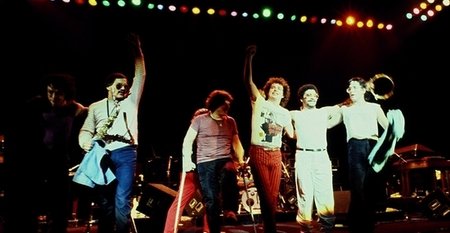
Toto is the great paradox of rock history: a band of studio musicians so talented that half the records you love from the 1970s already had their fingerprints on them — who then became superstars almost by accident, won six Grammys in a single night, lost their drummer in one of the strangest deaths in rock, and watched their biggest song become a billion-view internet meme forty years later. They never set out to be famous. Fame just kept finding them in the studio.
The Word on the Tape
Toto formed in Los Angeles in 1977, and its members were already legends behind the glass. Keyboardist David Paich and drummer Jeff Porcaro had played together for years as first-call session musicians, appearing on records by Sonny & Cher, Seals & Crofts, and Steely Dan. Paich had co-written much of Boz Scaggs’s silk-smooth “Silk Degrees” album. They recruited bassist and fellow session veteran David Hungate, Grant High School classmates Steve Lukather (guitar) and Jeff’s younger brother Steve Porcaro (keyboards), and former S.S. Fools singer Bobby Kimball.
The band’s name came from pure studio practicality. At their first recording sessions, Jeff Porcaro wrote the word “Toto” on the band’s demo tapes so they could tell their reels apart from everyone else’s in the studio. When the group still needed a name after finishing the album, bassist David Hungate pointed out that the Latin phrase “in toto” means “all-encompassing” — fitting for six musicians who had played virtually every genre there was. For a while in the early 1980s, the band told the press they were named after Dorothy’s dog in “The Wizard of Oz.” The truth was more boring and more perfect: they were named after a piece of tape.
The Busiest Men in Hollywood
Before Toto ever had a hit of its own, its members were the secret ingredient in other people’s classics. Jeff Porcaro was arguably the most in-demand studio drummer in rock from the mid-1970s to the early 1990s, playing on hundreds of albums. The band’s fingerprints are all over Michael Jackson’s “Thriller” — the best-selling album of all time. Steve Porcaro co-wrote “Human Nature,” one of its dreamiest tracks. Jeff Porcaro’s drums and Steve Lukather’s guitar appear across the record, including the immortal groove of “Beat It.”
Their 1978 debut album, powered by the Top 5 single “Hold the Line,” made them stars in their own right and earned a Grammy nomination for Best New Artist. But critics never quite knew what to do with them: too polished for rock, too rocking for pop, too anonymous-looking for MTV. Toto’s revenge was simple — they just kept playing on everyone else’s records, collecting royalties and reputations while the spotlight looked elsewhere.
The Slump Before the Summit
What makes the “Toto IV” triumph so remarkable is how close the band came to losing its record deal first. After the debut’s success, 1979’s “Hydra” underperformed — though it still went gold and produced the single “99,” a moody, futuristic track inspired by George Lucas’s cult film “THX 1138” (a song Steve Lukather would later confess is one of his least favorites). Then came 1981’s “Turn Back,” a deliberate lurch into heavier arena rock with fewer keyboards. It flopped almost everywhere — except Japan, where the single “Goodbye Elenore” unexpectedly broke through and made the band permanent touring royalty there. Japan has been a staple of Toto’s touring schedule ever since.
By 1981, Toto hadn’t had a North American hit in nearly two years, and Columbia was losing patience. The band was, in the most literal sense, playing for its career when it walked into Sunset Sound to make “Toto IV.” Desperation, it turns out, was the missing ingredient.
The Song Nobody Wanted
The making of “Africa” is one of rock’s great comedy-of-errors stories. In the summer of 1981, Toto was rushed into Sunset Sound in Hollywood to record “Toto IV” under heavy pressure from Columbia Records — the previous two albums had underperformed, and the label needed a hit. “Africa” was the last song recorded for the album, and keyboardist David Paich, who wrote it with Jeff Porcaro, practically had to beg his bandmates to take it seriously. “We’re from North Hollywood!” was the gist of the objection. “What do we have to sing about Africa?”
Paich persisted, and the band finally committed. The song — all shimmering keyboards, otherworldly percussion, and that soaring chorus — was released as a single in late 1982 and went to No. 1 on the Billboard Hot 100 in February 1983. Its video, directed by Steve Barron, cast Paich as a researcher in a library being closed in on by the jungle, and it played endlessly on MTV. “Africa” became Toto’s signature, then its albatross, then — decades later — its resurrection, as the internet adopted it as the ultimate earnest anthem, streaming it past a billion plays on both Spotify and YouTube.
The album’s other giant, “Rosanna,” carries its own delightful footnote. At the time, Steve Porcaro was dating actress Rosanna Arquette, and everyone assumed the song was about her. Songwriter David Paich has insisted for decades that it isn’t — the name just fit the melody. Sometimes a song is about a girl. Sometimes it’s just about a syllable.
The Grammy Sweep and the Fall
“Toto IV” was a commercial and critical monster: triple platinum, three Top 10 singles, and six Grammy Awards in a single night — including Album of the Year, Record of the Year for “Rosanna,” and Producer of the Year. For one evening in 1983, the anonymous session men were the most celebrated band on earth.
The fall came fast. Bassist David Hungate quit right after the album’s success, feeling that fame would keep him from his family in Nashville. Lead singer Bobby Kimball spent early 1983 facing drug prosecution — the charges were dismissed that May — but was fired from the band in 1984 anyway, with Lukather citing vocal problems and missed sessions. At one point the band offered the lead singer job to Richard Page of Mr. Mister; he turned them down to stay with his own band. Toto cycled through Fergie Frederiksen and then Jean-Michel Byron before landing, in 1986, on Joseph Williams — the son of film composer John Williams — who sang the hits “Pamela” and “Stop Loving You.” The revolving door never really stopped spinning.
The Night the Heartbeat Stopped
On the evening of August 5, 1992, Jeff Porcaro — the band’s co-founder, de facto leader, and, in Lukather’s words, its heartbeat — was doing yard work at his home in Hidden Hills, California, spraying insecticide in his garden. He fell ill, collapsed, and by the time paramedics arrived he had no pulse. He was pronounced dead that night at Humana Hospital-West Hills. He was 38 years old.
What followed was almost as painful as the loss. The doctors who treated him attributed the heart attack to an allergic reaction to the pesticide. Weeks later, the Los Angeles County coroner issued a different ruling: death by heart attack due to occlusive coronary artery disease, with no trace of pesticides in his system but traces of cocaine in his blood — implying prolonged drug use had hardened his arteries. Lukather was furious, calling the coverage “irresponsible journalism” and insisting the amount found was minuscule — “two crystals on a matchstick.” He and Porcaro’s family maintained that Jeff had an undiagnosed heart condition, worsened by heavy smoking, and that the pesticide had entered his system while he gardened without gloves.
The truth, as with so many rock deaths, remains contested. What isn’t contested is the hole it left. Paich and Lukather, gathering in the awful days afterward, briefly agreed the band was over. A memorial concert that December at the Universal Amphitheatre drew an all-star lineup — George Harrison, Don Henley, David Crosby, Eddie Van Halen — a testament to how many great records Jeff Porcaro had quietly powered. Toto eventually carried on with Simon Phillips on drums, but the band’s center of gravity was gone forever.
The Brother They Rallied For
Tragedy struck the Porcaro family again. In February 2010, the band announced that Mike Porcaro — who had replaced Hungate on bass back in 1982 and played with Toto for a quarter-century — had been diagnosed with amyotrophic lateral sclerosis (ALS), Lou Gehrig’s disease, forcing his retirement. Less than two years after Lukather had declared Toto finished, the band reformed for a run of benefit shows to raise money for Mike’s care and for ALS awareness. The 2010 reunion lineup — Lukather, Paich, Phillips, Steve Porcaro, Joseph Williams, and bassist Nathan East — became the “real” Toto again, and the band has essentially never stopped touring since.
It was a rare happy twist in a saga full of sad ones: the session wizards, who had spent their youth making other people sound great, coming back together not for a record or a Grammy but for a brother.
Still Holding the Line
Toto never repeated the chart dominance of “Toto IV,” but they outlasted almost everyone. They were inducted into the Musicians Hall of Fame and Museum in 2009 — a fitting honor for the ultimate musicians’ band — and became permanent road warriors, huge in Japan and Scandinavia, releasing albums into the 2010s and finally deciding, after 2018’s “Old Is New,” to stop making studio records altogether. Steve Lukather remains the only original member still recording and touring under the name; Paich, retired from the road, still makes guest appearances. In 2022 they launched the “Dogz of Oz” tour opening for Journey, and Joseph Williams — back for his third stint as lead singer — was still nailing the high notes.
And then there is “Africa.” Dismissed, even by the band, as a lightweight oddity, it has become one of the most durable songs of the rock era — a billion YouTube views, a Weezer cover that was itself a hit, placements in shows from “Stranger Things” to “South Park,” countless memes, and stadium singalongs. David Paich had to talk his bandmates into recording it. Forty years later, it is the reason most young people know the band’s name at all.
Toto’s story is really the story of the people behind the curtain — the players whose names you never learned but whose grooves you hummed for decades. They wrote their name on a piece of tape so they wouldn’t lose their demos, and somehow that name ended up in the Grammy history books, on a billion screens, and in the permanent collection of the world’s memory — with Jeff Porcaro’s unmistakable groove still sitting underneath half the hits of the 1980s. Not bad for a bunch of session guys from North Hollywood who had nothing to sing about Africa.
Leave a Reply