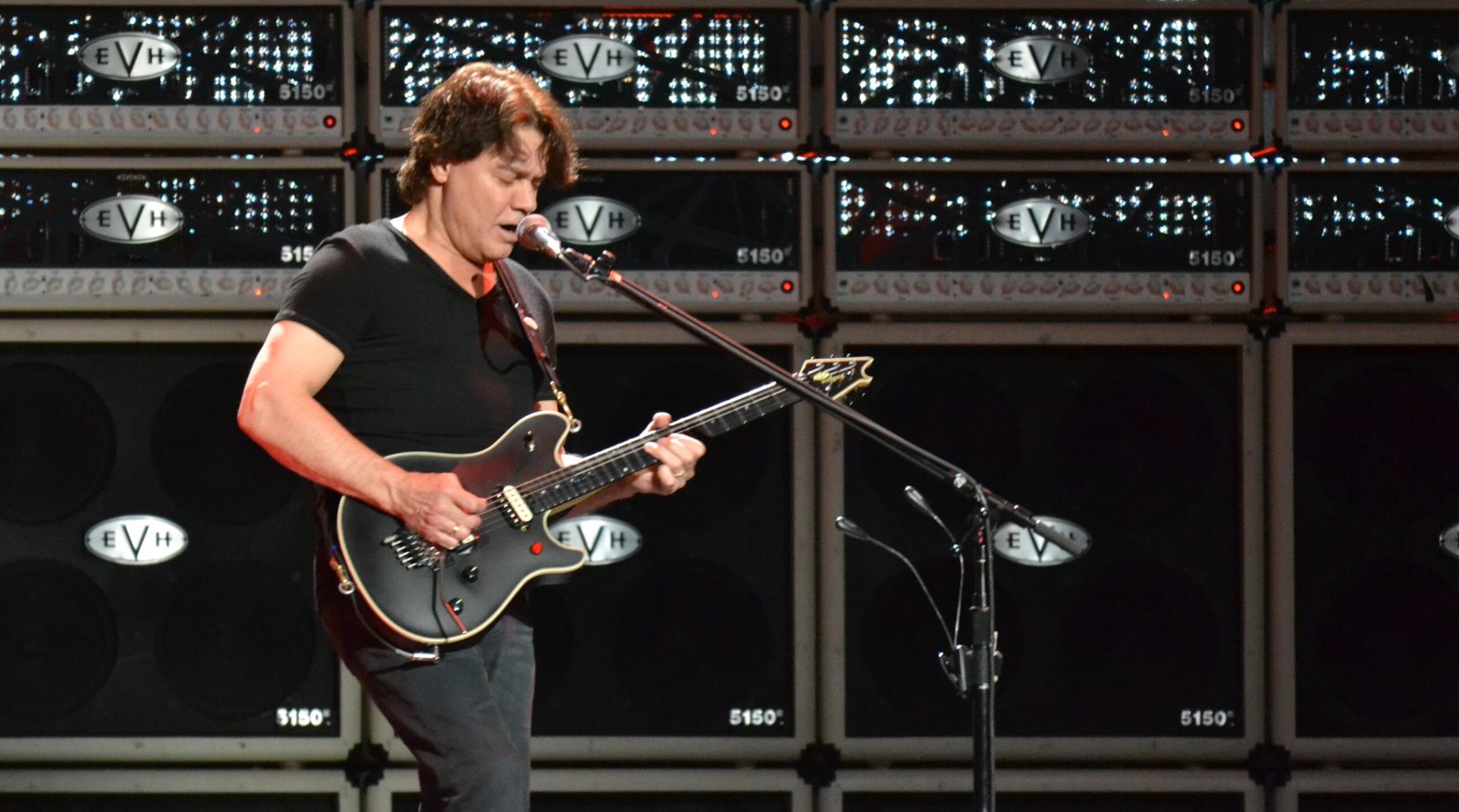
Strip away the pyrotechnics, the Frankenstrat, the sold-out stadiums, and Van Halen was always, at its core, a family story. Two brothers from the Netherlands who crossed an ocean with almost nothing and conquered America with everything they had. A father who gave them music and died too soon. A son who became his father’s bandmate and his brother’s keeper. And a guitar hero whose greatest legacy isn’t a solo but the children he helped put instruments into the hands of — thousands of them, in schools across America. Behind the loudest band in America beat one of the tenderest, most generous hearts in rock.
Fifty Dollars and a Piano
The Van Halen story begins not in Pasadena but in Amsterdam. Eddie was born on January 26, 1955; his older brother Alex on May 8, 1953. Their father, Jan Van Halen, was a Dutch jazz musician — a saxophonist, clarinetist, and pianist who played the clubs of the Netherlands. Their mother, Eugenia, was Indonesian. Music wasn’t a hobby in that house; it was the air they breathed. Eddie’s earliest memory, he once said, was of hearing his father downstairs in his music room, holding a single note on his clarinet for as long as he could.
In the early 1960s, the family emigrated to America — the story goes that they arrived with roughly fifty dollars and a piano, because Jan insisted the piano come with them. They settled in Pasadena, California, where the Dutch brothers were outsiders: bullied for their accents, poor among the comfortable, different in every way that matters to children. Eddie later recalled kids mocking the way they spoke, the way they dressed, the food their mother packed. Their parents’ answer was music. Both boys were drilled in classical piano, practicing for hours while other kids played outside, and Eddie — who never learned to read music — won competition after competition by ear and memory, playing with a feeling that judges couldn’t ignore. The discipline was strict, even harsh, but it forged something unbreakable: two brothers who could communicate without words, in music.
Then rock and roll arrived, and everything changed. The pianos were pushed aside. And in a twist that decided music history, the brothers initially chose the “wrong” instruments: Eddie took up drums, Alex took up guitar. It didn’t last. Alex kept sneaking onto Eddie’s drum kit, and Eddie discovered the guitar — and, as Alex later told NPR, “when Ed played the guitar, he made it sing.” They switched, and the world tilted on its axis — the drummer became the guitar god, the guitarist became the thunder behind him, and neither ever looked back.
Jan’s Clarinet
Jan Van Halen never became famous, but he lived to see his sons conquer the world — and he got one beautiful moment of his own. In 1982, when Van Halen recorded their album “Diver Down,” they needed a clarinet for their cover of the 1924 jazz tune “Big Bad Bill (Is Sweet William Now).” There was only one man for the job. The sixty-year-old Jan, nervous and out of practice — he had lost part of a finger years before — sat in the studio with his sons, sheet music on a stand, and played.
Alex later recalled the session with Rolling Stone, describing his father’s nerves and the beauty of the moment: they were all just equals in the studio, playing — not rock stars and a session man, but a family making music. Eddie remembered it too — how he himself had to read the chart because there were so many chords, sitting next to his father, both of them with music stands, the jazzman and the guitar hero meeting in the middle of a 1924 pop song. It was the only time Jan Van Halen ever appeared on a Van Halen record. He died in December 1986, at sixty-six — almost the same age his son Eddie would be when he died decades later. The clarinet solo on “Big Bad Bill” remains: a father’s voice, preserved in wax, playing alongside his boys.
Alex never forgot. In 2024, he published “Brothers,” a memoir of his life with Eddie — a love letter to the kid brother he had played beside since childhood, the musical telepathy they shared, the grief of losing him. “He played guitar from the moment he woke up to the moment he went to sleep,” Alex told NPR. For Alex, the band was never really about fame. It was about family.
Valerie, Wolfgang, and the Light of His Life
In 1980, at a Van Halen concert in Shreveport, Louisiana, Eddie met a young woman backstage who had come with her brothers: Valerie Bertinelli, the beloved star of the sitcom “One Day at a Time,” then at the height of her fame as America’s sweetheart. Eight months later, on April 11, 1981, they were married — the guitar hero and the girl next door, the most unlikely and most beloved rock romance of the eighties.
For ten years they waited, and then, in March 1991, their son Wolfgang was born — named, the family said, for Mozart. Eddie was transformed. Bandmates and friends describe a man utterly devoted to his boy, teaching him music, taking him on tour, beaming with a pride that dwarfed anything he felt about his own fame. Wolfgang grew up in studios and soundchecks, and in 2006, at just fifteen, he joined Van Halen on bass — playing beside his father and his uncle, the third generation of the family’s music.
The marriage didn’t survive — Eddie and Valerie separated in 2001 and divorced in 2007, worn down by the familiar rock demons of addiction and excess, by the pressures of two enormous careers and a lifestyle that forgave nothing. But their love for Wolfgang never wavered, and in the end, it was Wolfgang who held his father’s hand through the final battle. Eddie married publicist Janie Liszewski in 2009, and by all accounts found a measure of peace in his final decade. But Valerie remained, as she wrote after his death, his soulmate in the ways that mattered — the mother of his child, the keeper of their shared history, the woman who visited him every day in his final weeks.
The Battle He Couldn’t Win
In 2000, when Wolfgang was just nine years old, Eddie was diagnosed with tongue cancer. A third of his tongue was removed in surgery, and in 2002 he was declared cancer-free — a reprieve the family cherished. Eddie, with characteristic dark humor, blamed the disease on the metal guitar picks he used to hold in his mouth. He quit smoking, eventually got sober after rehab in 2007, and threw himself back into music with the hunger of a man granted a second chance.
But the cancer came back. Around 2014 it appeared in his throat; in 2017 he was diagnosed with stage four lung cancer. He fought it the way he played guitar — relentlessly, inventively, refusing to surrender a single note. He sought treatments in Germany, kept working, kept smiling that famous impish grin, kept his illness largely private while those closest to him watched the bravest battle of his life. On October 6, 2020, Edward Lodewijk Van Halen died at St. John’s Hospital in Santa Monica, surrounded by Wolfgang, his wife Janie, and his brother Alex. He was sixty-five. Wolfgang announced it himself, in a message that broke the internet’s heart: “My father… has lost his long and arduous battle with cancer this morning.”
The tributes poured in from every corner of music — but the most moving came from the family. Valerie posted broken-heart emojis and, later, revealed his final words to her. Alex lost not just a bandmate but the brother he had played beside since they were children with switched instruments. And Wolfgang lost his father, his teacher, his hero.
Seventy-Five Guitars
Here is the Eddie Van Halen the world should remember alongside the guitar god: the giver. In 2012, Eddie donated seventy-five guitars from his personal collection to the Mr. Holland’s Opus Foundation, a nonprofit that puts instruments into underfunded school music programs. The guitars were distributed to nine schools across Los Angeles County — to kids who had never held a real instrument, from a man who knew exactly what one could mean.
“If I can help a kid discover a liking, or even a passion for music in their life, then that’s a wonderful thing,” Eddie said. “Music has provided a good life for me, and, hopefully, it can help make life better for others.” He didn’t just write a check; he showed up. In December 2013, he made a surprise visit to the Foshay Learning Center in Los Angeles, spending the afternoon with twenty-seven young musicians, sharing stories about what music had meant to a poor immigrant kid from Pasadena — and personally teaching one lucky student the intro to “Ain’t Talkin’ ‘Bout Love.”
After his death, it was revealed that Eddie had left the foundation a seven-figure bequest in his will — described by the organization as “transformative,” a gift that would put instruments into thousands more young hands for years to come. And Wolfgang carried the torch: his debut solo single, “Distance” — a heartbreaking tribute to his father, released in November 2020 with a video full of home movies — donated its proceeds to the foundation. In 2024, Wolfgang and the Van Halen family gave another $100,000. The immigrant kid with the piano had come full circle: the boy who was given music was giving it to everyone, and his son was making sure the giving never stopped.
The Music Plays On
Van Halen the band ended with Eddie — there was never any question of continuing without him, and Alex has said the band is finished. But Van Halen the family plays on: in Alex’s memoir, in Wolfgang’s thriving solo career, in the thousands of schoolchildren making noise on Eddie’s guitars, in every kid who picks up an instrument because a Dutch immigrant’s son showed them what was possible. The tapping and the harmonics will be studied forever. But the heart — the father’s clarinet, the brother’s memoir, the seventy-five guitars — that’s the part that will never fade.
The brothers’ story began with fifty dollars and a piano, and it became the great American rock and roll epic — but its truest chapters were never about fame. They were about a father holding one clarinet note, two brothers switching instruments and finding destiny, a son joining his father’s band, and a guitar hero giving away seventy-five guitars to strangers’ children. Loud as Van Halen was, their real legacy is quiet: the music they gave away, and the love that made it.
Leave a Reply