He is rock’s great enigma — the “Belfast Cowboy” who turned mysticism into a chart career, the singer who can sound like an angel and act like a thundercloud, often in the same evening. Journalists have spent sixty years trying to decode Van Morrison, usually by asking about the music. But the answers were always in Belfast: in a terraced house on Hyndford Street, in a shipyard electrician’s record collection, in a mother’s stagecraft and a father’s obsession — and in the family ties, frayed, mended, and enduring, that shaped everything he ever sang.
125 Hyndford Street
George Ivan Morrison was born on August 31, 1945, at 125 Hyndford Street in Bloomfield, East Belfast — an only child, in a modest terraced house in a working-class Protestant neighborhood. The Belfast of his childhood was a city of shipyards and factories, of rain and hymns and sectarian certainties. It was also, for a boy with ears, a city full of music: the skiffle craze, the showbands, the American records drifting across the Atlantic.
Hyndford Street would become sacred ground in Morrison’s mythology. Decades later, on “Hymns to the Silence,” he would sing “On Hyndford Street” — a spoken-word reverie about his childhood that names the street like a prayer. Fans now make pilgrimages to the little house, marked by a brass plaque from the Belfast Blues Appreciation Society. It is the closest thing rock has to a shrine built for a living man, and it tells you everything about how Morrison sees himself: not as a star who transcended his origins, but as a Belfast boy who carried them with him everywhere.
The Belfast Bands
Before the mystic, there was the showband grinder. As a teenager, Morrison played saxophone and harmonica with the Monarchs, a Belfast showband, touring military bases in Europe and learning the unglamorous craft of entertaining a crowd — four sets a night, every request honored. It was a hard education, and it made him a professional before he was twenty.
Then came Them. Formed in Belfast in 1964, the band became the city’s answer to the Rolling Stones — raw, ferocious, and fronted by a nineteen-year-old Morrison who sang like a man three times his age. Their version of “Gloria” — a three-chord garage-rock classic Morrison wrote himself — became a standard, covered by everyone from the Doors to Patti Smith. For a brief, blazing moment, Them were the hottest band in Britain, and Morrison was the wild-eyed kid from Hyndford Street howling his way to the top. The band burned out fast, as bands do, but “Gloria” never died. He was still playing it with the Caledonia Soul Orchestra in 1973 — the Belfast teenager’s song, transformed by horns and strings, the past carried triumphantly into the present.
George’s Record Collection
The defining figure of Morrison’s childhood was his father, George Morrison — a shipyard electrician by trade, but a music obsessive by calling. In the early 1950s, George worked for a time in Detroit, and he returned with something extraordinary: one of the largest record collections in Northern Ireland.
Think about what that meant in 1950s Belfast. While other kids were hearing whatever the BBC chose to play, young Van had a private university of American music at home: Muddy Waters and Lead Belly, Mahalia Jackson and Solomon Burke, Charlie Parker and Jelly Roll Morton, Woody Guthrie and Hank Williams and Jimmie Rodgers, Ray Charles. The blues, gospel, jazz, country, and folk — the entire root system of modern popular music — was sitting on shelves in a terraced house in Bloomfield.
George gave his son his first guitar at age eleven. But the greater gift was the collection itself: an education no school could provide, and a standard no ordinary career could meet. Every note Van Morrison ever sang was measured, consciously or not, against Muddy Waters and Mahalia Jackson. His famous perfectionism, his impatience with mediocrity, his refusal to phone anything in — it all starts here, in a boy who grew up knowing exactly how great music could be.
Violet — Singer and Tap Dancer
Less celebrated but just as important was his mother, Violet Stitt Morrison — a singer and tap dancer in her youth, a performer who understood the stage from the inside. If George gave Van his record collection, Violet gave him his showmanship: the sense of timing, the physicality, the knowledge that a song is not just notes but a performance.
The parents’ story has a lovely late chapter. Years later, George and Violet moved to California and opened a record store in Fairfax — Caledonia Records, named for their son’s mythic word for home. Picture it: the Belfast couple who raised a legend, selling vinyl in Marin County, the father’s obsession become the family business, the mother who once tap-danced now presiding over the counter. The collection that started in a terraced house in Bloomfield ended up on shelves in California. The circle, as Morrison might say, was complete.
Janet Planet
Morrison’s first marriage belongs to the strangest chapter of his career. In the late 1960s, tangled in a brutal contract dispute with Bang Records — the label he later said left him never receiving royalties for “Brown Eyed Girl” — he married Janet Planet Rigsbee, partly in the context of visa and deportation pressures that threatened his ability to stay and work in America. She had a young son, Peter, from a previous relationship, whom Morrison helped raise.
Janet was more than a footnote. She appeared on the cover of “Tupelo Honey” (1971), the album Morrison wrote as a kind of love letter to their life together — one of the warmest, most open records he ever made, all domestic bliss and country-soul sunshine. And in 1970, she gave birth to his daughter, Shana Morrison. But the marriage could not survive the pressures around it — the legal battles, the touring, Morrison’s own restlessness — and it ended in divorce in 1973. That same year, Morrison returned to Belfast for the first time since 1966, a pilgrimage that would feed directly into the haunted introspection of “Veedon Fleece.” The personal and the artistic, in his life, were never separate.
Shana Morrison — The Singer
Of all Morrison’s children, Shana has lived most in the public eye — and entirely on her own terms. Born in 1970, she grew up around music and eventually became a singer-songwriter herself, working in a soulful, jazz-inflected style that honors her father’s legacy without imitating it.
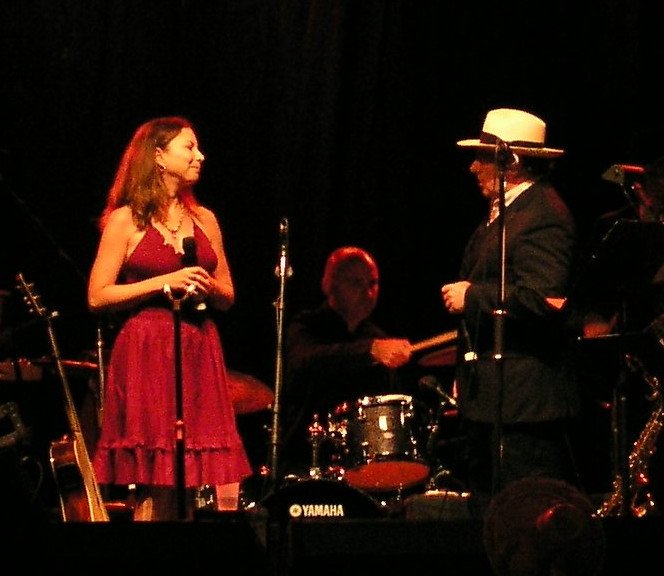
The father-daughter bond has played out, movingly, on record. Shana duetted with Van on “A Night in San Francisco” (1994) and on “Days Like This” (1995) — performances where you can hear the pride in his voice, the famously guarded man letting his guard down for his girl. There is something deeply touching about hearing that gruff, uncompromising voice soften beside his daughter’s. For an artist so protective of his privacy, these collaborations were a rare public window into his heart. Whatever complications marked Morrison’s romantic life, his devotion to Shana was never in doubt. She was the child of the “Tupelo Honey” years, the living link to the happiest chapter of his young adulthood, and he has championed her career with a father’s fierce, quiet loyalty.
Michelle Rocca and the Later Family
Morrison’s second marriage, to Irish journalist, model, and television presenter Michelle Rocca — whom he met in 1992 — brought a late second family. The couple had a daughter, born in February 2006, and a son, born in August 2007 — children born when Morrison was in his sixties, a full generation after Shana.
The marriage eventually ended in divorce, and Morrison, true to form, has said almost nothing about it publicly. He guards his private life with a ferocity rare even among rock stars. But the bare facts tell their own story: a man who became a father again at an age when most men are becoming grandfathers, who chose, twice in one lifetime, to start over with young children. For all his reputation as a recluse and a curmudgeon, Van Morrison kept choosing family — kept choosing the chaos and joy of children, the thing his own parents had given him in that terraced house in Bloomfield.
Coming Home
And then there is the homecoming — the long, slow reconciliation between the exile and his city. Morrison left Belfast in the sixties and spent decades as a wanderer: London, New York, California, Ireland again. But Belfast never left him. It is in every “Caledonia,” every “Hyndford Street,” every misty Celtic invocation in his songs.
The most moving symbol of that bond is “Days Like This.” Released in 1995, the song became an unlikely anthem of the Northern Ireland peace process — its message of quiet optimism, of ordinary days made golden, was used in television campaigns around the ceasefires. Imagine it: the most private man in rock, the Belfast exile, providing the soundtrack to his homeland’s hope. The boy from Hyndford Street, who had sung about his street like a prayer, watched his song become a prayer for peace.
He has been honored by his city and his country — knighted, celebrated, his 70th birthday in 2015 marked by concerts on Cyprus Avenue itself, the street he made famous in “Astral Weeks,” with fans singing his songs back to him on the very pavement he once walked as a boy. The prodigal son, it turned out, had never really left. He had just been carrying Belfast with him, all along, in every note.
So who is Van Morrison, really? Not the enigma of legend, but something simpler and more moving: a working-class Belfast boy, raised on his father’s records and his mother’s stagecraft, who spent sixty years trying to live up to Muddy Waters and Mahalia Jackson. A man whose marriages faltered but whose devotion to his children never did. A perfectionist who could be impossible, and a father who sang duets with his daughter. An exile who never stopped writing about home, until home finally claimed him back.
The mysticism, the “Celtic soul,” the incantatory concerts — it all comes from Hyndford Street. From a shipyard electrician who worked in Detroit and came home with a treasure. From a singer-dancer mother who knew how to hold a stage. From an only child who listened, and listened, and then spent a lifetime trying to give back what he had been so generously given. The Belfast boy behind the mystic was never hiding. He was just waiting for us to listen as carefully as he did — to the records, to the street, to the silence between the notes where the real story has always lived.
The video above is “Days Like This” — the beloved song that became an unlikely anthem of hope for Northern Ireland, and the beautiful sound of Van Morrison coming home at last.
Leave a Reply