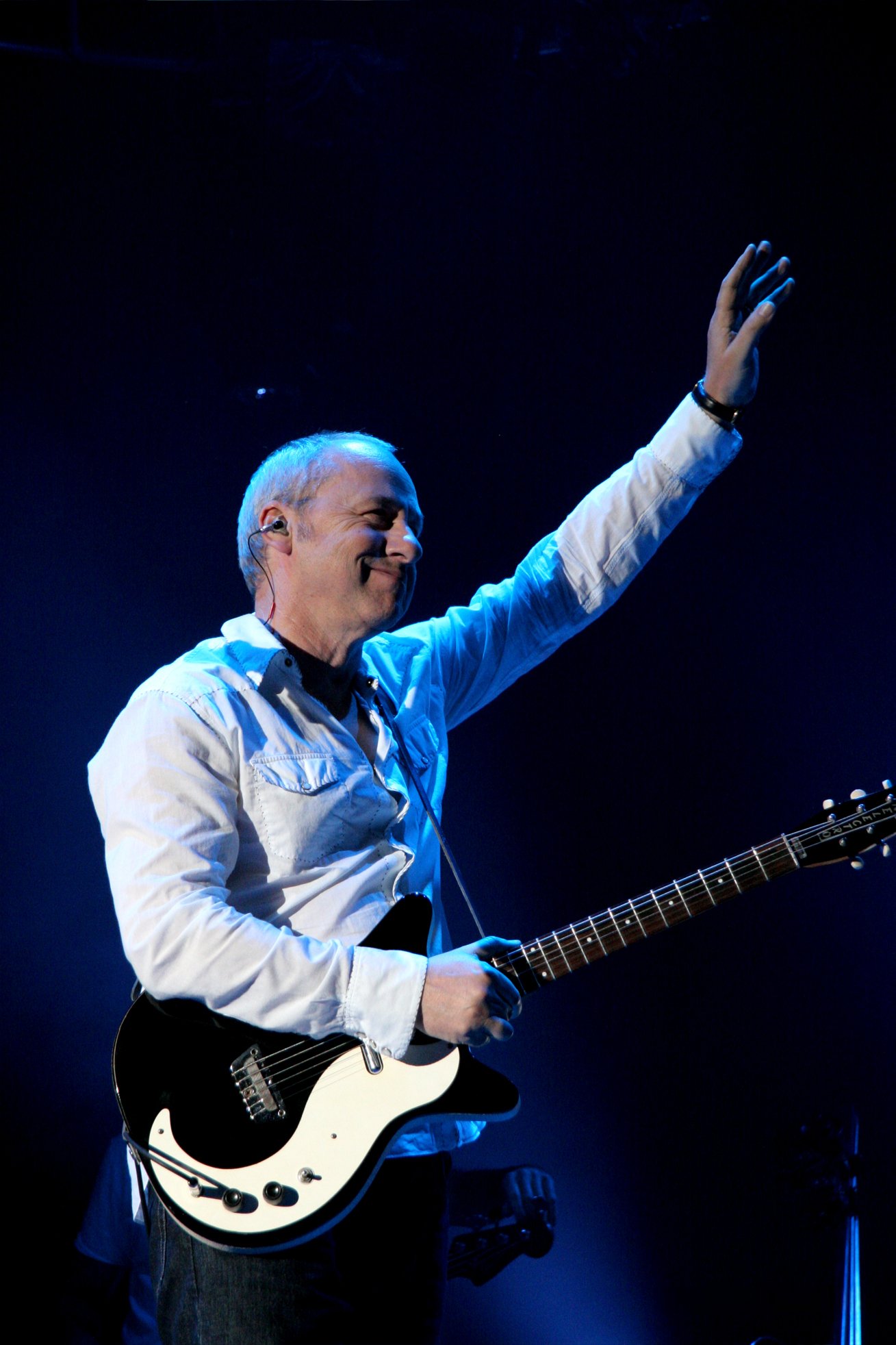
He is one of the greatest guitarists who ever lived, the voice behind “Sultans of Swing” and “Brothers in Arms,” a songwriter of rare literary grace whose fingerpicked lines are instantly recognizable from the first note. And yet Mark Knopfler has spent his entire career avoiding the spotlight — a reluctant star who would rather be reading, watching football, or crossing the street to stare into a guitar shop window. While his peers chased fame, he chased the perfect phrase, the perfect tone, the perfect story — and somehow, the fame came anyway. This is the story of the quietest genius in rock: his roots, his family, his films, and the day he gave away his guitars.
The Boy From Blyth
Mark Freuder Knopfler was born on August 12, 1949, in Glasgow, Scotland — but he grew up in the northeast of England, in Newcastle upon Tyne and the nearby town of Blyth, and it is as a Geordie that he thinks of himself. His background was anything but rock and roll. His father, Erwin Knopfler, was a Hungarian Jewish architect who had fled the Nazis in 1939, arriving in Britain as a refugee. His mother, Louisa Mary Laidler, was an English schoolteacher. It was a household of books, culture, and quiet discipline.
Music came early, through his uncle Kingsley, who played harmonica and boogie-woogie piano — the first live music young Mark ever heard up close, rattling the windows of an ordinary house in the northeast of England. He fell in love with the guitar, teaching himself fingerpicking on a cheap acoustic with a warped neck — an accident of poverty that shaped his entire technique. Unable to afford a proper instrument or lessons, he developed the distinctive fingerstyle approach, without a pick, that would become his signature. The limitation became the gift: that warm, articulate, utterly recognizable touch that made “Sultans of Swing” sound like no other record on earth.
The Reporter and the Lecturer
Before the fame, Knopfler lived a life that sounds like one of his songs. After studying English at the University of Leeds — reading widely, thinking deeply, storing it all away — he worked as a junior reporter for the Yorkshire Evening Post, chasing stories by day and playing guitar in pubs by night. The newsroom taught him economy: say it plainly, say it truly, and let the details do the work. It’s a lesson audible in every song he ever wrote. Every “Sultans of Swing” pub musician, every weary narrator, was observed first and imagined second.
He then spent three years as a lecturer in English at Loughton College in Essex, teaching by day and playing in pubs by night — the classic double life of the almost-famous. In 1973, he finally made the leap, moving to London to join the band Brewers Droop — the first real step toward the life he’d been dreaming about since the warped-neck acoustic, the moment the hobby became the plan. He was in his mid-twenties, old for a rock hopeful, but he brought something the teenagers didn’t have: an education, a work ethic, and a head full of stories. When Dire Straits formed a few years later — with his brother David, bassist John Illsley, and drummer Pick Withers — Knopfler wasn’t a kid with a guitar. He was a writer who happened to play like a dream — and the maturity that set the band apart from the punk generation wasn’t an act. It was the product of a man who had waited his turn and knew exactly what he wanted to say.
Chet, the Films, and “Going Home”
Knopfler’s great guitar hero was Chet Atkins, the American master of fingerstyle guitar — the man who had invented the style Knopfler taught himself on that warped-neck acoustic. The admiration was mutual: in 1990, the two recorded the album “Neck and Neck” together, a meeting of the master and his most devoted student. For Knopfler, it was the fulfillment of a childhood dream — the boy from Blyth, playing alongside the man who had taught him everything, as an equal.
Hollywood came calling, too. Knopfler’s film scores — beginning with “Local Hero” in 1983 — revealed a composer of extraordinary sensitivity, a guitarist who could say as much with silence as with notes. The “Local Hero” theme, “Going Home,” became one of the most beloved pieces of film music ever written: wistful, soaring, instantly recognizable, the sound of longing made melody — the kind of tune that seems to have always existed. It earned a BAFTA nomination and, in a twist no one could have scripted, became the walk-out music for Newcastle United at St. James’ Park — the local boy’s melody greeting his hometown team every match day, forty thousand voices rising to meet it. He went on to score “Cal,” “The Princess Bride,” and “Wag the Dog,” among others, each one marked by that unmistakable touch. And in 1985, at Live Aid, his hero Hank Marvin of the Shadows joined Dire Straits on stage at Wembley — the boy with the warped-neck acoustic, sharing a stage with the man who had taught him to dream, in front of the world.
The Day He Gave Away His Guitars
On January 31, 2024, the music world watched in astonishment as Christie’s in London auctioned 122 of Mark Knopfler’s guitars and amplifiers — the tools of a lifetime, each one worn smooth by his hands. The sale — drawn from a lifetime of collecting — raised a staggering £8,840,160, with bidders from 61 countries competing for pieces of history. It was one of the most significant rock memorabilia auctions ever held, and every lot told a story.
The highlights were breathtaking. His 1959 Gibson Les Paul Standard — the holy grail of electric guitars — sold for £693,000, a record price for the model. His 1983 Les Paul, the guitar heard on “Money for Nothing,” “Brothers in Arms,” and the Live Aid performance, found a new home. But the most moving lot was the last: a 2021 Gibson Les Paul goldtop signed by 33 stars, which sold for £403,200 — every penny going to the Teenage Cancer Trust.
And Knopfler gave away a quarter of the entire hammer price to charity: 25 percent to the British Red Cross, to the wildlife charity Tusk, and to Brave Hearts of the North East, a children’s charity in his beloved northeast — the region that raised him, receiving something back after all these years. “Wherever I go,” he once said, “I’m still crossing streets to look at guitars in the windows.” He had spent a lifetime collecting them, each one a chapter of his story. He gave them up with grace — and gave the proceeds to the world, the way he had always given the music.
A Private Family Man
For all his fame, Knopfler has guarded his private life with unusual determination. He has been married three times: first to his school-days girlfriend Kathy White; then, in November 1983, to Lourdes Salomone, with whom he had twin sons, Benji and Joseph, born in 1987, before the marriage ended in 1993; and finally, on Valentine’s Day 1997 in Barbados, to the British actress and writer Kitty Aldridge, with whom he has two daughters, Isabella and Katya. The family lives quietly in Chelsea, far from the rock-star circus — no reality shows, no tell-alls, no drama. Just a musician, his wife, and their children, living something close to an ordinary life in the middle of London. He is, by every account, a devoted father and a man of simple pleasures: football, reading, long walks, and the guitar — the same pleasures he had before the fame, unchanged by it. Friends describe a man utterly without rock-star pretension, happiest in his studio or at St. James’ Park. He skipped Dire Straits’ induction into the Rock and Roll Hall of Fame in 2018 — not out of bitterness, but out of a genuine disinterest in ceremony. The spotlight was never the point. The music was.
The Guitar Heroes Encore
In March 2024, Knopfler pulled off one of the most extraordinary charity projects in rock history. He re-recorded “Going Home” — the “Local Hero” theme, the melody that had become Newcastle’s anthem — with more than sixty of the greatest guitarists who ever lived: Eric Clapton, David Gilmour, Bruce Springsteen, Brian May, Pete Townshend, Joan Jett, Slash, Ronnie Wood, and dozens more. Sting played bass. Ringo Starr and his son Zak Starkey played drums. Roger Daltrey played harmonica. The track was recorded at Knopfler’s own British Grove Studios in London, produced by his longtime collaborator Guy Fletcher, and wrapped in cover art by Sir Peter Blake — the man behind the “Sgt. Pepper” sleeve.
The track opened with the final recording ever made by Jeff Beck, laid down shortly before his death in January 2023 — a ghostly, beautiful farewell from one master to another, the last notes of a legend opening a song about going home. Released as “Mark Knopfler’s Guitar Heroes,” the single raised funds for the Teenage Cancer Trust and Teen Cancer America, and entered the UK charts at number 18 — a hit parade of guitar heroes, all playing for children they’d never meet. It was the perfect Knopfler gesture: no ego, no spotlight-hogging — just a beautiful song, played by everyone, for children with cancer. The quiet man, conducting a choir of legends — sixty guitar heroes, one beautiful song, and a cause worth playing for. It was Knopfler at his best: generous, humble, and utterly musical to the end. The boy who crossed streets to stare into guitar shop windows had become the man every guitarist wanted to play beside — and he used that power for children with cancer. If that’s not a life well played, nothing is. The quietest genius in rock, making the loudest difference — one song, one guitar, one act of generosity at a time. The crossing continues, and the music plays on, as it always has, as it always will. Somewhere, a kid is pressing his nose to a guitar shop window right now — and the future is tuning up, one fingerpicked note at a time, just like it always has.
The Crossing
Mark Knopfler once said that wherever he goes, he’s still crossing streets to look at guitars in shop windows. It’s the perfect image of the man: the world-famous musician who never stopped being the boy from Blyth, pressing his nose to the glass, still hungry for the next beautiful sound. He gave away his guitars, but he kept the thing that mattered — the touch, the tone, the stories, the quiet generosity. The instruments were never the point. The music was. And the music, thank heaven, is still with us.
Leave a Reply