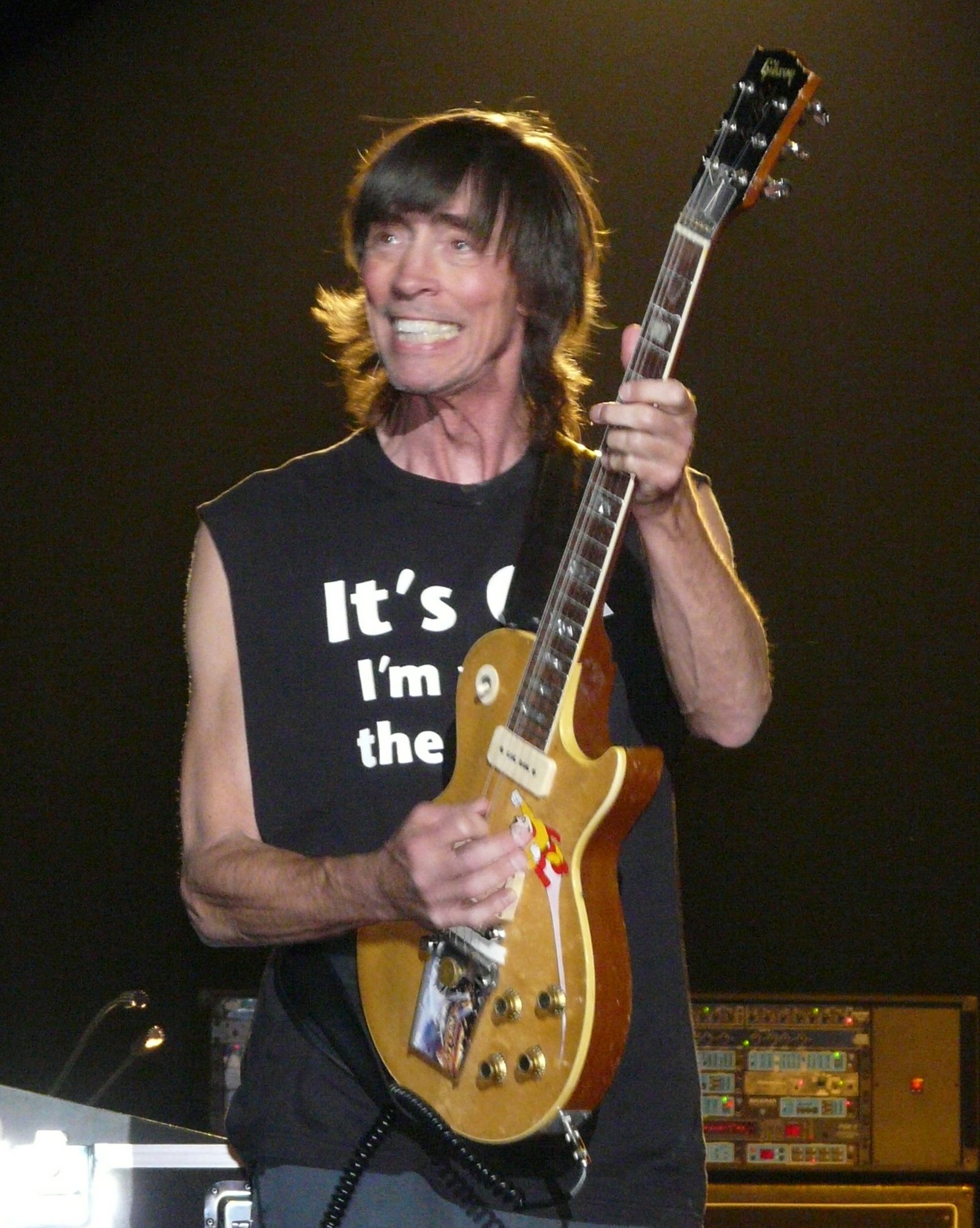
It is the greatest con in the history of rock and roll — and it produced one of the greatest debut albums ever made. In 1975, Epic Records signed a Boston band on the condition that they record their album in a proper professional studio in Los Angeles. The band’s mastermind, Tom Scholz, nodded agreeably — and then went home to Massachusetts and recorded almost the entire record in his basement. While the label thought the band was cutting tracks in Hollywood, Scholz was hunched over a 12-track machine next to his furnace in Watertown, building Boston one painstaking overdub at a time. The album sold 17 million copies and became the best-selling debut of its era. Nobody at Epic knew they’d been fooled until it was far too late to matter — and by then, nobody cared, because they were too busy counting the money.
The Engineer in the Basement
Tom Scholz was not supposed to be a rock star. He was an MIT graduate with a master’s degree in mechanical engineering, working days in product design at Polaroid, spending his nights tinkering with tape machines in the basement of his apartment house on School Street in Watertown, Massachusetts. He had, by his own account, cobbled together a studio from junk — tape machines he’d bought broken and repaired with parts, electronics knowledge absorbed from Polaroid colleagues. “After I had blown enough money doing that and realizing that this was just gonna cost too much, I decided I would put my own little demo studio together,” he recalled in 2023.
For about seven years, Scholz wrote and recorded demos with singer Brad Delp, submitting tapes to label after label and collecting rejections. Along the way, Scholz formed a band called Mother’s Milk with Delp and guitarist Barry Goudreau — but he was soon dissatisfied with the live sound, disbanded the group, and retreated to the basement to concentrate on studio work. It was a telling decision: for Scholz, the record was the thing, not the gig. The songs were there — “More Than a Feeling” alone took five years to write — but the industry couldn’t hear past the homemade sonics. What the labels didn’t understand was that the homemade sonics were the sound: Scholz had invented a guitar tone, a way of layering harmonies, a whole sonic world that no professional studio could reproduce, because no professional studio had his basement, his machines, or his ears.
The Deal
In 1975, the demo tape finally landed in the right hands: Epic Records signed Scholz and Delp. But the contract came with conditions. First, a live audition — which meant assembling a full band, fast. Enter Barry Goudreau on guitar, Fran Sheehan on bass, and Sib Hashian on drums: the lineup that would become Boston’s touring band. Second, and more fatefully, Epic refused Scholz’s request to use his home demos. The album, the label insisted, had to be recorded in a professional studio. Seven years of work, scrapped — or so Epic thought.
Scholz knew something Epic didn’t: he couldn’t reproduce his sound under professional-studio conditions. The basement wasn’t a limitation. It was the instrument. So he found an ally in producer John Boylan, and together they hatched one of the most audacious schemes in recording history.
The Great Deception
The plan was elegant. While Scholz stayed in Massachusetts, secretly re-recording nearly the entire album in his basement, Boylan took the newly assembled band to Capitol Studios in Los Angeles for “official” sessions — a very expensive diversion designed to keep Epic’s executives happy. The label believed its shiny new band was cutting a shiny new record on the West Coast. In reality, Scholz was painstakingly reconstructing 80 percent of the album at home, transferring his 12-track basement tapes to professional 24-track format.
The logistics were worthy of a heist film. A remote truck drove up from Providence to Watertown, ran cables (“snakes”) through a basement window, and copied Scholz’s tracks onto a two-inch 24-track recorder. Scholz then took a leave of absence from Polaroid, flew to Los Angeles with his tapes, and oversaw final overdubs and mixing — including Delp’s vocals and most of the drum tracks, the main elements actually recorded in California. Aside from those, very little of the Los Angeles material made the final mix. Epic never knew. By the time anyone could have objected, they were holding a masterpiece.
Foxglove Studios
The album’s liner notes credit “Foxglove Studios, Watertown, Mass.” It sounds like a real studio. It was, in Scholz’s words, “a tiny little space next to the furnace in this hideous pine-paneled basement of my apartment house, and it flooded from time to time with God knows what.” He built partitions, constructed a minuscule carpeted isolation booth — “you could just get the drums in there, just” — and recorded on a 12-track Scully machine, layering harmonized electric guitars, keyboards, and vocals into arrangements that sounded like they’d cost a fortune.
Scholz played nearly everything himself: lead and rhythm guitars, bass, organ, clavinet, percussion. Brad Delp sang — all of those soaring, impossible harmonies are Delp, often multi-tracked into a choir of one. Goudreau contributed lead guitar on “Foreplay/Long Time” and “Let Me Take You Home Tonight.” Jim Masdea, an early drummer, played on one track (“Rock and Roll Band”); Hashian played the rest. It was, as one critic later put it, pretty much a Tom Scholz solo project wearing a band’s clothes — and Scholz wore them well.
The Voice
No account of Boston is complete without Brad Delp — because for all of Scholz’s engineering genius, it’s Delp’s voice that makes the album fly. Delp had one of the great rock voices: a tenor of extraordinary range and purity, capable of soaring over Scholz’s guitar orchestrations without ever sounding strained. And he was a harmony singer without peer, stacking his own voice into choirs that gave songs like “More Than a Feeling” their cathedral-sized choruses.
The partnership was the classic rock alchemy: Scholz the introverted perfectionist, laboring alone in the basement; Delp the warm, generous vocalist who could humanize the machinery. Scholz has said that Delp could nail in a few takes what would take other singers days. When you hear those harmonies bloom — Delp times twelve, times twenty — you’re hearing the sound of two perfectionists who happened to be perfect for each other. It remains one of the great singer-producer partnerships in rock history.
The Songs
Boston plays like a greatest-hits album because, in a sense, it is one: seven years of Scholz’s best writing, distilled to eight tracks with not an ounce of fat. “More Than a Feeling” — five years in the making — opens with that chiming, instantly iconic guitar figure and builds into one of the most euphoric choruses ever recorded; it reached number five as a single and never left the radio. “Peace of Mind,” inspired by Scholz’s Polaroid years and the soul-deadening grind of the day job, is the working man’s anthem disguised as a rocker — three minutes of escape for everyone punching a clock. “Foreplay/Long Time” is a prog-rock miniature, all instrumental grandeur giving way to pop bliss, Scholz showing off everything he’d learned in the basement. “Rock & Roll Band” is the garage-rock mission statement, Delp testifying over a bar-band stomp. “Smokin’” struts with a swagger the band would spend years trying to recapture. “Hitch a Ride” floats on acoustic guitars and melancholy, the album’s quietest and most beautiful moment.
The one outlier is “Let Me Take You Home Tonight,” written by Delp and recorded at the Record Plant in Los Angeles with the “decoy band.” It’s the only track on the album not produced by Scholz, and careful listeners swear they can hear the difference — fatter drums, less otherworldly guitars. It’s a fine song. It just sounds like it was recorded on Earth, while the rest of the album sounds like it was beamed in from somewhere better.
August 25, 1976
Boston arrived on August 25, 1976, with a science-fiction cover — a guitar-shaped spaceship hovering over a planet, designed by Paula Scher — and a slogan: “Better music through science.” It was the perfect packaging for an album made by an engineer in a basement. Radio didn’t know what hit it. “More Than a Feeling” was released as the first single in early September and exploded. The album went gold in October, platinum in November, had sold two million copies by January 1977, and reached roughly six million by the end of that year. It peaked at number three and spent 132 weeks on the chart. Eventually it would sell 17 million copies in the United States alone — the best-selling debut album of its time.
The numbers only tell half the story. Boston resurrected guitar rock at the exact moment punk and disco were supposed to kill it, proving there was still a massive audience for meticulously crafted, gloriously melodic hard rock — music made with slide rules and soldering irons as much as with guitars. Every kid with a guitar in 1977 wanted to sound like Tom Scholz. Guitar magazines spent the next decade trying to figure out how he’d done it. (The answer — his basement, his hands, his ears — wasn’t replicable, which was the point.)
The Riff That Ate the Nineties
Here is the coda that proves Boston‘s immortality: in 1991, a scruffy trio from Seattle released a single built around a quiet-loud-quiet guitar riff that conquered the world and killed hair metal overnight. Kurt Cobain later acknowledged that the riff in Nirvana’s “Smells Like Teen Spirit” was borrowed — consciously or not — from “More Than a Feeling.” The most revolutionary guitar record of the nineties was built on the foundation of a basement tape from 1976. Scholz, the engineer, had built something so structurally perfect that even the revolutionaries couldn’t help but use it.
Put Boston on today and the miracle is how fresh it sounds. The guitars still soar — that harmonized, endlessly imitated tone that launched a thousand guitar-magazine cover stories. Delp’s voice still defies physics, still sounds like joy made audible. The production — made on junk equipment next to a furnace in Watertown — still sounds more expensive than records made for a hundred times the budget, because it was made with something money can’t buy: time, obsession, and absolute certainty about what it should sound like. Tom Scholz fooled Epic Records, fooled the industry, and fooled anyone who thought great rock and roll needed a great studio. All it needed was a genius in a basement, seven years of rejected demos, a singer with a voice from heaven, and the nerve to trust his own ears. Better music through science, indeed.
Leave a Reply