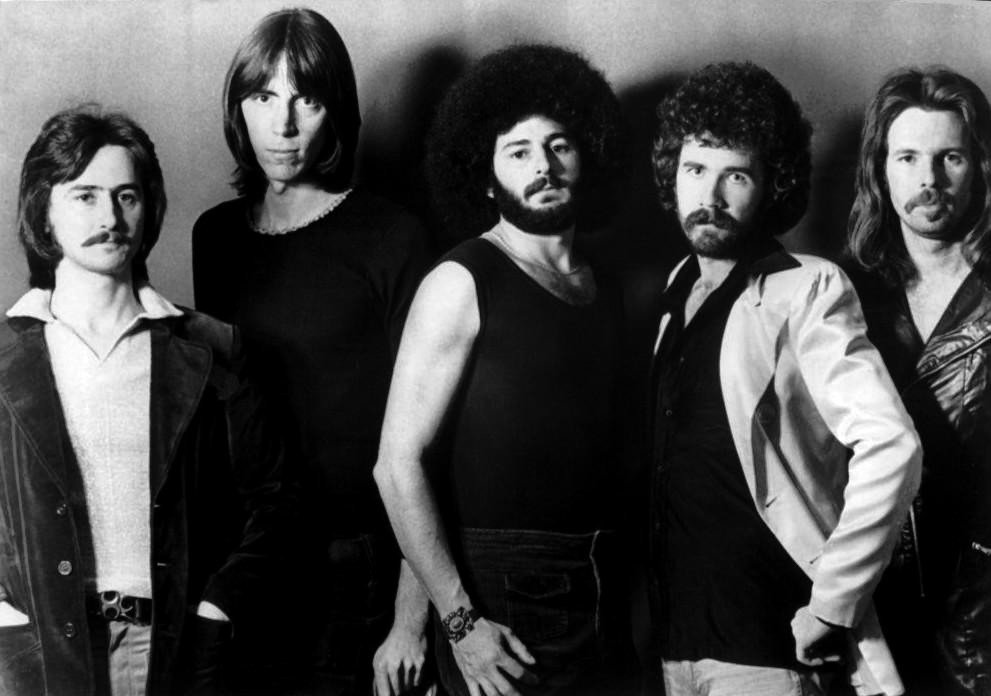
Tom Scholz is the most unlikely rock star in history. He didn’t want to be famous — he wanted to build things. An MIT-trained engineer who recorded one of the best-selling debut albums of all time in his basement, invented a legendary guitar device, learned to fly airplanes, played competitive basketball for 35 years, and then gave away millions of dollars to save animals, feed the hungry, and shelter the homeless. He fought bitter legal battles, lost his singer and best friend to suicide, and kept going — still recording, still touring, still tinkering, still giving. If Boston’s music is about precision and euphoria, Scholz’s life is about something rarer still: a man who had everything and decided the whole point of it was to give it away.
The Toledo Tinkerer
Donald Thomas Scholz was born on March 10, 1947, in Toledo, Ohio, and raised in nearby Ottawa Hills. His father, also named Donald, was a homebuilder who designed prefabricated luxury homes and founded Scholz Homes Inc. — a man who built things for a living. Young Tom took piano lessons, played sports, and spent his childhood taking apart anything motorized to see how it worked — radios, engines, appliances, anything with moving parts and a mystery inside. The tinkering wasn’t a hobby; it was an identity, the earliest expression of a mind that couldn’t leave well enough alone.
He carried that identity to MIT, where he earned his bachelor’s and master’s degrees in mechanical engineering — one of the most demanding programs in the world. Classmates remember him as brilliant and obsessive, the guy who wouldn’t leave a problem unsolved. It was the perfect education for what came next — not because he planned to become a rock star, but because engineering taught him to solve problems methodically, to build systems from scratch, to trust his own measurements over other people’s opinions. Every Boston record is, in a sense, an engineering project that happens to rock: designed, tested, refined, and released only when it met spec.
The Polaroid Years
After MIT, Scholz took a job in product design at Polaroid, the Cambridge camera giant. By day, he helped develop media machinery he still isn’t supposed to talk about. By night, he was building a recording studio from junk in his Watertown basement and teaching himself the physics of sound. “I learned all about the technical part of tape recording at Polaroid, from a couple of friends I had there in the electronics department,” he later recalled.
Those years — the day job, the basement, the slow accumulation of knowledge — shaped everything. “Peace of Mind,” one of Boston’s signature songs, was directly inspired by the Polaroid grind: the soul-deadening routine, the fluorescent-lit meetings, the dream of escape that every working person knows. Scholz wasn’t writing about rock-star life. He was writing about his life — about the specific ache of knowing you’re meant for something else while the clock ticks toward five. Millions of listeners recognized their own days in it. When he finally took a leave of absence from Polaroid to finish the Boston album in Los Angeles, he was betting his sensible engineering career on a basement tape. The tape won, and Polaroid’s loss was rock and roll’s gain.
The Perfectionist’s Price
Genius has a price, and Scholz paid it in relationships. He was famously exacting — a perfectionist who heard flaws no one else could hear and pursued them without mercy, in the studio and out of it. Where other bandleaders compromised, Scholz calculated. Where others let things slide, he filed suit. The first casualty was guitarist Barry Goudreau, fired in 1981 after releasing a solo album on CBS that the label marketed with copy trading on the “Boston Sound.” Scholz saw it as a betrayal of the band’s identity; Goudreau saw it as a musician’s right to have a career. The split was bitter and permanent, one of rock’s great might-have-beens — two talented men who could never agree on what loyalty meant.
There were lawsuits — with the record label, with former associates — and a libel battle with the Boston Herald that ended in defeat. Scholz fought the way he recorded: methodically, relentlessly, certain he was right. Sometimes he was. Sometimes the fight cost more than the principle. Through it all, one relationship held firm: Brad Delp, the singer, the harmony stack, the warm heart to Scholz’s cool head. They were opposites who fit — for thirty years.
Losing Brad
On March 9, 2007, Brad Delp died by suicide, carbon monoxide poisoning, at his home in New Hampshire. He was 55. The news devastated the Boston family and stunned the music world. Delp had been the voice of joy itself — the man who sang “More Than a Feeling” like he meant it, because he did. That someone so associated with happiness could be so privately despairing was a cruelty no one saw coming.
Scholz’s grief was profound and public. In August 2007, he organized a memorial concert for Delp at the Bank of America Pavilion in Boston — a night of music and mourning, with Boston alumni and friends celebrating the voice that had defined them. And it was there that the next chapter began: among the performers was Tommy DeCarlo, a 43-year-old Home Depot credit manager from North Carolina who had posted karaoke-style videos of himself singing Boston songs on MySpace. Scholz had discovered the videos and been floored — here was an ordinary guy with an extraordinary voice, a fan who’d absorbed Delp’s style down to the cellular level. He invited DeCarlo to sing at the memorial, and watched him bring the house down. DeCarlo became Boston’s new lead singer that year — a fairy-tale succession, the fan who became the frontman, carrying Delp’s legacy forward with humility and power. It was exactly the kind of second chance Delp himself would have wanted for the band.
The Man Who Gave It Away
Here’s the part of the Tom Scholz story that deserves to be better known — the chapter that never made the guitar magazines. In 1987, at the height of his wealth and fame, Scholz established the DTS Charitable Foundation — a vehicle, as he put it, for giving his money away. “Primarily it was set up as a vehicle for me to give my money away,” he said. “I don’t solicit donations for it.” The foundation’s missions span animal protection, vegetarian resources, stopping world hunger, homeless shelters, food banks, animal rescues and sanctuaries, and children’s rights. To date, it has raised and donated millions of dollars.
Scholz has been a vegetarian for more than thirty years — inspired, by his own account, by Brad Delp, who adopted ethical vegetarianism first. “His commitment to ethical vegetarianism over thirty years ago was a major factor in my emerging awareness of the unnecessary cruelty to animals in our society,” Scholz said when he dedicated his 2007 Celebrity Animal Advocate of the Year Award to Delp’s memory. PETA gave him their Compassionate Action Award in 2013. He’d earlier received the Mahatma Gandhi Award in 1987 and been named Man of the Year by the National Hospice Organization in 1988.
This isn’t celebrity charity as brand management. Scholz doesn’t solicit donations, doesn’t plaster his name on galas, doesn’t do the televised check presentation. He just writes the checks — millions of them — to anti-cruelty and anti-suffering programs, to shelters and sanctuaries and food banks. The foundation funds other charities rather than running its own programs, a quiet engine of generosity operating far from the spotlight. Bandmates Brad Delp and Gary Pihl were longtime vegetarians alongside him, and the shared values kept them in tune through decades of turmoil. The anti-rock star, indeed — the man who used rock stardom as a funding mechanism for kindness.
The Inventor
Music was never Scholz’s only engineering project. He founded Scholz Research & Development, which created the Rockman — a headphone guitar amplifier that packed thousands of dollars’ worth of studio gear into a compact, battery-powered box. It was a sensation among guitarists, the sound of Boston in your pocket. He sold the company to Dunlop in 1995, but the Rockman remains a beloved piece of gear history.
He got his pilot’s license — because of course the man who built a spaceship for an album cover wanted to actually fly. He builds and flies radio-controlled airplanes, intricate machines that demand exactly the kind of patience he brought to the studio. A knee injury eventually ended 35 years of competitive basketball — yes, the six-foot-plus engineer was a serious hoops player, attacking the court with the same intensity he brought to a guitar solo. The picture that emerges is of a man whose curiosity never turns off: if it can be built, flown, played, or improved, Tom Scholz wants to try. Retirement, for him, is just another problem to solve.
Still Building
Boston never stopped, exactly — they just worked on Scholz time, which is to say slowly, carefully, and without regard for anyone’s release schedule. Walk On arrived in 1994, Corporate America in 2002, Life, Love & Hope in 2013, each one meticulously crafted over years, each one unmistakably Boston — those guitars, those harmonies, that gleaming, impossible precision. Scholz also drew lines in the sand: in 2008, he sent a cease-and-desist letter to Arkansas Governor Mike Huckabee, ordering him to stop using “More Than a Feeling” at campaign rallies. Scholz, a longtime Democrat, wasn’t about to let his anthem of escape become someone else’s political prop.
https://www.youtube.com/watch?v=IVVAT3AiyGM
He married Kim Hart in the Florida Keys on January 11, 2007 — his second marriage, after his first wife Cynthia Hartford, with whom he has a son who followed his father to MIT, proof that the engineering gene runs in the family. He lives in the Boston area, still recording, still touring with DeCarlo out front, still tinkering in the workshop, still writing the checks.
Tom Scholz built a spaceship in his basement and rode it to the stars. Then he spent the rest of his life using the altitude to see who needed help down below. The perfectionism, the lawsuits, the feuds — they’re part of the story, but they’re not the point. The point is the man who took seventeen million albums’ worth of fortune and turned it into food banks, animal sanctuaries, and homeless shelters. The engineer who measured success not in decibels but in decency. The tinkerer from Toledo who never stopped building — only the projects got bigger, from guitar tones to a better world, from a basement studio to a foundation that feeds the hungry and shelters the homeless. Better music through science was the slogan. Better world through generosity was the life. That is the heart behind the hits.
Leave a Reply