The Man Who Swam to Shore
In the autumn of 1951, a twenty-one-year-old hitchhiker in a Navy uniform boarded a torpedo bomber at Sand Point Naval Air Station in Seattle, catching a ride south to visit his parents. Somewhere off Point Reyes, California, the plane ran out of fuel and ditched into the Pacific. The young man survived the crash, climbed out of the sinking wreck, and swam — through cold, shark-patrolled water, in the gathering dark — until he reached the shore. He had swum, by his own later account, something like three miles.
The young man’s name was Clinton Eastwood Jr. He would spend the next seventy-five years surviving things that should have sunk him: a Hollywood that didn’t want him, critics who despised him, marriages that collapsed, and an industry that buries men half his age. He just kept swimming. That is, in the end, the whole story of Clint Eastwood — the drifter who refused to drown.
A Depression Childhood
He was born on May 31, 1930, in San Francisco, in the teeth of the Great Depression, to Clinton Eastwood Sr. — a bond salesman who would later become a manufacturing executive — and Ruth Wood, a housewife who would later work as an IBM clerk. He had a younger sister, Jeanne. The family chased work across northern California the way Dust Bowl families chased rain, moving from town to town before settling long enough for young Clint to finish his schooling at Oakland Technical High School in the East Bay.
He was a big, handsome, restless kid — six-foot-four by the time he stopped growing — bored by classrooms and held back a grade for his indifference. What held his attention were two things: machines and music. He loved tinkering with engines, and he taught himself to play the piano with a patience and feel that surprised everyone. Decades later, when he began composing the scores for his own films, critics would discover what his childhood friends already knew: the squinting gunfighter had the soul of a jazz pianist.
After graduating in 1949, his parents and sister moved to Seattle, and Clint drifted through the Pacific Northwest doing the kind of hard, unglamorous work that builds a man’s back: operating log broncs in Springfield, Oregon, lifeguarding summers in Renton, Washington. He returned to California in 1951, did a two-year stint at Fort Ord — which is how he ended up in that doomed Navy plane — then enrolled at Los Angeles City College and promptly dropped out. Acting, a pursuit he had approached with no particular artistic ambition, began to look like steady employment. In the early 1950s he signed a contract with Universal Studios, mostly because it was a job.
The Contract Player Nobody Noticed
Universal didn’t know what to do with him. For several years he played uncredited bit parts in forgettable B-pictures — a lab technician in Revenge of the Creature (1955), a fighter pilot in Tarantula (1955) — while digging swimming pools and driving a garbage truck to pay the rent. He was, by every available measure, going nowhere.
Then, in 1958, came Rawhide. Cast as the young ramrod Rowdy Yates opposite Eric Fleming’s trail boss, Eastwood spent eight seasons on CBS learning the only film school that ever mattered to him: six days a week of shooting, fast and cheap, no wasted motion. When Fleming departed in the final year, Eastwood was promoted to series star. He had become a recognizable face to millions of American television viewers — and he had learned to work at a pace that would define his directing style forever: get it right, get it fast, don’t burn daylight.
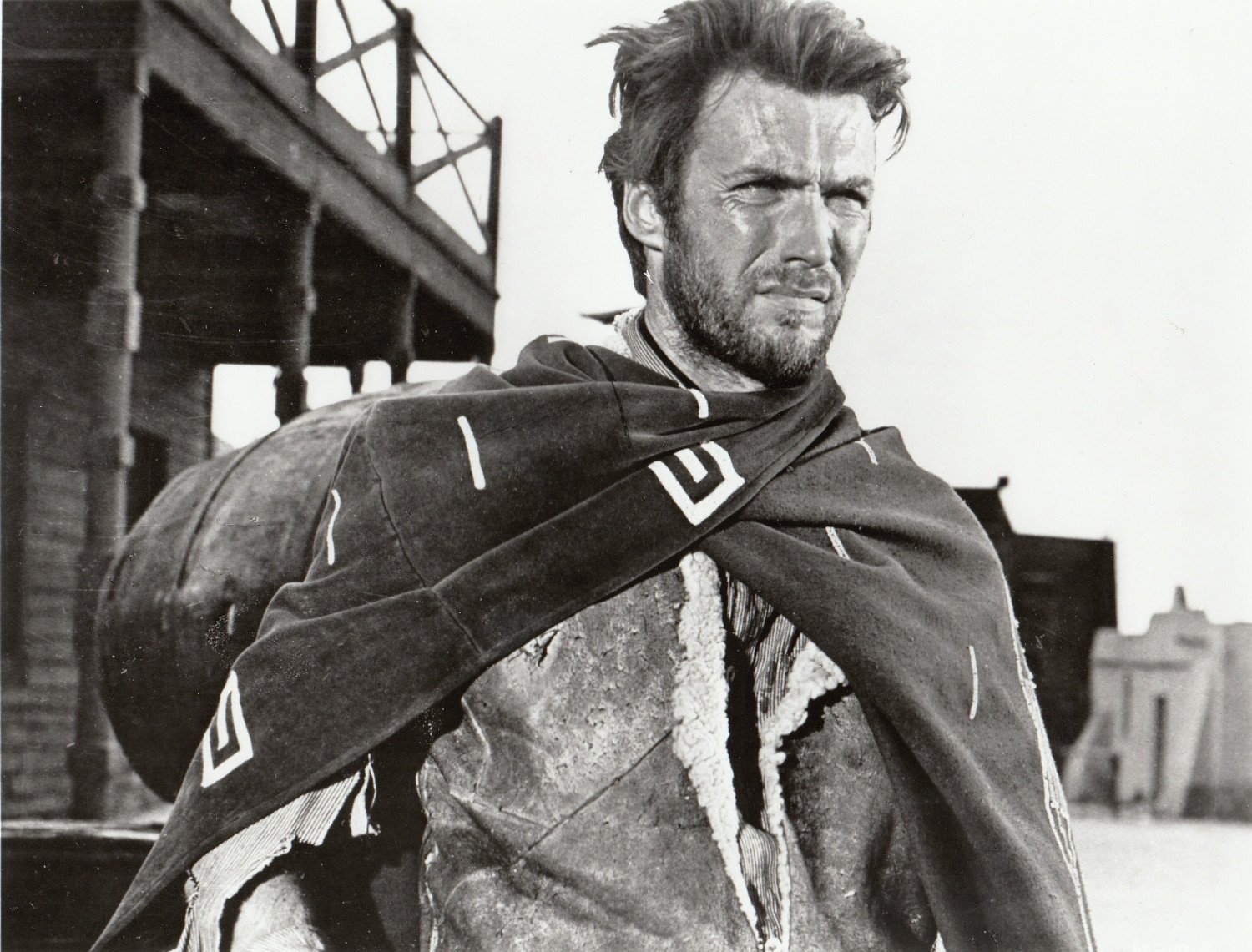
But American television was a ceiling, not a future. What happened next is one of the great gambles in Hollywood history. As Quentin Tarantino later observed, appearing in Italian genre pictures in the 1960s was considered an elephant’s graveyard for faded American stars. Eastwood went anyway. Sergio Leone’s “Dollars Trilogy” — A Fistful of Dollars (1964), For a Few Dollars More (1965), The Good, the Bad and the Ugly (1966) — didn’t bury him. It made him immortal. Leone’s extreme close-ups found something in Eastwood’s face that American directors had missed: a whole moral universe in a squint.
Building Malpaso
Eastwood understood something most stars never learn: the only freedom that matters in Hollywood is the freedom to say no. In 1967 he founded his own company, Malpaso Productions — named, with characteristic dry humor, after a creek on his property — and began producing his own pictures, starting with the western Hang ‘Em High (1968). Malpaso became his fortress. Through it, he fought for the right to choose his stories, protect his vision, and answer to no one.
In 1971 he directed his first film, the psychological thriller Play Misty for Me, in which he also starred as a radio disc jockey stalked by an obsessed fan. It was a confident, unsettling debut — and the template for everything that followed. As a director, Eastwood became famous for the opposite of everything Hollywood directors are famous for: one take, maybe two; no rehearsal marathons; finished on budget and often ahead of schedule. Actors adored him. Studios, once they saw the balance sheets, left him alone. He had built the rarest thing in the industry: total independence, earned one efficient shoot at a time.
The directing career eventually outgrew the acting career in prestige, if never in the public’s heart. Bird (1988), his biopic of jazz legend Charlie Parker — a labor of love from the piano-playing kid from Oakland — won him a Golden Globe for directing. Then came the twin summits: Unforgiven (1992) and Million Dollar Baby (2004), each winning him the Academy Award for Best Director and the Oscar for Best Picture. Four Oscars in total, plus the Irving G. Thalberg Memorial Award, the AFI Life Achievement Award, an honorary Golden Lion, an honorary Palme d’Or, and France’s Légion d’honneur. The garbage-truck driver from Oakland had become American cinema’s elder statesman.
And he kept pushing into uncomfortable territory. Letters from Iwo Jima (2006) told a World War II story entirely from the perspective of Japanese soldiers — the very men the young Clint Eastwood might once have faced across a battlefield. It was the act of a man spending his final decades arguing with the myth he had created, film by film, refusing to let Dirty Harry have the last word.
The Complicated Heart
If Eastwood’s professional life has been a masterclass in control, his personal life has been gloriously, messily human. He married Maggie Johnson in 1953, before the fame, and the marriage endured — through long separations and longer rumors — until their divorce in 1984. His relationship with actress Sondra Locke, from the mid-1970s to 1989, spanned five films they made together and ended in bitter public litigation. He married news anchor Dina Ruiz in 1996; they divorced in 2014. His partner from 2014, Christina Sandera, died of cardiac causes in July 2024 — a loss that those close to him say hit the then-94-year-old hard.
He has eight children by several relationships — a sprawling, complicated clan that includes actor Scott Eastwood and jazz musician and composer Kyle Eastwood, who inherited his father’s piano soul. There is Laurie Murray, born in 1954, whose mother has never been publicly identified; Kimber, with stuntwoman Roxanne Tunis; Kyle and Alison with Maggie Johnson; Scott and Kathryn with Jacelyn Reeves; Francesca with Frances Fisher; Morgan with Dina Ruiz. It is a family tree with deep roots and tangled branches, and Eastwood has spent his later years drawing its scattered members closer.
In 1986, in a move that surprised everyone except those who knew how stubbornly he loved his hometown, he was elected mayor of Carmel-by-the-Sea, California, serving until 1988. He ran, characteristically, on a platform of common sense and ice cream — he wanted to overturn the town’s ban on eating ice cream cones on the main street, among other small tyrannies. He won. Of course he won.
The Second Act Nobody Saw Coming
Most movie stars fade by sixty. Eastwood, impossibly, got better. His sixties and seventies produced the run that finally silenced every critic who had ever dismissed him as just a squint: Unforgiven (1992), his elegiac dismantling of the very western mythology that made him famous; A Perfect World (1993); The Bridges of Madison County (1995), a tender romance nobody expected from Dirty Harry; Mystic River (2003); Million Dollar Baby (2004); Letters from Iwo Jima (2006); Gran Torino (2008), in which his growling, bigoted veteran Walt Kowalski became an unlikely folk hero for a new generation; and American Sniper (2014), one of the biggest box-office hits of his directing career.
He did it all his way — Malpaso money, Warner Bros. distribution, tiny crews, no fuss. Studios learned that an Eastwood picture would arrive on time, on budget, and with a built-in audience of loyalists spanning three generations. He became the rare director whose name above the title meant something to ticket buyers, and the rarer star who aged on screen without apology: the craggy face, the gravel voice, the moral weight of a man who had seen the myth from the inside.
The Piano Player
Ask Clint Eastwood what he is, and somewhere below “actor” and “director” you’ll find the truest answer: musician. The kid who taught himself piano in Oakland never put the instrument down. He has composed or co-composed the scores for many of his own films — the spare, mournful themes of Unforgiven, the aching melody of Million Dollar Baby — writing music the way he directs: simply, without showing off, letting silence do half the work.
It runs in the blood. His son Kyle Eastwood became a respected jazz bassist, bandleader, and film composer in his own right, and father and son have collaborated on scores — the student surpassing the teacher’s hobby and turning it into a craft. When Eastwood made Bird, his 1988 biopic of Charlie Parker, it wasn’t a director taking on a subject; it was a jazz devotee paying tribute to a god. He even financed the painstaking work of isolating Parker’s saxophone from old recordings so the film could feature the real thing. The Golden Globe he won for directing it might be the award that meant the most — because it honored the part of him the squint had always hidden.
Still Standing
The numbers are almost unbelievable. A career spanning more than seven decades. Still directing in his nineties — his film Juror #2 premiered in November 2024 to a warm critical reception. When headlines in 2025 claimed he would never retire, he dismissed them as “entirely phony” — the man makes no promises about tomorrow, only films. In early June 2026, a death hoax swept social media; his representatives denied it within twenty-four hours. His son Scott said in January 2026: “He’s doing good — he’s a survivor, a trouper.”
He divides his time between Carmel-by-the-Sea and Hawaii, still playing the piano, still watching the dailies of a life nobody else could have lived. Think of the distance: from a drowning Navy hitchhiker off Point Reyes to the most independent filmmaker in Hollywood history. From swimming pools dug for wages to the Irving Thalberg Award. From a contract player Universal didn’t know how to light to the man who lit himself.
Clint Eastwood’s great subject, across a hundred roles and forty films as a director, was always the same: what it costs a man to stand alone, and whether the standing was worth it. He never answered the question the same way twice — the young gunslinger, the vengeful cop, the weary boxing trainer, the Japanese general on a doomed island. But he kept asking it, film after film, decade after decade, with the patience of a piano player and the efficiency of a man who learned on Rawhide never to waste a shot.
He swam three miles through the dark in 1951. He’s been swimming ever since.
Leave a Reply