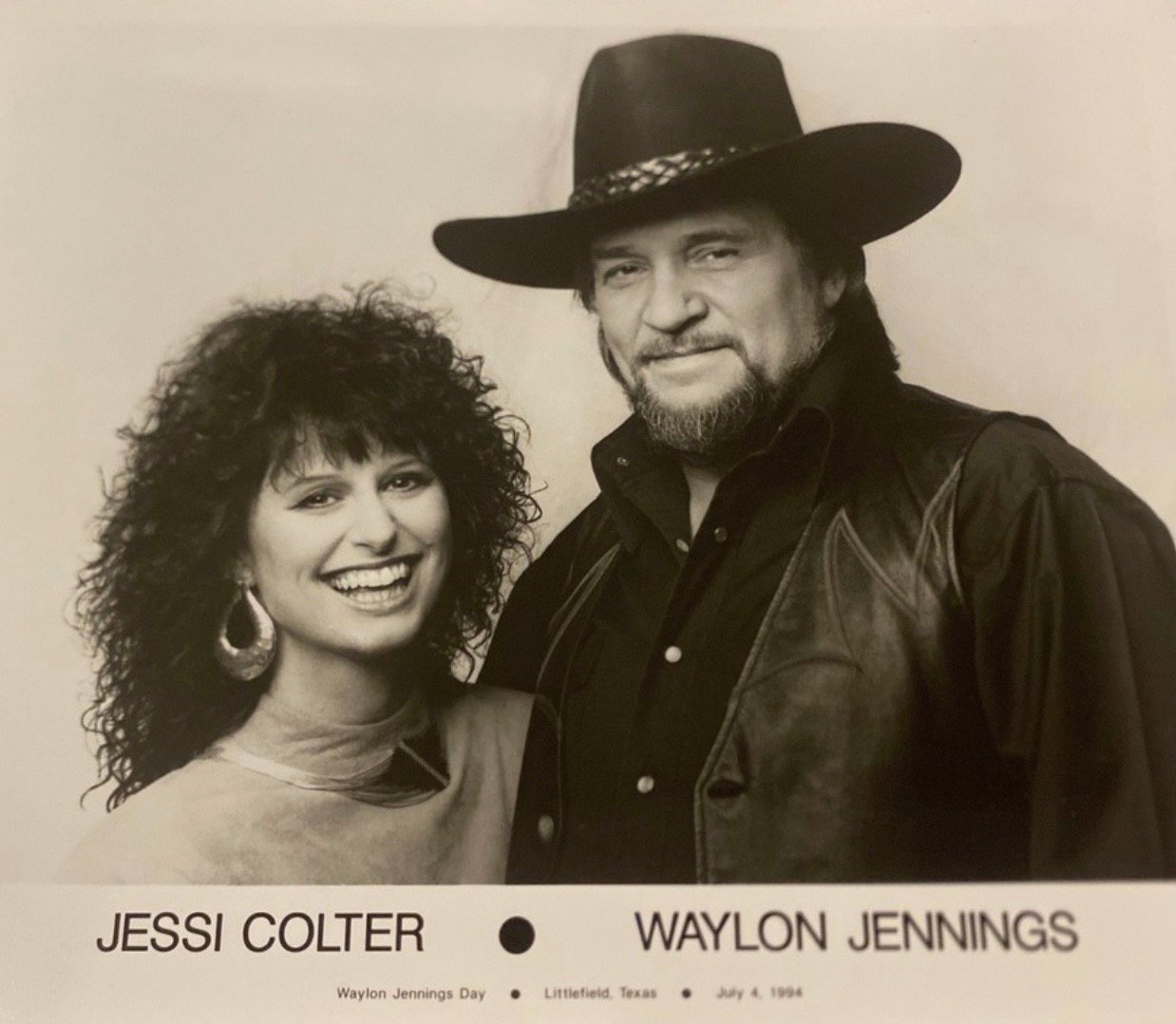
He was the toughest man in country music — the outlaw who stared down Nashville, the baritone who sounded like thunder, the survivor of Buddy Holly’s plane crash who carried that ghost his whole life. But those who knew Waylon Jennings best tell a different story: of a man who wept at his children’s recitals, who adopted children not his own without a second thought, who gave away songwriting credit out of sheer generosity, who quit cocaine cold turkey because he saw his little boy imitating him. Behind the outlaw was a tender heart. This is the story of the man his family knew.
The Ghost of February 1959
To understand Waylon’s tenderness, you have to understand his guilt. In 1959, as a young bass player, he was touring with Buddy Holly on the Winter Dance Party tour through the frozen Midwest. On February 3, Holly chartered a small plane to get to the next gig. Waylon gave up his seat to J.P. “The Big Bopper” Richardson, who had the flu. The plane crashed that night, killing Holly, Richardson, and Ritchie Valens — the Day the Music Died.
As Waylon told it for the rest of his life, his last exchange with Holly was a joke. Holly teased him about the freezing tour bus: “I hope your ol’ bus freezes up.” Waylon shot back: “Well, I hope your ol’ plane crashes.” Hours later, it did. He carried those words for forty-three years. Friends said he never truly got over it — the survivor’s guilt, the cruel joke, the seat he gave away. It made him cherish the people he loved with a fierce urgency, as if any goodbye might be the last. The tender heart was not born tender. It was broken into tenderness, on a frozen night in Iowa, and it never quite healed.
Jessi
The love story begins on October 26, 1969, in a church in Phoenix, Arizona. Waylon Jennings married Jessi Colter — born Miriam Johnson, a singer-songwriter in her own right, and the former wife of guitar legend Duane Eddy. She had taken her stage name from a great-granduncle who rode with Jesse James’s gang, which tells you something about the family she was joining: outlaws, all of them, one way or another.
Waylon adopted Jessi’s daughter Jennifer from her previous marriage, and the blended family became the center of his world. It was a pattern: Waylon collected children the way other men collect guitars — with love, without hesitation, without caring about bloodlines. Jessi was not just a wife. She was his duet partner (“Suspicious Minds,” “Storms Never Last”), his co-writer, his anchor, and eventually his savior. Through the cocaine years, the health crises, and the long decline, she stayed — or rather, she left when she had to, and came back when he earned it, which he did. Their marriage, all thirty-three years of it, was the great romance of outlaw country: volatile, passionate, and ultimately unbreakable.
The Marriages Before
Jessi was Waylon’s fourth wife, and the road to her was littered with wreckage. He married first at nineteen: Maxine Lawrence, in 1956. The marriage lasted until 1962 and produced four children — Terry, Julie Rae, Buddy Dean, and Deana. Waylon was barely more than a kid himself, chasing a music career that kept him on the road and away from home. The marriage did not survive the touring.
Next came Lynne Jones (1962–1967), during which Waylon adopted her daughter, Tomi Lynne — another child he claimed as his own without hesitation, a pattern of generosity that would define his fatherhood. Then Barbara Rood (1967–1968), a brief marriage that barely lasted a year. By the time he met Jessi, Waylon had been married three times, had five children, and had every reason to believe he was no good at the whole thing.
He was wrong. The fourth time was the charm — not because Jessi was easy, but because she was strong enough to demand he become the man she knew he could be. The outlaw who could not be tamed by Nashville was tamed, slowly and incompletely, by love.
Shooter
On May 19, 1979, Waylon and Jessi had a son: Waylon Albright Jennings, whom the world would know as Shooter Jennings. He was the child of the great love story, born at the height of Waylon’s fame, and he would become the hinge on which his father’s life turned.
Shooter grew up on tour buses and in studios, the outlaw’s kid, and he worshipped his father — which is precisely what made what happened next so devastating. When Shooter was three, his parents’ marriage nearly collapsed under the weight of Waylon’s cocaine addiction. Jessi took the boy and left for Arizona. When Shooter was five, he did something that saved his father’s life: he imitated him. But that is the next chapter’s story.
Today, Shooter Jennings is a respected musician and producer in his own right, the keeper of his father’s legacy. He has spoken openly about the man Waylon became in his final years — sober, present, tender. The little boy with the foot-powder canister grew up to make sure the world remembered the tender heart, not just the outlaw.
The Cocaine Years
By the early 1980s, Waylon’s cocaine habit had become monstrous — by his own later admission, a $1,500-a-day habit, one of the most expensive drug problems in music history. It was fueling the touring, the recording, the persona: the outlaw who never slept, never stopped, never came down. But it was destroying everything else.
Jessi had watched it long enough. In 1982, she separated from Waylon, taking three-year-old Shooter with her to Arizona. It was not a divorce — it was an ultimatum, delivered with love and steel. She loved him, but she would not watch him kill himself, and she would not let their son grow up watching it either. For a man who had spent his life refusing to be told what to do, it was the one refusal he could not ignore. The woman he loved had left. The boy he adored was gone. The cocaine suddenly did not seem like freedom. It seemed like what it was: a cage.
The Foot-Powder Moment
The moment of reckoning came in 1984, and it is one of the most moving stories in country music. Waylon was home, and five-year-old Shooter was playing nearby. Waylon watched as his little boy picked up a canister of foot powder, held it the way Waylon held his cocaine paraphernalia, and imitated his father — the ritual, the posture, the whole sad ceremony.
Waylon later said it was like being struck by lightning. He saw himself through his son’s eyes, and what he saw horrified him. Here was his baby boy, learning to be an addict before he could read. That same day, Waylon quit cocaine cold turkey — no rehab, no weaning, just stopped. It was the hardest thing he ever did, harder than staring down RCA, harder than any tour. And he did it for the same reason he did everything that mattered in the end: for his family.
Jessi came home. The marriage was saved. And Waylon, who had spent a decade running from himself, finally stood still long enough to become the man he was meant to be.
Health Battles
Sobriety could not undo the damage. In December 1988, Waylon underwent triple-bypass heart surgery — the bill coming due for decades of excess. The surgery scared him straight in a new way: he quit smoking, ending a habit that had seen him burn through six packs a day. Six packs. A day. The fact that he had a voice left at all was a miracle.
But the hits kept coming. In the early 1990s, he was diagnosed with diabetes, the disease that would define his final decade. His health declined through the nineties — the touring slowed, the weight fluctuated, the energy dimmed. In December 2001, the diabetes claimed his left foot, amputated in a desperate bid to stop the disease’s spread. The outlaw who had once strode across every stage in America was now in a wheelchair. He bore it, friends said, with characteristic grit and without self-pity. He had survived Buddy Holly’s plane, cocaine, and Nashville. He would face this the same way: head-on.
The Last Goodbye
Waylon Jennings died on February 13, 2002, at his home in Chandler, Arizona, in his sleep. He was sixty-four. Jessi was with him, as she had been — through separation and reunion, through addiction and recovery — for thirty-three years.
The honors had come, even if he was too modest, or too stubborn, to chase them. In 2001, he was inducted into the Country Music Hall of Fame; too ill to attend, he sent his son Buddy to accept in his place — a father’s pride, a family’s continuity. In 2000, he had played the “Never Say Die” concerts at the Ryman Auditorium, the mother church of country music, a defiant farewell from a man who knew his time was short. He played like the outlaw he was: on his terms, to the end.
The funeral was a gathering of the tribe — Willie, Kris, the family, the friends. And the music played on, as it always does. But something had gone out of country music that February day: the toughest, tenderest heart it ever had.
So what remains? The records, of course — “Honky Tonk Heroes,” “Dreaming My Dreams,” “Waylon & Willie,” the Highwaymen sessions, a catalog as deep as country’s. The influence — every Americana artist with a Telecaster and an attitude owes him. The legend — the outlaw, the survivor, the man who gave rock and roll its attitude and country its soul.
But those who loved him remember something else. They remember the man who adopted his wives’ children without a second thought. Who gave Willie half of “Good Hearted Woman” for a line or two. Who quit a $1,500-a-day habit in a single day because his five-year-old imitated him with foot powder. Who wept, Jessi said, at the small tender moments most tough guys pretend not to notice.
The video above is Waylon singing “Amanda” — Bob McDill’s heartbreaking ballad, the tenderest song he ever recorded — live in Austin, Texas. Listen to it. That is not an outlaw singing. That is a man who loved deeply, lost nearly everything, and found his way home. The thunder in his voice was real. But so was the tenderness — the father who adopted children not his own, the friend who gave away half a song, the survivor who turned guilt into devotion. In the end, the tenderness won. It always does, in the songs that last.
Waylon Jennings, 1937–2002. The outlaw. The husband. The father. The friend. The tender heart — gone now, but never forgotten.
Leave a Reply