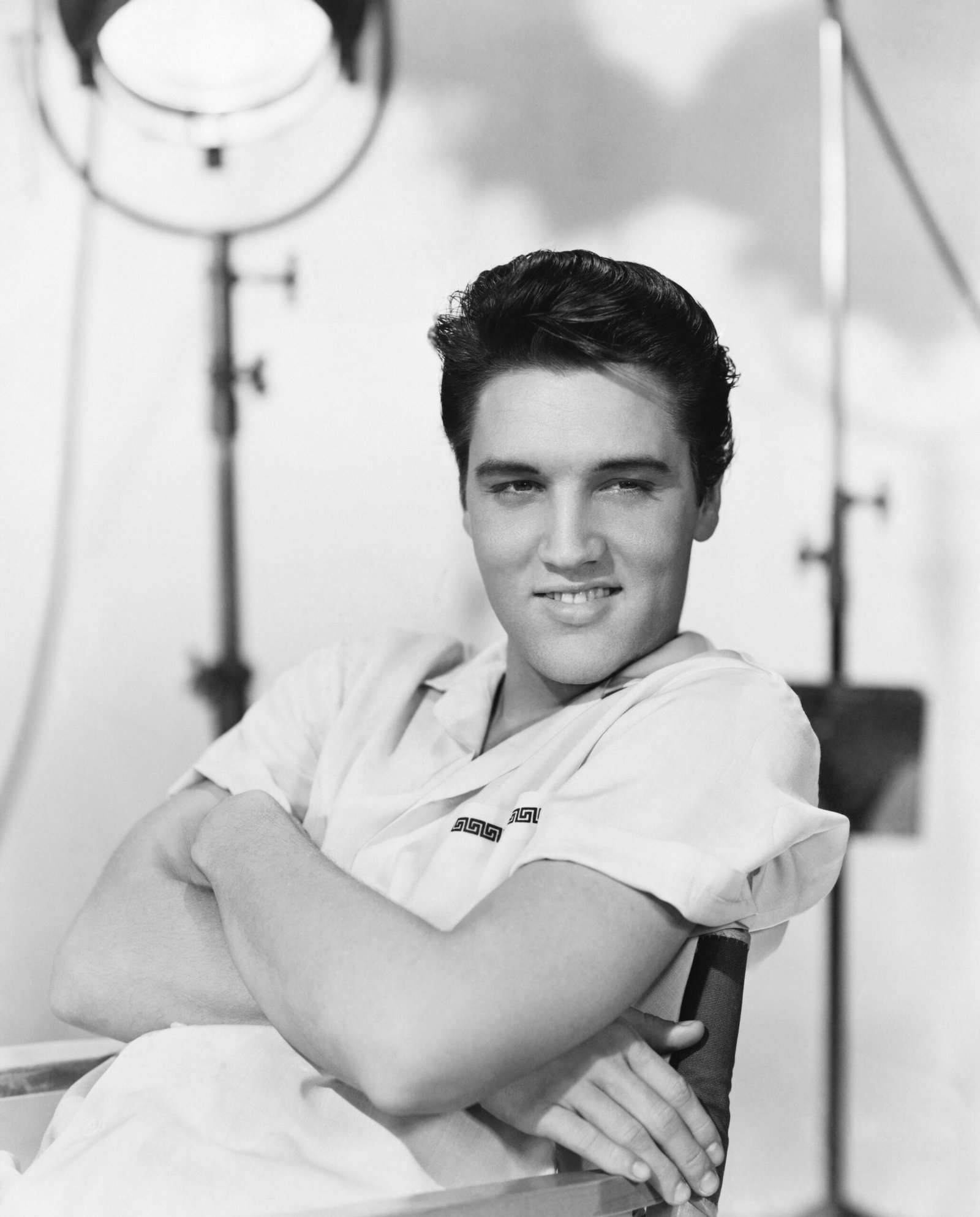

The night the television belonged to Elvis again
On 3 December 1968, NBC broadcast a television programme simply called Elvis, sponsored by the Singer company and therefore also billed as Singer Presents Elvis. It lasted about an hour, yet it has lived in popular memory for more than half a century under a different name: the 68 Comeback Special. The label was not one Elvis himself is said to have liked, because it suggested that he had somehow become a has-been. On the night itself, however, there was nothing faded about him. He walked out in black leather, faced a live audience arranged around him, and sang as if he had something to prove and, at last, a stage on which to prove it.
The opening was deliberately stark. There was no grand curtain, no chorus line, and no attempt to dress the occasion up as a polite variety show. Elvis began with Trouble, a song from his 1958 film King Creole, and the camera stayed close enough for viewers at home to see that this was not a nostalgic imitation of his younger self. It was a working singer, leaner and sharper, using his voice, his hands, his guitar and his whole body as instruments. By the end of the hour, millions of Americans had watched a performer reclaim the ground he had once owned, not by pretending that the intervening years had not happened, but by returning to the music that had made him matter in the first place.
That return is the reason the special still matters. It was not merely a successful television show, although it was that too, becoming the top-rated programme of its week on NBC and drawing a reported 42 percent of the television audience. It was also a turning point in a career that had drifted into routine, and a demonstration of how a live performance, filmed simply and honestly, can cut through years of over-production. The black-leather sessions at its centre — the informal sit-down performances and the more formal stand-up performances — remain the clearest filmed evidence of Elvis as a musician among musicians, listening, laughing, taking risks and finding his way back to the sound that had first electrified America.
The long silence before Burbank
To understand why December 1968 felt so dramatic, it helps to remember how quiet Elvis had become as a live performer. In the 1950s he had been a sensation: a young singer from Memphis who combined country, rhythm and blues and gospel influences into a style that sounded new, dangerous and irresistible to teenagers, and alarming to many of their parents. With guitarist Scotty Moore and drummer D. J. Fontana beside him, he had made records and television appearances that changed the sound of popular music. Then came military service, and then, through most of the 1960s, a long run of Hollywood films.
The films were not all without merit, and Elvis remained a famous and popular figure, but the pattern became familiar and restrictive. He was cast, again and again, in light musical comedies built around songs written to fit a plot, rather than songs chosen because they were worth singing. The records that came from those films often lacked the urgency of his earlier work, and his chart fortunes faded as the decade went on and as new British and American groups reshaped rock music. Most importantly, he stopped performing live. His last live, non-film performance before the television special had been a benefit concert at Bloch Arena in Hawaii on 25 March 1961, raising money for the USS Arizona Memorial. After that, for more than seven years, audiences could see Elvis on a cinema screen, but they could not see him walk onto a stage and sing to them in person.
By 1968, that absence had become part of his story. A new generation of listeners knew the name Elvis Presley, but many of them knew him mainly as a film star, or as a figure from an earlier era of rock and roll. The question facing him in 1968 was therefore a serious one. Could he still command a stage? Could he still sing with conviction in front of a live audience? And could he do it without simply repeating himself, as if the 1950s had never ended? The television special gave him a chance to answer all three questions at once, and the way it was made mattered as much as the songs it contained.
A Christmas special that became something else
The original idea, as it was put to Elvis by his manager, Colonel Tom Parker, was for a conventional Christmas television special. Elvis would sing seasonal songs, probably with guest stars, in a festive setting. It was a safe idea, and safety was part of its appeal: it would remind viewers that Elvis was still there, without asking him to take a creative risk. Elvis, however, was not enthusiastic about that plan, and the programme’s producer, Bob Finkel, and its director, Steve Binder, persuaded Parker to allow a different kind of show to take shape.
Binder, who had directed the concert film The T.A.M.I. Show, understood that Elvis did not need a costume change or a novelty routine. He needed a setting that let his voice and his presence do the work. Together with Finkel and the production team, Binder developed a programme built around Elvis himself: his career told in song, with staged production numbers, newly written material, and, crucially, live performances in front of a studio audience. The Singer sponsorship remained, which is why the broadcast was titled Singer Presents Elvis, but the programme that reached the screen was not a Christmas special at all. It was a portrait of a singer, made by people who believed that the singer was still the most interesting thing about the show.
That shift in approach also changed the atmosphere around the project. Instead of treating Elvis as a guest on his own programme, the production treated him as its centre and its reason for existing. The rehearsals in June 1968 at NBC Studios in Burbank, California, with additional studio work at Western Recorders in Hollywood, became a process of rediscovery. Elvis worked with a band and with an orchestra, he learned new material, and he spent time in informal rehearsals that would turn out to be just as important as the polished production numbers. The special was recorded over several sessions in June 1968, and it would not be broadcast until December, which gave the production time to shape hours of material into a single hour of television. What survived that editing process, however, was not a smoothed-out version of Elvis. It was a performance with edges, humour and tension still visible.
The suit that said everything
No image from the special is more famous than the black leather suit. Designed by Bill Belew, it was a soft, flexible outfit with a high, stand-up collar that framed Elvis’s face. It was simple, dark and modern, and it stood in sharp contrast to the bright, decorative costumes associated with television variety shows of the period. It also stood in contrast to the image of Elvis in his recent films, where he had often appeared in colourful, lightweight clothes suited to beach and resort settings. The black leather suit did not look like a costume borrowed from a film set. It looked like the clothing of a performer who had come to work.
The suit mattered because it matched the staging. For the live sections, Elvis performed on a small, boxing-ring-style stage, surrounded on all sides by an audience. There was nowhere to hide, no elaborate set to distract from a weak moment, and no distance between the singer and the people watching him. When he moved, the audience moved with him, in attention if not in body. When he paused, joked or changed direction in a song, the reaction was immediate and visible. That closeness is part of why the black-leather performances still feel alive on screen: they were not filmed as if the audience were an afterthought. The audience was part of the set, and its energy became part of the performance.
The colour black also carried a quieter meaning. It stripped away decoration and put the focus on Elvis’s face, voice and movement. In the sit-down sections, he sat with his guitar, dressed in the same leather, and the informality of the setting made the outfit feel less like stage armour and more like working clothes. In the stand-up sections, with a full band and orchestra behind him, the same suit gave him a sense of authority. He did not need to change clothes to change mood. The suit stayed the same while the music changed around him, which is one reason the special feels coherent despite its different sections: the man at the centre of it does not change, even as the songs move from rock and roll to gospel, from ballads to blues.
The sit-down sessions: Elvis among friends
The most revealing part of the special grew out of something unplanned. During rehearsals, Binder noticed Elvis relaxing in his dressing room, jamming and talking with friends, and recognised that this informal musicianship was itself worth filming. The result was the sit-down show: Elvis seated in the round, with his guitar, joined by Scotty Moore and D. J. Fontana, the guitarist and drummer from his earliest records and performances, together with Charlie Hodge and Alan Fortas. The format was deliberately simple. There were no production numbers, no choreography and no script to follow in the usual television sense. There was a small group of musicians, a live audience close at hand, and a set of songs that Elvis knew in his bones.
Watching the sit-down performances today, what stands out is how much listening is going on. Elvis is not simply delivering songs; he is responding to Moore’s guitar, to Fontana’s drumming, to Hodge’s harmony singing and to the audience’s reactions. He introduces songs with stories, he laughs, he changes tempo, he stretches a phrase or cuts one short, and he lets the performance breathe in a way that a studio recording rarely allows. The medley form, in which several early hits run together, suits this approach perfectly, because it lets the music move the way memory moves: one song reminding him of another, one rhythm suggesting the next. Songs such as Heartbreak Hotel, Hound Dog, All Shook Up, Jailhouse Rock and Love Me Tender appear not as museum pieces, but as living material, played by the people who had helped create them.
The sit-down sessions also restored something that the film years had taken away: the sense of Elvis as a member of a band. In the films, he had often been a solo figure, singing to a backing track or to musicians who were part of the scenery. In the sit-down show, he was a guitarist as well as a singer, and his guitar playing mattered. He played rhythm guitar with a sharp, percussive attack, and he used the instrument to cue the band, to drive a song forward and to signal when a song was about to change direction. For viewers who had only seen him as a film star, this was a revelation. For older fans who remembered the 1950s, it was a homecoming. Either way, it explained why the special came to be described, years later, as an ancestor of the unplugged concert format: long before that format had a name, Elvis was sitting in a circle, playing old songs with old friends, and letting the television camera watch.
The stand-up shows: power without decoration
If the sit-down sessions showed Elvis at his most intimate, the stand-up shows showed him at his most commanding. Standing on the same ring-like stage, now backed by a larger band and orchestra, he performed a set that moved between his early hits and newer material, with the full force of a live concert behind him. The stand-up performances were not as loose as the sit-down sessions, but they were not stiff either. Elvis moved across the small stage, used the microphone as a prop and as an instrument, and sang with a physical confidence that had been missing from his film performances.
The stand-up set is also where the range of his voice becomes most obvious. He could still sing rock and roll with a snarl and a snap, but he could also slow a song down, soften his tone and hold a ballad with real control. Love Me Tender, in the stand-up show, is not a hurried run-through of an old hit. It is a performance that allows the melody room to breathe, and it shows how much his singing had matured since the 1950s, even if his career had not always given him material worthy of that maturity. The same is true of the other ballads and mid-tempo songs in the programme: they benefit from being sung live, in front of people, rather than recorded quickly for a film soundtrack.
The contrast between the sit-down and stand-up sections is one of the special’s great strengths. Together, they present two versions of the same performer, and both are convincing. The seated Elvis is a musician among friends, relaxed, funny and musically alert. The standing Elvis is a star, aware of the audience, aware of the camera and determined to hold the room. Neither version cancels out the other. Instead, they complete a portrait: a singer who could be intimate and powerful, casual and commanding, often within the same hour. That duality is part of why the special has lasted. It does not present Elvis as a single, simple image. It presents him as a working artist with more than one way of reaching an audience.
The production numbers: a career told in song
Around the live sections, the special included staged production numbers built around the song Guitar Man. These sequences told a stylised version of Elvis’s career, moving through settings such as a small-town street, a gospel church and a nightclub world, with songs including Nothingville, Saved, Little Egypt, Big Boss Man and Let Yourself Go woven into the narrative. On paper, this sounds like the kind of elaborate television production that Binder had wanted to avoid, but in practice the numbers served a different purpose. They gave the programme a shape, they allowed Elvis to perform in character as well as in person, and they provided a bridge between the live sections, so that the hour did not feel like a simple concert film.
The production numbers also showed Elvis’s range as a performer in a different way. In the gospel sequence, for example, he sang with a choir and with a conviction that drew on the church music of his childhood in Mississippi and Tennessee. Gospel had always been central to his musical identity, even when his film work had little room for it, and the special gave that part of his voice a prominent place. In the other sequences, he moved between blues, rock and roll and ballad singing, often within a few minutes, and the changes of setting helped viewers hear how those styles connected in his work. The production numbers were, in that sense, a kind of musical biography: not a literal account of his life, but a demonstration, in song, of where his music had come from and how many directions it could go.
It is worth noting, too, that the production numbers did not overshadow the live sections. That was a deliberate choice, and it is one reason the special still feels modern. Many television specials of the period used production numbers as the main event, with live singing as a secondary attraction. Here, the balance was reversed. The staged sequences were interesting, but the moments people remember, and the moments that have been most widely shared since, are the black-leather performances, where Elvis stood or sat in front of a live audience and sang without a set to hide behind. The production numbers gave the programme its structure; the live sections gave it its soul.
Two new songs, and a closing that changed the tone
The special also introduced two new songs that became central to its legacy. The first was Memories, written by Mac Davis specifically for the show. It was a reflective ballad, suited to a programme that looked back over a career, and it gave Elvis a contemporary song that was not tied to a film plot. It also pointed forward: it suggested that Elvis could sing new, adult material with the same seriousness he brought to his early hits, and that his future did not have to depend on repeating the past.
The second new song was the closing number, If I Can Dream, written by W. Earl Brown especially for Elvis and the special. It was recorded in the studio in June 1968, with Elvis singing in a white suit for the filmed closing sequence, in contrast to the black leather of the live sections. The song was an anthem of hope, written in a year marked by division and by the assassination of Martin Luther King Jr. earlier in 1968. Its lyrics drew on the language of King’s speeches, and its performance at the end of the special gave the programme a serious, emotional conclusion that was very different from a light variety-show finale. Elvis sang it with full commitment, standing still for much of the performance, letting the orchestra and backing singers build around his voice, and the result was one of the most powerful vocal performances of his career.
The commercial response to If I Can Dream confirmed that audiences heard it as more than a television closing number. The song reached No. 12 on the Billboard Hot 100, spent 13 weeks on the chart and sold more than a million copies, according to contemporary chart reporting. That was a significant result for a singer whose recent singles had not made the same impact, and it suggested that the special had done more than remind people of Elvis’s past. It had given him a present-tense success, and a song that listeners could take away from the television screen and hear on the radio. The soundtrack album from the special, released in December 1968, also performed strongly, giving Elvis his first Top 10 album in three years, according to later career summaries. The comeback, in other words, was not only a matter of critical praise. It could be measured in records sold and charts climbed.
What the broadcast proved
When the special aired on 3 December 1968, its success was immediate and measurable. It was the top-rated programme of its week on NBC, and it drew a reported 42 percent of the television audience. Those figures matter because they show that the special did not merely impress critics or please existing fans. It reached a broad, mainstream audience, including viewers who may not have bought an Elvis record in years, and it convinced them, in a single hour, that he was still a major performer. In a television landscape where a single broadcast could still become a national conversation, that was a powerful achievement.
The success also changed the terms of Elvis’s career. A month after the broadcast, in January and February 1969, he recorded at American Sound Studios in Memphis, his first Memphis recording sessions since his Sun Records days in the 1950s. Those sessions produced In the Ghetto and Suspicious Minds, among other songs, and Suspicious Minds became one of the defining singles of his later career. The connection to the special was direct: the television programme had restored his confidence as a live and studio singer, and the Memphis sessions gave him contemporary material that matched that confidence. He was no longer only a singer of old hits or film songs. He was a singer with new hits, recorded in the city where his career had begun.
The next step followed in the summer of 1969. On 31 July 1969, Elvis opened at the International Hotel in Las Vegas, giving his first full concert appearances since 1961. The engagement was a success, and it began a long Las Vegas chapter in his career, with regular residencies that would last through the 1970s. It is easy, in retrospect, to treat Las Vegas as a separate phase, and to argue about its artistic ups and downs, but its starting point matters. Elvis did not return to the concert stage because a film contract required it. He returned because the television special had proved, to audiences and to himself, that he could still hold a live audience, and because the Memphis sessions had given him new songs worth singing to that audience. The special, the studio and the stage formed a sequence, and the special came first.
Why the black-leather sessions still feel modern
More than fifty years later, the black-leather sessions still feel modern, and that is not only because black leather never quite goes out of fashion. It is because the format itself was ahead of its time. The sit-down performances, in particular, anticipated the intimate, acoustic concert films that became popular decades later, in which a famous performer sits with a small band, tells stories and plays old songs in new arrangements. When viewers watch those later programmes, they are watching a format that Elvis and Binder helped to establish, even if the later programmes rarely acknowledge the debt. The special showed that a television audience would watch a singer simply sing, without elaborate staging, if the singing was good enough and the setting was honest enough.
The sessions also endure because they capture Elvis at a moment of balance. He was old enough to have a past worth revisiting, at 33, and young enough to have a future worth building. He was experienced enough to command a stage, and hungry enough to want to prove himself again. That combination is rare, and it is visible on screen. In the sit-down show, he looks like a man enjoying music with friends. In the stand-up show, he looks like a man determined not to waste the opportunity. In the closing performance, he looks like a man who understands that music can carry a serious message as well as a good time. None of those moods feels forced, because none of them is presented as the whole story. Together, they make a complete performer.
For new listeners, the best way into the special is to watch the live sections first, rather than starting with the production numbers or with later compilations. Start with a sit-down performance, and listen for the interplay between Elvis, Moore and Fontana: the way a guitar figure answers a vocal phrase, the way a drum pattern steadies a song that might otherwise rush ahead, the way a harmony vocal lifts a chorus without overwhelming it. Then watch a stand-up performance, and notice how the same singer changes his physical approach when he is standing, how he uses the space of the small stage, and how he holds a ballad as carefully as he attacks a rock-and-roll number. Finally, watch the closing performance, and notice how still he becomes when the song requires stillness. That arc — from conversation, to command, to reflection — is the arc of the whole special, and it is why the hour still holds together as a piece of television, not just as a collection of clips.
A comeback that was really a return
It is tempting to call the 1968 special a comeback in the simplest sense: a famous singer who had faded, suddenly becoming famous again. That description is not wrong, but it misses something important. Elvis had not disappeared. He had been visible throughout the 1960s, in films and on records, even if that visibility had not matched his talent. What had disappeared was the direct connection between Elvis and a live audience, and between Elvis and the kind of music that had first made him important. The special restored both connections at once. It put him back in front of people, and it put him back in touch with the songs, the musicians and the musical traditions that had shaped him.
That is why the phrase black-leather sessions is so apt. Leather is a working material, tough and practical, and the sessions themselves were working sessions: musicians playing together, in real time, in front of real people, with no second take to hide behind in the live sections. The suit was not a disguise. It was a signal that Elvis was ready to work again, on terms that suited a live performer rather than a film star. When he sat down with Scotty Moore and D. J. Fontana, he was not pretending to be young again. He was showing that the music of his youth still had life in it, and that he still knew how to play it. When he stood up and sang to a full band and orchestra, he was showing that he could also meet the demands of a modern television stage.
The legacy of the special can therefore be measured in several ways. It can be measured in ratings, in record sales and in the Memphis and Las Vegas successes that followed. It can also be measured in influence, in the concert formats it anticipated and in the many later performers who have cited it as a model for how to return to the stage after a fallow period. But perhaps its most important legacy is simpler: it left behind a filmed record of Elvis Presley as he wanted to be seen, and as he deserved to be seen, at a moment when his career could have gone either way. He chose the harder path, the live path, and for one hour on a December night in 1968, that choice was visible to everyone watching.
If you have only heard Elvis through his films, or through his later Las Vegas years, the 1968 special is the place to start again. It is not a perfect programme — the production numbers have dated in places, and the hour as a whole reflects the television conventions of its time — but its centre is as strong as anything in popular music on film. A singer in black leather, surrounded by an audience, singing old songs with old friends and new songs with new conviction, proved that a career is not over until the performer decides it is over. On 3 December 1968, Elvis Presley decided that his was not over, and television audiences have been watching that decision ever since.
Image credit: Family watching television at home, c. 1958, public domain, Evert F. Baumgardner / U.S. National Archives and Records Administration, via Wikimedia Commons (thematic image only, not a photograph of Elvis Presley)
Sources / further reading
- The Current, Fifty years ago, NBC and Singer helped Elvis Presley mend his career: https://www.thecurrent.org/feature/2018/12/03/fifty-years-ago-nbc-and-singer-helped-elvis-presley-mend-his-career
- Vintage Rock, Elvis Presley – The ’68 Comeback Special: http://www.vintagerockmag.com/2024/10/elvis-presley-the-68-comeback-special/
- The Second Disc, Holiday Gift Guide Review: Elvis Presley, ’68 Comeback Special: 50th Anniversary Edition: https://theseconddisc.com/2018/11/30/holiday-gift-guide-review-elvis-presley-68-comeback-special-50th-anniversary-edition/
- Rock and Roll Globe, The Comeback King: https://rockandrollglobe.com/rock/elvis-presley-and-the-68-comeback-special/
- Best Classic Bands, Elvis Presley’s Inspiring ‘If I Can Dream’: Behind the Song: https://bestclassicbands.com/elvis-if-i-can-dream-behind-the-song-8-23-2222/
- RCA / Legacy press release, Elvis Presley’s Groundbreaking ’68 NBC-TV Comeback Special Celebrated with Definitive 50th Anniversary Edition: https://assets.speakcdn.com/assets/2597/elvis_presley_-_68_comeback_special_-_50th_-_press_release_10-23.pdf
- Goldmine, Elvis Presley’s 1969 rebirth in Las Vegas: https://www.goldminemag.com/articles/elvis-presleys-1969-rebirth-in-las-vegas
- Rock Cellar Magazine, Recalling Elvis Presley’s Iconic 1969 Las Vegas Run, 50 Years Later: https://rockcellarmagazine.com/elvis-presley-live-las-vegas-1969-50-year-anniversary/
Leave a Reply