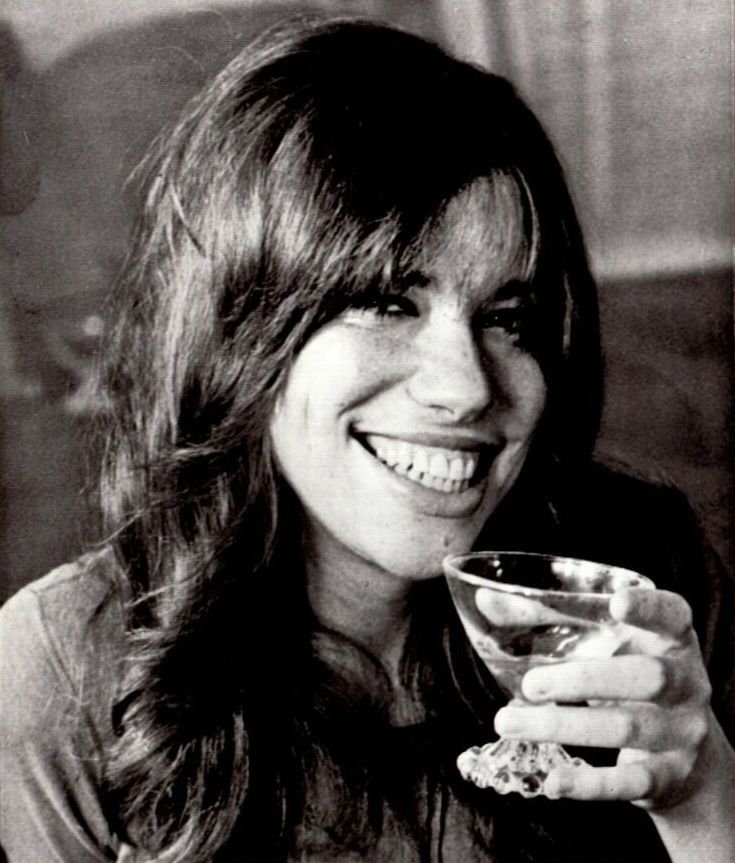
Here is the strangest line on Carly Simon’s résumé: the biggest, longest-running hit of her career is a song she did not write. Nobody Does It Better, the theme to the 1977 James Bond film The Spy Who Loved Me, spent longer on the charts than You’re So Vain, longer than Anticipation, longer than anything she ever composed herself. It was handed to her by two of the most decorated songwriters in Hollywood, it broke the Bond series’ oldest naming rule, and it spent three weeks parked at No. 2 behind the one record nobody could pass that autumn. It also may never have been offered to her at all — if her songwriters hadn’t been thinking about another man’s vanity.
By 1977 Simon was five years past the peak that You’re So Vain had given her, still a major artist but no longer the centre of the culture. The Bond assignment was, on paper, a job for hire: sing someone else’s song, over someone else’s film titles, and go home. What she did with it instead was a masterclass in interpretation — proof that a singer who didn’t write a note could still own a record so completely that the whole world would assume it was hers.
A Franchise on the Ropes
The film needed rescuing as much as the singer needed a hit. The Spy Who Loved Me was the tenth Bond picture and Roger Moore’s third, and the series had rarely felt more fragile. Its predecessor, The Man with the Golden Gun (1974), had underperformed badly; Harry Saltzman, co-founder of the franchise, had sold his stake and departed, leaving Albert R. “Cubby” Broccoli in sole charge. The new film was widely understood to be make-or-break — a lavish reboot of the formula, with a submarine-swallowing supertanker, a steel-toothed giant named Jaws, and a budget of some $14 million, enormous for its day.
Broccoli’s team understood that a Bond film announces itself through its song. For fifteen years the ritual had been fixed: the theme carried the film’s title, usually belted over Maurice Binder’s title sequence by a voice as big as the production — Shirley Bassey, Tom Jones, Paul McCartney. Whoever sang this one would be singing the franchise’s survival notice.
The Composer Who Collected Oscars
The music went to Marvin Hamlisch, and in 1977 there was arguably no safer pair of hands in American entertainment. In April 1974, at the 46th Academy Awards, Hamlisch had done something no one had ever done: he won all three of the year’s music Oscars in a single night — Best Original Song and Best Original Dramatic Score for The Way We Were, and the scoring award for The Sting — before his thirtieth birthday. A Tony and a Pulitzer for A Chorus Line followed. He remains, with Richard Rodgers, one of only two people to hold a Pulitzer alongside an Emmy, Grammy, Oscar and Tony.
His lyricist was Carole Bayer Sager, one of the most commercially reliable wordsmiths in pop. Their Bond song was written as a slow-burning power ballad — a woman’s awestruck hymn to a lover of superhuman gifts, which happened to be a secret agent. And it was Sager, according to Hamlisch in a 1977 documentary on the making of the film, who effectively cast the record: hearing the lyric read back, she remarked that it sounded “incredibly vain.” The association was instant. The singer of You’re So Vain — a woman whose most famous song was a portrait of an irresistibly self-adoring man — was the obvious voice for a song serenading the most self-assured man in fiction. Simon got the call.
The Theme That Broke the Naming Rule
What Hamlisch and Sager delivered broke with Bond tradition in a way nobody at Eon seems to have minded. Nobody Does It Better was the first Bond theme since Dr. No in 1962 not to be named after its film — the title appears nowhere in the movie’s name at all. Instead, the film’s title is smuggled into the lyric itself, folded into the song’s most swooning line, about the spy who loved her keeping all her secrets safe tonight. The gambit worked so well that the song detached from the film entirely: millions who have never seen a frame of The Spy Who Loved Me know every word.
Simon recorded it in April 1977 with producer Richard Perry, who had produced her No Secrets album five years earlier and knew exactly what her voice could do. The record opens in near-whisper — piano, and Simon almost confiding the title line — then widens, verse by verse, into full orchestral sweep, the arrangement swelling exactly as the lyric’s devotion swells. Billboard, reviewing the single, wrote that she sang it “as if she believed sincerely in the superhuman love powers of 007.” That sincerity is the record’s whole engine: where other Bond themes wink, Simon’s believes.
Three Weeks at Number Two
The film premiered in London on 7 July 1977, with Princess Anne in attendance, and became the biggest Bond of all time to that point, grossing $185.4 million worldwide and reviving the series at a stroke. The single, released on Elektra the same month, climbed to No. 2 on the Billboard Hot 100 — and stayed there for three weeks, held off by Debby Boone’s You Light Up My Life, the immovable object of 1977. On the Easy Listening chart it did what the pop chart wouldn’t allow: seven weeks at No. 1, enough to make it the biggest adult contemporary hit of the year. It was certified gold in America, reached No. 7 in Britain, topped the chart in Ireland, and repeated the American pattern in Canada — No. 2 on the pop chart, No. 1 on the adult contemporary chart. The single, backed with After the Storm, was drawn from the film’s soundtrack album, and for a generation of listeners the two products fused: Moore’s face on the cinema screen, Simon’s voice on the radio, each selling the other all through the long summer of 1977.
Then the awards season delivered the punchline. At the 1978 Academy Awards and Golden Globes, Nobody Does It Better was nominated for Best Original Song — and lost, both times, to You Light Up My Life. The same record that had blocked it at No. 2 now blocked it at the podium. Simon was nominated at the Grammys for Best Pop Vocal Performance, Female, and the song for Song of the Year; it won neither. By every official measure of 1977–78, it was the eternal runner-up. History, however, was keeping a different score.
The Verdict of Time
Ask a modern ranking to settle it and the runner-up keeps winning. In 2004 the American Film Institute named Nobody Does It Better the 67th greatest film song of all time. Rolling Stone placed it third among all Bond themes; Billboard put it second; USA Today, in 2021, ranked it the single greatest James Bond theme ever recorded — above Goldfinger, above Live and Let Die, above Skyfall. Celine Dion has performed it in concert. Radiohead took to covering it live in the nineties, with Thom Yorke introducing it as, in his words, the sexiest song ever written. Simon herself eventually conceded the song’s place at the centre of her story: her 1998 greatest hits collection was titled The Very Best of Carly Simon: Nobody Does It Better.
The deepest irony is the chart book’s. You’re So Vain was the bigger peak — three weeks at No. 1 — but Nobody Does It Better stayed on the Hot 100 two months longer, making it, by endurance, the most successful single of her career, and easily the most successful song she ever sang that she did not write. The woman who built her legend on one great act of songwriting was, in the end, outrun by an act of pure interpretation — a borrowed ballad about a fictional spy, cast for her because a lyricist thought it sounded vain, and sung as if she believed every word.
Leave a Reply