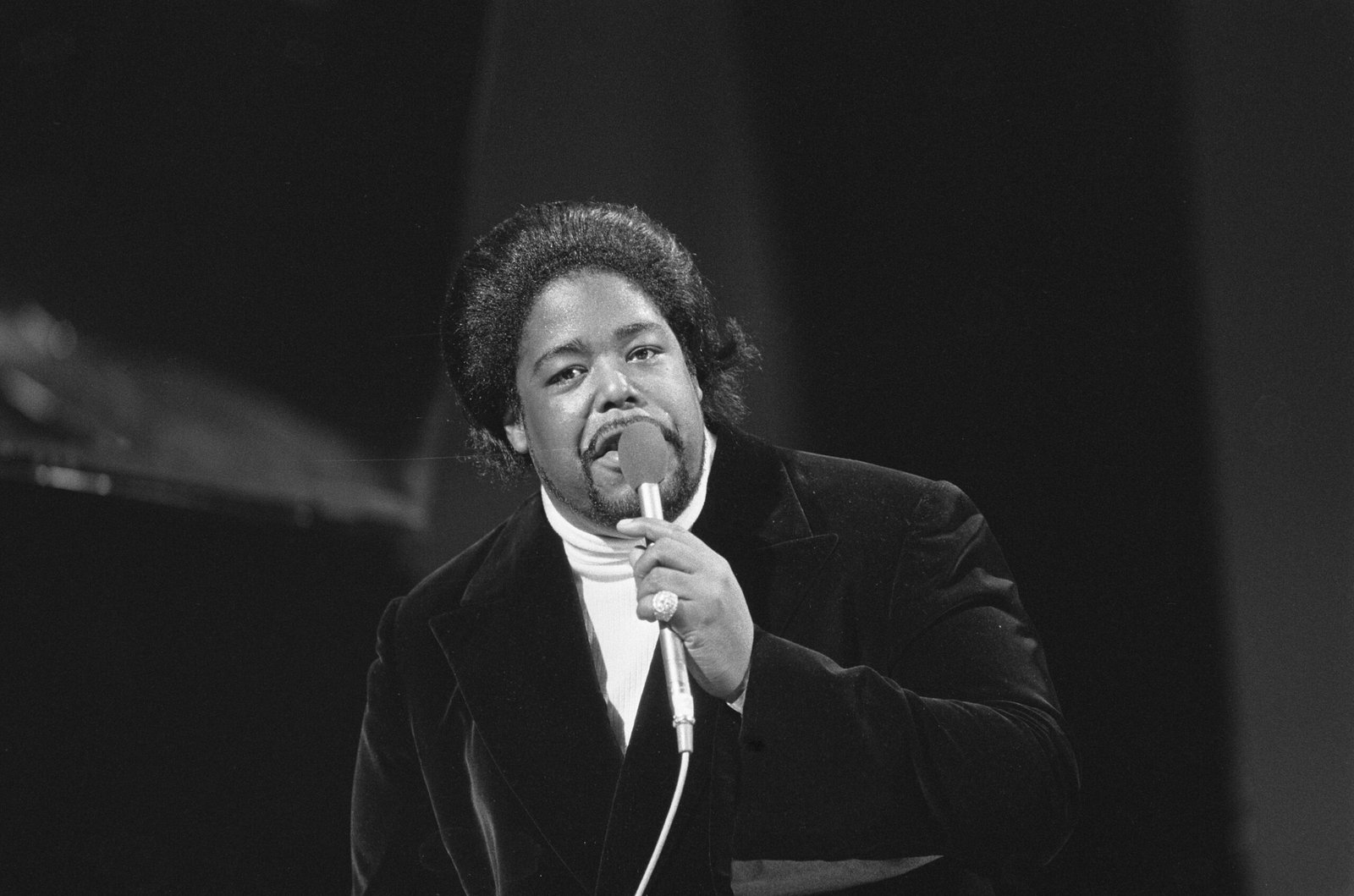
Before 1973, Barry White’s plan was to stay invisible. He was a Los Angeles songwriter, producer and arranger who built records for other people and was genuinely uncomfortable with the sound of his own voice — that vast, velvet baritone the world would soon treat as an aphrodisiac. Then he sang three demos at a piano, his business partner heard them, and the back-room man had nowhere left to hide. I’m Gonna Love You Just a Little More Baby, his debut single under his own name, went to No. 1 on the R&B chart, No. 3 on the pop chart and gold in a matter of weeks, and it established, in a single record, every element of the Barry White sound: the spoken confession, the surging strings, the rhythm section that moves like a heartbeat.
The Voice in the Back Room
White had served a long apprenticeship in other people’s careers. Raised in Los Angeles, he had sung with doo-wop groups as a teenager, played piano on records while still young, and worked his way into the business side of the Los Angeles soul scene as a talent scout, songwriter and producer. The voice itself had arrived like a thunderclap: White liked to recall that as a boy he had a normal squeaky voice, until one morning in his teens he woke up, spoke to his mother, and, in his words, “scared both of us” — the baritone had simply appeared overnight. Life nearly diverted him permanently. At sixteen he was jailed for four months for stealing $30,000 worth of Cadillac tires, and it was in jail, hearing Elvis Presley’s It’s Now or Never on the radio, that he later said the course of his life changed. He came out determined to make music his living — but other people’s music, made from behind the scenes. His breakthrough came as the Svengali behind Love Unlimited, the female trio whose Walkin’ in the Rain with the One I Love he wrote and produced into a million-selling hit in 1972 — complete with White himself murmuring a spoken passage down a telephone line at the record’s end. The formula was already there: lush orchestration, a groove built for romance, and Barry White everywhere on the record except the label. It is arguably the cruellest almost in soul history: the first time that unmistakable voice appeared on a million-selling record, it was as an unbilled actor in someone else’s love scene — and still the industry, and White himself, read the lesson backwards, treating the voice as a device to be applied to other artists rather than the main event. His partner would shortly read it the other way: if a thirty-second spoken cameo could help sell a million records, what might a whole album of that voice do? He was, by his own account, a man who had to be talked into believing his voice was an asset rather than an embarrassment.
Three Demos and a Partner Who Wouldn’t Listen
The turning point came in private. White recorded three demos of new songs, singing them himself while accompanying himself at the piano — working tapes, intended to guide other singers, not to launch a solo career. One of them was I’m Gonna Love You Just a Little More Baby, a song of pure escalation: whatever love you had yesterday, here is a little more of it today. White played the demos for his business partner Larry Nunes expecting a conversation about which artist might record them. Nunes had a different reaction entirely. He told White that the singer on the tapes was the artist — that White should re-record the songs properly and release them under his own name. It was the push the producer had been avoiding for years, and this time he took it. White signed as a solo artist with 20th Century Records, a label rebuilding itself around soul music, and went into the studio not as the man behind the glass, but as the name on the sleeve. The single was released in April 1973, and radio programmers who had known White for years as a credit in small print suddenly had to reckon with him as a voice.

Strings, Vibraphone and a Confession
The finished record shows how completely White’s back-room training had prepared him for the spotlight. He wrote, produced and arranged the song himself, with orchestral arrangements by Gene Page, the arranger who would become his indispensable collaborator, and Frank Kejmar engineering. Around White’s voice he assembled a session band of astonishing pedigree: guitarists Ray Parker Jr., Wah Wah Watson, Dean Parks and David T. Walker; drummer Ed Greene; bassists Wilton Felder and Nathan East; and Gary Coleman on vibraphone, whose shimmering runs float over the track like light on water. The record opens in the manner White was already making his signature — before the singing starts, he talks, low and unhurried, telling the woman exactly what he intends. Then the strings lift, the wah-wah guitars start their slow prowl, and the title line arrives not as a chorus so much as a promise being kept in real time. The spoken introduction was White’s masterstroke, borrowed from the lesson of Isaac Hayes’s long, conversational record openings and refined into something unmistakably his own: Hayes spoke like a philosopher, White like a man already halfway through the door of the bedroom. By the time the orchestra surges and the singing begins, the seduction the lyric describes has, in a sense, already happened. Everything later identified as the Barry White formula is present on his very first single, fully formed.
Number One, and No Way Back
Released in the spring of 1973 as the first single from his debut album I’ve Got So Much to Give, the song climbed to No. 1 on the Billboard R&B chart, where it stayed for two weeks, and crossed over to No. 3 on the Billboard pop chart; it reached No. 23 in Britain. On 6 June 1973 the RIAA certified it gold for a million copies sold — a remarkable return for a man who, months earlier, had not intended to be a recording artist at all. The transformation was total and immediate. By the end of that same year White had built his own orchestra, the Love Unlimited Orchestra, and in February 1974 its instrumental Love’s Theme — White’s strings and rhythm section with no voice at all — topped the pop chart, proving the sound Nunes had heard on the demos was a franchise, not a fluke. The album followed him up the charts, and the supposed stopgap became a career: within eighteen months White would top the pop chart outright with Can’t Get Enough of Your Love, Babe.

The afterlife has been long and varied. In 1974 the Jamaican singer Lloyd Charmers carried the song into Britain’s reggae circuit with a cover on Trojan Records; saxophonist Boney James included it on his 2009 album Send One Your Love; and in 2020 Summer Walker recorded it for the Birds of Prey soundtrack, with White’s original appearing in the film alongside her version. The record has underscored seduction scenes in films and television for fifty years, turned up in High Fidelity and Friends, and become the default musical shorthand for a kind of confidence White more or less invented. Yet its most remarkable quality is how accidental its existence was. One of the most recognisable voices in popular music spent years convinced it belonged in the background, and it took a partner’s refusal to take no for an answer to put it on a record. I’m Gonna Love You Just a Little More Baby is not just a debut single; it is the sound of a man discovering, in public and at No. 1, that the voice he had been hiding was the whole point.
Leave a Reply