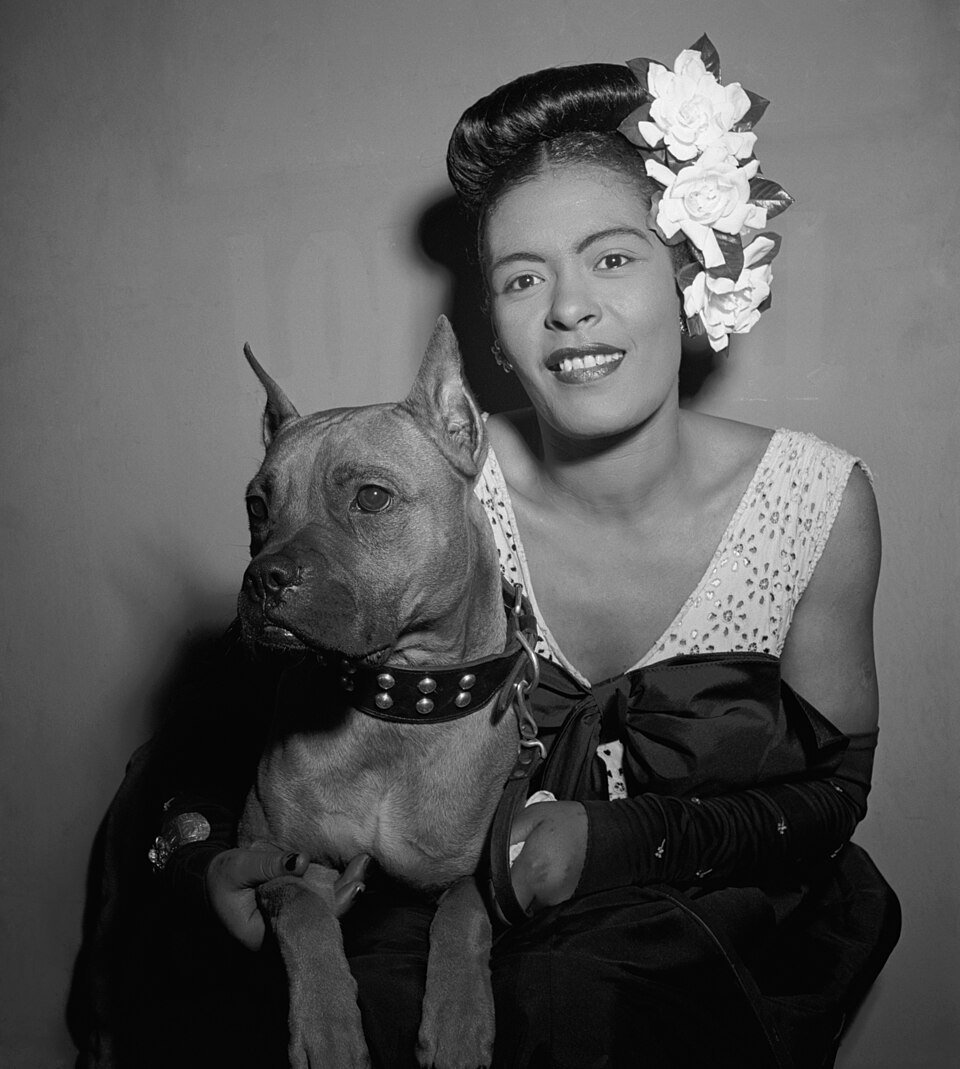
On the afternoon of December 8, 1957, American television showed something it had never quite shown before: Billie Holiday, seated among a circle of ageing swing masters in a CBS studio in New York, singing a blues she had written herself nearly twenty years earlier. The programme was The Sound of Jazz, and the song was Fine and Mellow. Holiday was forty-two, her voice frayed and her health failing. Across the circle sat Lester Young, the tenor saxophonist who had named her Lady Day, so weak he had been told he could play sitting down. What passed between them in the next few minutes became one of the most treasured performances in all of jazz.
Yet the song at the centre of it was no late-career revival piece. Fine and Mellow had been there at the defining session of Holiday’s life, on the back of the most dangerous record she ever made. It was her own composition, her own words, her own hard-earned philosophy of love — and in 1957 it gave her and Young the farewell neither of them knew they were singing.
A Blues of Her Own
Holiday built most of her repertoire from other people’s songbooks — the standards of Tin Pan Alley, reshaped by her phrasing until they sounded autobiographical. Fine and Mellow was different: she wrote it herself. It is a twelve-bar blues, the oldest and plainest frame in the music she grew up on, and the lyric is just as plain. A woman describes a man who does not love her and treats her, in her words, awful mean — the lowest man she has ever seen. Then comes the turn that gives the song its title: when he starts in to love her, he is so fine and mellow that everything else is forgiven, at least until the next verse.
That contradiction is the whole song. There is no rescue and no reform, only the clear-eyed accounting of someone who knows exactly what the bargain costs and keeps paying it anyway. Later verses widen the warning, reflecting on what love makes people do against their own judgement, but Holiday never raises her voice or her hopes. She sings the blues the way she sang everything, a fraction behind the beat, letting the words land like statements of fact. It became one of the very few songs she both wrote and made into a signature — a composition other singers would still be recording decades later, and the piece she returned to when she wanted an audience to hear Billie Holiday unmediated, with no songwriter standing between her and them.
April 20, 1939: The Other Side of Strange Fruit
The song reached record by accident of history. In 1939 Holiday was determined to record Strange Fruit, Abel Meeropol’s searing song about lynching, which she had been performing at Café Society, the integrated Greenwich Village club where she was appearing with trumpeter Frankie Newton’s band. Her label, Columbia, refused to touch it, fearing the reaction of Southern retailers and of the radio affiliates of its sister network. Her producer John Hammond would not record it either. So Holiday turned to her friend Milt Gabler, whose tiny Commodore label was granted a one-session release from her Columbia contract.
On April 20, 1939 — two weeks after her twenty-fourth birthday — she cut four sides with Newton’s band for Gabler. Strange Fruit took one side of Commodore 526. For the other side she offered a song of her own: Fine and Mellow. Gabler saw to it that the blues was copyrighted in her name, so its royalties stayed hers for the rest of her life — no small thing for a Black artist of that era. The record became the biggest seller of her career, and while Strange Fruit drew the headlines and the outrage, the unflinching little blues on the back became a jukebox favourite in Harlem, the side dancers and drinkers played over and over. History remembers the session for its protest song. The public of 1939 also kept the change: a writer’s blues, owned outright by the woman singing it.

Lady Day and Prez
No account of the song is complete without the saxophonist in the circle. Holiday and Lester Young met in Harlem in the early 1930s, and for a time Young boarded at the apartment she shared with her mother, Sadie. They worked together in Count Basie’s band and on the celebrated small-group sessions led by Teddy Wilson, where their interplay became a byword: Young said that when he listened back, the two of them could sound like two of the same voice, or the same mind. Playing on her surname, he christened her Lady Day. She returned the honour by calling him Prez — short for President — because Franklin D. Roosevelt was, in her judgement, the greatest man around, and Young was the greatest tenor player, so his title had to match.
Their friendship was deep, platonic and, like most long friendships under the pressure of the road, not unbroken. By the 1950s they had drifted apart, and both were in decline — Young, traumatised by a wartime army detention that had broken something in him, drinking heavily; Holiday battling addiction, arrests and failing health. But the musical understanding had never depended on conversation. It lived in the way her phrases leaned back and his lines floated forward, two halves of one thought, and it was still there waiting when television, of all unlikely places, called them back into the same room.

December 8, 1957: The Sound of Jazz
The Sound of Jazz was an edition of CBS’s The Seven Lively Arts, aired live on Sunday, December 8, 1957, from Studio 58 in New York, produced by Robert Herridge with jazz writers Nat Hentoff and Whitney Balliett as consultants. It gathered more than thirty leading musicians, and for Fine and Mellow Holiday was backed by an all-star band: Ben Webster, Lester Young and Coleman Hawkins on tenor saxophones, Gerry Mulligan on baritone, Roy Eldridge and Doc Cheatham on trumpets, Vic Dickenson on trombone, Mal Waldron at the piano, Milt Hinton on bass, Danny Barker on guitar and Osie Johnson on drums.
Hentoff recalled that during rehearsals Holiday and Young kept to opposite sides of the room. Young was so weak that Hentoff excused him from the big-band part of the show and told him he could sit for his solo. Then the cameras rolled. Webster played the first solo. Then, Hentoff remembered, Lester got up and played the purest blues he had ever heard, while he and Holiday looked at each other, their eyes interlocked, she nodding and half-smiling — as if they were both remembering what had been. In the control room, Hentoff said, everyone was crying. Dickenson, Mulligan, Hawkins and Eldridge followed, each a giant, none of it able to eclipse those few bars. It was the last time Holiday and Young ever performed together. When the show ended, they went their separate ways.
Four Months Apart
The ending came quickly for both of them. Young made his final recordings in Paris in March 1959, at the end of a European tour on which he had eaten almost nothing and drunk heavily, and he died in New York in the early hours of March 15, 1959, hours after flying home, aged forty-nine. Holiday attended his funeral. Critic Leonard Feather, who shared a taxi with her afterwards, recalled her saying that she would be the next to go. She was right almost to the season: Billie Holiday died on July 17, 1959, aged forty-four, four months after the man who had named her.
The Standard She Left Behind
What survived them both was the song. Fine and Mellow settled into the repertoire as Holiday’s signature blues, recorded by Nina Simone on Nina Simone at Town Hall, by Ella Fitzgerald, and by Dee Dee Bridgewater on her Holiday tribute album, among many others; Lou Rawls even flipped its lyric to sing about a woman. Singers keep coming back to it for the same reason audiences did in 1939 and 1957: it is an adult song, funny and bruised at once, that refuses to lie about love or about itself.
But its definitive performance remains the one no studio could have planned — a frail singer, a dying saxophonist, a look held a moment too long across a television studio. Holiday wrote Fine and Mellow as a young woman explaining a bad bargain. Eighteen years later, without changing a word, she sang it as something else entirely: a goodbye, in the shared language only she and Prez had ever spoken.
Leave a Reply