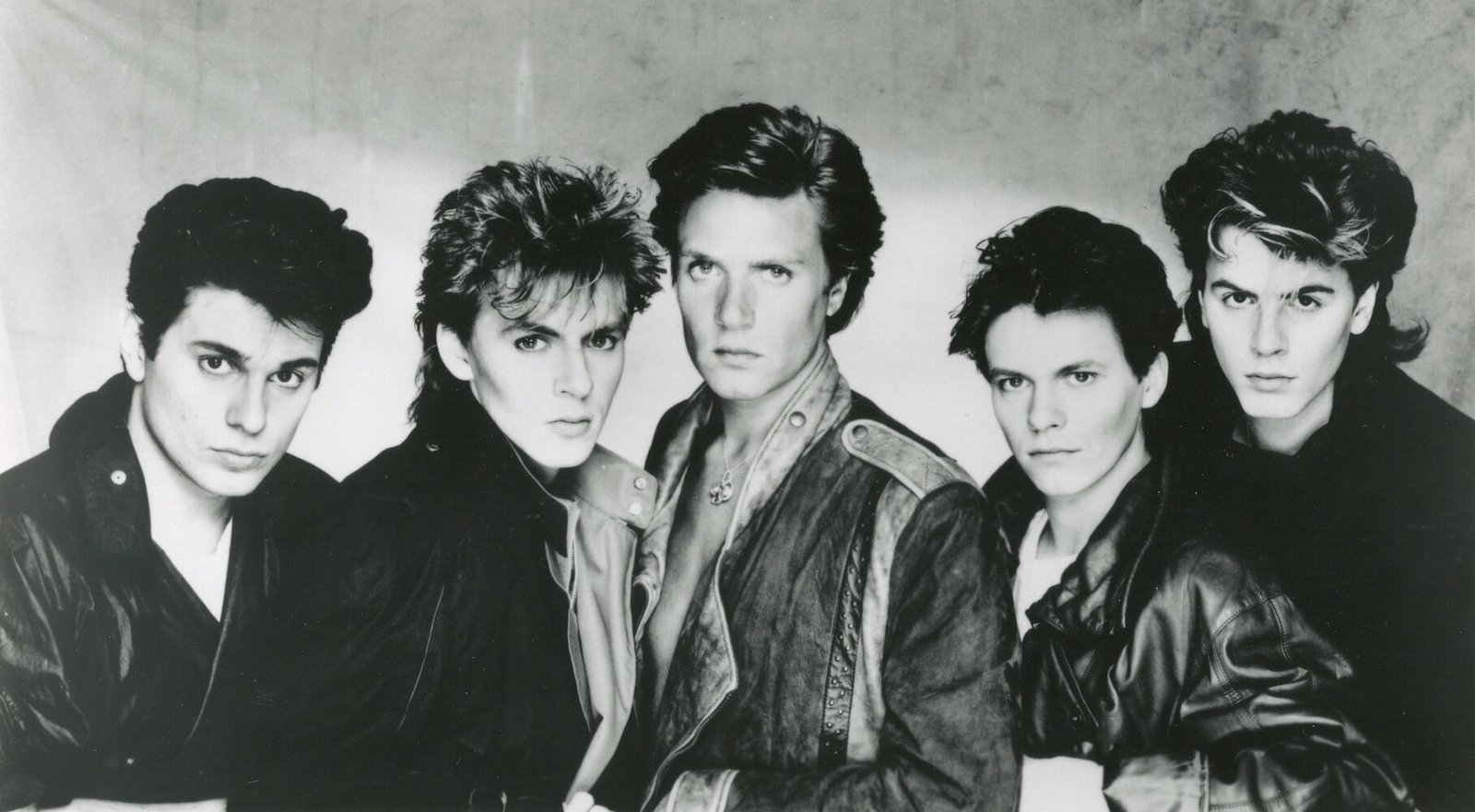
It is the definitive album of the New Romantic era — nine songs, forty minutes, and a painted cover of a woman with a cherry-red smile. Rio took Duran Duran from British pop hopefuls to global superstars, invented the modern music video as an art form, and gave the 1980s its soundtrack. But the album almost didn’t happen the way we know it: it was recorded in six to eight weeks in a studio built by a Beatle, its biggest hit was written in a single day, and America initially refused to buy it. This is the story of how five young men from Birmingham made a masterpiece.
The Pressure of the Second Album
Duran Duran’s self-titled debut, released in 1981, had been a genuine success in Britain, spinning off the hits “Planet Earth” and “Girls on Film.” But in the music business, the second album is where careers are made or broken, and the band knew it. They had the look, they had the momentum, and they had a growing reputation as the prettiest band in pop — a reputation that made critics sharpen their knives. What they needed now was the record: a complete, undeniable statement that would prove the songs were as strong as the cheekbones.
They also had a secret weapon: songs. By the summer of 1981, the band was writing at a furious pace, road-testing new material and stockpiling ideas. The debut had been made by newcomers; the follow-up would be made by a band that had toured the world and knew exactly what it could do. They even had a title before they had finished the album. Bassist John Taylor brought the word back from the band’s first world tour — “Rio,” a city that stood for everything he had seen and not grown up with, shorthand for a party that would never stop. They named the record for a feeling.
Demos in Manchester Square
On August 28, 1981, Duran Duran gathered at EMI’s Manchester Square studios in London and cut demos of three songs: “My Own Way,” “New Religion,” and “Last Chance on the Stairway.” “My Own Way” was released as a single that November, but the band wasn’t satisfied with it — when the album sessions began, they re-recorded it from scratch, building the new version off the demo. The released single and the album track are significantly different animals, and the re-recorded version’s swagger is a measure of how fast the band was growing. Even the demos crackled with ambition: you can hear five young musicians who know they are onto something big and are determined not to waste it.
The demos captured a band in transition, stretching beyond the debut’s sound. “Save a Prayer,” the album’s wistful centerpiece, had started even earlier, in a Birmingham rehearsal room, when Nick Rhodes found a new keyboard and Andy Taylor answered it on guitar. Piece by piece, the album was assembling itself before the band ever entered a proper studio.
Six Weeks at AIR
In January 1982, Duran Duran moved into AIR Studios in London — the state-of-the-art facility founded by former Beatles producer George Martin — to record Rio with producer and engineer Colin Thurston, the man behind their debut who had previously worked with David Bowie and Iggy Pop. The sessions lasted six to eight weeks, and the atmosphere was electric. Rhodes, in particular, was eager to experiment with the studio’s high-tech equipment, and Thurston — who believed in leaving air in the tape — gave the band room to play. The tracks were cut essentially live, with minimal overdubbing trickery, a discipline that kept the performances urgent and human beneath the glossy surfaces.
And then there was the neighbor. Paul McCartney happened to be recording at AIR at the same time, and the former Beatle would famously say goodnight to the young band as they worked. The Japanese band Japan were also recording there. For five lads from Birmingham, it must have felt like the center of the universe — because, for a few weeks in early 1982, it was.
The Songs: A Wolf in a Day
The album’s most famous song came together with startling speed. “Hungry Like the Wolf” was written in a day — a Saturday session that already sounded finished at three minutes and forty seconds. Legend has it the track was essentially complete by the end of that single day’s work, a burst of inspiration the band barely needed to touch afterward. It was primal, urgent, unstoppable, and EMI released it as a single in May 1982. It climbed to number five in Britain and, months later, to number three in America — the song that announced Duran Duran to the world, written in less time than it takes to watch a football match, and still thrilling nearly half a century later, every single time that opening riff kicks in.
The title track was a stranger beast. For its iconic opening sound effect, Thurston resorted to old-fashioned studio trickery: a metal bar was thrown at a grand piano, and the tape was reversed and looped. The saxophone solo that gives “Rio” its slinky swagger was played by session musician Andy Hamilton. Across the album, the band experimented with vibraphone, marimba, and found sounds — lit cigarettes, cracking ice — layering textures that made Rio feel lush and exotic. John Taylor’s bass, melodic and driving, gave the songs their strut, while Roger Taylor’s drumming kept everything taut and danceable. This was a traditional rock record in its bones — guitar, bass, drums, keyboards, vocals — dressed in the most modern clothes 1982 could tailor.
The Dark Side of the Yacht
For all its sunshine, Rio has a shadow — and that shadow is what makes it a great album rather than just a glamorous one. “New Religion” is tense and paranoid, all coiled bass and whispered menace. “Lonely in Your Nightmare” drifts through genuine unease. And the closing track, “The Chauffeur,” is one of the strangest things a pop band ever put at the end of a hit record: a slow, noir-ish, almost whispered piece that filmmaker David Lynch himself has praised, a song that feels like driving through a city at 3 a.m. with the headlights off.
Simon Le Bon’s lyrics across the album are impressionistic and literary — fragments of poetry rather than pop slogans, full of rain, glass, and distant cities. He had auditioned for the band with a notebook of his own verse, and Rio is where that literary instinct fully bloomed. It was this darkness beneath the gloss that gave Rio its staying power. The yachts and the suits were the invitation; the unease was the reason people stayed. Decades later, artists from the Killers to Mark Ronson would cite the album as a touchstone, drawn as much to its shadows as its shine.
Patrick Nagel’s Girl
Then there was the cover: a painted portrait of a woman with a pale face, sharp cheekbones, and a beguiling cherry-red smile, set against a vivid purple background. The image was painted by artist Patrick Nagel and designed by Malcolm Garrett, and it became instantly iconic — a sort of Mona Lisa for the New Romantic age.
Nagel actually created two paintings for the band to choose from. The runner-up wasn’t wasted: it appeared on the Japanese single release of “My Own Way.” The chosen image, meanwhile, became one of the most recognizable album covers of the decade, as inseparable from the music as the songs themselves. You could spot it across a record shop. You still can.
Sri Lanka: The Videos That Invented MTV
Between the recording and the release of Rio, the band made a decision that would change pop music forever. They hired director Russell Mulcahy — who had directed “Planet Earth” — and flew to Sri Lanka in the spring of 1982 to shoot lavish mini-movie videos for “Hungry Like the Wolf,” “Save a Prayer,” and the title track. Nick Rhodes stayed behind in London to finish mixing the album, then flew out to join the others, bringing a cassette of the completed record with him.
The videos were revelations: the band as adventurers, racing through jungles and sailing yachts off Antigua, pursuing beautiful women through impossibly glamorous landscapes. EMI reportedly spent around $200,000 on the Sri Lanka shoot — an unprecedented video budget at the time — and every penny showed on screen. MTV, then a fledgling cable channel desperate for content with an edge, played them endlessly. American teenagers had never seen anything like it: a band that treated a three-minute pop song as a license to make cinema. Duran Duran hadn’t just made an album; they had invented the visual language of the 1980s pop star, where the video was as important as the song. Every artist who has ever treated a video premiere as an event owes them a debt.
America Says No — Then Yes
Rio was released on May 10, 1982, and soared to number two in Britain. America, however, was unmoved. The album came out in the States on the Harvest label, and as one account memorably put it, Capitol couldn’t hear Thurston’s mix on a pickup-truck radio. Nothing happened.
What happened next is a masterclass in record-company persistence. EMI’s Rupert Perry handed “Hungry Like the Wolf” to producer David Kershenbaum and asked him to Americanize it — more compression, more sizzle on the vocal, the air taken out so it would punch through FM radio. The remixes appeared on an EP that September, and Kershenbaum was brought back to redo the entire first side of the album that November: a remixed “Rio,” a longer “Hungry Like the Wolf,” a rebuilt “My Own Way.” This time, America listened. Rio climbed to number six on the Billboard chart, where it sat for seven weeks starting in March 1983, and “Hungry Like the Wolf” roared to number three on the Hot 100. The Second British Invasion had its flagship — and Duran Duran had their proof that patience, like everything else they did, could be glamorous.
Four decades on, Rio has lost none of its shine. It inspired an entire book in the 33⅓ series by Annie Zaleski, chronicling its making in forensic detail. Critics who once dismissed Duran Duran as pretty faces now rank it among the great albums of the 1980s, and younger artists cite it the way earlier generations cited Bowie. It remains the definitive LP of the New Romantic era — the record that proved style and substance were never opposites. Five boys from Birmingham walked into a Beatle’s studio with a word — Rio — and walked out with immortality. The party, it turns out, really never stopped.
Leave a Reply