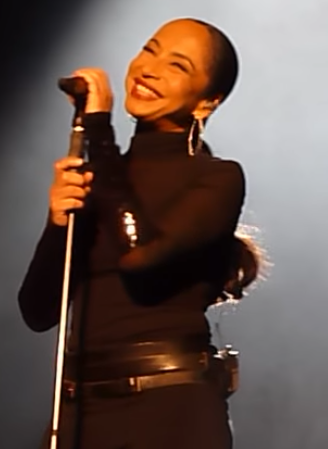
She is the most private star in pop music — a woman who has given fewer interviews in forty years than most celebrities give in a month. Sade Adu has sold tens of millions of records while living like someone determined to be forgotten by the gossip columns. But behind the silence is a rich, deeply human story: a Nigerian-English childhood split between two worlds, a short first marriage, a beloved child whose journey became her most personal song, and a quiet life in the English countryside with a man who was once a Royal Marine. This is the Sade the cameras never see.
A Child of Two Worlds
She was born Helen Folasade Adu on January 16, 1959, in Ibadan, Nigeria. Her father, Adebisi Adu, was a Nigerian economics lecturer of Yoruba heritage; her mother, Anne Hayes, was an English district nurse. Her parents had met in London, married in 1955, and moved to Nigeria to build a life. It did not last. When Sade was four years old, her parents separated, and Anne brought Sade and her older brother Banji back to England, settling near her own parents in Colchester, Essex.
Growing up between two cultures left its mark. Sade was a quiet, watchful child — the kind who absorbs everything and volunteers nothing. She has rarely spoken about those early years in Nigeria, but the duality never left her: the English reserve and the Nigerian warmth, the stillness and the rhythm. Friends from those days remember a girl who was already private, already self-contained, already certain about who she was. When she won the Grammy for Best New Artist in 1986, she became the first Nigerian-born artist ever to win a Grammy — a milestone she has carried with quiet pride ever since, never trading on it, never needing to.
Folasade: The Heritage She Carries Quietly
For all her English reserve, Sade has never hidden her Nigerian roots — she has simply worn them the way she wears everything: without fanfare. Her full name, Helen Folasade Adu, honors her Yoruba heritage through her father, and she has spoken over the years about the pride she feels in that lineage. Nigeria named a generation of British-Nigerian artists who followed her, and she remains a touchstone for them — proof that you can honor where you come from without turning it into a slogan.
It is worth noting how rare her path was. In the 1980s, Black British women were not supposed to become global pop stars on their own terms, fronting their own bands, refusing the industry’s scripts. Sade did it by being unmistakably herself: elegant, composed, and rooted in something deeper than fashion. Her heritage wasn’t a marketing angle. It was simply who she was — and that authenticity became her power.
The First Marriage
Long before the world knew her name, Sade married Spanish film director Carlos Pliego. The marriage lasted from 1989 to 1995 — six years that coincided exactly with the band’s long silences between Stronger Than Pride and Love Deluxe, and then between Love Deluxe and the hiatus that followed. She has said almost nothing about the relationship in public, which is entirely in character. What is known is that it ended quietly, without scandal, without tell-all interviews, without a single bitter word in the press. In an era when celebrity divorces were public blood sports, Sade’s silence was its own statement: some things belong to the people who lived them, and no one else.
That discretion was not an accident. Even as her fame peaked, Sade treated her personal life as a walled garden. While other stars of the era traded their private lives for headlines, she simply refused the transaction. The marriage came and went, and the music continued, and the public learned nothing — which was precisely how she wanted it. It is a discipline she has maintained for nearly forty years, through relationships, motherhood, and everything in between.
The Caribbean Years and a Child
In the late 1990s, Sade did something unexpected: she left England for the Caribbean, where she lived for a time with Jamaican music producer Bob Morgan. It was a retreat in the truest sense — away from the industry, away from expectations, toward sun, sea, and a different rhythm of life. Those who knew her then describe a woman decompressing from a decade of fame, rediscovering the simple pleasures of anonymity. On July 21, 1996, she gave birth to her only child. In 1996, the baby was a daughter, Mickailia Ila Adu. Today, the world knows her child as Izaak Theo Adu — a transgender man. The Caribbean years didn’t last — Sade eventually returned to the English countryside she loved — but they gave her something no studio ever could: the experience of being nobody special, just a new mother, for a little while.
Sade’s devotion to her child has been the defining relationship of her adult life. When the band went silent for eight years after Love Deluxe, it was largely because Sade had chosen motherhood over music. She raised Izaak away from the spotlight, in the countryside, with the fierce protectiveness of a woman who had spent her whole career guarding her privacy and now had something infinitely more precious to guard. Friends say she threw herself into motherhood the way she throws herself into everything: completely, without reservation, and without any interest in applause. The pop star vanished; the mother remained.
A Mother’s Unconditional Love
On National Coming Out Day in 2016, Izaak Theo Adu publicly came out as a transgender man, and began a transition journey he would document with striking honesty on social media. In 2019, after gender-affirming surgery, he wrote a message to his mother that stopped hearts: thank you, he said, for fighting alongside him to become the man he is, for encouraging him when he was down.
Sade’s response, true to form, was not a press release but a song. In late 2024, after more than a decade without releasing new music, she contributed “Young Lion” to TRANSA, a Red Hot compilation celebrating trans and non-binary artists. It was a musical letter to her son — tender, aching, honest about a mother’s struggle to understand and her determination to love without conditions. The song’s lyrics reflect on the pain of not fully grasping her child’s experience, and the fierce resolve to stand beside him anyway. The video, a collage of home footage from Izaak’s childhood directed by her old friend Sophie Muller, ends with mother and grown son embracing — and earned a Grammy nomination. For an artist who had always hidden her feelings behind elegance, it was the most exposed she had ever been. And it was for her child.
Izaak has since built his own creative life as an artist and model, moving between painting, carpentry, and fashion work, and in 2021 married his partner, Emily Margaret Shakeshaft, in a small ceremony in Hawaii. Through it all, his mother’s support has never wavered — the quietest superstar in music, showing up exactly where it mattered, not with statements but with constancy. It is the same loyalty she once showed her bandmates when the whole industry wanted her solo. Some people never change their nature; they just find new people to be loyal to, and new quiet ways to show it.
Ian Watts and the Gloucestershire Farm
Since the mid-2000s, Sade’s partner has been Ian Watts — a man about as far from the music industry as it is possible to get. A former Royal Marine who went on to serve as a fireman before studying chemistry at Cambridge, Watts shares Sade’s love of quiet. Together they live on a farm near Stroud, in the rolling countryside of Gloucestershire in the west of England, raising their blended family far from any red carpet.
It is, by all accounts, an ordinary life lived extraordinarily well: dogs, gardens, long walks, no paparazzi because there is nothing to photograph. Sade cooks. She gardens. She is, neighbors say, simply a pleasant woman who keeps to herself — the kind of neighbor who waves from the garden gate and means it. Watts, with his military background and his chemistry degree, is said to share her dry humor and her distaste for fuss. The contrast with her stage persona — the smoky, untouchable chanteuse — could not be more complete, and that is exactly the point. The farm is where Helen lives. The stage is where Sade works. She has kept the two apart for forty years, and the boundary has held because both of them wanted it to.
The Art of Disappearing
Sade’s privacy is not shyness; it is philosophy. She understood early that fame is a hungry animal, and she decided how much of herself she would feed it: almost nothing. She gives interviews perhaps once a decade. She has no interest in celebrity culture, award-show circuits, or social media performance. When she was made an Officer of the Order of the British Empire in 2002 and promoted to Commander in 2017, she accepted with characteristic grace and then went home. Even her bandmates — men who have known her for over forty years — describe her as intensely private, someone whose inner life remains her own. In an age when every celebrity is expected to narrate their existence online, her refusal feels less like withdrawal and more like wisdom.
This discipline extends to her art. She has said she only makes records when she feels she has something to say — a statement that sounds simple and is, in the modern music industry, almost revolutionary. Six albums in four decades is not laziness. It is the output of someone who refuses to manufacture feeling, who waits until life has given her something worth singing about. Motherhood, heartbreak, a child’s courage: these are the materials of her songs, gathered slowly, in private, over years. While other artists document their lives in real time for millions of followers, Sade lives hers first and sings about it a decade later — if she sings about it at all.
Behind the silence, then, is not emptiness but fullness: a life rich with family, love, and hard-won wisdom, lived deliberately out of view. Sade Adu didn’t disappear from the world. She chose a different world — one with farms instead of flashbulbs, with a son’s gratitude instead of a tabloid’s attention, with a partner who loves the woman rather than the legend. Every few years she emerges, sings what she has learned, and vanishes again. It is the most honest arrangement in pop music, and the most generous: she gives us the music, and keeps the life. And it has never once let her fans down.
Leave a Reply