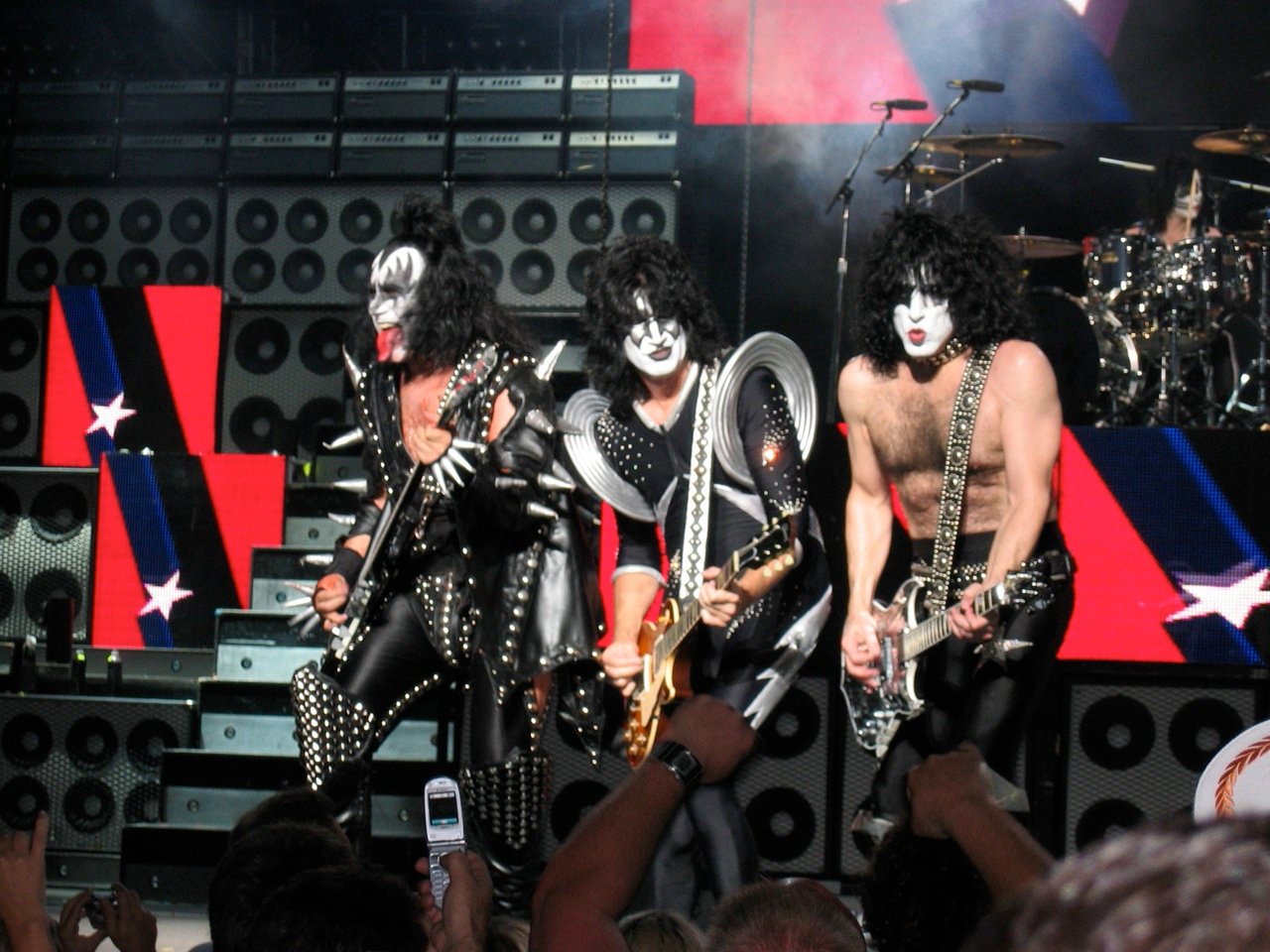
Kiss built their empire on volume, fire and four-inch heels, and their biggest American hit contains none of it. Beth is two minutes and forty-nine seconds of piano, strings and a drummer singing softly about a woman waiting at home. It was written as a joke in somebody else’s band, smuggled onto a Kiss album over the objections of the men who ran the label, buried on a B-side by a record boss who hated it for the most personal of reasons — and then rescued by disc jockeys, a Canadian programme director’s teenage daughter, and the listening public. It reached No. 7, won a People’s Choice Award, and remains, nearly fifty years later, the highest-charting single of Kiss’s career.
A Joke in Chelsea
Long before Kiss, Peter Criss drummed in a New York band called Chelsea, alongside guitarist Stan Penridge. Chelsea’s other guitarist, Mike Brand, had a wife, Becky, whose telephone calls interrupted rehearsals so reliably that Criss and Penridge turned her into a song — a teasing number called Beck, about a man who can hear his girl calling but cannot come home, because he and the boys are playing and have not yet found the sound. Penridge kept the words in a notebook. Criss later maintained the song was also, in part, about his own first wife, Lydia, and the calls and loneliness of a working musician’s marriage; the two claims have been argued about ever since.
The joke outlived the band. Criss and Penridge demoed Beck again in their later group Lips, and in 1975 Criss carried it into the sessions for Kiss’s fourth album, Destroyer, determined to get a composition of his own onto a record. The determination had a history: across Kiss’s first three albums, Criss’s writing credit amounted to a single shared instrumental, Love Theme from Kiss. He had sung plenty of other men’s songs. This one, however unlikely, was his.
The Limo Audition
On a limousine ride during the Destroyer period, Criss sang an uptempo version of Beck for Gene Simmons and Paul Stanley, fully expecting the band’s two songwriters to wave a sentimental ballad away. Instead they told him to sing it for the album’s producer, Bob Ezrin — the man behind Alice Cooper’s theatrics, hired to give Kiss a bigger, stranger record.
Ezrin heard what Simmons and Stanley had not. Kiss’s catalogue, as he reasoned, was largely about sex and conquest; here was a love song that everyone could relate to. He promised Criss the song would be a success, and then he rebuilt it. Ezrin slowed the tempo drastically, reworked the melody, rewrote part of the lyric and wrapped the whole thing in an orchestral arrangement. Even the name changed: Beck became Beth — a change variously claimed by Simmons, who said it sang better and avoided confusion with Jeff Beck; by Lydia Criss, who noted the original Becky had a twin sister named Beth; and credited by Ace Frehley to Ezrin himself. The squabbling over this song began before it was even released, and it has never entirely stopped.

Twenty-Five Tuxedos
The recording was as unlikely as the song. Ezrin seated himself at a grand piano in a top hat, brought in members of the New York Philharmonic — and, in the session’s most repeated detail, had the orchestra’s twenty-five players wear fake tuxedos while Criss sat for photographs in full Catman make-up. Alice Cooper’s guitarist Dick Wagner played the acoustic guitar part in place of Frehley, who, by both Criss’s and Simmons’s accounts, was otherwise engaged playing cards with friends. Criss recorded his vocal alone at the Record Plant in New York.
The result is a statistical curiosity without parallel in rock: Beth is the only Kiss recording on which no member of Kiss plays an instrument. The loudest band in the world had made its gentlest record with the band, essentially, out of the room.
The B-Side That Ate the A-Side
By the summer of 1976, Casablanca needed Destroyer to work harder. The album had peaked at No. 11 on the Billboard 200 and begun to slide, and its first two singles, Shout It Out Loud and Flaming Youth, had stalled well short of the live Rock and Roll All Nite. Getting the next single right mattered, and getting it wrong is exactly what the label’s president proceeded to do. Neil Bogart asked DJ and promoter Scott Shannon which Destroyer track had hit potential; Shannon chose Beth, and Bogart told him to forget it — the song, he felt, was on the album as a favour to Criss. His vice-president Larry Harris knew another reason: Bogart’s ex-wife was named Beth, and he heard his own divorce in the lyric. Before leaving on vacation in Acapulco, Bogart ordered Beth placed on the B-side of the next single, the thundering Detroit Rock City, precisely so that it would go nowhere.
It went everywhere. Disc jockeys flipped the record over. At CKLW, the powerhouse station in Windsor, Ontario, music director Rosalie Trombley was persuaded by her own daughter, who owned the single and was hooked on the flip side; Trombley added Beth to the playlist, and requests flooded in. Casablanca reissued the single with Beth as the A-side in August 1976. By December it stood at No. 7 on the Billboard Hot 100 and No. 5 in Canada. The RIAA certified it gold on January 5, 1977, it won Favorite Song at the 1977 People’s Choice Awards, and its success pushed Destroyer itself to platinum. Kiss later presented Trombley’s daughter with a gold record of her own. Manager Bill Aucoin, watching the painted faithful absorb a string ballad, admitted the fans had not quite known what to make of it at first. They learned.

A Song Its Singer Had to Carry Alone
Success created a practical problem: how do you perform, on a Kiss stage, a song the band never played on? Criss’s bandmates had not wanted to play it live at all, but Aucoin insisted — some of the new fans filling the seats, he reasoned, were coming precisely because of Beth. The first rehearsals were, in Criss’s word, a nightmare — Frehley could not manage the acoustic guitar part, and nobody else had a part at all. Manager Bill Aucoin and his partner Sean Delaney found the solution that became part of Kiss folklore: a pre-recorded backing track, and the drummer perched on a drum case at the front of the stage, singing his ballad alone in the middle of the loudest show on earth. Its television debut had already come on The Paul Lynde Halloween Special on October 29, 1976, with Criss miming at a piano. It also crossed over to the adult contemporary chart, peaking at No. 14 — a Kiss record, in 1976, on the easy-listening listings, filed between the crooners.
The credit dispute trailed the song into old age — Stanley argued in 2014 that Penridge was the true writer and Criss a passenger; Criss answered that the men who sang lead for Kiss simply hated that the drummer wrote the hit. The song itself outlasted the argument and even its singer’s tenure. Eric Carr, who replaced Criss in 1980, was given a studio version of it to sing on the 1988 compilation Smashes, Thrashes & Hits, and when the original band reunited for Kiss Unplugged in 1996, their acoustic Beth became the only recording of the song with the members of Kiss actually backing Criss themselves. Audiences never cared about the paperwork. Beth did something no Kiss anthem managed: it brought the band to listeners who would never have bought a ticket, and it set the template for every power ballad that followed — critics have credited it with setting the mark for the decade of hair-metal slow songs that came after. The joke song from Chelsea rehearsals, the B-side a label boss tried to bury — that is the record the loudest band in the world will be remembered by on the singles chart.
Leave a Reply