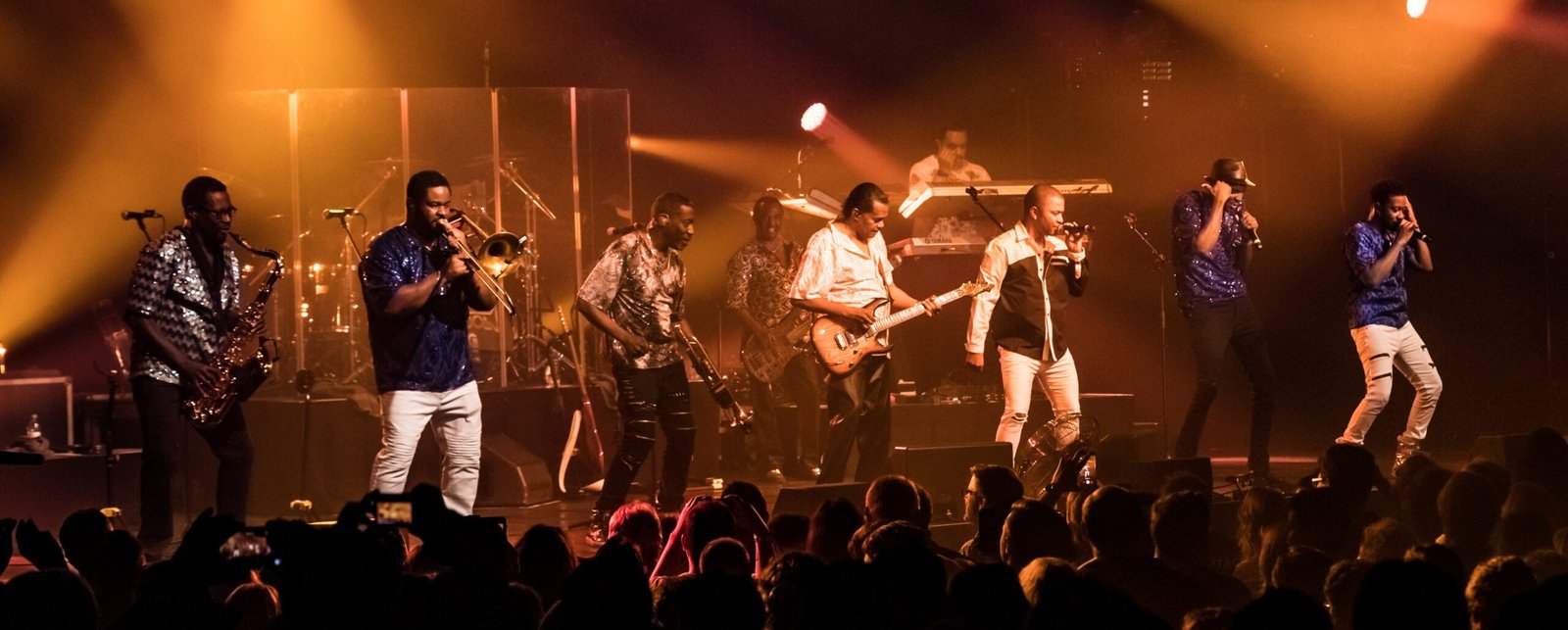
By 1973, Kool & the Gang were in trouble. The Jersey City band — formed back in 1964 as the Jazziacs by brothers Robert “Kool” and Ronald Bell, with Dennis “Dee Tee” Thomas, Robert “Spike” Mickens, Claydes Charles Smith, George “Funky” Brown and Ricky West — had been schooled in jazz and signed to De-Lite Records, and had made three albums of sophisticated instrumental funk that critics admired and the charts ignored. Drummer George Brown remembered the pressure plainly: the group was under orders from its label to come up with a hit song. What the band produced, in essentially one take, was three minutes and eight seconds of grunting, chanting, horn-punching primitivism with almost no conventional lyric at all — and it turned them into stars.
The performance above, from Soul Train in 1974, is the original line-up in full flight: this was never a record meant to be sat with. It was meant to be danced to, immediately, by everyone in the room.
A Rock Riff, Rebuilt as Funk
The unlikely starting point was a rock instrumental. Ronald “Khalis” Bell, the band’s saxophonist and musical architect, had been listening to the Edgar Winter Group’s Frankenstein — a No. 1 hit in the spring of 1973 — and found himself fixated on its riff. “I was listening to Edgar Winter’s ‘Frankenstein’ record,” Bell recalled. “I thought, Wow — that riff is interesting, how he’s doing that. Then I just took a structure from the rhythm, and I came up with the horn riff.”
There is a pleasing symmetry in the borrowing. Winter had written the Frankenstein riff years before it became a hit, as a personal showcase for his own Hammond organ and saxophone playing. Bell took a one-man showpiece and rebuilt it as a seven-man one: the riff moved from organ to a full horn section — Bell, Thomas and Mickens punching in unison — while his brother Robert’s bass circled underneath and Clay Smith’s guitar chopped at the edges. A rock riff, passed through a jazz band’s discipline, came out as funk.
At home, Bell worked the idea up with a chant attached — “Jungle Boogie, boogie woogie, Jungle Boogie, boogie woogie” — but in the studio he had second thoughts about the middle of it. “When I got to the studio, I thought I’ll take all of that middle part out and just go ‘Jungle Boogie… Jungle Boogie.’ And that’s how we came up with ‘Jungle Boogie.’ It was just pure rhythm.”

One Night, Three Songs
The session became the stuff of band legend. Robert “Kool” Bell recalled the group locking themselves into a New York rehearsal room — “We just started groovin’ and funkin’” — and emerging by eleven that night with three finished songs: Jungle Boogie, Funky Stuff and Hollywood Swinging, the entire hit payload of their next album, the self-produced Wild and Peaceful. Bell’s account of the recording, at New York’s Mediasound studios, is even more offhand: “We made the song up in the rehearsal, went in and recorded it that night. ‘Jungle Boogie’ is one take. There’s no more to that. Three minutes and, ‘Okay, enough of that.’”
Listen for what one take means here: Ricky West’s electric piano vamping in the cracks, Brown’s drums locked to Robert Bell’s bass, the horn section breathing as a single animal. There is no soloist, no star turn — the arrangement is the star, and its discipline is exactly what three albums of ignored jazz-funk had trained into them. The sophistication they had been punished for was still there. It had just been pointed at the dancefloor.
It nearly kept its working title. The band had been calling the groove “Jungle Jim” until alto saxophonist Dennis “Dee Tee” Thomas heard the playback and overruled them. As George Brown told it: “He said, ‘No man — people are boogieing. Let’s call it Jungle Boogie.’ Bingo. Done.”
The Roadie Who Sang the Hook
One thing was missing, and Bell knew it: “After we recorded it, we felt we had something, but we didn’t know what it was missing.” The answer came from outside the band entirely. The group’s roadie, Don Boyce, announced that he had something for the track — the band hollering like Tarzan on the end of it. They brought him into the studio, and Boyce delivered the record’s unmistakable signature: the deep, gravelly, spoken commands of “Get down, get down,” woven through the track between the grunts, pants and scats, and capped by a full Tarzan yell as the record fades.
It was an inspired accident. The most recognisable voice on Kool & the Gang’s breakthrough hit belongs to a man whose job was moving their equipment — and the band acknowledged it properly: Boyce’s name sits in the songwriting credits alongside all seven members, making him a co-writer of a million-selling single. It may be the best-paid night of roadie work in the history of funk. Around his voice the band layered its own grunting, panting and scatting, turning the studio into the jungle of the title: the record doesn’t describe a party, it sounds like one already in progress, and the listener is simply late arriving.

Number Four — Then Immortal
De-Lite released Jungle Boogie as a single on 24 November 1973, backed with North, South, East, West, from the band’s fourth album, Wild and Peaceful. It climbed to No. 4 on the Billboard Hot 100 in March 1974 and No. 2 on the soul chart, sold more than a million copies, and finished as Billboard’s No. 12 single of the whole of 1974 — while Hollywood Swinging and Funky Stuff made Wild and Peaceful a three-hit breakthrough, and the album itself gave the band its first real foothold on the pop album chart. In the clubs it was bigger still: all chant, grunt and percussion, it became a foundational record of the dawning disco era, built for dancers at the exact moment dancers were taking charge of American nightlife. Television carried it the rest of the way: the band performed it on Soul Train in 1974 — the show’s famous line dancers took to it so completely that the footage is still counted among Soul Train‘s greatest moments — and closed the year on The Midnight Special‘s “Million Sellers” edition, hosted by Wolfman Jack, sharing the bill with Gladys Knight & the Pips, the O’Jays and the Ohio Players — precisely the neighbourhood they had been trying to move into. A flute-led instrumental remake, Jungle Jazz, surfaced on the 1975 album Spirit of the Boogie, but it was always a footnote to Boyce’s version.
The record also redrew the band’s future. The jazz musicians who had been ordered to simplify did not abandon their sophistication — they weaponised it, and within six years the same line-up, fronted now by singer James “J.T.” Taylor, had become the smoothest hit machine in American pop: Ladies’ Night, Celebration, Cherish. Every one of those triumphs runs on the engine built in that rehearsal room — horns played as rhythm, a chant doing the work of a melody, and a whole room shouting “get down.”
The afterlife has been longer than anyone in that rehearsal room could have guessed. The track became raw material for the sampling era — its groove turns up in the Beastie Boys’ Hey Ladies and Janet Jackson’s You Want This, and Madonna built part of Erotica on it in 1992. Two years later, Quentin Tarantino dropped it under the opening credits of Pulp Fiction, and a generation that had never heard of De-Lite Records absorbed the groove whole. Ronald Bell, the man who borrowed the riff and stripped out the middle of his own chant, died in 2020; four years later, in October 2024, when Kool & the Gang were inducted into the Rock and Roll Hall of Fame, Jungle Boogie was in the medley — fifty-one years after a jazz band under orders to produce a hit locked a door, borrowed a rock riff, handed the microphone to their roadie, and got it right in one take.
Leave a Reply