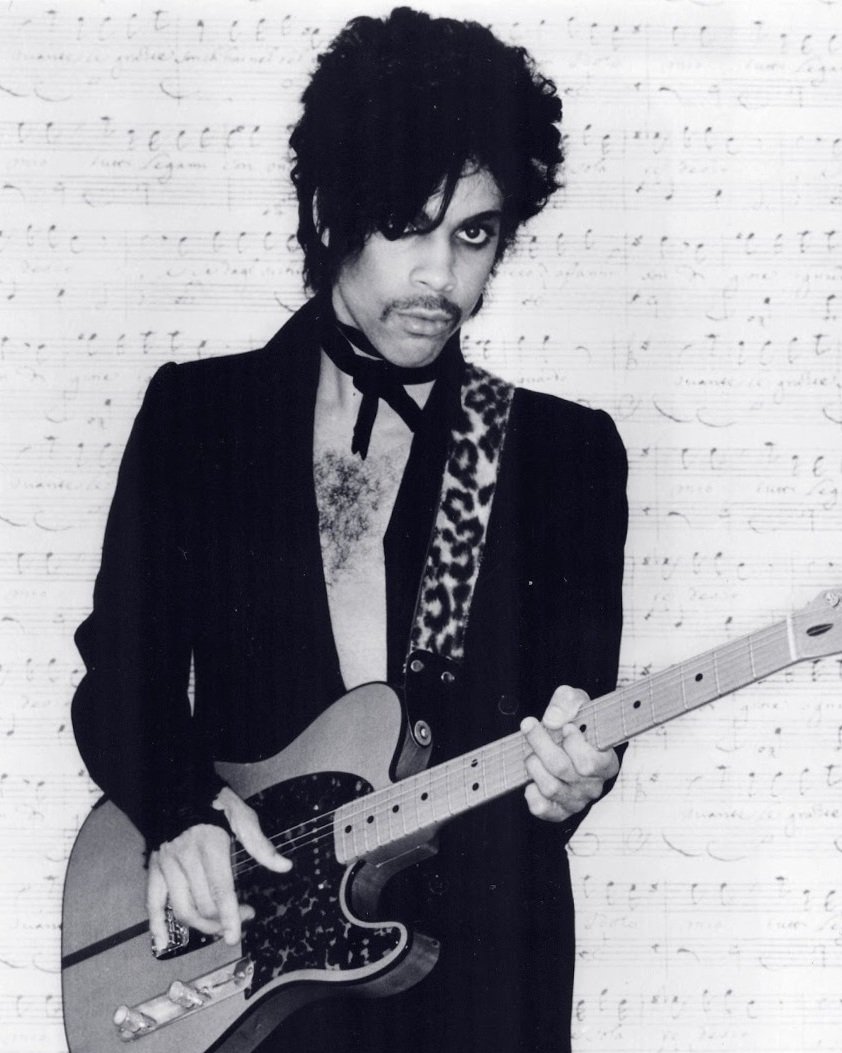
The most famous car in Prince’s catalogue was never a Corvette, and it was not red. It was a pink-and-white 1964 Mercury Montclair Marauder, a vast vintage cruiser belonging to Lisa Coleman, the keyboard player in his band. In the spring of 1982, Prince was working the punishing hours that were already his trademark, recording through the night and snatching rest wherever he could find it. Coleman has recalled that he was always borrowing her car because, in her words, it was awesome — the perfect cruise-mobile on a beautiful day in Minneapolis — even if he kept putting dents in it and mumbling apologies afterwards. Somewhere in that car, between exhaustion and sleep, one of the great pop songs of the decade began to arrive. Prince later said he always considered the song a dream, because it was written between three or four catnaps and he was never fully awake.
A Song Written Between Catnaps
The opening lines came first, the way Prince’s best openings often did — as a small, perfect observation. “I guess I should’ve known, by the way you parked your car sideways, that it wouldn’t last”: a whole relationship, diagnosed from a parking job. In his unpublished liner notes for the 1993 compilation The Hits, Prince described the writing of “Little Red Corvette” as something closer to dreaming than composing. The lyrics surfaced in fragments while he dozed in Coleman’s Mercury after an all-night session, each nap delivering another piece, until the half-awake singer had the shape of a song about a woman moving much too fast — and a narrator who knows he should slow her down, even as he climbs in beside her.
Coleman herself later added a mischievous footnote to the legend. Talking to the BBC in 2019, she suggested that the seed of the idea may not have come from solitary sleep at all: Prince had company in the back seat, she believed — Denise Matthews, soon to be famous as Vanity — and Coleman joked that she had found some of the other woman’s hair wound around the car’s window handle. Whatever happened in the Mercury, her verdict on the mythology was cheerful and definitive: “But it’s not a red Corvette — it’s a pink Mercury!” The transformation was a songwriter’s instinct. A pink Mercury was Coleman’s beloved, dented runabout; a little red Corvette was an American symbol, sleek and dangerous, that turned a private encounter into a universal metaphor of speed, desire and a love that would need to last longer than one night.

Three People in a Home Studio
Prince wasted no time turning the dream into a record. The basic tracking for “Little Red Corvette” took place on 20 May 1982 at his Kiowa Trail home studio in Chanhassen, Minnesota — the first session, according to accounts of the studio’s history, on which he used a newly installed 24-track Soundcraft console. Mixing followed later that summer, on 11–12 August 1982, at Sunset Sound in Los Angeles. For a record that would soon be everywhere, it was made by remarkably few hands. There were just three people involved: Prince, who sang lead and played virtually every instrument; Coleman, who added backing vocals; and guitarist Dez Dickerson, who sang backing vocals and played the guitar solos.
The track itself is a study in the hybrid sound Prince was perfecting in 1982. A Linn LM-1 drum machine lays down the steady electronic pulse, Oberheim synthesisers build the slow, smouldering introduction, and then the chorus opens out into pure rock and roll. The lyric rides on that contrast — verses that confess, a chorus that pleads. “Little red Corvette, baby, you’re much too fast” is at once a warning to the woman in the song and, heard another way, advice the singer might have needed himself: he was twenty-three, working at a pace nobody could sustain, and writing songs in his sleep because there was no other time left to write them.
The Solo Prince Did Not Play
The record’s secret weapon belonged to somebody else. Dickerson, a Minneapolis guitar hero before he was ever in Prince’s band, was summoned to Prince’s house and played the track. His instruction, as he remembered it in a Guitar World interview, was gloriously minimal: Prince pointed out where the solo went and told him, “Do what you do.” Dickerson recorded five passes on one of his custom Explorer-style guitars, built from Schecter parts by a local music shop, and the finished solo was comped together from those takes — a stinging, distortion-drenched break that crashes into the song’s synth-funk surface and announces that this is a rock record as much as an R&B one.
It was one of Dickerson’s last great contributions to Prince’s music; he left the band in 1983, before the group was formally billed as the Revolution on record. History has kept the receipt, though: readers of Guitar World later ranked his “Little Red Corvette” solo at No. 64 in a poll of the greatest guitar solos of all time — a remarkable placing for a guest spot on a song its creator had dreamed in the back of somebody else’s car.

Second Track, Second Single, First Breakthrough
“Little Red Corvette” sat second on 1999, Prince’s fifth album, released as a double LP on 27 October 1982. The album became his first Top 10 record on the Billboard 200, peaking at No. 9, and the song was chosen as its second single, released on 9 February 1983. It entered the Hot 100 modestly, at No. 66, and then climbed for months — twenty-two weeks on the chart in all — until it reached No. 6 in May 1983. It was, at that point, the highest-charting single of Prince’s career and his first ever Top 10 hit in America, and tellingly, it was also his first single to do better on the pop chart than on the R&B chart. The crossover he had been engineering in the studio had arrived in the marketplace.
Television carried it there. The video, directed by Bryan Greenberg and filmed in late January 1983 at the Lakeland Civic Center in Florida during rehearsals for the second leg of the 1999 tour, was a performance clip — Prince and his band on a stage, all charisma and choreography. “Little Red Corvette” was Prince’s second video shown on MTV, after “1999”, and it joined the tiny handful of clips by Black artists placed in heavy rotation by the young channel in early 1983, arriving just before Michael Jackson’s “Billie Jean”. For millions of viewers, that sleek, strutting performance was their first sight of Prince at all.
No. 2 in Britain, and an Echo in Stevie Nicks
Britain, characteristically, took longer. The single stalled at No. 54 there in 1983, and a reissue later that year did worse still. But after Prince’s extraordinary 1984, Warner Bros. tried a third time: in January 1985 “Little Red Corvette” was reissued as a double A-side with “1999”, and this time it raced to No. 2 on the UK Singles Chart, kept from the top only by Foreigner’s “I Want to Know What Love Is”. The song the British public had twice ignored became, on its third attempt, one of his biggest British hits.
Its influence travelled in stranger ways, too. Stevie Nicks has told the story of driving on the day she married Kim Anderson in January 1983, hearing “Little Red Corvette” on the car radio, and writing her own hit “Stand Back” to its rhythm that same day. She telephoned Prince to confess what she had done; he came to the studio and played the uncredited synthesiser part on her record.
Listening Back
Time has kept the Corvette running. Dickerson’s solo remains a fixture of guitar polls, and when Prince died in April 2016, “Little Red Corvette” re-entered the Hot 100 and climbed to No. 20, as a grieving public reached instinctively for the hits that had introduced him. Heard today, the record still feels like the moment everything about him clicked: the drum machine and the guitar hero, the confession and the chorus, the funniest opening line of his career and one of its saddest warnings.
And it all began with borrowed keys. Somewhere in Minneapolis there was a pink Mercury, longer than a Corvette, slower than a Corvette, dented by its most famous passenger — and in its back seat, between three or four catnaps, Prince dreamed the little red sports car that drove him into the Top 10 for the very first time.
Leave a Reply