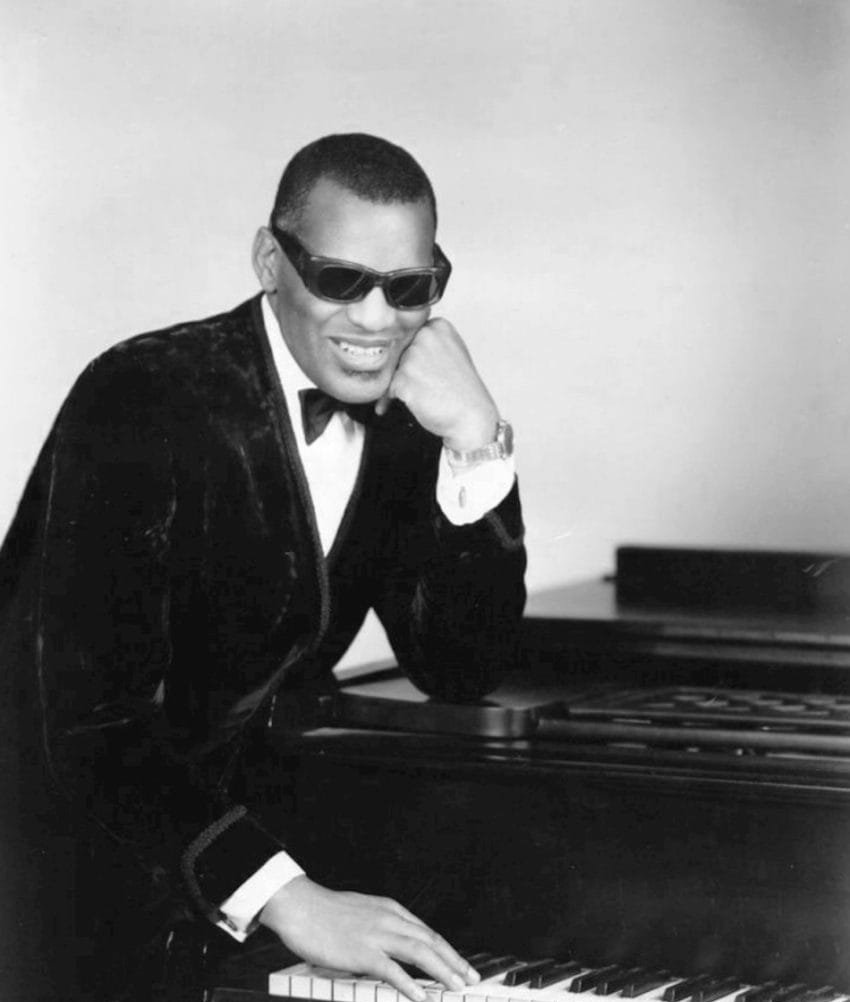
In the summer of 1954, Ray Charles was a twenty-three-year-old pianist grinding through one-night stands in the segregated South, still best known — where he was known at all — for smooth records imitating Nat King Cole and Charles Brown. Atlantic Records had signed him in 1952, but nothing had quite caught. Then, on the road with his band, a gospel song came through the car radio: It Must Be Jesus, by a little-known vocal group called the Southern Tones. Charles heard the rolling piano, the hand-clapping urgency, the sound of a congregation working itself into a fervour — and he heard something nobody had thought to put on a secular record. What if that feeling, the exact feeling of church on a Sunday morning, was aimed not at Jesus but at a woman? Within months he had turned the idea into I Got a Woman, a record so charged with gospel fire and so cheerfully earthly that preachers denounced it, blues elders tutted at it, and American music quietly changed direction around it. It is routinely described as one of the first soul records. It may be the very first.
A Gospel Song on the Car Radio
Charles never hid where the song came from, because in his mind he had not stolen anything — he had translated it. It Must Be Jesus was a gospel performance built for praise, but its musical engine was pure excitement: a driving rhythm, call-and-response shouting, and a melody that climbed like a testimony. Charles had been raised in the Baptist church in Greenville, Florida, and gospel was not a style he had studied from the outside. It was his first musical language. What he understood, earlier than almost anyone in the record business, was that the emotional machinery of gospel — the moans, the shouts, the sense of a singer possessed — did not belong exclusively to sacred words.
So he kept the machinery and changed the message. Where the Southern Tones sang about Jesus, Charles would sing about a woman who was good to him, who gave him money when he was in need — a kind of salvation all her own. The audacity was the point. Listeners who knew the original tune — and in 1954, a great many Black listeners knew it instantly — could hear exactly what he had done. He was testifying, with full church conviction, about earthly love. Nobody had put that on a commercial record before, at least not this openly, this joyfully, and this well.
Writing It on the Road
The song took shape the way so much of Charles’s early work did: on tour, in motion, with the band as his workshop. He developed it with Renald Richard, his trumpeter and bandleader, credited alongside Charles as co-writer. Working on the road in the summer of 1954 — Richard helping to shape and write down the arrangement as Charles worked out his ideas — they rebuilt the Southern Tones’ tune into a band number with a frenetic gospel pace, secular lyrics, and a jazz-inflected rhythm and blues backing. Charles later told the Pop Chronicles interviewers that he performed the song for about a year before recording it, so Southern club audiences had tested it long before record buyers heard it.
One more ingredient went into the writing. The bridge was inspired by Living on Easy Street, by bluesman Big Bill Broonzy — rich irony, because Broonzy would become one of the record’s most quoted critics, objecting to its mixture of the sacred and the profane. In 1954 Charles was simply absorbing everything around him: gospel from the radio, blues from his own tradition, and big-band horn arrangements. The originality was in the combination, and in his refusal to see a wall where everyone else saw one.

November 18, 1954: Recording in a Radio Station
When Charles decided his new band was ready, he summoned Atlantic to come and hear it — not in New York, but on the road. Ahmet Ertegun and Jerry Wexler, the label’s founders, travelled to Atlanta and heard the band at the Peacock nightclub. Wexler, credited as the record’s producer, knew immediately what he was hearing. Atlanta’s leading rhythm and blues disc jockey, Zenas Sears, arranged time at the studios of WGST, the Georgia Tech radio station, and on 18 November 1954 Charles and his seven-piece band cut the song there — in a working radio studio where, by the often-retold account, the band had to pause each hour so the station could read the news.
It was an efficient day’s work. The session produced four songs — I Got a Woman, Come Back Baby, Greenbacks and Blackjack — and I Got a Woman was the revolution: just under three minutes of Charles shouting, moaning and preaching over his own piano and a honking horn section, the band answering him like a congregation. Atlantic released it as a single in December 1954, on Atlantic 45-1050, with Come Back Baby on the B-side. Both songs were later gathered onto his 1957 album Ray Charles, subsequently reissued as Hallelujah I Love Her So.
A Hit That Sounded Like Church on Saturday Night
The record was Charles’s first hit, climbing quickly to No. 1 on the Billboard R&B chart in January 1955 — the first of what would become eleven R&B chart-toppers for him. But the triumph came with a backlash that tells you how radical the record was. Gospel preachers condemned it from the pulpit. Listeners raised on It Must Be Jesus heard blasphemy: not a singer borrowing a little church feeling, but one taking a song of praise they knew by heart and filling it with a woman’s name, a woman’s money and a woman’s love. Big Bill Broonzy’s complaint about mixing the sacred with the profane became the era’s shorthand for the offence.
Charles, characteristically, did not apologise. He had grown up too deep inside both traditions — the church and the blues joint — to accept they were strangers. And the audience voted with its money. The record did not cross over to the pop chart; in segregated 1955 America, that was not yet how such things worked. But within Black America it was inescapable, and musicians heard it loudest of all. Here was proof that gospel’s ecstasy could be carried intact into popular song.

Elvis, the Beatles and a Standard Is Born
The speed with which other singers reached for the song shows how quickly it entered the common language. Elvis Presley, who had been performing it live, recorded I Got a Woman on 10 January 1956 at RCA’s studio in Nashville, during his first sessions for the label. It appeared that year on his debut album, Elvis Presley, and as a single in August 1956, and stayed in his stage repertoire for years — as direct a line as exists from the WGST session to rock and roll stardom. The Beatles recorded it twice for BBC radio, in 1963 and 1964. Jimmy McGriff took an organ version into the pop Top 20 in 1962, and versions by Freddie Scott and Ricky Nelson charted in 1963. By then the song was no longer controversial. It was a standard.
The institutions caught up eventually. In 1990, the original 1954 Atlantic recording was inducted into the Grammy Hall of Fame. Rolling Stone placed it at No. 239 on its 500 Greatest Songs of All Time list, one of five Charles recordings there. And in 2005, half a century after WGST, Kanye West built his hit Gold Digger around a sample of I Got a Woman — with Jamie Foxx, fresh from playing Charles in Ray, recreating the vocal for the introduction — carrying the melody back to No. 1 for a generation that had never heard the Southern Tones.
Why Historians Call It the Birth of Soul
Music historian Peter Guralnick has argued that I Got a Woman exerted as profound an influence on American popular music as any single record before or since. That is a large claim for a record made in borrowed time in a college radio station, interrupted hourly by news bulletins. But listen to what is on it: the testifying vocal, the horns answering back like a congregation, the piano pounding like a revival meeting, and a lyric treating romantic devotion with the absolute conviction of faith. Everything soul music would become over the next fifteen years — the sound of singers who grew up, as Charles did, singing in church on Sunday and wanting to be heard the rest of the week — is present in embryo in those three minutes.
Charles would go on to bigger hits, proving the WGST breakthrough was no accident. But I Got a Woman remains the hinge. Before it, he was a gifted imitator looking for himself. After it, he was Ray Charles — and American music had a new genre, whether it had a name for it yet or not.
Leave a Reply