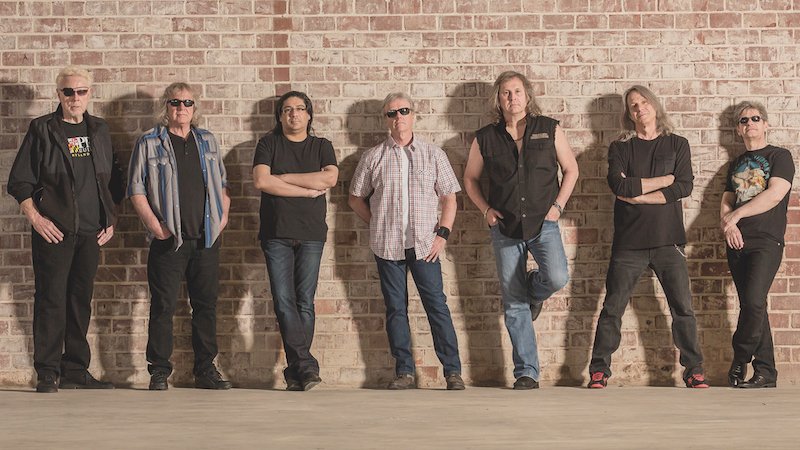
“Dust in the Wind” — Kansas’s most beloved song — is a meditation on mortality. All we are is dust in the wind. Everything passes. Nothing lasts. Kerry Livgren wrote it as a young man, as a philosophical exercise. He could not have known that he and his bandmates would spend the next fifty years living out its truth: surviving strokes, losing brothers, watching their bodies fail and their music endure.
This is the story of what happened to the six men from Topeka after the arenas went quiet — the illnesses, the farewells, the miracles, and the unbreakable thing that kept them going.
The Seeker
To understand what happened to Kansas, you have to understand Kerry Livgren — because in many ways, his journey was the band’s journey. Livgren was always the seeker: the quiet guitarist who read philosophy, who wrestled with life’s biggest questions in his lyrics, who converted to Christianity in 1980 and poured his faith into albums like “Vinyl Confessions” and “Drastic Measures.” While his bandmates rocked, Livgren pondered. While they toured, he searched.
That searching spirit would be tested in ways no philosophy book could prepare him for. In 2009, at the age of sixty, Kerry Livgren suffered a stroke. And not a mild one. His neurosurgeon described it as as bad a stroke as a human could have — the kind that kills, or leaves the survivor a shell. In the initial aftermath, roughly half of Livgren’s brain tissue died.
Half his brain. Gone.
What happened next, by every medical account, was miraculous. Within two years, the majority of that tissue was alive and healthy again — a recovery his doctors struggled to explain. Livgren himself has spoken of it with the awe of a man who knows he was given something he did not earn. But the recovery was not complete, and it was not easy. The stroke left him with lasting deficits. He had to find a new way to play “Dust in the Wind” — the gentle acoustic masterpiece he had written as a young man — because his hands would no longer do what they had once done effortlessly.
In August 2020, Livgren self-published an autobiography through his own Numavox label: “Miracles Out of Somewhere.” The title was characteristically honest. He did not claim to understand what had happened to him. He only knew it was a miracle, and that it had come from somewhere beyond himself. The seeker, who had spent his life asking questions, had received an answer he could not explain — and the humility to say so.
Remarkably, Livgren never stopped creating. Working from his studio at his own pace, he continued to write and record — composing new music, overseeing reissues, tending the Kansas legacy the way a gardener tends a beloved plot. The stroke had taken much, but it had not taken the music. The quiet one from Topeka, who had written an album to save his band in a storage facility forty years earlier, was still writing. Some fires do not go out.
The Violin Falls Silent
If Livgren was the band’s brain, Robby Steinhardt was its heart — literally the link between the musicians on stage and the people in the crowd. The violinist, vocalist, and co-frontman was the most visually and emotionally distinctive member of Kansas: the classically trained rocker who made a violin wail like an electric guitar, the showman whose energy bridged the gap between progressive complexity and arena spectacle.
Steinhardt’s musical pedigree was extraordinary. He was the adopted son of Milton Steinhardt, the director of music history at the University of Kansas, and he had studied classical violin from the age of eight. When he joined Kansas, he brought that discipline to rock and roll — and something more: a performer’s instinct for connection. Livgren himself said it best: “Robby was the link between the band on the stage and the audience.” He was the translator, the ambassador, the man who made the complex feel joyful.
On July 17, 2021, Robby Steinhardt died in Tampa, Florida. He was seventy-one. The cause was complications of acute pancreatitis — a sudden, cruel ending for a man who had seemed indestructible on stage. The tributes poured in from across the rock world, but Livgren’s words cut deepest, because they named what was lost: not just a violinist, but the connection itself.
Steinhardt had been working on a solo album before his death — a project he never got to finish promoting. It was released posthumously on October 25, 2021, under the wry and wonderful title “Not In Kansas Anymore / A Prog Opera.” Even in death, Robby had a sense of humor about his legacy. He was not in Kansas anymore. But his music — the violin soaring over “Dust in the Wind,” the voice crying out on “Point of Know Return” — will be in Kansas forever, and in the hearts of fans everywhere.
The Voice Steps Down
Steve Walsh was the voice of Kansas — the soaring tenor on “Carry On Wayward Son,” the piano-pounding frontman who had carried the band through its greatest triumphs. But decades of singing at full throttle take their toll, and by the 2010s, Walsh knew his time was coming. In the summer of 2014, he retired from the band he had co-founded — a dignified farewell after more than forty years.
Replacing a voice like Walsh’s seemed impossible. The band found the answer in the most unlikely place: behind the wheel of a truck. Ronnie Platt, the man chosen to succeed Walsh, had been working as a truck driver — singing in bands on the side, dreaming the dream every working musician dreams. His elevation to the front of Kansas was, as one profile put it, a Cinderella story: the truck driver who woke up as a rock star.
Platt threw himself into the role with gratitude and grit, honoring Walsh’s legacy while bringing his own energy to the catalog. It was a reminder of something essential about Kansas: the band had always been working-class heroes, six guys from Topeka who made it on talent and sweat. Hiring a truck driver to sing “Carry On Wayward Son” was not a compromise. It was a homecoming.
The Heartbeat Falters
Phil Ehart was the band’s drummer, its co-founder, its manager, its institutional memory — the man who had overseen everything from the “Leftoverture” cover art to the band’s business affairs across five decades. If Kansas had a center of gravity, it was Ehart: the steady beat behind the music and behind the organization.
In February 2024, Ehart suffered a major heart attack. He survived — but he has not toured with the band since. For a man who had been behind the kit for every era of Kansas, the absence was seismic. Yet in typical Ehart fashion, he did not walk away. He continues to manage the band, guiding its affairs from off the road, while veteran drummer Eric Holmquist fills in on stage. The heartbeat faltered, but the heart kept working.
And then there is Rich Williams — the guitarist, the other half of the band’s twin-guitar attack, now one of rock’s most distinctive visual figures. Williams wears an eyepatch, the result of health issues that have limited his touring in recent years. He plays select shows now, appearing when he can, his patch a badge of survival. The fans who see him know what they’re witnessing: a man who refuses to stop, on his own terms.
Miracles Out of Nowhere
In 2015, the band released a documentary with a title that could have been Livgren’s book title: “Miracles Out of Nowhere.” The film told the Kansas story from the beginning — Topeka, the storage facility, the swamp, the breakthrough — and it featured all six original members, together on camera, remembering what they had built.
Watching it now, the documentary feels like a gift the band gave itself: a chance to sit together, while they still could, and acknowledge the miracle. Six boys from Kansas, told they had one last chance, made “Leftoverture.” They toured the world. They survived the eighties, the nineties, the changing fashions. They lost Steinhardt. They nearly lost Livgren. They lost Walsh to retirement and Ehart to his heart. And still — still — the music plays.
There is something deeply moving about the sight of all six original members in one frame, older, grayer, laughing about the swamp and the storage facility. Bands are fragile things. Most do not survive five years, let alone fifty. That these six men — who began as teenagers in Topeka with nothing but talent and stubbornness — were still in the same room, still friends, still proud, is its own kind of miracle. Not the chart positions. Not the platinum plaques. The friendship. That was the real “miracle out of nowhere.”
Kansas marked its fiftieth anniversary with the dignity of true survivors. The lineup has changed; the road has thinned. But the songs remain untouched by time: “Carry On Wayward Son,” “Dust in the Wind,” “Point of Know Return.” They play on classic rock radio every day, and every time they do, some teenager hears them for the first time and feels the same jolt the seventies felt. New generations keep discovering the band — through films, through streaming, through parents passing the music down like an inheritance.
Dust, Wind, and What Remains
Livgren wrote “Dust in the Wind” as a young man contemplating impermanence. He has now lived long enough to watch its prophecy come true — and to discover the verse he didn’t write. Yes, all we are is dust in the wind. The bodies fail. The voices fade. The violin falls silent.
But the music — the music is not dust. The music is what the dust leaves behind for all of us.
Kerry Livgren survived a stroke that should have killed him and taught his hands to play again. Robby Steinhardt died, but his violin still soars from a thousand speakers. Steve Walsh retired, but his voice still opens “Carry On Wayward Son” every time it plays. Phil Ehart’s heart faltered, but he still guides the band he built. Rich Williams wears his eyepatch like a medal.
That is the heart behind the dust. Not the hits, though the hits were glorious. The heart is the survival: six men from Topeka who were given one last chance in a Louisiana swamp and turned it into fifty years of music — and who, when life came for them one by one, met it with the same grace and grit they had always brought to the stage. They carried on, wayward sons all. And the wind, for all its blowing, never took the songs.
Leave a Reply