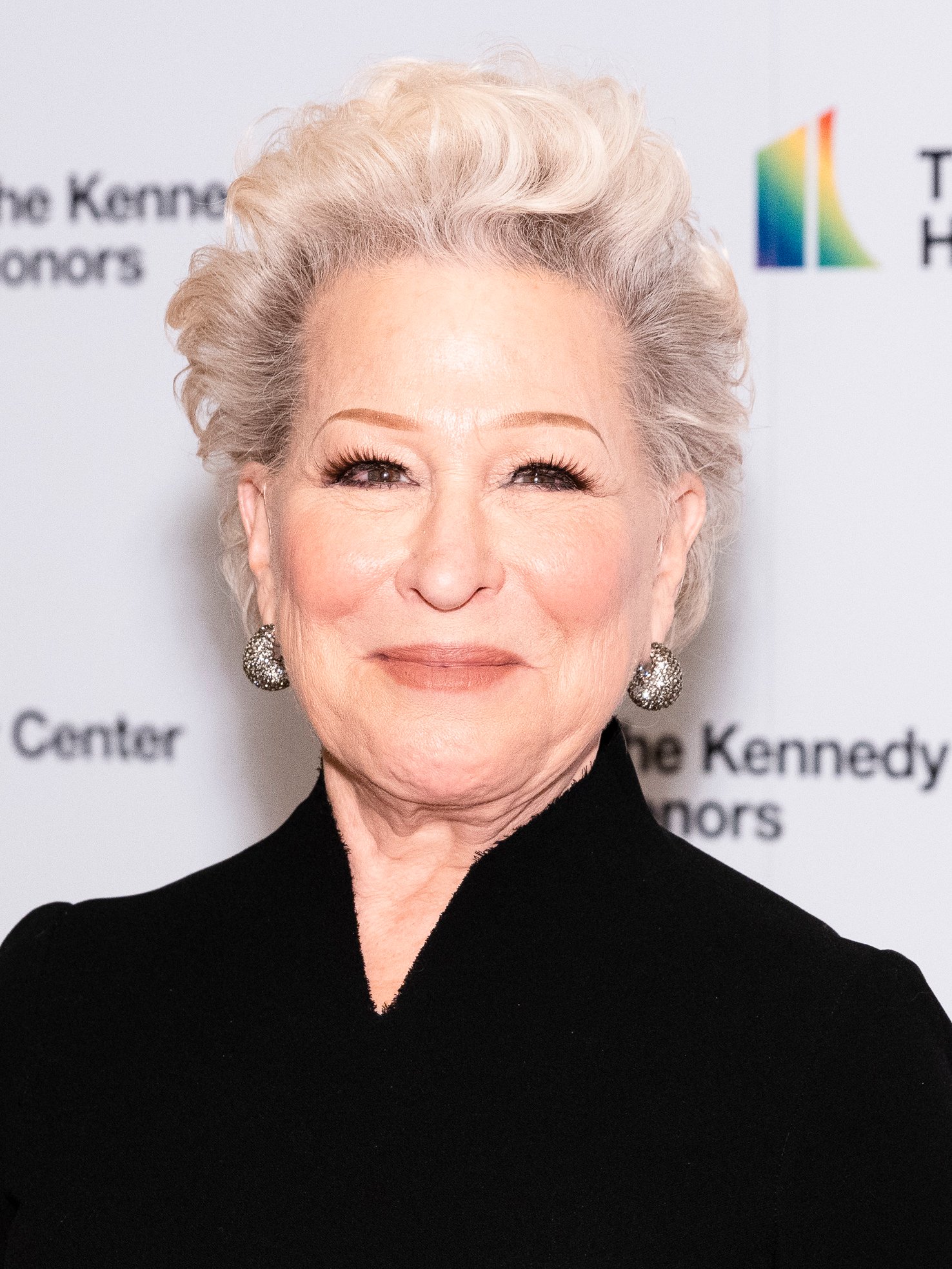
Before she was the Divine Miss M — before the Grammys, the Golden Globes, the Tony Awards, and the Kennedy Center Honors — Bette Midler was a girl from Honolulu singing her heart out in a basement full of steam, chlorine, and men in towels. Her rise is one of the strangest, funniest, and most hard-won in show business history, and it is littered with near-misses, bad movies, good instincts, and one song she never wanted to sing in the first place.
A Seasick Extra in a Hollywood Epic
Bette Midler was born in Honolulu, Hawaii, in 1945, one of the few Jewish kids in a mostly Asian neighborhood in Aiea. She was voted “Most Talkative” in her high school class, and she burned through three semesters of drama at the University of Hawaii before deciding that New York was where she belonged. She paid her way east with money she earned as a film extra — an uncredited, seasick passenger named Miss David Buff in the 1966 epic “Hawaii,” starring Julie Andrews and Max von Sydow.
It was hardly a glamorous start. But Midler had something that could not be taught: a voice that could shatter glass and a comic timing that could mend it back together. In New York she studied at HB Studio under Uta Hagen, landed a chorus job in the Broadway production of “Fiddler on the Roof” in 1966, and eventually took over the role of Tzeitel, which she played until 1970. Broadway gave her a paycheck. It did not give her a spotlight. For that, she had to go underground — literally.
Bathhouse Betty
In the summer of 1970, Midler took a gig singing at the Continental Baths, a gay bathhouse in the basement of the Ansonia Hotel on Manhattan’s Upper West Side. Picture it: leaking pipes, clouds of steam, and an audience of men in towels who had come for the facilities and stayed for the show. Her piano accompanist was another unknown named Barry Manilow — who, according to legend, sometimes performed wearing nothing but a towel himself.
It was here, in the unlikeliest finishing school in entertainment, that the Divine Miss M was born. Midler mixed 1940s girl-group harmonies with raunchy stand-up, vaudeville shtick, and burlesque. “The more outrageous I was, the more they liked it,” she later said. “It loosened me up.” The bathhouse crowd, outsiders themselves, recognized a fellow outsider — and they gave her the confidence to become enormous.
She has never been embarrassed by those days. Decades later, she said she felt she had been at the forefront of the gay liberation movement, and she wore the nickname “Bathhouse Betty” with pride. Manilow, meanwhile, went on to produce her debut album, “The Divine Miss M,” released in December 1972. It cracked the Billboard Top 10, went platinum, and won her the 1973 Grammy for Best New Artist. The girl from the basement had officially arrived.
The Divine Miss M and the Harlettes
The name itself has a charming origin story. Early in her career, an emcee needed to know how to introduce her, and the inspiration came from the “Eloise” children’s books — about a sassy, sophisticated little girl who lived at the Plaza Hotel. “I was one of those little Eloise types,” Midler recalled. “I was always saying, ‘Oh, that’s too divine.’” She had spent her childhood imitating Tallulah Bankhead, dreaming of being a sophisticated woman of the world who smoked cigarettes and talked about Sartre. The Divine Miss M was that dream, weaponized.
No diva rises alone, and Midler’s secret weapons were her backup singers, the Harlettes — a trio that began life under considerably less glamorous names. With Manilow’s help at the Baths, Midler assembled her first group of backing vocalists, which included a young Melissa Manchester. They were first called the Red Light District, then M.G.M. — for the initials of original members Melissa, Gail, and Merle — before finally settling on the Harlettes. The original trio later toured with Manilow himself after his breakthrough in 1974. Through endless lineup changes, the Harlettes remained part of Midler’s chaos: mermaids in wheelchairs, brassy dance routines, and all.
The Rose: Channeling Janis
By the late 1970s, Midler wanted to prove she could act. She found her vehicle in “The Rose” (1979), a rock-and-roll tragedy about a self-destructive, drug-addicted star transparently modeled on Janis Joplin. Midler threw herself into the role of Mary Rose Foster with a ferocity that startled critics who had filed her under “novelty act.”
The gamble paid off spectacularly. Her performance earned her an Academy Award nomination for Best Actress and won her the Golden Globe for Best Actress in a Comedy or Musical. The soundtrack sold over two million copies in the United States, and the title song — written by Amanda McBroom — gave Midler her first Gold single, five weeks at No. 1 on the Adult Contemporary chart, and a Grammy for Best Female Pop Vocal Performance. She had set out to prove she was more than Bathhouse Betty, and she had done it by playing a woman the industry had chewed up and spit out.
The Song She Never Wanted to Sing
Here is the great irony of Bette Midler’s career: her biggest hit, the song that defines her for millions of people, was a song she initially disliked. “Wind Beneath My Wings,” written by Jeff Silbar and Larry Henley, had already been recorded by Roger Whittaker, Sheena Easton, Lee Greenwood, and Gary Morris before Midler cut her version for the 1988 film “Beaches,” in which she co-starred with Barbara Hershey.
It was not even the first single from the soundtrack — that honor went to her cover of “On Broadway,” which missed the Hot 100 entirely. But when “Wind Beneath My Wings” caught fire, it became unstoppable: No. 1 on the Billboard Hot 100 in June 1989, Midler’s first and only chart-topper, at the age of 43. At the 1990 Grammys it won both Record of the Year and Song of the Year, giving Midler her third Grammy. She later admitted to the London Times that the song had grown on her. Millions of wedding dances, graduations, and memorial services suggest the feeling became mutual.
The Flops, the Fights, and the Comeback
For all her triumphs, Midler’s career has never been a straight line — and she has the battle scars to prove it. In 1981 she signed on to the comedy “Jinxed!,” and the production turned into a legendary disaster. She clashed bitterly with co-star Ken Wahl and with the film’s director, the great Don Siegel of “Dirty Harry” fame. The movie flopped hard in 1982, and Midler did not appear in another film for four years.
It was a humbling stretch for a woman who had just been Oscar-nominated. She retreated to music, releasing “No Frills” in 1983 — produced by Chuck Plotkin, best known for his work with Bruce Springsteen and Bob Dylan — and an all-comedy album, “Mud Will Be Flung Tonight!,” in 1985. She sang on USA for Africa’s “We Are the World” and performed at Live Aid in Philadelphia. Then, in 1985, she signed a multi-picture deal with the Walt Disney Studios and reinvented herself as a comedy star through its Touchstone Pictures division, producing the films herself through her All Girl Productions banner with partner Bonnie Bruckheimer.
The run that followed — “Down and Out in Beverly Hills,” “Ruthless People,” “Outrageous Fortune,” “Big Business” — made her one of the most bankable comedy actresses in Hollywood. And then came “Beaches” in 1988, the weeper that gave the world “Wind Beneath My Wings” and became her biggest-selling album ever, reaching No. 2 on the Billboard chart with U.S. sales of four million copies. From box-office poison to the top of the charts in six years: only Bette Midler could make a comeback feel like a punchline she had been setting up all along.
The Mermaid and the Mayhem
Through the 1980s and ’90s, Midler built a film career on a string of Touchstone comedies — “Down and Out in Beverly Hills,” “Ruthless People,” “Outrageous Fortune,” “Big Business” — and proved she could do almost anything. She voiced a snobbish poodle in Disney’s “Oliver & Company,” earned a second Oscar nomination for “For the Boys” (1991), and became Winifred Sanderson in “Hocus Pocus” (1993), a role that turned her into a Halloween immortal for a whole new generation.
But the stage remained her natural habitat, and her concerts were legendary for their controlled anarchy. One of her signature creations was Delores De Lago — “the toast of Chicago” — a mermaid character who performed sitting in a wheelchair, fins and all. The famous mermaids-in-wheelchairs routine, with Midler and the Harlettes hopping across the stage to “Boogie Woogie Bugle Boy,” left audiences in stitches night after night. It was vaudeville, burlesque, and pure Midler: glamorous, ridiculous, and executed with total commitment.
Hello, Dolly! and the Long Game
If there was any doubt that Midler’s career operated on its own timeline, she erased it in 2017. More than fifty years after her Broadway debut in the chorus of “Fiddler on the Roof,” she returned to Broadway in her first leading role in a musical — Dolly Levi in the revival of “Hello, Dolly!” — and won the Tony Award for Best Actress in a Musical. She was 71.
The honors kept coming. From 2008 to 2010 she held a lavish residency at Caesars Palace in Las Vegas with “The Showgirl Must Go On,” proving she could still fill a showroom night after night at an age when most performers are long retired. In 2022 she even returned to her wicked roots as Winifred Sanderson in “Hocus Pocus 2,” delighting a new generation of Halloween devotees. A Kennedy Center Honor in 2021 placed her among the immortals of American culture. Across six decades, she has collected three Grammys, four Golden Globes, three Emmys, and two Tonys, selling over 30 million records along the way. Not bad for a girl who once sang for tips in a basement full of steam.
Bette Midler’s story endures because it is not really a story about talent — though the talent is staggering. It is a story about nerve. She took the strangest gig in show business and turned it into a persona; she took a song she didn’t like and turned it into an anthem; she took a joke name dreamed up for a bathhouse emcee and turned it into a title nobody else could ever claim. The Divine Miss M was never just a character. She was a promise Midler made to herself in the basement of the Ansonia Hotel — and she spent the next fifty years keeping it.
Leave a Reply