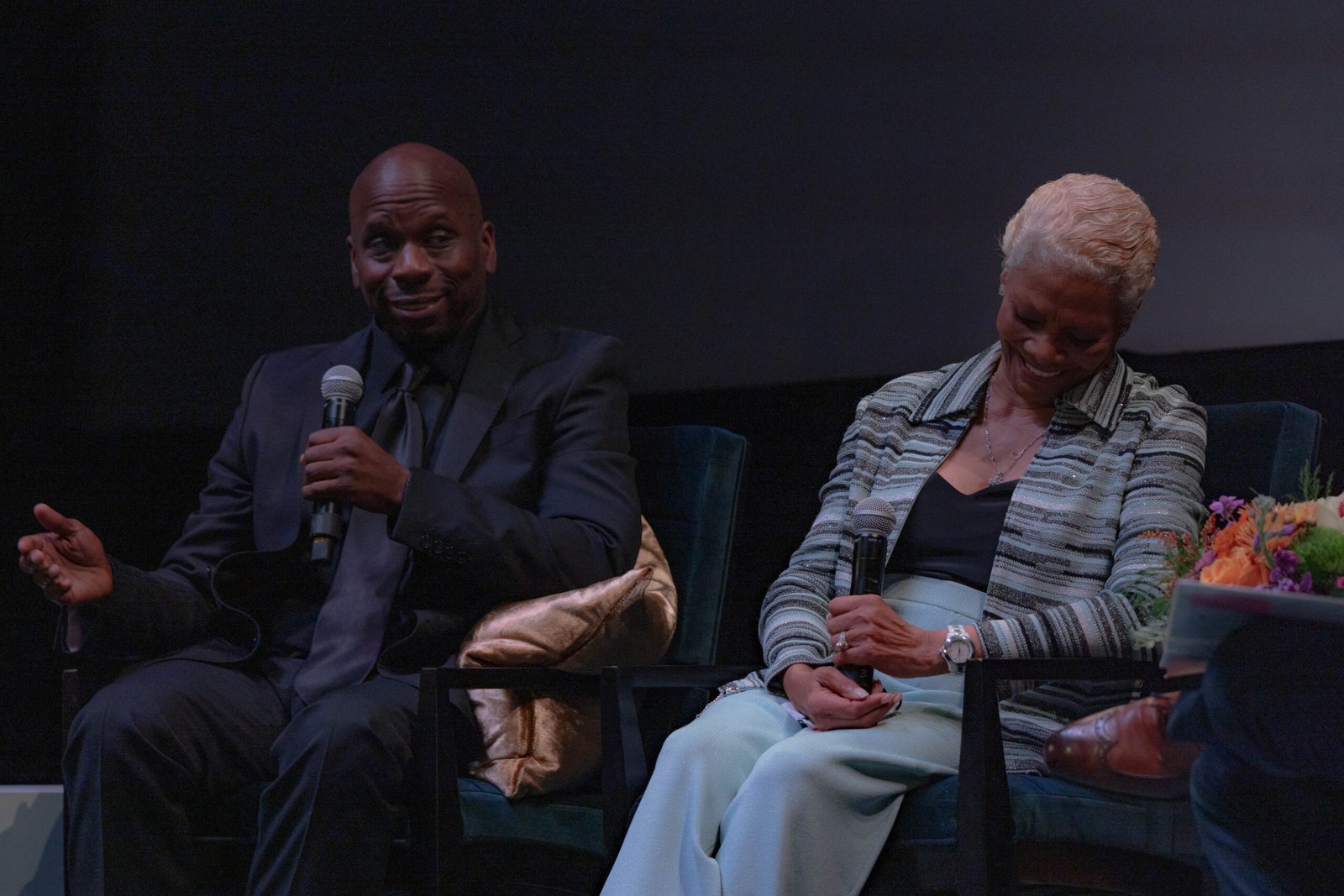
Dionne Warwick has lived about nine lives in show business, and nearly every one of them turned on something absurd: a printer’s typo that became her name, an astrologer’s advice that nearly sank her career, a B-side that became a signature, and a lipstick container that got her arrested. Through it all — the chart triumphs, the lawsuits, the bankruptcy, the reinventions — one thing never changed: that voice, cool and precise and heartbreaking, singing songs nobody else could sing the way she did.
The Typo That Named Her
She was born Marie Dionne Warrick in East Orange, New Jersey, in 1940, into gospel royalty. Her mother managed the Drinkard Singers, her father promoted gospel records, and her aunt was Cissy Houston — which made the young Dionne a cousin of Whitney Houston. She sang her first church solo at six years old and spent her teens as a background singer, riding the bus from East Orange to Manhattan after school to sing on sessions for the Drifters, Dinah Washington, and Solomon Burke, then hurrying home in time for homework.
It was at a Drifters session for “Mexican Divorce” that songwriter Burt Bacharach noticed her. He hired her to sing demos of his songs with lyricist Hal David for $12.50 a session. One of those demos caught the ear of Scepter Records president Florence Greenberg, who reportedly told Bacharach: “Forget the song, get the girl!”
Her first solo single, “Don’t Make Me Over,” arrived in November 1962 — and its label misspelled her surname as “Warwick.” Instead of correcting it, the 22-year-old singer adopted the typo as her professional name. She would later joke that fate had typeset her destiny. The title itself came from real life: Warwick had learned that a song she wanted for her debut, “Make It Easy on Yourself,” had been handed to Jerry Butler instead, and she snapped the phrase “don’t make me over” at Bacharach and David in anger. They turned her fury into a hit the very next day.
The B-Side That Became the Song
If any artist owned the art of the accidental hit, it was Dionne Warwick. In April 1964, Scepter released “Any Old Time of Day” as her new single, with “Walk On By” tucked away on the B-side as an afterthought. New York disc jockey Murray “The K” Kaufman listened to both sides, decided the label had it backwards, and began playing “Walk On By” instead. Listeners agreed in droves.
“Walk On By” peaked at No. 6 on the Billboard Hot 100 and became one of the defining records of the 1960s — a masterclass in underplayed heartbreak, Warwick’s cool delivery floating over Bacharach’s restless, off-kilter arrangement. It was, remarkably, not the only time Warwick would be upstaged by her own flip side. Her recording of “I Say a Little Prayer” was also initially released as a B-side before disc jockeys flipped it into a Top 5 smash and the first million-selling single for the Bacharach-David songwriting team. Twice, the industry had tried to tell Dionne Warwick which song was the hit. Twice, she and the public had overruled them.
The Rival Who Made Her Furious
Warwick’s success in America was undeniable — by the mid-1960s she was holding her own against the entire British Invasion. But across the Atlantic, her songs kept being handed to British singers. The most galling case was Cilla Black, whose cover of “Anyone Who Had a Heart” went to No. 1 in the UK while Warwick’s original settled for the American Top 10.
Warwick did not hide her feelings. Told that British executives wanted her songs recorded by someone else, she described feeling insulted — and when she met Black on tour, she let her have it. “I told her that ‘You’re My World’ would be my next single in the States,” Warwick recalled. “I honestly believe that if I’d sneezed on my next record, then Cilla would have sneezed on hers too. There was no imagination in her recording.” It is one of the great put-downs in pop history, delivered with the same icy precision she brought to a lyric. And yet Paris adored her: after her first French tour in 1962, critics crowned the 22-year-old “Paris’ Black Pearl,” and she was introduced on stage at the Paris Olympia that year by none other than Marlene Dietrich.
The Bond Theme That Got Away
In 1965, Warwick came within a whisker of one of the most glamorous gigs in music: the theme song for the James Bond film “Thunderball.” Eon Productions had Warwick record “Mr. Kiss Kiss Bang Bang,” a slinky Bacharach-David number, as the film’s title song. But producer Albert R. Broccoli insisted the theme had to include the movie’s title. A replacement, “Thunderball,” was composed and recorded at the eleventh hour by Tom Jones.
Warwick’s loss became a footnote with a long tail: the melody of “Mr. Kiss Kiss Bang Bang” survived as a major component of the film’s score, and her recording eventually surfaced on Bond anniversary collections. She had been deemed not quite right for 007 — a verdict history has not been kind to, given that her version remains a cult favorite among Bond music obsessives.
The $5 Million Breakup
The partnership of Warwick, Bacharach, and David — the “triangle marriage that worked,” as the industry called it — produced an astonishing run: “Anyone Who Had a Heart,” “Walk On By,” “Alfie,” “I Say a Little Prayer,” “(Theme from) Valley of the Dolls,” “Do You Know the Way to San Jose.” Then, in the early 1970s, Bacharach and David’s own partnership fractured, with Bacharach retreating from songwriting after the bruising failure of the “Lost Horizon” film score.
Warwick was left stranded. In 1971 she had signed with Warner Bros. Records for a $5 million contract — the most lucrative deal ever given to a female vocalist at the time — a contract premised on Bacharach and David continuing to write and produce for her. When they failed to deliver, Warner Bros. threatened to sue her, and Warwick responded by filing a $5.5 million breach-of-contract suit against her former collaborators. The case settled out of court in 1979 for a reported $5 million, including co-ownership of her master recordings. Bacharach told the press he would probably never work with her again. A decade passed before they spoke — and then, characteristically, they collaborated all over again.
The E That Sank a Career
Here is where the astrologer enters. In 1971, at the urging of her friend Linda Goodman — the bestselling author of “Sun Signs” and Warwick’s personal astrologer — Dionne added a small “e” to her surname, becoming “Dionne Warwicke.” Goodman believed the extra letter would add a vibration to balance her name and bring greater fortune to her marriage and career. Her sister Dee Dee followed suit.
Warwick later called it the worst decision she ever made. “All my troubles started in 1971 when I added an extra e to my last name,” she said. The Warner Bros. years were a commercial desert — with one glittering exception. In 1974, billed as “Dionne Warwicke and the Spinners,” she recorded “Then Came You” with the Spinners, and it became her first-ever No. 1 on the Billboard Hot 100. In 1975, she finally dropped the cursed “e” and became Dionne Warwick again. The comeback was already being plotted: Clive Davis signed her to Arista Records, Barry Manilow produced her 1979 album “Dionne,” and “I’ll Never Love This Way Again” and “Déjà Vu” returned her to the top of the charts and the Grammy podium.
The Psychic Lady, the Lipstick, and the Bankruptcy
The 1990s brought Warwick a strange new kind of fame. She became the national spokesperson for the Psychic Friends Network, hosting its late-night infomercials with the earnestness of a woman reading the weather. The gig made her a punchline — in a 2002 Biography Channel interview, her tour manager revealed she had been crushed when a child at an airport recognized her as “that psychic lady on TV.” She had worked too hard, she said, to become known as the psychic lady. The network filed for bankruptcy in 1998.
The same year the infomercial era ended, stranger headlines arrived. In 2002, Warwick was arrested at Miami International Airport after baggage screeners found eleven suspected marijuana cigarettes hidden inside a lipstick container in her carry-on luggage. She was charged with possessing less than five grams; the charges were eventually dropped after she agreed to a drug program, a charity donation, and an anti-drug public service announcement. A British tabloid covering the story could not resist: “Walk on High, Dionne.”
Then came the financial reckoning. In 2013, Warwick filed for Chapter 7 bankruptcy in New Jersey, listing just $25,500 in assets against $10.7 million in debts — most of it owed to the IRS and the state of California, swollen by years of penalties and interest. She blamed “negligent and gross financial mismanagement” by those who had handled her affairs from the late 1980s through the mid-1990s. For an artist who had sold tens of millions of records, it was a staggering fall — and a reminder that in the music business, the money and the music have always traveled in opposite directions.
The Queen Gets Her Crown
And yet — she endured. In 1985, Warwick had assembled Elton John, Gladys Knight, and Stevie Wonder for “That’s What Friends Are For,” a charity single for AIDS research that raised more than $3 million, spent four weeks at No. 1, and won the Grammy for Song of the Year. It was the biggest-selling single of 1986 in America, and the last No. 1 for everyone involved. In 2019 she received the Grammy Lifetime Achievement Award. In 2024, she was inducted into the Rock and Roll Hall of Fame in the Musical Excellence category — an honor that finally placed her where she had always belonged.
Along the way she became something nobody could have predicted: the undisputed queen of Twitter, roasting celebrities and schooling the platform’s CEO with the same imperious wit she once aimed at Cilla Black. A 2021 documentary, “Dionne Warwick: Don’t Make Me Over,” introduced her to a generation that knew her first as a meme and stayed for the voice.
Dionne Warwick’s career is a catalog of accidents that turned into landmarks: a misprint that became a name, a B-side that became a classic, an extra letter that became a cautionary tale, a charity record that became the song of a year. Through every twist, the instrument at the center never wavered — that unmistakable voice, precise as a diamond cutter and warm as gospel, singing Bacharach’s impossible melodies as if they were the most natural thing in the world. The typo made her famous. The talent made her immortal.
Leave a Reply