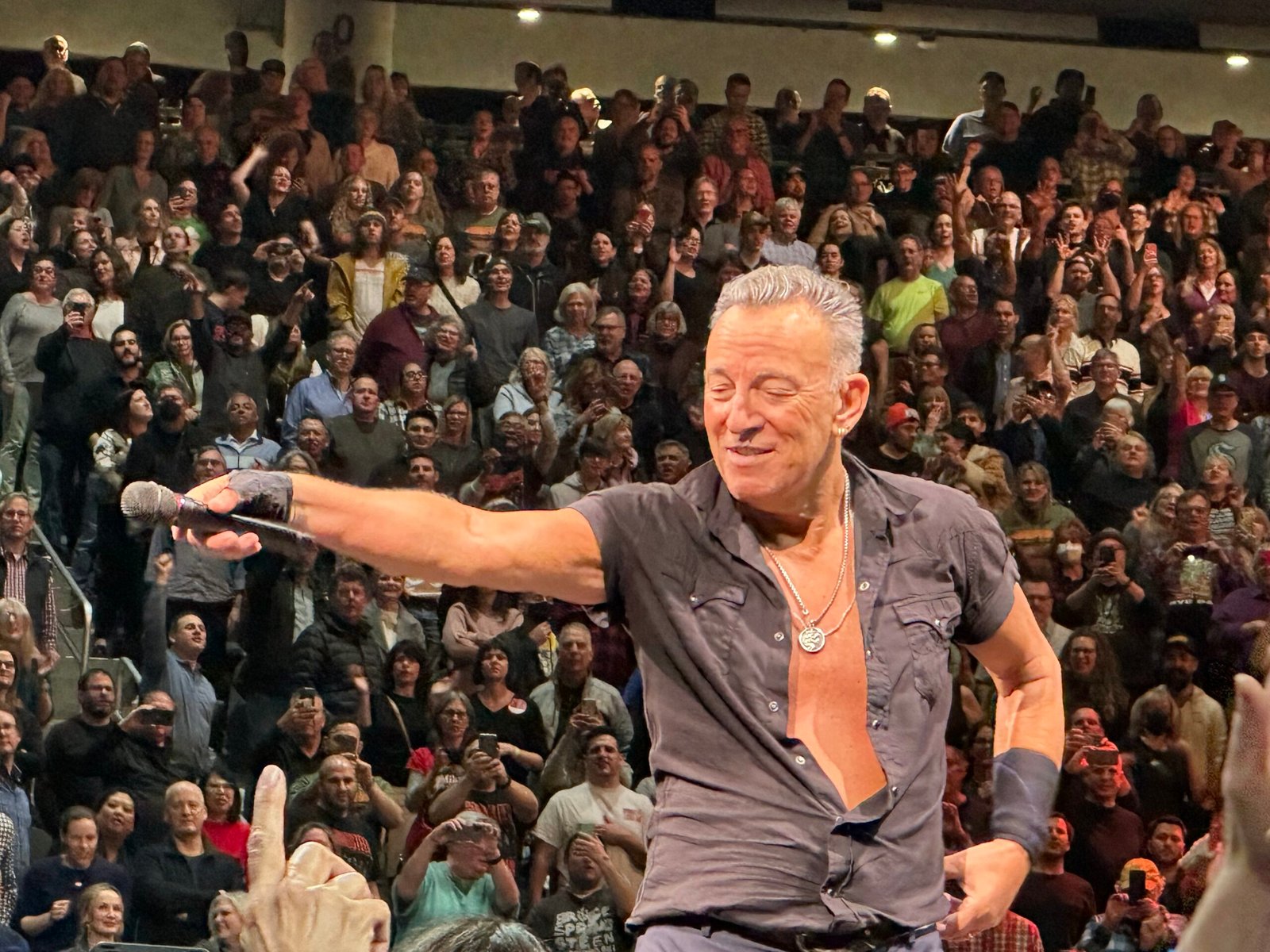
Bruce Springsteen has spent fifty years singing about escape — cars, highways, rivers, the promised land just over the horizon. But the most Springsteen moment of all wasn’t in a song. It was a wet September night in 1971 in Asbury Park, New Jersey, when a thunderstorm ripped the front door of a beach-town bar clean off its hinges, and a six-foot-four saxophone player walked in out of the lightning and changed music history. Before the Boss was the Boss, he was a scrawny bar-band guitarist with a borrowed guitar, a brutal contract, and a habit of turning every disaster into a masterpiece. This is the untold story of how it happened.
The Kid from Freehold
Bruce Frederick Joseph Springsteen was born on September 23, 1949, in Long Branch, New Jersey, and raised in nearby Freehold — a working-class town of factories, churches, and Friday-night boredom. He was a restless kid who clashed with the nuns at St. Rose of Lima Catholic school, briefly enrolled at Ocean County College, and dropped out. What he didn’t drop was the guitar.
By his late teens, Bruce was a fixture of the Jersey Shore bar circuit, grinding through a half-dozen local bands — the Castiles, Earth, Steel Mill — playing five sets a night for beer money and learning his trade the hard way. For a stretch, he even lived at a surfboard factory in Asbury Park, rehearsing between the boards and teaching himself to surf. It was a hand-to-mouth existence, but it gave him two things no record label could buy: a decade of hardcore bar-band experience before he ever cut a record, and a cast of characters — drifters, dreamers, factory kids — who would populate his songs for the rest of his life.
The Audition That Took Two Hours
In the spring of 1972, Springsteen’s manager, Mike Appel, hustled him an audition with the most legendary talent scout in the business: John Hammond of Columbia Records, the man who had signed Billie Holiday, Bob Dylan — and, as it happens, Aretha Franklin. Hammond gave the scruffy 22-year-old a few minutes of his time in his Manhattan office. Springsteen sat down with a borrowed acoustic guitar with a cracked neck and played.
Hammond was floored. “The kid absolutely knocked me out,” he later told Newsweek. “I only hear somebody really good once every ten years, and not only was Bruce the best, he was a lot better than Dylan when I first heard him.” What was supposed to be a quick meeting stretched into a two-hour session. That evening, Hammond caught Springsteen’s showcase at Gerde’s Folk City in Greenwich Village — an open-mic night with maybe six people in the audience — and the deal was done. Afterward, Springsteen and Appel celebrated the only way two broke Jersey guys knew how: with a cheeseburger. The next day, Springsteen cut twelve demos at CBS Studios in about two hours — including an early version of “Growin’ Up,” the autobiographical song that had helped seal the deal. He signed with Columbia on June 9, 1972. Within weeks, he was holed up at 914 Studios in Blauvelt, New York, recording his debut album, “Greetings from Asbury Park, N.J.” — a dense, word-drunk record that wore its Dylan influence a little too proudly, but announced a major new voice all the same.
When the Door Blew Off
A year before the record deal, on a stormy night in September 1971, the most mythic meeting in rock history took place — and both men swore it really happened. Clarence Clemons, a 6-foot-4 tenor sax player, had finished a matinee gig with his band Norman Seldin & the Joyful Noize at one end of Asbury Park and decided to walk down to the Student Prince, where a local group called the Bruce Springsteen Band was playing.
Then a nor’easter blew in. “It was thundering and lightning,” Clemons recalled years later. “I walked into the club, and when I opened the door, the wind actually tore the door out of my hand and blew it down the street!” Bouncers went chasing the door down Ocean Avenue while Clemons stood in the entrance, backlit by lightning, a giant of a man in a club where he instantly stood out. Springsteen himself later eulogized the moment: “A mighty gale blew down Ocean Avenue, ripping the door off its hinges. A good omen.”
Clemons walked up to the skinny guitarist and said, “I wanna sit in.” Bruce said, “Sure, whatever you want!” Clemons sat in, and as he put it, “it was a magical moment.” Roughly a year later, the Big Man officially joined the new E Street Band. For the next forty years, until Clemons’ death in 2011, the sight of the two of them squaring off at opposite ends of a stage — the Boss and the Big Man, racing to meet in the middle — was the most joyful image in rock and roll.
The Lawsuit That Silenced Him
Success came fast — “Born to Run” in 1975 made him a star — and then the business nearly killed the career. In 1976, Springsteen sued his manager and producer Mike Appel over the terms of their contract. As Bruce later put it with characteristic dryness, “We would split everything 50-50. The problem would be all the expenses would end up coming out of my half.”
The legal battle was brutal and total: for nearly a year, Springsteen was barred from recording. At the absolute peak of his early fame, with the world waiting for the follow-up to “Born to Run,” the hottest young rocker in America couldn’t set foot in a studio. When the dust settled and he finally got back to work with new manager-producer Jon Landau, the result was 1978’s “Darkness on the Edge of Town” — a leaner, harder, angrier record, stripped of every wasted word. The lawsuit had cost him a year. It gave him his backbone.
The Four-Track Masterpiece
In January 1982, at the height of his commercial powers, Springsteen did the strangest thing of his career. Holed up in a rented house in Colts Neck, New Jersey, he recorded a batch of stark, haunted songs alone — just his voice, an acoustic guitar, a cheap four-track cassette machine, and an Echoplex — intending them as demos for the E Street Band. The whole session cost about $1,050.
He tried re-recording them properly with the band. It didn’t work; every polished version lost the ghost. So he did the unthinkable: he released the demos almost exactly as they were. “Nebraska” — ten songs about killers, losers, and desperate men on empty highways — became one of the most influential albums ever made, a lo-fi landmark released years before lo-fi was a thing. Decades later, the “Nebraska ’82: Expanded Edition” box set finally let fans hear what might have been, unveiling the legendary full-band “Electric Nebraska” sessions that Springsteen had abandoned in favor of the lonely bedroom tapes.
And here’s the twist most fans miss: the biggest hit of his career was born in those same sessions. “Born in the U.S.A.” started in 1981 as a title song for a film director Paul Schrader was contemplating — a project that eventually became “Light of Day” — and Springsteen liked the title so much he thanked Schrader in his album liner notes. He cut a bleak acoustic demo of it on January 3, 1982, during the “Nebraska” sessions, but Landau felt it didn’t fit the album’s mood, so it was shelved. In April 1982, Springsteen revived it at New York’s Power Station with the full E Street Band — take four, cut on April 27 — and much of the arrangement was invented on the spot, including Roy Bittan’s clarion opening synthesizer riff. Engineer Toby Scott captured Max Weinberg’s cannon-shot snare by running the microphone through a broken reverb plate. Two years later, that happy accident became the title track of the best-selling album of Springsteen’s life.
The Hit He Wrote Out of Spite
Here’s the irony: for all its anthems, “Born in the U.S.A.” almost didn’t have a hit single — until Jon Landau demanded one. Landau told Springsteen the album needed something for radio, and Bruce, irritated at being asked to write to order, went home and dashed off a song in a single night. That song, written essentially out of spite, was “Dancing in the Dark.” It became the album’s first single and his biggest hit ever. (Its B-side, the throwaway “Pink Cadillac,” later became a gleaming Top 10 dance-pop hit for Natalie Cole in 1988 — even Springsteen’s castoffs turned to gold.)
The video became almost as famous as the song. The first attempt — directed by Jeff Stein, best known for the Who documentary “The Kids Are Alright” — featured just Bruce and Clarence Clemons in an empty studio, one camera, no cutaways. Springsteen watched the takes and killed it: “No way… we can’t use this.” So they hired Hollywood director Brian De Palma, who staged a full concert at the St. Paul Civic Center in Minnesota on June 28 and 29, 1984. Midway through, Springsteen pulled a young woman out of the front row to dance with him onstage — a then-unknown actress named Courteney Cox, years before “Friends.” The rejected Stein footage sat in a file cabinet for four decades before being auctioned for charity. The De Palma version made Bruce Springsteen an MTV star.
The Most Misunderstood Song in America
And then there’s the misunderstanding that never dies. “Born in the U.S.A.” — with its chest-thumping chorus and that titanic snare — has been blasted at political rallies and Fourth of July barbecues for forty years as a flag-waving anthem. It isn’t one. The verses tell the story of a Vietnam veteran sent home to nothing: no job, no help, no welcome. Springsteen wrote it partly as a tribute to friends who’d gone to Vietnam — some of whom never came back — and drew on Ron Kovic’s memoir “Born on the Fourth of July” for its bitter portrait of how America treated its returning soldiers.
Springsteen himself explained the trick on “Fresh Air” in 2005: the pride lives in the roaring chorus, while the verses carry the blues of daily struggle — and the collision between the two is the whole point. It’s a protest song wearing an anthem’s clothes, which is why it works as both. Politicians have been misreading it since 1984, and Bruce has been politely correcting them ever since.
Bruce Springsteen once sang about being born to run, but the real story is about standing your ground: in a bar in Asbury Park while a storm tore the door off, in a courtroom against your own manager, in a bedroom with a four-track machine when the world expected a stadium record. He turned a nor’easter into a forty-year partnership, a lawsuit into “Darkness,” a demo tape into “Nebraska,” and a spite-written single into immortality. The door blew off its hinges that night in 1971. Rock and roll walked in — and it never left.
Leave a Reply