There is a moment in every guitar legend’s life when the world decides who they are. For Eric Clapton, it happened on a wall in London in the mid-1960s, when someone spray-painted three words that would follow him forever: “Clapton Is God.” He was barely twenty years old. What makes his story so moving is not that he earned that worship — it is what he did with the six decades that followed: the bands, the heartbreak, the addictions, the losses, and the quiet, graceful way he eventually grew into something far more interesting than a guitar god. He became a survivor.
The Boy Who Became a Guitar God
Eric Patrick Clapton was born on March 30, 1945, in Ripley, Surrey, England, to a sixteen-year-old mother and a Canadian soldier who returned to his wife in Canada before Eric was born. He was raised largely by his grandparents, believing for years that his mother was his sister — a secret the family kept from him until he was nine. Music became his refuge early on. He got his first guitar at thirteen, struggled with it, put it down, and picked it up again at fifteen. This time, he never put it down.
In 1963, after stints in local bands, Clapton joined the Yardbirds, a rhythm-and-blues group where his fierce, blues-drenched playing quickly made him the star. But when the band chased commercial success with the pop-flavored hit “For Your Love” in 1965, Clapton walked out. He was a blues purist, and he would not compromise. He joined John Mayall’s Bluesbreakers instead, and his playing became the talk of the London club scene. Fans were so fanatical that the “Clapton Is God” graffiti started appearing around the city. The unwanted deification had begun.
Cream: The First Supergroup
In 1966, Clapton did something nobody had done before: he formed a band with two other virtuosos — bassist Jack Bruce and drummer Ginger Baker — and called it Cream. It was rock’s first true supergroup, a high-volume fusion of blues, rock and psychedelia built around long, improvisational solos. Their second album, “Disraeli Gears” (1967), made them international stars, powered by the immortal riff of “Sunshine of Your Love.” “Wheels of Fire” (1968) and “Goodbye” (1969) followed, but the band burned bright and fast, breaking up in November 1968 after barely two years together.
Cream proved that three musicians could fill an arena with nothing but volume, blues and nerve. It also proved something to Clapton: he was tired of being worshipped. He spent the next few years trying to disappear.
Blind Faith and the Road to Derek
In 1969, Clapton formed another short-lived supergroup, Blind Faith, with Steve Winwood, Ginger Baker and Rick Grech. They recorded exactly one album and played one tour before splitting. Then Clapton did something braver: he tried to become anonymous. He toured as a sideman with Delaney & Bonnie, recorded his first solo album in 1970, and then assembled a new band from session musicians — Bobby Whitlock, Carl Radle and Jim Gordon — under a deliberately low-key name: Derek and the Dominos. The name itself was an accident, a misreading of a provisional name, “Del and the Dynamos.”
What happened next was anything but low-key. Recording at Criteria Studios in Miami with legendary producer Tom Dowd, the band was joined by a young slide guitar wizard named Duane Allman. The twin guitars of Clapton and Allman produced “Layla and Other Assorted Love Songs,” a double album released in November 1970 that is widely regarded as Clapton’s masterpiece. The title song, “Layla,” was a blazing two-part epic inspired by Clapton’s hopeless love for Pattie Boyd — the wife of his close friend George Harrison. Its opening riff and its aching piano coda remain among the most recognizable passages in all of rock.
Here is the cruel twist: almost nobody bought it at first. Disappointed by the album’s lackluster sales and sinking into heroin addiction, Clapton withdrew from music almost entirely for two years. Duane Allman died in a motorcycle crash in October 1971, at just 24. It would take years before “Layla” was recognized as the landmark it is.
The Wilderness Years and the Comeback
Clapton’s lowest point became his turning point. In January 1973, his friend Pete Townshend of the Who organized the famous Rainbow Concert in London to coax Clapton back onto a stage. It worked. Clapton got clean, and in 1974 he released “461 Ocean Boulevard,” named after the Miami house where he recorded it. The album’s laid-back groove — heavily influenced by the Oklahoma songwriter J.J. Cale — included a reggae cover of Bob Marley’s “I Shot the Sheriff,” which became Clapton’s first and only American number-one single as a solo artist.
The hits kept coming. “Slowhand” (1977) gave the world “Wonderful Tonight” — written, legend has it, while waiting for Pattie Boyd to get ready for a party — along with “Lay Down Sally” and his smoldering cover of Cale’s “Cocaine.” In 1979, Clapton married Pattie Boyd at last. The guitar god had become a hitmaker, a husband, and, for the first time in years, a happy man.
Grief, Grace and “Tears in Heaven”
Then came the tragedy that changed everything. On March 20, 1991, Clapton’s four-year-old son Conor died after falling from the window of a 53rd-floor New York apartment. Out of that unimaginable grief came “Tears in Heaven,” written for the soundtrack of the film “Rush.” The song reached number two on the American charts and became one of the most beloved — and most heartbreaking — ballads of the decade.
On January 16, 1992, still raw with loss, Clapton taped an episode of MTV’s “Unplugged” at Bray Film Studios in Windsor, England. The performance was intimate, acoustic and devastatingly honest. He radically reworked “Layla” as a slow, bluesy shuffle and played “Tears in Heaven” with a tenderness that silenced the room. Released on August 25, 1992, the “Unplugged” album shot to number one in six countries, topped the American Billboard 200, and eventually sold more than ten million copies in the US alone. At the 1993 Grammy Awards, Clapton won six trophies, including Record of the Year, Song of the Year and Album of the Year — the biggest night of his career, born from his darkest year.
The Only Man in the Hall of Fame Three Times
Clapton holds a distinction no one else in rock history can claim: he is the only person inducted into the Rock and Roll Hall of Fame three times — with the Yardbirds in 1992, with Cream in 1993, and as a solo artist in 2000. In 2004, Queen Elizabeth II named him a Commander of the British Empire. He founded the Crossroads Centre, an addiction treatment facility in Antigua, turning his own battles into help for others, and his Crossroads Guitar Festivals have raised millions while celebrating the instrument he loves.
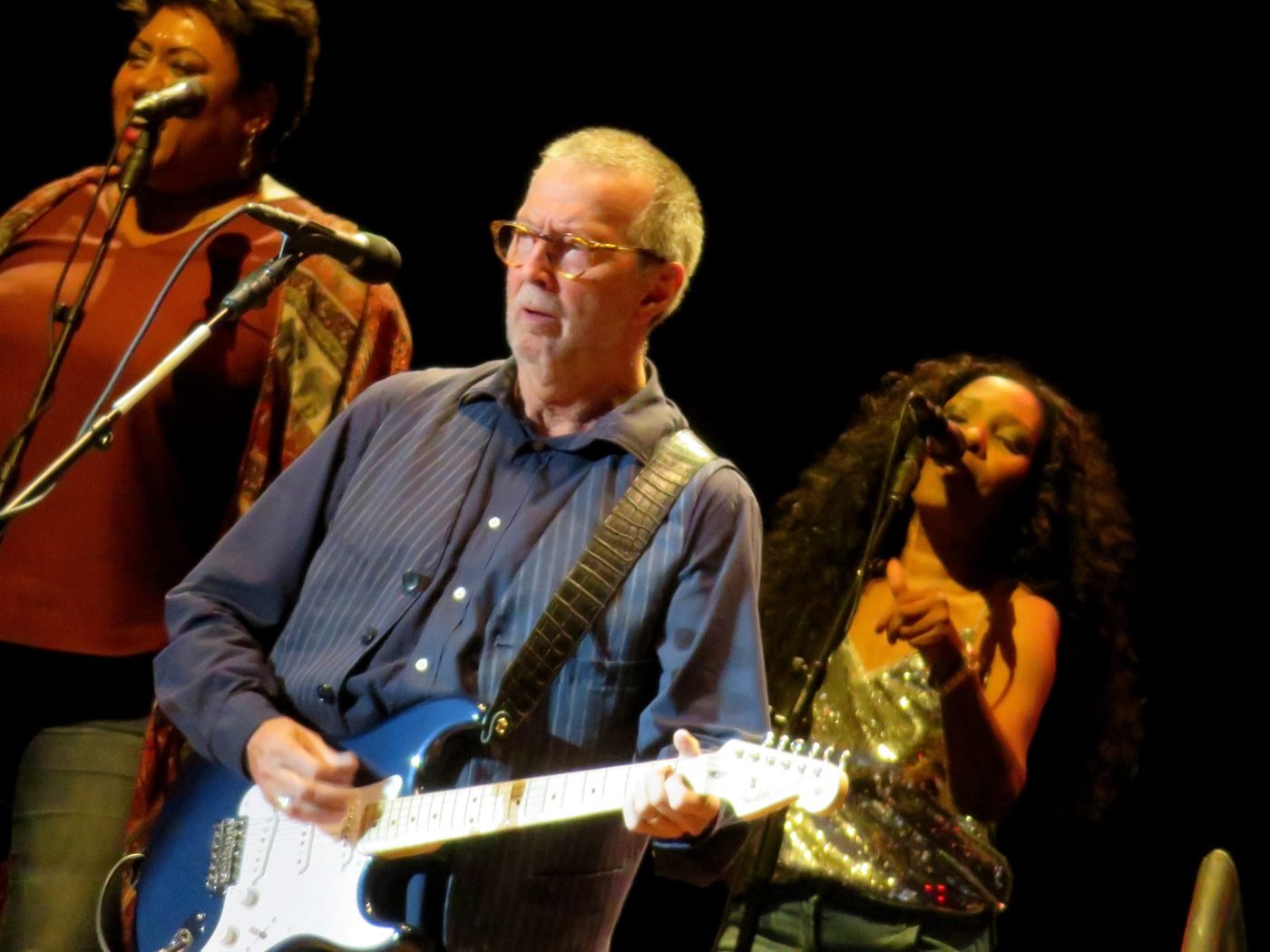
Through it all, the boy from Ripley never really lost the blues. He still tours, still plays with that unmistakable warm tone on his Stratocaster, and still treats the guitar not as a weapon but as a companion. The graffiti on that London wall got it wrong, in the end. Eric Clapton was never a god. He was something better: a man who fell apart in public, put himself back together piece by piece, and let us listen to every step of the journey. Slowhand indeed — slow, steady, and still standing.
Leave a Reply