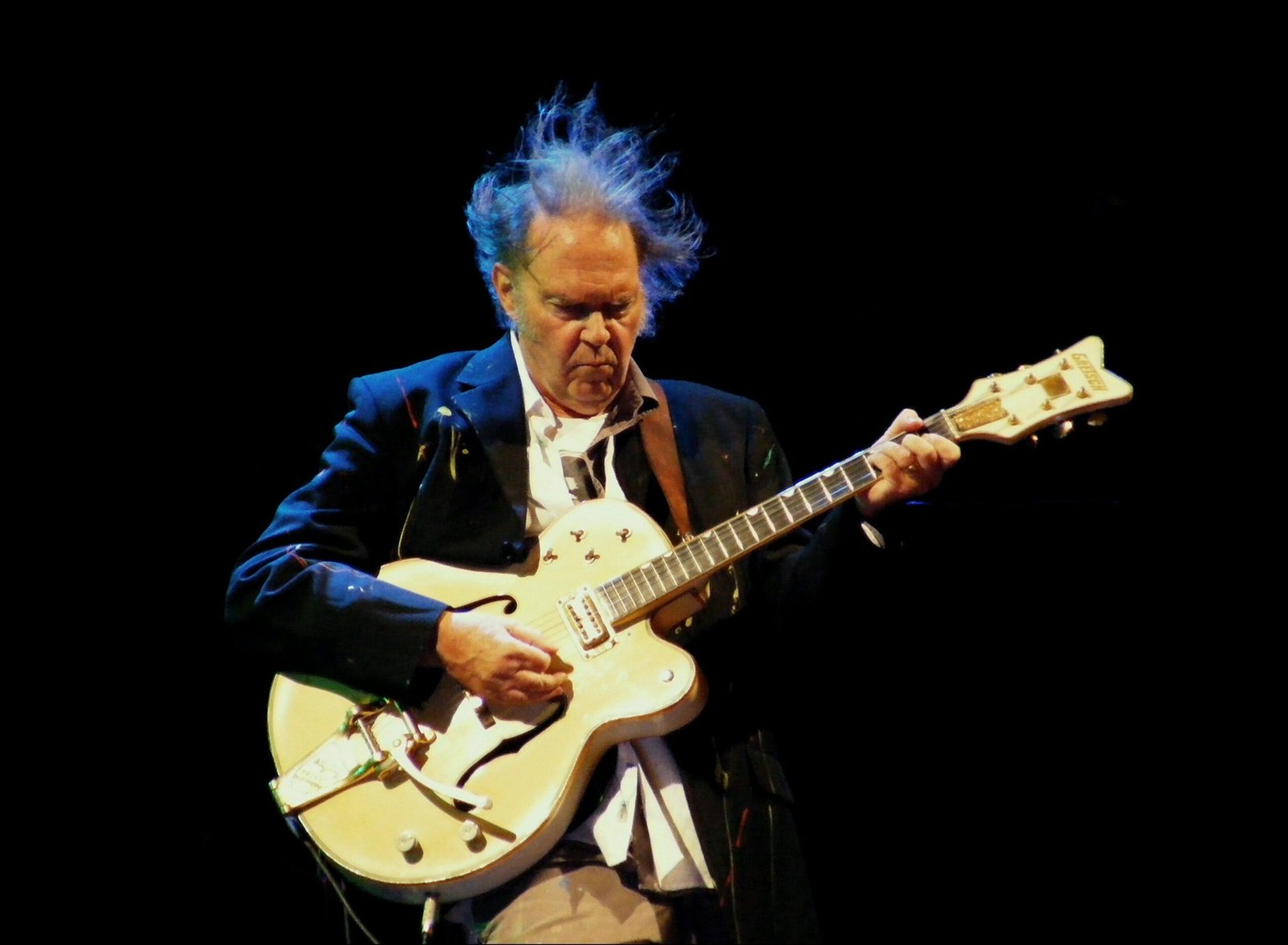
Most rock stars spend their careers chasing a hit. Neil Young spent his running away from one. He found massive success in 1972 with the best-selling album of the year and a number-one single — and his response was to deliberately head in the opposite direction, making some of the darkest, strangest, most uncommercial records of the decade. That stubborn refusal to sit still, to repeat himself, to be anyone’s idea of a star, is exactly why fans love him with a devotion few artists ever inspire. He is folk singer and garage rocker, country crooner and grunge godfather, often within the same concert.
The Canadian Kid Who Could Not Sit Still
Neil Percival Young was born on November 12, 1945, in Toronto, Ontario, Canada, to the journalist and author Scott Young and his wife Edna. He grew up in Winnipeg, Manitoba, where he played in teenage instrumental bands, including the Squires, who scored a local hit with a surf-style instrumental called “The Sultan.” Even then, Young was restless. He worked the folk clubs of Toronto, where he befriended a young Joni Mitchell and crossed paths with Stephen Stills.
In 1966, Young joined a Toronto soul band called the Mynah Birds — fronted by a flamboyant young singer named Rick James, years before “Super Freak” — and the group briefly signed with Motown. When that deal collapsed, Young did what restless kids do: he got in a car and drove to Los Angeles. He arrived in 1966 with almost nothing, slept in his car, and went looking for Stephen Stills.
Buffalo Springfield and the Birth of a Songwriter
Young found Stills, and together with Richie Furay, Bruce Palmer and Dewey Martin they formed Buffalo Springfield — named, wonderfully, after a brand of steamroller spotted parked outside their house. The band mixed folk, country, psychedelia and rock, with the twin lead guitars of Stills and Young giving it a hard edge. Stills’ “For What It’s Worth” became their hit, but Young contributed some of their finest songs: the brooding “Mr. Soul,” the ambitious “Broken Arrow” and the lovely “Expecting to Fly.”
The band was brilliant and doomed. Young quit Buffalo Springfield several times — he was already famous for walking out on success — before leaving for good in 1968 to go solo. His self-titled debut arrived in early 1969 to mixed reviews. It would take a scruffy backing band and two weeks in a studio to change everything.
Crazy Horse: Two Weeks That Changed Everything
Wanting a harder sound, Young recruited three musicians from a struggling LA band called the Rockets — guitarist Danny Whitten, bassist Billy Talbot and drummer Ralph Molina — and renamed them Crazy Horse. In May 1969, they recorded “Everybody Knows This Is Nowhere” in just two weeks. The album opens with the chugging “Cinnamon Girl” and stretches out into the long, hypnotic guitar jams “Down by the River” and “Cowgirl in the Sand.” It remains one of the great guitar records of all time, and it established the partnership Young would return to for the rest of his life.
The same year, Young reunited with Stills by joining Crosby, Stills & Nash, forcing the trio to add his name to the letterhead. Crosby, Stills, Nash & Young played Woodstock in only their second-ever live performance, and their 1970 album “Déjà Vu” topped the charts, featuring Young’s haunting ballad “Helpless.” When four students were shot dead by National Guardsmen at Kent State University in May 1970, Young wrote the furious protest single “Ohio” in a single sitting. It was released within weeks. Few songs have ever captured a nation’s shock so fast.
“Heart of Gold” and the Middle of the Road
By 1971, Young was one of the biggest names in rock, and he retreated to Nashville to record a simple, homey album. He hired producer Elliot Mazer and a group of local session players, and invited James Taylor and Linda Ronstadt — who happened to be in town for the Johnny Cash Show — to sing harmonies. The result was “Harvest,” released in February 1972.
“Harvest” went to number one on both the American and British album charts in March 1972 and became the best-selling album of the year in the United States — outselling the Rolling Stones’ “Exile on Main Street,” Bowie’s “Ziggy Stardust” and Elton John’s “Honky Château.” Its lead single, “Heart of Gold,” with Young’s fragile voice floating over banjo and harmonica, reached number one on the Billboard Hot 100 — the only chart-topping single of his entire career. “Old Man,” a tender song Young wrote about the caretaker of his California ranch, reached the Top 40 as well.
And Neil Young hated it. Not the album — the success. In the liner notes of his 1977 compilation “Decade,” he wrote the most famous sentence of his career: “Heart of Gold put me in the middle of the road. Travelling there soon became a bore, so I headed for the ditch. A rougher ride, but I saw more interesting people there.”
Heading for the Ditch
The ditch was real, and it was dark. In November 1972, Crazy Horse guitarist Danny Whitten — Young’s close friend and musical brother — died of a heroin overdose at 28, hours after Young had fired him from a tour and handed him $50 and a plane ticket home. The following year, Young’s roadie and friend Bruce Berry died of an overdose too. Grief-stricken, Young made three defiantly uncommercial albums that fans now call the Ditch Trilogy: the ragged live record “Time Fades Away” (1973), the bleak and beautiful “On the Beach” (1974), and “Tonight’s the Night” (1975), a raw, grief-soaked elegy recorded in 1973 and shelved for two years because it was too painful to release.
These albums sold poorly and confused everyone. Today they are considered masterpieces — proof that Young would rather tell the truth than sell a record. That is the whole of Neil Young in one decision.
Rust Never Sleeps: The Godfather of Grunge
Young closed the seventies with a roar. “Rust Never Sleeps” (1979) paired gentle acoustic songs with ferocious Crazy Horse rockers, and its anthem “Hey Hey, My My (Into the Black)” — with its defiant line that rock and roll will never die — was Young’s salute to the punk explosion. A decade later, a new generation of loud, distorted guitar bands — Pearl Jam, Sonic Youth, Nirvana — claimed him as their spiritual father. Albums like “Ragged Glory” (1990) showed he could out-rock musicians half his age, and the nickname stuck: the Godfather of Grunge.
He never stopped shape-shifting. “Freedom” (1989) gave him the anthem “Rockin’ in the Free World.” “Harvest Moon” (1992) returned him to the gentle country-folk of his biggest success, this time on his own terms. He was inducted into the Rock and Roll Hall of Fame twice — as a solo artist in 1995 and with Buffalo Springfield in 1997. He directs films under the pseudonym Bernard Shakey. He still tours relentlessly, still plays his battered 1953 Gibson Les Paul, “Old Black,” and still refuses to play the hits the way anyone expects.
Neil Young once sang that it is better to burn out than to fade away, and then spent sixty years proving there is a third option: keep moving. He ran from the middle of the road his entire life, and the ditch turned out to be the most interesting place in rock and roll. The restless Canadian kid never did sit still — and we are all still trying to keep up.
Leave a Reply