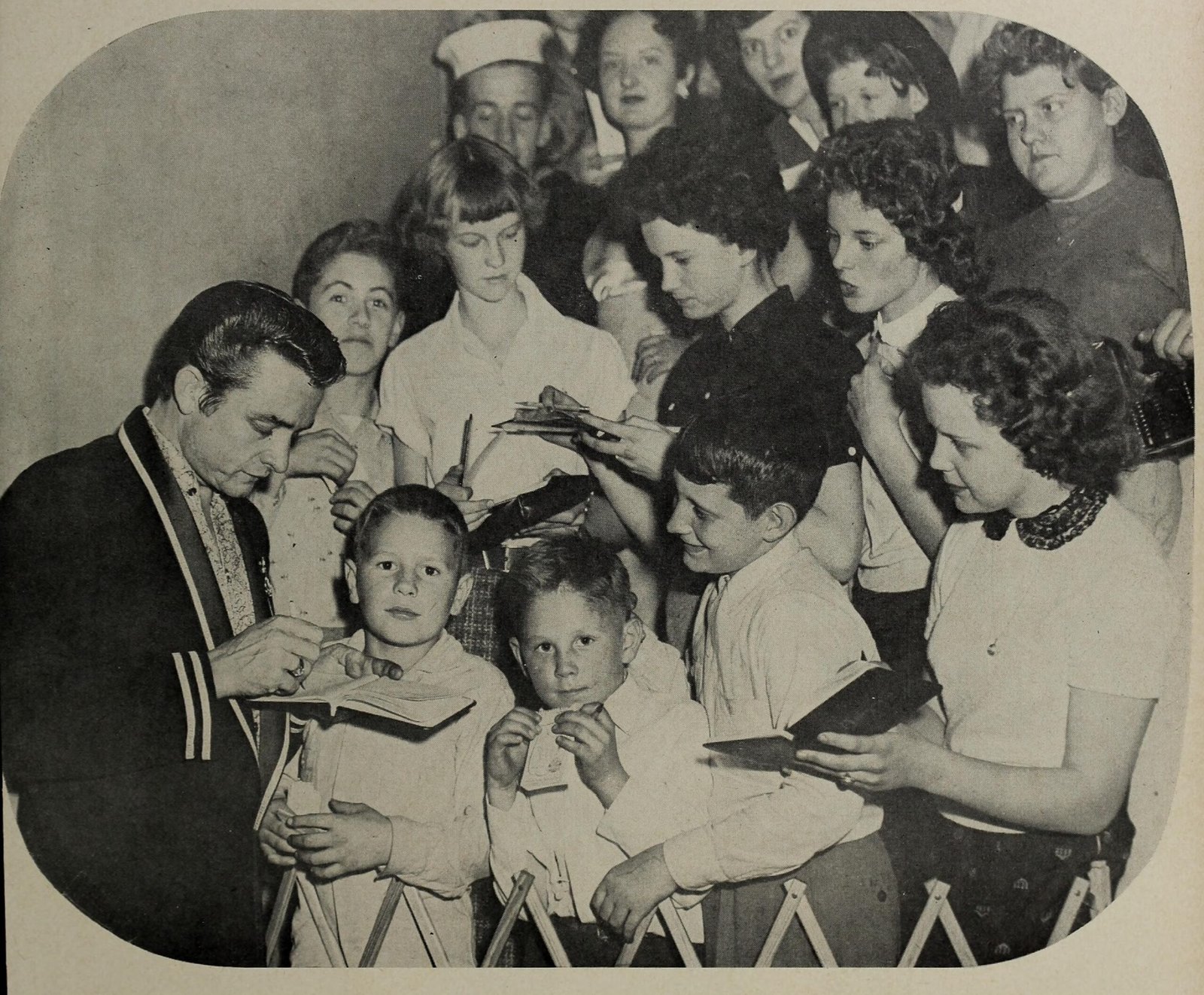
Johnny Cash was never just a singer. He was a witness — to poverty, to addiction, to redemption — and he turned everything he saw into songs that sounded like they were carved out of stone. Born J.R. Cash on February 26, 1932, in Kingsland, Arkansas, he grew up picking cotton on a Roosevelt-era farm colony in Dyess, one of seven children of a sharecropper family that knew hard times as a way of life.
He would become the only artist ever inducted into the Country Music, Rock and Roll, Songwriters, and Gospel Music Halls of Fame. But the road there ran through prisons, heartbreak, and a voice as deep and dark as a well — and it ended with one of the most astonishing comebacks in music history.
Memphis, 1954: The Audition That Changed Everything
After a stint in the Air Force — he was stationed in Germany in the early 1950s, where he taught himself guitar and started writing songs — Cash settled in Memphis and set out to make music. He started playing with the Tennessee Two: guitarist Luther Perkins and bassist Marshall Grant, whose stripped-down, chugging rhythm would become the famous “boom-chicka-boom” sound.
In 1954, Cash talked his way into an audition with Sam Phillips at Sun Records. He wanted to record gospel; Phillips had other ideas. But he heard something in that deep, mournful baritone and signed him in 1955.
The records came fast: “Hey Porter,” “Cry! Cry! Cry!,” “Folsom Prison Blues,” and, in 1956, “I Walk the Line” — the song that made him a star. By 1957 he was the top recording artist in country music. Seeking more artistic freedom, he jumped to Columbia Records in 1958, and his reach kept growing: the 1963 hit “Ring of Fire,” written by June Carter and Merle Kilgore, climbed all the way to No. 17 on the pop charts and made him a household name.
The Dark Years
But success nearly killed him. Through the 1960s, Cash was lost in a fog of pills and alcohol. He wrecked cars, got arrested — most famously in 1965 in El Paso, caught carrying more than a thousand pills across the Mexican border in his guitar case — and watched his career slip into the provincial confines of the country charts.
In January 1968, in the depths of despair, he crawled into Tennessee’s Nickajack Cave intending to end his life. He walked out somehow, and what happened next reads like a parable. With the help of June Carter — the Carter Family singer he’d loved for years — and her family, he fought his way out of addiction. On March 1, 1968, he married June. The turnaround had begun.
Folsom Prison: The Most Audacious Album Ever Made
Cash had been singing about prison since “Folsom Prison Blues,” and he’d been playing concerts behind bars since January 1959, when he performed at San Quentin — where, famously, a young inmate named Merle Haggard was in the audience. Over a decade he’d done some thirty prison shows, and he had long dreamed of recording one live for an album. Columbia’s executives said no. It was too risky, too strange.
Everything changed when Bob Johnston took over the label’s Nashville division in 1967. Johnston believed in the idea, shepherded the project through, and on January 13, 1968, Cash walked into California’s Folsom Prison and played for some 2,000 inmates in the prison cafeteria.
“At Folsom Prison” went gold and turned Cash into a cultural icon overnight. The follow-up, “At San Quentin” (1969), did even better — it held the No. 1 spot on the Billboard 200 for four weeks. Cash used his new platform to fight for prison reform and social justice, and he carried that mission for the rest of his life.
From 1969 to 1971, “The Johnny Cash Show” aired on ABC from the Ryman Auditorium, with guests like Bob Dylan, Neil Young, and Louis Armstrong. Cash used the show to speak up for the causes he’d long cared about — Native American rights, prisoners, and the poor. He’d already dedicated a whole album to the first of those in 1964, “Bitter Tears: Ballads of the American Indian,” a record his label barely wanted to release and one he fought hard to get played on the radio. He was named CMA Entertainer of the Year in 1969 and, at forty-eight, became the youngest living inductee into the Country Music Hall of Fame.
The Man in Black Fades — Then Meets Rick Rubin
The 1980s and early 1990s were quiet years. The industry had moved on; Cash was playing dinner theaters and nostalgia tours, his records barely making the charts. His last hit single, “The Baron,” had peaked at No. 10 in 1981.
Then came the most unlikely phone call in country music. Rick Rubin — the bearded producer who co-founded Def Jam and made records with the Beastie Boys, Slayer, and Public Enemy — reached out. On February 27, 1993, Cash met Rubin backstage after a show in Santa Ana, California. Cash asked what Rubin was going to do to sell his records. Rubin’s answer was disarmingly simple: come sit in my living room with a guitar and two microphones, and sing everything you’ve ever wanted to record.
The result, “American Recordings” (1994), was a triumph. Just Cash, his guitar, and his battered voice. Rolling Stone said it was the best his voice had sounded in thirty years, and it won the Grammy for Best Contemporary Folk Album. The follow-ups teamed him with Tom Petty and the Heartbreakers (“Unchained,” a Grammy winner for Best Country Album) and found him covering songs by young rock bands — Soundgarden, Depeche Mode — and making every one of them sound like his own.
“Hurt” and the Farewell
Then came “American IV: The Man Comes Around” (2002), the last album released in his lifetime — and it contained “Hurt.” Cash took Trent Reznor’s Nine Inch Nails song about addiction and hollow fame and turned it into a devastating farewell from a dying man. The Mark Romanek-directed video, filmed in Cash’s own home, is heartbreaking: the legend walking through his museum of memories, his voice cracking on the weight of it all. It won Single of the Year and Music Video of the Year at the CMA Awards; the album took Album of the Year.
June Carter Cash died in May 2003. Johnny followed her on September 12, 2003, at seventy-one. He kept recording until almost the very end — the posthumous “American V: A Hundred Highways” would become his first No. 1 pop album since “At San Quentin,” thirty-seven years earlier.
The Voice That Outlived the Man
Thirteen Grammys. Nine Country Music Association Awards. Walk the Line, the 2005 film about his life, introduced him to a new generation. But his true legacy is simpler and deeper: Johnny Cash sang for the prisoners, the down-and-out, the working poor — the people the rest of the world walked past.
He wore black, he said, for the poor and the beaten down, for the prisoner who has long paid for his crime, for those who never knew their savior. He didn’t just wear it. He lived it. And long after the last note of “Hurt” fades, the Man in Black is still standing there, boom-chicka-boom, reminding us that every soul is worth a song.
Leave a Reply