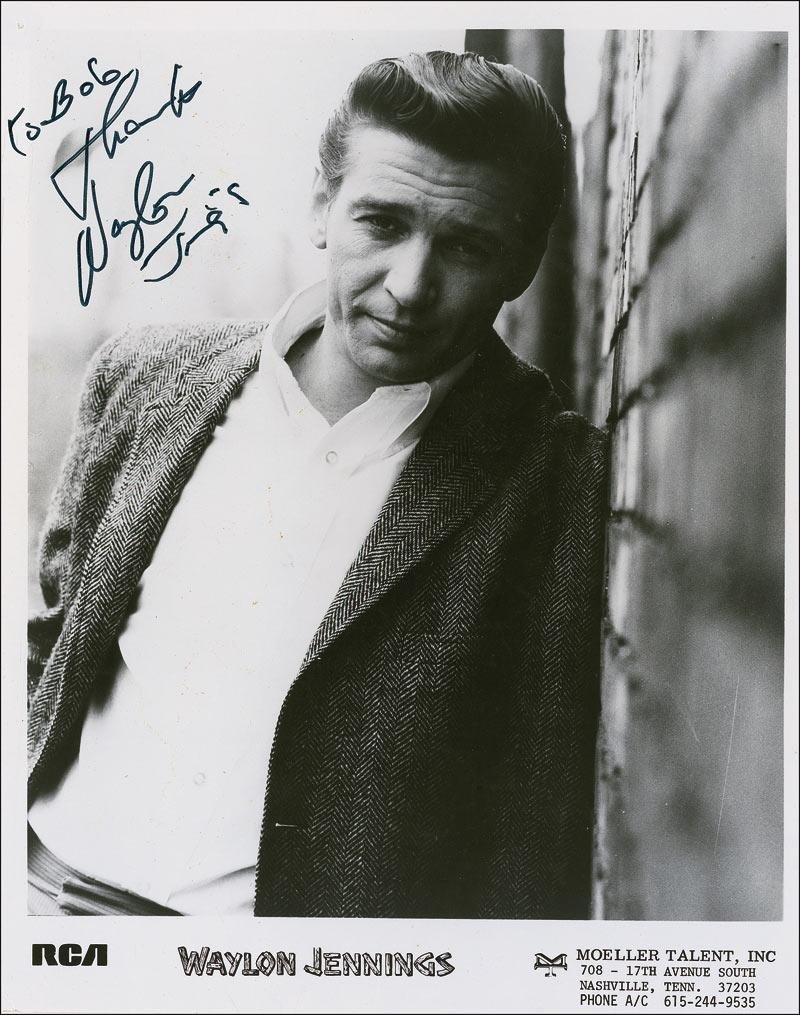
If country music in the 1970s had a rebel flag, it would have been flying from Waylon Jennings’ guitar. With a baritone growl, a Telecaster twang, and a stare that could melt a record executive, Jennings helped tear down Nashville’s polished studio system and built outlaw country in its place — music made by the artists, for the people, with the road band instead of the session players.
Born Waylon Arnold Jennings on June 15, 1937, in Littlefield, Texas, he recorded some sixty albums and scored sixteen No. 1 country singles across five decades. But his real achievement wasn’t on the charts. It was freedom: the freedom he won for himself, and for every country singer who came after him.
The Boy Who Played Guitar and Talked on the Radio
Waylon was eight years old when he picked up the guitar, and by his early teens he was performing on KVOW, a radio station in his hometown, and had formed his first band, the Texas Longhorns. The kid had a voice — deep, weathered beyond his years — and the DJ’s booth became his second classroom. He worked as a disc jockey at stations all over West Texas, spinning records by day and playing honky-tonks by night.
Then, in 1958, came the moment that changed everything. Buddy Holly — already a rock and roll star — arranged Jennings’ first recording session. Holly took a liking to the lanky Texan, and when he set out on the 1959 Winter Dance Party tour, he hired Jennings to play bass in his band.
The Seat He Gave Away
On the night of February 2, 1959, after a miserable show in Clear Lake, Iowa, Holly chartered a small plane to get the band to the next stop. The bus had been freezing and breaking down, and everyone wanted on that plane. Jennings, the newest member of the band, gave his seat to J.P. “The Big Bopper” Richardson, who was fighting the flu.
The plane went down in a snowstorm outside Mason City, Iowa. Buddy Holly, Ritchie Valens, and the Big Bopper were all killed — the night Don McLean would later call “the day the music died.” Jennings was left with a survivor’s guilt he carried for the rest of his life, and a lesson about how thin the line is between living and dying on the road.
He drifted through the early 1960s — back to DJ work in Phoenix, fronting a rockabilly club band he called the Waylors, cutting records for small labels. It was Chet Atkins who finally brought him to RCA Records in 1965. But Nashville’s system nearly broke him: the label chose his songs, chose his producers, chose his studio musicians. Waylon Jennings, one of the most distinctive voices in country music, was being turned into just another smooth Nashville product.
“Lonesome, On’ry and Mean”: The Great Rebellion
In 1972, Jennings hired a tough New York manager named Neil Reshen and did something almost no country singer dared to do: he renegotiated his RCA contract and demanded total creative control over his records. RCA, terrified of losing him the way they’d nearly lost his friend Willie Nelson, gave in.
What followed was a revolution in three albums. “Lonesome, On’ry and Mean” and “Honky Tonk Heroes” (both 1973) were recorded with his own road band — the Waylors — not Nashville’s slick session men, and they sounded edgy, raw, and real. “Honky Tonk Heroes,” built almost entirely from songs by a then-unknown Texas songwriter named Billy Joe Shaver, became the defining record of the outlaw movement: honky-tonk music with a rock and roll heart.
Jennings scored his first No. 1 single in 1974 with “This Time,” and the hits kept coming: “I’m a Ramblin’ Man,” “Are You Sure Hank Done It This Way” (1975), “Good Hearted Woman,” and the good-time anthem “Luckenbach, Texas (Back to the Basics of Love)” from 1977’s “Ol’ Waylon” — the first platinum album by a solo country artist.
Wanted! The Outlaws
In 1976, RCA packaged Jennings with Willie Nelson, Tompall Glaser, and his wife Jessi Colter — herself a fine country singer — on an album called “Wanted! The Outlaws.” It became the first platinum country album in history, hit No. 1 on the pop charts, and made Waylon Jennings a genuine superstar. He was named the Country Music Association’s Male Vocalist of the Year, and outlaw country was no longer an underground movement — it was the sound of the moment.
The duets with Willie became country standards: “Mammas Don’t Let Your Babies Grow Up to Be Cowboys” from the multi-platinum “Waylon & Willie” (1978). Jennings’ sound — that phasing, leathery voice over driving rhythms — influenced everyone from Hank Williams Jr. to the alternative country bands of the 1990s and beyond.
The Dukes, the Cocaine, and the Highwaymen
By the late 1970s, Waylon was everywhere. He became the Balladeer of the hit TV show “The Dukes of Hazzard,” narrating each episode and singing the theme song, “Good Ol’ Boys” — a No. 1 hit in its own right. Kids who’d never bought a country record knew his voice.
But the outlaw life had a cost. Through the early 1980s, Jennings was deep in a cocaine addiction that drained his money and nearly his health. In 1984, he quit — cold, and for good. It was one of the proudest achievements of his life.
Clean and clear-eyed, he joined forces with Willie Nelson, Kris Kristofferson, and Johnny Cash in 1985 to form the Highwaymen — country music’s first supergroup, and one of its most beloved. They released three albums between 1985 and 1995, four old friends standing shoulder to shoulder, proving that the outlaws had become the establishment without ever selling out. His later solo records, like “I’ve Always Been Crazy” (1978) and the tender ballad “Amanda,” showed an artist still digging deeper, still surprising people who thought they’d heard it all.
The Last of the Outlaws
The honors came late but they came: induction into the Country Music Hall of Fame in 2001 — characteristically, he chose not to attend the ceremony — and, after his death, the Academy of Country Music’s Cliffie Stone Pioneer Award in 2007. Waylon Jennings died on February 13, 2002, from complications of diabetes. He was sixty-four.
He left behind six children, including the musician Shooter Jennings; his fourth wife Jessi Colter, his partner in music and in life; and a catalog of songs that still sound like they were cut yesterday.
Waylon Jennings didn’t just make great records — he changed the rules of the game. Before him, Nashville told its singers what to sing and how to sing it. After him, no one could pretend that was the only way. His fierce independence paved the road for every artist-driven movement that followed, from the alt-country of the 1990s to the Texas scene of today. He gave up a seat on a doomed plane and lived to sing about it; he gave up the safety of the Nashville system and lived to change it. That’s what outlaws do. And somewhere out on a Texas highway, if you listen close, you can still hear that growl: lonesome, on’ry, mean — and absolutely free.
Leave a Reply